Soil is a delivery system for water and nutrients — hydroponics skips the middleman and hands the plant exactly what it needs, when it needs it.
Strawberries are one of the most rewarding crops to grow hydroponically. They are compact, productive, and — when grown in the right system with the right variety — will put out ripe fruit every few weeks, twelve months a year. A soil strawberry patch in Minnesota goes dormant under snow by October and does not wake up until May. A hydroponic tower in a spare bedroom does not notice the calendar.
The catch is that strawberries have specific preferences: a narrow pH window, moderate but steady electrical conductivity, and a genuine need for hand pollination indoors. Get those three right and the rest is maintenance. This guide covers every piece of the system — which varieties perform best, how NFT, substrate, and vertical tower systems differ, what the nutrient solution needs to contain, how to pollinate flowers without bees, and how to head off the two diseases that wipe out more hydroponic strawberry crops than anything else.
If you are already growing other hydroponic crops, the techniques here slot in naturally alongside DIY hydroponic systems like Kratky and DWC. If this is your first foray into soil-free growing, start with the beginner build section and scale from there.
Key takeaways
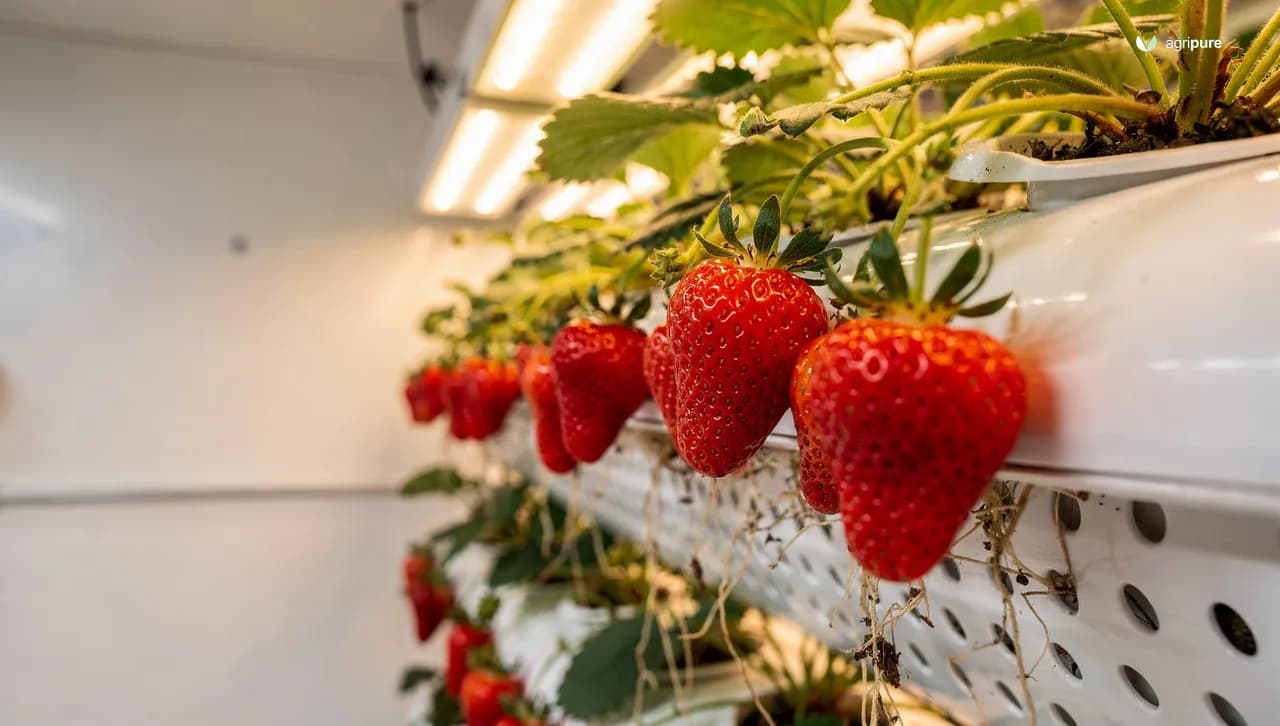
Close-up of ripe, red strawberries growing in a vertical hydroponic tower, surrounded by lush green foliage. The berries are plump and ready for harvest, illustrating the productivity of soil-free cultivation.
Harvesting fresh, ripe strawberries year-round is a reality with hydroponic systems. These vibrant berries thrive in controlled environments, delivering consistent yields regardless of the season.
- Day-neutral varieties — Albion, Monterey, San Andreas, Seascape — fruit continuously regardless of day length, making them the only sensible choice for indoor hydroponic systems.
- Maintain pH between 5.8 and 6.2 and EC around 1.4–1.8 mS/cm; outside those bands, nutrient uptake collapses.
- Substrate systems (perlite-coir-peat) and vertical towers outperform deep water culture for strawberries — the roots like support.
- Hand-pollinate every open flower with a soft brush every two to three days or expect small, misshapen fruit.
- Botrytis gray mold is the primary disease threat; keep humidity below 70% and ensure airflow between plants.
- Expect 150–400 grams per plant per season from a well-managed indoor system; Illinois Extension trials clocked up to 0.76 lb (345 g) per plant from Monterey in a single outdoor-assisted season.
Why day-neutral varieties are the only choice for indoor growing
Standard June-bearing strawberry varieties flower only once, triggered by the short days of late summer and early fall, then produce a single flush of fruit the following spring. That photoperiod dependency makes them useless indoors, where you control the light schedule. Day-neutral varieties are genetically wired differently: they initiate flower buds when soil temperature drops below about 60°F, and they continue setting buds regardless of day length once established. In a climate-controlled indoor grow, that means continuous flower production and, therefore, continuous fruit.
The four day-neutral varieties with the strongest track record in hydroponic systems are:
Variety | Fruit size | Yield | Flavor profile | Notes |
|---|---|---|---|---|
Albion | Medium–large (42.8 fruit/lb) | ~0.48 lb/plant | Sweet, firm, classic | Most widely planted commercial day-neutral; botrytis-resistant relative to San Andreas |
Monterey | Medium (highest yield tier) | ~0.76 lb/plant | Excellent, complex | Best yield in Illinois Extension trial; outperformed Albion and San Andreas on flavor |
San Andreas | Large (28.7 fruit/lb) | ~0.54 lb/plant | Sweet, high sugar | Largest fruit of the three; more susceptible to Botrytis in humid indoor environments |
Seascape | Medium–large | Moderate | Bright, tart, complex | Tolerates warmer temperatures well; closer to wild strawberry flavor |
Data from a 2023 Illinois Extension hydroponic trial at UIUC. Yields represent a single season in a perlite-stack system from May through October — a well-lit, year-round indoor system may exceed those figures across multiple production cycles.
Source your plants as plugs or bare-root runners, never from seed. Strawberry seeds are viable but take 18 months or more before they fruit reliably — far too slow for a production system. Most specialty hydroponic nurseries ship certified, disease-tested plugs in late winter and early spring.
Choosing your system: NFT, substrate, and vertical towers compared
Side-by-side view of a white PVC NFT channel system and a vertical tower planter filled with strawberry plants in an indoor grow room
NFT channels keep roots in a thin flowing film; vertical towers maximize plant density per square foot of floor space.
Three system types dominate home and small-commercial hydroponic strawberry production: nutrient film technique (NFT), substrate-based beds or bags, and vertical towers. They are not equally suited to strawberries, and the difference matters.
A 2025 peer-reviewed comparison published in PubMed Central found that substrate systems outperformed water-culture systems (including NFT and DWC) for strawberry yield. Vertical towers performed comparably to substrate beds. The reason is mechanical: strawberry roots are vigorous and fibrous; they prefer something to grip. In DWC, roots suspended in oxygenated water work reasonably well for lettuce but leave strawberries prone to crown rot and inconsistent fruiting.
NFT (Nutrient Film Technique). Nutrient solution flows in a thin film along the bottom of shallow channels; roots dangle in and out of the film. NFT is a clean system with low water volume, but the channels must slope precisely (about 1:30 gradient) and the pump must run without interruption — strawberry roots dry out within hours if flow stops. NFT works best for experienced growers comfortable with system maintenance. Plant spacing in channels runs 20–25 cm (8–10 inches) center to center.
Substrate systems. Plants grow in a porous medium — the Ohio State indoor berry program recommends 50% perlite, 25–30% coconut coir, and 20–25% peat. Nutrient solution is delivered by drip or flood-and-drain on a timer (about 1 minute per hour is a workable starting point; adjust based on drainage). Containers should hold at least 2 liters per plant. This is the most forgiving system for beginners because substrate buffers short power outages and brief pump failures.
Vertical towers. Plants sit in pockets along a vertical column; solution is pumped to the top and gravity-fed down. A single 5-foot tower can hold 20–28 plants in about 2 square feet of floor space — density three to five times higher than flat NFT for the same footprint. Pre-built towers run $150–$500; DIY versions from 4-inch PVC pipe cost under $80 in materials. Airflow matters more in towers because the canopy is dense — leave at least 12 inches between towers.
Dialing in nutrients: EC, pH, and solution composition
Strawberries are moderately demanding feeders with a narrow tolerance for pH drift. Getting the numbers right is non-negotiable — get them wrong and fruit quality drops before yield does, so you will not see a warning coming.
pH. The working range is 5.8–6.2. Illinois Extension’s hydroponic strawberry program holds pH at 6.6 for outdoor-assisted systems with some leeway from root-zone buffering; for fully indoor, recirculating systems the tighter 5.8–6.2 window is safer. Outside that range — particularly below 5.5 or above 6.5 — calcium and magnesium become unavailable to roots even when they are present in the solution, causing blossom-end browning and stunted new leaves.
Electrical conductivity (EC). Target 1.4–1.8 mS/cm during fruiting, lower (1.0–1.2 mS/cm) for young transplants. Illinois Extension’s perlite-stack system ran at 1.8 mS/cm throughout the season. Ohio State’s indoor berry program notes that strawberries are salt-sensitive — do not push EC above 2.0 mS/cm or tip burn and root damage follow. A pre-planting substrate flush at EC ≤ 0.4 mS/cm removes any residual mineral buildup before roots establish.
Macronutrients. A common starting formula: 160–170 ppm nitrogen, 55–60 ppm phosphorus, 400–500 ppm potassium. The Illinois Extension formula — 3-15-28 (mono/di-potassium phosphate base) at 1 lb per gallon plus calcium nitrate (15.5-0-0) at 0.5 lb per gallon — hits these targets. Keep ammonium nitrogen to no more than 10% of total nitrogen to avoid acidification of the root zone. Pre-formulated strawberry nutrient concentrates from hydroponic retailers simplify this considerably for home growers.
Secondary nutrients and micronutrients. Calcium and magnesium are the ones most likely to run short — both are consumed heavily during fruiting. An independent calcium-magnesium supplement is worth adding when you see interveinal yellowing on young leaves (magnesium deficiency) or brown margins on new growth (calcium deficiency). Iron must remain in the ferric chelate form (Fe-EDTA or Fe-DTPA), which holds solubility at pH 6.0–6.5.
Light, temperature, and the indoor environment
Strawberries are not low-light crops. They evolved as sun-loving plants in open meadows, and they will fruit poorly under dim conditions no matter how good the nutrients are.
Full-spectrum LED grow light panels mounted above rows of strawberry plants in a white-walled indoor grow tent, plants showing healthy green foliage and red fruit
Full-spectrum LEDs in the 300–450 µmol/m²/s range keep day-neutral strawberries in continuous fruit production year-round.
PPFD and photoperiod. A peer-reviewed 2023 study in PubMed Central (PMC9965992) found that flowering in Albion strawberries was accelerated by 17–21 days when the photoperiod was extended from 12 to 16 hours, at a PPFD of at least 300 µmol/m²/s. First fruit harvest came 17 days earlier at 450 µmol/m²/s. The practical upshot: aim for 14–16 hours of light per day at a canopy PPFD of 300–450 µmol/m²/s. Consumer LED grow light panels rated at 200–300W will hit that range over a 3–4 square foot canopy at the distances specified by the manufacturer.
Temperature. Day temperatures of 65–75°F (18–24°C) are the sweet spot; night temperatures can drop to 60°F without harm and may slightly enhance sugar accumulation in fruit. Above 80°F, flower abortion increases and fruit size drops. Below 55°F, growth stalls. A small fan pointed across — not directly at — the canopy addresses both temperature and humidity simultaneously.
Humidity. Keep relative humidity between 50% and 70%. Higher humidity is the primary driver of Botrytis gray mold, which can devastate a crop in 48 hours. A $30 combination thermometer/hygrometer mounted at canopy level is the most useful diagnostic tool in a small indoor system.
CO₂. At ambient CO₂ levels (about 400 ppm), strawberries perform well. Supplementing to 800–1,000 ppm in a sealed grow tent can accelerate vegetative growth and may increase yield slightly — but only if all other parameters (light, EC, temperature) are already dialed in. For a beginner system, ambient CO₂ is fine.
Pollination: the step most growers miss
Every strawberry flower contains both male and female parts — technically perfect, self-fertile flowers. In a field, wind and bees do the work in seconds. Indoors, with no breeze and no insects, pollen moves only if you move it. Incomplete pollination is the single most common reason for small, misshapen, or nubbin-like fruit in indoor hydroponic systems.
Each strawberry flower has dozens of pistils arranged in a dome at the center. Every one of them needs to be fertilized for the berry to fill out evenly. Miss half of them and you get a half-formed fruit — visually obvious and commercially worthless, though still edible.
How to hand-pollinate. Use a small, soft-bristled artist’s paintbrush or a clean cotton swab. Gently touch and rotate it around the yellow center of each fully open flower, moving from flower to flower in a single pass. Do this every two to three days — strawberry flowers open and are receptive for about three days each. In a tower with 28 plants, the routine takes about five minutes once you are practiced. Alternatively, a small battery-powered toothbrush touched briefly to each flower stem vibrates the pollen loose (the same principle as electric bee vibration).
A gentle oscillating fan running 15–30 minutes per hour also moves pollen between flowers and doubles as humidity control. It is not as reliable as hand-pollination for full coverage, but it helps.
Pests and diseases: what will actually hurt your crop
Close-up of a strawberry plant leaf showing early signs of gray mold (Botrytis cinerea) with tan-brown lesions at the leaf margin, next to healthy green leaves
Botrytis gray mold spreads rapidly in humid, stagnant air — early detection and immediate removal of infected tissue are the first line of defense.
The indoor environment eliminates many field pests (no cucumber beetles, no slugs, no deer) but creates conditions that favor a short list of serious problems.
Botrytis cinerea (gray mold). This is the dominant threat in any indoor strawberry system. USDA ARS research estimates Botrytis accounts for up to 25% of strawberry postharvest losses — and in a humid indoor environment with limited airflow, it can spread from a single infected flower to half the crop in two days. The fungus thrives at 50–77°F and high humidity. Symptoms: gray-brown fuzzy lesions on flowers, stems, and fruit. Control: maintain humidity below 70%, ensure airflow between and around plants, remove infected material immediately and bag it before removing from the grow space, and harvest ripe fruit the day it colors. Bacillus subtilis-based biocontrols (sold as Serenade or Cease) are effective as preventative sprays and OMRI-listed for organic use.
Spider mites. Tiny (0.5 mm), fast-reproducing, and nearly invisible until populations explode into visible webbing. Yellow stippling on leaves is the early sign. Neem oil (azadirachtin) at one tablespoon per gallon of water applied as a foliar spray is effective when applied at first detection. Predatory mites (Phytoseiulus persimilis or Neoseiulus californicus) are a biological option that works well in enclosed growing spaces.
Fungus gnats. The larvae feed on roots and beneficial mycorrhizal networks in any substrate-based system. Adults emerge from wet growing media. The fix is a cultural one: allow the top inch of substrate to dry slightly between irrigations. Yellow sticky traps catch adults; Bacillus thuringiensis var. israelensis (Bti) drenched into the root zone kills larvae without harming roots.
Powdery mildew. White powdery patches on leaf surfaces — a different disease from Botrytis, favoring warm temperatures (68–86°F) with moderate humidity. Improve airflow, reduce leaf wetness, and apply a potassium bicarbonate or copper-based fungicide at first sign.
A beginner build: a 12-plant substrate tower for under $150
The simplest credible hydroponic strawberry setup for a beginner is a pair of six-pocket vertical towers fed by a small reservoir and pump. Here is a workable bill of materials and process that can be running in a weekend.
What you need
- Two six-pocket tower planters (available from hydroponic suppliers; approximately $25–$40 each)
- 5-gallon reservoir with lid — a food-grade bucket works
- Submersible pump rated at 100–200 gallons per hour with timer (runs 2–3 minutes every 60 minutes)
- 3/8-inch tubing to connect pump to tower tops
- Perlite + coconut coir mix (50/50 is a safe simplification of the Ohio State formula)
- pH meter (digital; do not rely on strips for a recirculating system)
- EC/TDS meter
- Hydroponic strawberry nutrient concentrate (one- or two-part formulas reduce mixing errors)
- Full-spectrum LED panel, 200W equivalent, with a timer
- 12 day-neutral plugs (Albion, Monterey, or San Andreas)
Step-by-step setup
- Fill pockets with pre-wetted perlite-coir mix. Do not compact — air porosity is what makes the mix work.
- Mix nutrient solution in the reservoir: target pH 5.8–6.2 and EC 1.2 mS/cm (lower for new transplants).
- Set pump timer to run 2 minutes every hour; adjust if pockets stay too wet (shorten) or dry out between cycles (lengthen).
- Plant plugs with the crown (the junction between roots and leaves) at or just above media surface — buried crowns rot.
- Set LED timer to 14–16 hours on, 8–10 hours off. Position light so canopy receives 300–400 µmol/m²/s.
- Check pH and EC every two to three days for the first month. Top off with plain pH-adjusted water between full reservoir changes.
- Replace the full nutrient solution every two to three weeks to prevent salt buildup and nutrient imbalance.
- Begin hand-pollinating once the first flowers open — typically 4–6 weeks after transplant for bare-root starts.
Total cost including the LED panel: $120–$180 for a basic 12-plant setup. This fits comfortably within the DIY hydroponic system budget range. Expect the first ripe berries 60–90 days after transplanting healthy plugs.
Harvest, flavor, and keeping your system productive
Hydroponic strawberries ripen quickly once color breaks — move from white to full red in 24–48 hours under good light. Harvest daily once fruit is setting; ripe berries left on the plant in a humid indoor environment are the fastest route to Botrytis infection. Fruit fully ripe on the plant is noticeably sweeter than fruit harvested early, because sugar concentration jumps in the final 24 hours of ripening — a benefit soil growers have always had that hydroponic growers can fully exploit since no transport logistics force early picking.
Day-neutral strawberries produce in flushes rather than a steady trickle. Expect a flush every three to four weeks. Between flushes, prune runners promptly — every runner the plant sends out is energy diverted from fruiting. Unlike field growing (covered in the how to grow strawberries guide), where runners are used to propagate new plants for the next season, indoor hydroponic plants are typically replaced annually from fresh plugs to maintain yield and disease-free crowns.
Over the life of a system, connect what you learn here to the broader closed-loop logic of aquaponics systems — the same nutrient-solution precision applies, and growers who understand EC and pH management in strawberry hydroponics find aquaponics considerably easier to pick up. Both sit within the wider permaculture gardening framework of producing more food in less space with less waste.
Frequently asked questions
What is the best hydroponic system for strawberries?
Substrate systems (perlite-coir-peat mix in pots or bags) and vertical towers consistently outperform deep water culture for strawberries in peer-reviewed trials. NFT works but requires precision pump management and punishes any system failure quickly. For beginners, a vertical tower or simple drip-into-substrate setup is the most forgiving starting point.
How long do hydroponic strawberries take to produce fruit?
From healthy day-neutral plugs or bare-root starts, expect the first ripe berries 60–90 days after transplanting into a well-lit, well-fed system. Growing from seed adds 12–18 months before meaningful fruiting — not practical for production.
Why are my hydroponic strawberries small and misshapen?
Almost always incomplete pollination. Each strawberry flower has dozens of pistils and all need to be fertilized for the berry to fill out evenly. Hand-pollinate every open flower with a soft brush every two to three days. Secondary causes include EC too high (above 2.0 mS/cm), pH outside 5.8–6.2, or temperatures above 80°F causing flower abortion.
Can you grow hydroponic strawberries year-round?
Yes — this is one of the primary advantages of the system. Day-neutral varieties fruit continuously when given consistent light (14–16 hours daily at 300–450 µmol/m²/s), temperature (65–75°F), and nutrients (EC 1.4–1.8 mS/cm, pH 5.8–6.2). Outdoor and greenhouse-assisted systems typically run March–October; a fully lit indoor setup has no seasonal off-switch.
References
- Hydroponic day-neutral strawberry production observations — Illinois Extension / University of Illinois
- Substrate systems for controlled environment berry production — Ohio State University Extension
- Growth, Flowering, and Fruit Production of Strawberry ‘Albion’ in Response to Photoperiod and Photosynthetic Photon Flux Density — PubMed Central (peer-reviewed)
- Substrate system outperforms water-culture systems for hydroponic strawberry production — PubMed Central (peer-reviewed)
- Mold-free Strawberries? Yes, Please! — USDA Agricultural Research Service
- Day-neutral strawberries — University of Minnesota Extension
- Strawberry diseases — University of Florida IFAS Extension
- Hydroponic strawberries: complete guide — Epic Gardening