Strawberries reward the grower who controls their runners — let the bed take over and you will harvest a carpet of leaves with no berries to speak of.
There is a reason the strawberry is the most widely grown small fruit in home gardens across North America. It is quick, it is compact, and a well-managed bed of June-bearing plants in Year 2 can yield 7 to 15 pounds from a single 10-foot row — that is more than most households can eat fresh. The challenge is not getting the plants to grow. It is getting the plants to fruit rather than colonize.
This guide covers the decisions that actually move the needle: which strawberry type fits your space and schedule, how to plant into beds, containers, or vertical setups, how to keep runners from swallowing your garden, and how to carry plants through winter so they come back stronger. The core science comes from University of Minnesota Extension, Oregon State University Extension, and Cornell Cooperative Extension — the same sources commercial growers use.
Strawberries are a natural companion to other small-space kitchen-garden methods. They fit neatly into raised-bed systems and work alongside the companion planting strategies that fill beds with beneficials. Once you have a productive bed running, it ties directly into a broader square-foot gardening plan.
June-bearing, everbearing, or day-neutral: choosing the right type
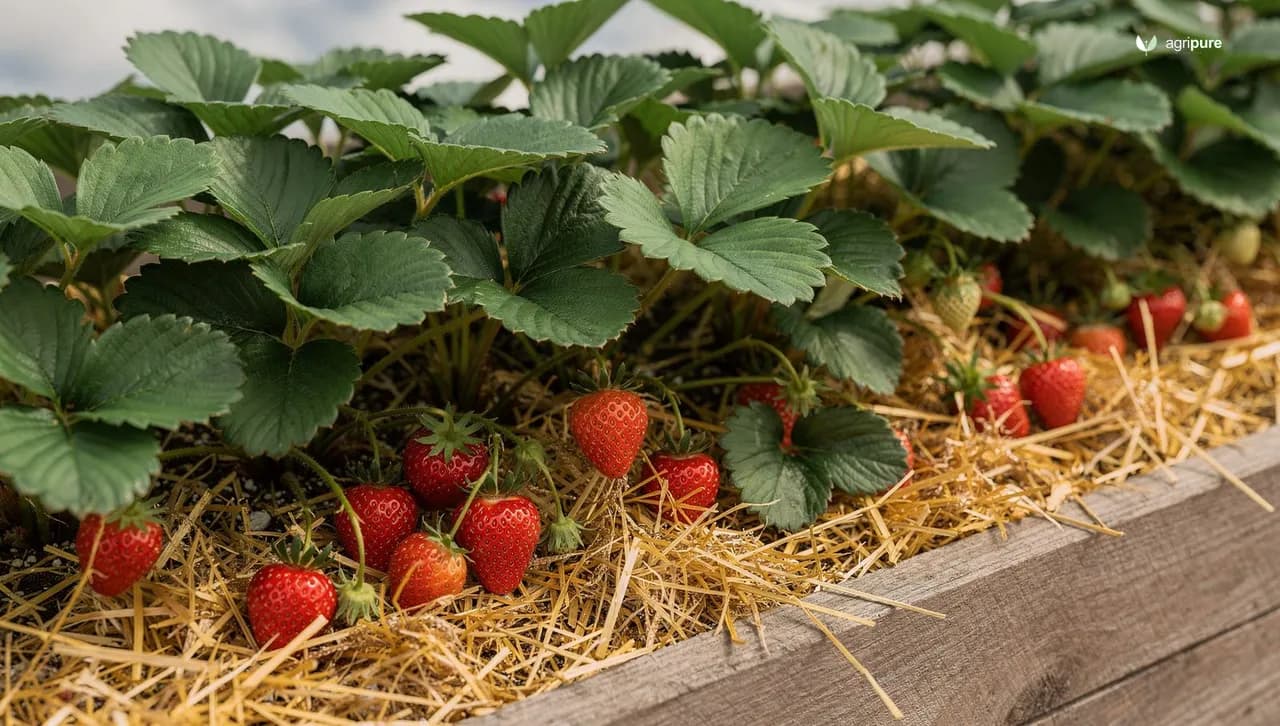
Close-up photograph of ripe, vibrant red strawberries on green plants in a garden bed, with soft-focus background.
A bountiful harvest of ripe strawberries, showcasing the rewards of a well-managed garden. Controlling runners is key to maximizing fruit production.
The single most important strawberry decision is which of the three fruiting types you plant. They look nearly identical in the nursery. In the garden, they behave completely differently.
June-bearing varieties produce one intense flush of fruit over roughly three weeks in late June to early July (later in colder zones). The fruit is the largest of the three types, and a mature matted-row bed delivers the highest per-plant yields. The catch: June-bearers do not fruit in their first year. You plant in spring, remove all blossoms that first season, let the plants put energy into runners and roots, and harvest starting Year 2. They also produce the most runners — one plant can throw up to 120 daughter plants in a single season, according to University of Minnesota Extension. Good varieties for cold climates include Honeoye, Cavendish, and Jewel; for the Pacific Northwest, Hood and Mary’s Peak are processing standbys.
Everbearing varieties produce two smaller crops — one in early summer and a second flush in late summer or early fall. They send out fewer runners than June-bearers and can fruit in their planting year if you allow blossoms after the first six weeks. Fruit size and total yield are lower than June-bearing.
Day-neutral varieties ignore day length entirely and fruit continuously from late spring through the first fall frost whenever temperatures stay between roughly 35°F and 85°F. They produce the fewest runners, deliver a moderate yield across three or four flushes per season, and fruit in their planting year. This makes them the best choice for containers, vertical towers, and any garden where you want a steady trickle of berries rather than a single harvest glut. Strong day-neutral varieties include Albion, Seascape, and Evie-2.
Side-by-side comparison of June-bearing and day-neutral strawberry plants, showing the size difference in fruit and the runner density around each plant
June-bearing plants (left) carry larger fruit and throw vigorous runners; day-neutral plants (right) stay compact and fruit throughout the season.
Type | Harvest timing | Fruit size | Runners | Fruits Year 1? | Best use |
|---|---|---|---|---|---|
June-bearing | One 3-week flush, late June–July | Large | Heavy (up to 120/plant) | No (remove blossoms) | Freezing, jam, big harvests |
Everbearing | Two flushes: early summer + fall | Medium | Moderate | Yes (after Week 6) | Fresh eating, smaller spaces |
Day-neutral | Continuous May–October | Small–medium | Few | Yes | Containers, vertical, steady supply |
Soil, sun, and site: getting the foundation right
Strawberries are shallow-rooted — most feeder roots stay in the top 6 to 8 inches of soil — which makes soil preparation the variable that either sets up a five-year bed or forces a replant in Year 2. Oregon State University Extension recommends sandy loam or clay loam with moderate water-holding capacity, organic matter above 3%, and a water table at least 14 inches below the surface. Standing water for more than an hour after rain is disqualifying; it promotes crown rot and leather rot in a way that nothing downstream can fix.
Soil pH should fall between 5.6 and 6.5. Below 5.5, manganese and aluminum become available at levels that stunt strawberries. Above 6.8, iron and zinc lock up. A soil test before planting — available from most state Cooperative Extension offices for under $20 — tells you whether to add lime or sulfur before you plant, when amendment is most effective. Work in two to three inches of finished compost at the same time; it improves drainage in clay soils and water-holding in sandy ones, and lifts organic matter toward that 3% target.
Sun is non-negotiable. University of Minnesota Extension sets the minimum at six hours of direct sunlight per day, with ten or more hours producing measurably better yields and lower disease pressure. Shaded beds are where gray mold wins. Site selection also matters for frost: higher ground with good air drainage loses fewer blossoms to late spring frosts than a low spot where cold air pools.
For in-ground beds, raised beds of 12 to 18 inches are worth the setup cost. They warm earlier in spring (extending the season in Zones 4–6), drain reliably, and put the crowns above any shallow high water table. The raised-bed approach also makes renovation and replanting cleaner — a critical advantage because strawberry plantings decline after three to four years and need cycling.
Planting: timing, spacing, and the crown-depth rule
The cardinal rule of strawberry planting is the crown depth: the crown — the short stub between roots and leaves — must sit exactly at the soil surface. Too shallow and the roots dry out and the plant heaves; too deep and the crown rots. Every extension guide says the same thing and every new grower buries at least a few plants anyway. Take an extra 30 seconds per plant.
Plant in early spring, as soon as the soil is workable, or in fall in Zones 7–9 where winters are mild. Bare-root transplants from mail-order nurseries work well; so do potted plugs from a local garden center, which are a few weeks ahead at planting time. Soak bare-root crowns in water for one hour before planting.
Two planting systems dominate home gardens:
- Matted row system (best for June-bearers): Set mother plants 15 to 18 inches apart in rows 3 to 4 feet apart. Let runners fill in the row to a width of 12 to 18 inches over the first season, then thin or mow at renovation. This is the standard approach for productive June-bearing beds.
- Hill system (best for day-neutral and everbearing): Set plants 12 to 15 inches apart in staggered double or triple rows, with 1.5 to 2 feet between rows. Remove every runner as it forms, every two to three weeks. More labor-intensive, but it puts all the plant’s energy into fruit rather than colonization.
Blossom pinching in Year 1 is not optional for June-bearers — remove every flower that appears in the planting year. For everbearing and day-neutral, remove blossoms for the first four to six weeks, then let the plant fruit.
Watering and feeding through the season
Established strawberry plants need the equivalent of 1 to 1.5 inches of water per week during the growing season. Newly planted crowns need more frequent attention — potentially two to three short waterings per week until roots establish. Soaker hoses or drip irrigation are strongly preferred over overhead watering; wet foliage is the primary driver of gray mold (Botrytis cinerea), the most widespread strawberry disease.
Water early in the day when overhead irrigation is unavoidable, so foliage dries before nightfall. In container growing, the calculus changes — containers dry out dramatically faster than ground beds, sometimes requiring daily or twice-daily watering during hot weather. Check soil moisture at the surface every morning during a heat spell. If the top inch is dry, water.
Feeding follows a simple annual rhythm. For June-bearing beds: apply a light balanced fertilizer (10-10-10, roughly 20 lbs per 1,000 sq ft) a week before planting, worked into the top few inches of soil. After harvest in Year 2 and beyond, side-dress with nitrogen — about 0.5 oz actual nitrogen per 10 feet of row — to fuel runner development and root growth heading into fall. For day-neutral and everbearing plants, a lighter monthly application (0.1–0.2 oz actual nitrogen per 10-foot section) from April through August keeps continuous producers fruiting without pushing excessive vegetative growth. Do not over-fertilize in spring — high nitrogen early pushes leaves over fruit and softens berries.
A drip irrigation line running along a row of strawberry plants mulched with straw, with small green berries forming on the plants
Drip irrigation keeps water at the root zone and off the foliage — the most effective single step for reducing gray mold pressure.
Runner management: the discipline that makes beds productive
A strawberry runner is a horizontal stem — a stolon — that the mother plant sends out to root daughter plants at intervals along its length. One vigorous June-bearing plant can produce 20 to 30 runners in a season, each capable of rooting two to five daughter plants. That arithmetic quickly produces a dense mat that looks lush but fruits poorly because the plants are competing for water, nutrients, and light at the crown level.
The management rule varies by type:
- June-bearers in matted rows: Let runners fill the row to 12 to 18 inches wide during the first season. After that, remove late-season runners (those forming after September 1) to prevent over-crowding and channel energy into fruit bud formation for next year.
- Day-neutral and everbearing, hill system: Remove every runner as it appears, every two to three weeks through the season. These types fruit on their current-season crowns; any runner that roots is a competitor, not a successor.
- Container plants: Remove all runners without exception. A container has a fixed nutrient pool; every rooted daughter drains it.
Renovation keeps June-bearing matted-row beds productive past Year 2. Within two to three weeks of harvest, mow the foliage to about one inch above the crowns (never cut the crowns themselves), narrow the rows back to 6 to 8 inches with a hoe, thin plants to 4 to 6 inches apart within the row, and apply nitrogen to stimulate new growth. Beds that skip renovation deteriorate quickly — crowding and old crowns reduce fruit size and increase disease pressure every year after Year 2.
Common pests and diseases
Gray mold (Botrytis cinerea) is the most widespread strawberry disease in North America. It infects during wet bloom and fruit periods, producing soft brown spots that quickly develop into fuzzy gray mold. The controls are cultural: drip irrigation rather than overhead watering, good plant spacing for airflow, and prompt removal of any infected berries. Once fruit is infected it will not recover; remove it immediately and keep it out of the compost.
Verticillium wilt is a soil-borne fungal disease that causes plants to wilt suddenly and collapse in mid-season, often when fruit is ripening. There is no fungicide cure — the pathogen persists in soil for many years. Avoid planting strawberries where tomatoes, peppers, potatoes, or raspberries grew in the previous three years (all are hosts). If verticillium is a known problem in your soil, choose resistant varieties: Albion and Camino Real carry meaningful resistance.
Slugs are most active in cool, wet weather and in beds with dense mulch. They chew holes in both leaves and fruit. Control with diatomaceous earth barriers around bed edges, beer traps sunk to soil level, or by reducing mulch depth in persistently wet springs.
Tarnished plant bugs and strawberry bud weevils damage flower buds, causing deformed or cat-faced fruit. Floating row covers applied at early bloom exclude both pests without pesticides and provide bonus frost protection — a double benefit in Zones 4–6 where late frosts hit just as June-bearer buds open.
Spotted wing Drosophila (SWD) — prevalent in the Pacific Northwest and spreading eastward — lays eggs inside ripening berries, causing larvae to appear in fruit that looks intact. Harvest daily or every other day, keep fallen fruit cleared, and use fine exclusion netting (mesh under 1 mm) over the bed at the start of ripening if SWD is confirmed in your area.
Spider mites show up in hot, dry summers as white stippling on upper leaf surfaces. Knock them back with a hard spray of water to the leaf undersides, followed by insecticidal soap or neem oil applied every five to seven days until stippling stops spreading.
Growing strawberries in containers and small spaces
Containers are an excellent home for day-neutral and everbearing strawberries. They work on patios, balconies, and decks where there is no ground-level bed space, and they sidestep the verticillium and nematode problems that can persist in in-ground soil for years. The tradeoffs are real — containers dry out fast and have limited nutrient reserves — but they are manageable with a consistent routine.
Iowa State University Extension recommends a container at least 12 inches in diameter and 8 inches deep. Strawberry pots with side pockets look charming, but the side pockets dry out unevenly; a plain terracotta or plastic pot is easier to manage consistently. Fill with an all-purpose potting mix (not garden soil, which compacts in containers and drains poorly), and incorporate a balanced granular fertilizer at planting. Space plants 8 inches apart. A 14-inch pot holds three plants comfortably.
Water when the top inch of the potting mix is dry — in summer heat, that may mean watering every morning, occasionally twice. Fertilize with a water-soluble balanced fertilizer two to three times during the growing season, particularly after each flush of fruit. Remove every runner promptly.
Vertical tower planters are a popular option that takes container logic a step further — a 5-foot tower can hold 20 to 30 plants in a 2-square-foot footprint. Day-neutral and everbearing types are best suited because their compact growth habit and low runner production keep the tower manageable. Towers dry out even faster than standard containers; a drip line running down the center column is worth the setup.
Overwintering containers is generally not recommended in Zones 6 and colder. The freeze-thaw cycle damages roots in a pot faster than roots in the ground, and small containers can freeze solid. Iowa State Extension advises treating container strawberries as annuals in cold climates — compost the plants at season’s end and start fresh each spring with new plugs or bare-root plants. In Zones 7–9, containers can be left outdoors unless temperatures will drop below 15°F, at which point moving them into an unheated garage suffices.
A vertical tower planter filled with day-neutral strawberry plants on a sunny patio, with ripe and ripening berries visible at multiple levels
A vertical tower planter puts 20–30 day-neutral plants in two square feet of patio space — a practical option for balconies and small gardens.
Overwintering in-ground beds
In Zones 4 through 7, strawberry plants need a protective mulch layer to survive winter without losing the crown tissue that carries next year’s fruit buds. The timing matters as much as the material. Cornell Cooperative Extension recommends applying mulch after two to three hard frosts and once soil temperatures have been at or below 40°F for three consecutive days — typically mid-November to mid-December in the northeastern United States. Apply too early and the plants stay too warm under cover and fail to harden properly; apply too late and the crowns freeze before the mulch is in place.
Use clean, weed-free straw from wheat, oats, or Sudan grass at a depth of 2 to 4 inches over the plants. Straw from hay or coarser sources mats down and traps water — avoid those. The zone-by-zone depth guide from extension literature: Zones 8–10 need no mulch; Zones 6–7 need two to three inches; Zones 4–5 need about six inches; the coldest regions can need up to a foot.
Spring removal is equally timed: rake mulch off when soil temperatures return to 40°F, typically late March to early April in the northern US. Mulch left on past early April causes crown rot and delays growth. Rake the straw into the aisles between rows where it continues to suppress weeds and conserve moisture through the growing season — do not discard it. Plants will show yellowed foliage when mulch is removed, then green up quickly. That yellow foliage is normal and not cause for alarm.
Harvest, ripening, and storage
Strawberries ripen from tip to stem — pick when the berry is fully red all the way to the cap, not just pink-tipped. Fruit that comes off the plant easily, with a gentle twist and pull that snaps the stem, is ready; if you have to tug, give it another day. Harvesting every one to two days during peak production keeps fruit quality high and reduces pressure from spotted wing Drosophila, gray mold, and birds. Leave the cap and a short stem attached until you are ready to eat or process the berry — removing the cap exposes the flesh and accelerates deterioration.
Expected yields for a well-managed planting: June-bearing matted rows produce 0.5 to 1 pound per row-foot in Years 2 and 3, or 7 to 15 pounds per 10-foot row, according to OSU Extension. Day-neutral types produce 0.25 to 0.75 lbs per row-foot in Year 1, increasing to up to 1.5 lbs per row-foot in subsequent years. A single plant in peak health can yield 1 to 1.5 lbs in a season across all flushes.
Fresh strawberries are highly perishable. Do not wash berries until just before eating — moisture accelerates mold. Store unwashed berries on a layer of paper towel in a loosely covered container in the refrigerator; they keep for five to seven days under ideal conditions, up to 10 to 14 days with careful moisture management. For longer preservation, freeze: spread berries in a single layer on a parchment-lined tray until frozen solid, then transfer to sealed bags. The National Center for Home Food Preservation (USDA/UGA) rates frozen strawberries at best quality for 8 to 12 months at 0°F. They are also one of the easiest fruits to process into water-bath canned jam — the high natural acidity makes them safe for the boiling-water method without added acid.
Key takeaways
- Choose your type first: June-bearing for big annual harvests starting Year 2; day-neutral for containers and a steady trickle of fruit from Year 1.
- Crown depth is the single most important planting detail — the crown sits exactly at the soil surface, never buried.
- Drip irrigation over overhead watering is the most effective cultural step for preventing gray mold, the most common strawberry disease.
- Remove all runners from day-neutral and container plants every two to three weeks; allow June-bearer runners to fill a 12–18 inch matted row, then renovate after each harvest.
- Mulch in-ground beds to 2–6 inches with weed-free straw after two to three hard frosts; remove no later than early April to prevent crown rot.
- Harvest when berries are fully red all the way to the cap, every one to two days at peak; refrigerate immediately and do not wash until ready to eat.
Frequently asked questions
What is the difference between June-bearing and everbearing strawberries?
June-bearing varieties produce one concentrated three-week harvest in late June or early July, delivering the largest fruit and highest single-season yields but no fruit in the planting year. Everbearing varieties produce two smaller crops — one in early summer and one in fall — with smaller fruit and fewer runners. Day-neutral varieties, often grouped with everbearing, fruit continuously from late spring through fall and produce in their planting year; they are the best choice for containers.
How far apart should you plant strawberries?
In a matted-row system for June-bearers, set mother plants 15 to 18 inches apart in rows 3 to 4 feet apart and let runners fill a 12 to 18-inch row width. In a hill system for day-neutral and everbearing types, space plants 12 to 15 inches apart in staggered rows 1.5 to 2 feet apart and remove all runners. In containers, 8 inches apart works well.
When should I mulch strawberries for winter?
Apply weed-free straw mulch after two to three hard frosts, once soil temperatures have been at or below 40°F for three consecutive days — typically mid-November to mid-December in the northern US. Apply 2 to 4 inches in Zones 6–7, about 6 inches in Zones 4–5. Remove mulch in early spring when soil temperatures return to 40°F, no later than early April.
Can you grow strawberries in pots?
Yes — day-neutral and everbearing types work best in containers of at least 12 inches in diameter and 8 inches deep. Use potting mix rather than garden soil, water when the top inch dries out (daily in summer heat), fertilize two to three times per season, and remove all runners. Treat container strawberries as annuals in Zones 6 and colder; the freeze-thaw cycle damages roots in pots faster than in the ground.
Why are my strawberry plants producing lots of leaves but no fruit?
The most common cause is too many runners — overcrowded beds direct energy into vegetative growth rather than fruit. Renovate by mowing foliage after harvest, thinning the row to 4 to 6 inches between plants, and removing all runners on day-neutral types every two to three weeks. Over-fertilization with nitrogen in spring also pushes leaves over fruit; reduce nitrogen rates and time applications to after harvest rather than before.
References
- Growing strawberries in the home garden — University of Minnesota Extension
- Growing strawberries in your home garden (EC 1307) — Oregon State University Extension Service
- How to grow strawberries in containers — Iowa State University Extension and Outreach
- What are the differences between the different types of strawberries? — Iowa State University Extension and Outreach
- Overwintering strawberries: timing of fall mulch application and spring removal — Cornell Cooperative Extension / Cornell Fruit Resources
- Day-neutral strawberries — University of Minnesota Extension
- Freezing strawberries — National Center for Home Food Preservation (USDA / University of Georgia)
- Strawberry production — everbearing guide — SARE (Sustainable Agriculture Research and Education / USDA)