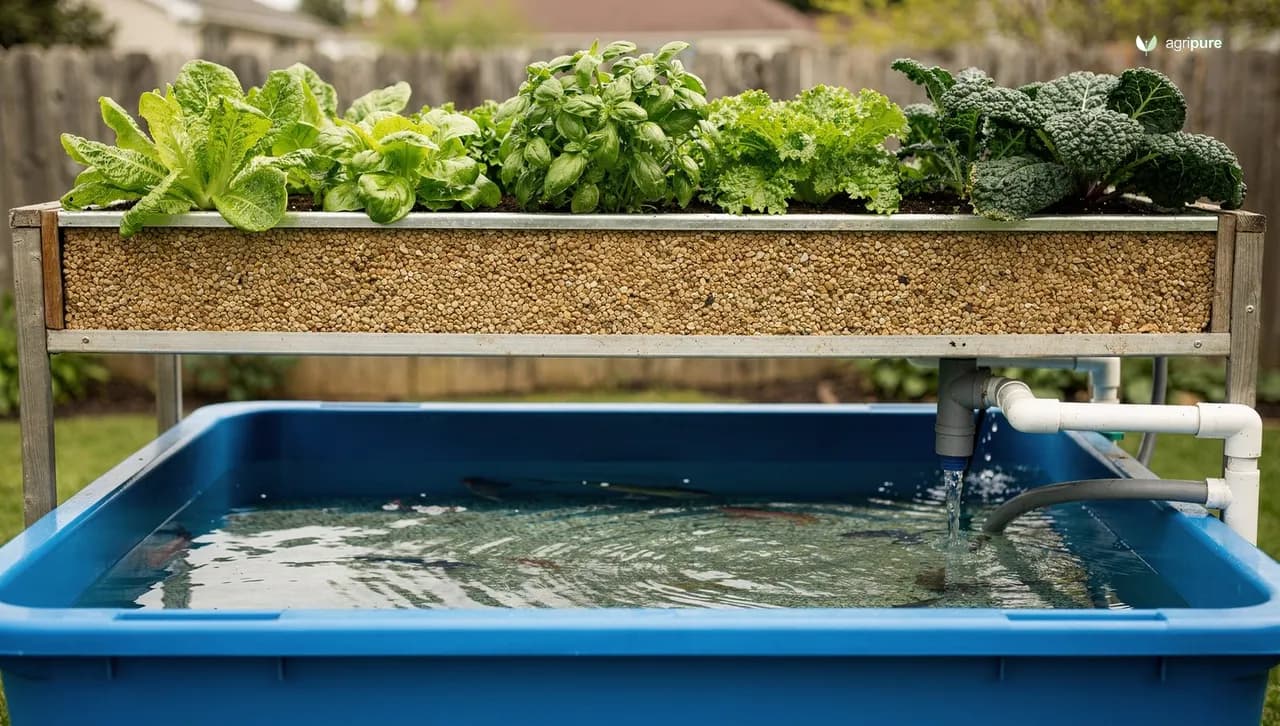
“In a well-cycled aquaponics system, the fish feed the plants and the plants clean the water — and you just manage the balance.”
Aquaponics is not complicated in principle. Fish eat, fish produce waste, bacteria convert that waste into plant fertilizer, and the plants purify the water that returns to the fish. The whole loop runs continuously, uses around 90% less water than a conventional soil garden, and produces two food streams — fish protein and fresh vegetables — from the same footprint. It is the closest thing to a closed-loop food system that a backyard or basement can hold.
What trips up beginners is the biology. Aquaponics is not just a tank with plants floating on top. It has three living communities — fish, nitrifying bacteria, and plants — that all require different conditions, and those conditions have to overlap. Get the chemistry right and the system nearly runs itself. Rush the setup or ignore the water tests and you lose fish, lose plants, or both. This guide covers how the nitrogen loop works, how to choose a system type and fish, and how to build and maintain a beginner rig that actually holds together.
If you are drawn to aquaponics because you want to grow food without soil, it is worth knowing where it sits relative to food-forest thinking and broader permaculture design — it shares the closed-loop logic but runs indoors or in a controlled structure rather than a landscape. Both approaches ask you to work with natural cycles rather than override them.
Key takeaways
A photorealistic image of a thriving aquaponics system. Lush green lettuce and basil plants with visible roots grow from grow beds above a transparent fish tank where active tilapia swim in clear water, illuminated by soft sunlight.
Witness the symbiotic dance of nature in a well-balanced aquaponics system. Fish provide vital nutrients for thriving plants, which in turn purify the water, creating a sustainable and efficient cycle for food production.
- Aquaponics combines fish culture with soilless plant growing in a closed recirculating loop driven by bacterial nitrification.
- The three system types — media bed, deep water culture (raft), and NFT — suit different crops and skill levels; media beds are the best beginner choice.
- Tilapia is the hardiest warm-water fish for home systems; trout suits cold climates; goldfish and koi work for ornamental or small-scale setups.
- Cycling the system — building up nitrifying bacteria — takes four to six weeks and must happen before you stock fish.
- pH 6.8–7.0 is the sweet spot where fish, bacteria, and plants all perform; total ammonia must stay below 0.25 ppm.
- A DIY media-bed system using a repurposed IBC tote costs around $400–500; a 165-gallon university-scale raft system costs $3,000–4,800.
How the nitrogen loop works
The chemistry is straightforward once you see it as a chain. Fish consume protein-rich feed. Only about 25–30% of the nitrogen in that feed converts to fish biomass — the rest is excreted into the water as ammonia (NH₃ and its ionized form NH₄⁺). Ammonia is toxic to fish above roughly 0.25 parts per million. Left unchecked, it kills them within days.
That is where the bacteria step in. Two groups of nitrifying bacteria live on every wet surface in your system — on gravel media, on tank walls, on filter material. The first group, ammonia-oxidizing bacteria (primarily Nitrosomonas), convert ammonia to nitrite (NO₂⁻). Nitrite is also toxic. The second group, nitrite-oxidizing bacteria (primarily Nitrobacter), convert nitrite to nitrate (NO₃⁻). Nitrate is the form plants can absorb, and it is harmless to fish at concentrations up to around 150 ppm.
Close-up of gravel grow media in an aquaponics media bed, with plant roots threading through the stones and water droplets visible on the surface
Gravel and expanded clay are the preferred grow media for media-bed systems — their rough surfaces provide maximum colonization area for nitrifying bacteria.
The plants complete the loop. Their roots absorb nitrate as nitrogen fertilizer, stripping it from the water. Cleaned water drains back to the fish tank. Aquaponics systems retain over 90% of their water daily — losses come from evaporation, plant uptake, and the occasional backwash. That efficiency comes directly from the recirculating loop.
New Mexico State University Extension describes pH as the “master variable” in this system, because it governs both ammonia toxicity and bacterial efficiency. At pH 7.0 or below, over 95% of ammonia stays in the safer ionized NH₄⁺ form. At pH 8.0, a higher fraction shifts to toxic NH₃. The target pH for a running system is 6.8–7.0 — a compromise that keeps fish safe, bacteria productive, and plant nutrient uptake efficient. Below 6.4, add potassium hydroxide or calcium hydroxide to raise it; above 7.4, let plant uptake and fish respiration naturally pull it back down.
The three system types
Every aquaponics build organizes around the same loop, but the hydroponic component — where the plants grow — differs substantially between system types, and that choice affects which crops you can grow, how much space you need, and how much filtration the fish tank requires.
System type | How it works | Best crops | Pros | Cons |
|---|---|---|---|---|
Media bed (flood & drain) | Gravel or clay pebbles flood on a timer or bell siphon, then drain | Tomatoes, peppers, herbs, leafy greens, most vegetables | Combined bio + mechanical filtration; most versatile crop range; best for beginners | Heavier than raft; media can compact over time |
Deep water culture (raft) | Plants float on foam rafts in a long channel; roots hang in water | Lettuce, spinach, kale, herbs | High plant density; simpler for leafy greens; used commercially | Needs separate solids and biological filtration; roots can clog channels |
Nutrient film technique (NFT) | Thin film of water flows continuously through angled channels over roots | Herbs, lettuce, strawberries | Space-efficient; low water volume | Pump failure stresses plants quickly; poor for large-rooted crops |
For a first build, the media bed is the clear choice. It combines mechanical filtration (solids settle into the media) and biological filtration (bacteria colonize the gravel) in a single unit, so you do not need a separate clarifier or biofilter tank. Clemson University’s Land-Grant Press notes that biofilters in media-bed systems are “easy to design and very efficient, with not much of an investment.” The flood-and-drain cycle also aerates plant roots with every drain — a feature the raft system cannot match without additional air pumps.
Choosing your fish
Tilapia fingerlings in a clean blue aquaponics fish tank viewed from above, with aeration bubbles visible in the water
Tilapia fingerlings are the standard beginner fish — fast-growing, hardy, and tolerant of the water quality swings common in new systems.
The fish you choose sets the temperature range your whole system must run at, because the bacteria and plants will be tuned to the same water. Match the fish to your climate and your space before anything else.
Tilapia is the default recommendation for most home systems in warm or temperature-controlled spaces. It tolerates a wide pH (6.5–9), grows fast — from fingerling to harvest-weight in roughly nine months — and handles the water quality swings that are common while a new system settles. It thrives between 75–86°F and performs best at 81–85°F. It is also legal to keep in most US states, though check your state fish and wildlife regulations before ordering fingerlings.
Trout suits cold climates and unheated spaces — it prefers 45–65°F. The trade-off is that trout are far less tolerant of poor water quality than tilapia. They need dissolved oxygen closer to 6.5 ppm and will not forgive ammonia or nitrite spikes. For growers in the Pacific Northwest or northern states who cannot cheaply heat a tank through winter, trout is a viable choice. For everyone else, it adds difficulty without much practical benefit.
Catfish (channel catfish in North America) sits between the two: it tolerates temperatures from 65–90°F, a pH range of 7–8.5, and some water quality variation. Channel catfish can reach harvestable size in as little as three months under good conditions. It is a solid alternative to tilapia in southern US systems.
Goldfish and koi are the ornamental option. They are extraordinarily hardy, legal everywhere, and produce sufficient waste to drive a small plant bed. The practical limit is that they are not a food fish — so you are giving up one of aquaponics’ two outputs. For a countertop or small patio system where the fish are decorative, goldfish are a sensible starting point before you graduate to tilapia.
Stocking density matters as much as species. A general guideline for established systems is one pound of fish per five to ten gallons of water. For smaller tanks under 50 gallons, stay closer to one inch of fish per gallon while the system is new. Overstocking — the impulse to fill the tank quickly — is one of the most common causes of ammonia crashes in first-year systems.
Plant selection and fish-to-plant balance
Not every vegetable grows well in aquaponics. The core constraint is that nutrient concentrations in an aquaponic system reflect what the fish produce, not a tailored fertilizer mix. Leafy greens and herbs are well matched to the nitrogen levels most home systems sustain. Fruiting crops like tomatoes and peppers are possible in media-bed systems but need higher fish densities — and therefore more fish management — to supply enough phosphorus and potassium alongside the nitrogen.
The best beginner plant choices are: lettuce, spinach, kale, chard, basil, mint, chives, parsley, and cilantro. These are the same crops well covered in seed starting guides — and in aquaponics you can start them the same way, transplanting seedlings into the grow bed once they have developed their first true leaves. Do not direct-sow into a media bed; small seeds wash around in the flood-and-drain cycle.
The fish-to-plant balance is not a fixed ratio — it is a dynamic you adjust by watching nitrate levels. If nitrate climbs above 150 ppm, you need more plants or fewer fish. If it stays below five ppm and plants look pale, you need more fish. The target window, 5–150 ppm nitrate, is wide enough that most home systems find equilibrium without constant intervention once they have cycled properly.
Building a beginner media-bed system
University of Maryland Extension’s low-cost build guide prices a complete DIY system using a repurposed IBC (intermediate bulk container) tote at approximately $405 in 2023. An IBC tote — the standard 275-gallon plastic-and-steel cage pallet used in food manufacturing — is the most economical fish tank available. Food-grade totes are critical; avoid any that held chemicals.
The build cuts the IBC tote horizontally: the lower three-quarters becomes the fish tank, the upper section becomes the media grow bed. A bell siphon regulates flood-and-drain without a timer — it is a passive valve that fills the bed to a set level, triggers a fast drain, and resets automatically. Bell siphons have no electrical components and rarely fail once properly tuned.
Core components for a beginner IBC build:
- Fish tank — the lower section of a 275-gallon IBC tote, or a 100–150 gallon stock tank or aquarium-quality vessel
- Grow bed — upper IBC section or a separate food-grade tote; fill to 12 inches with expanded clay pebbles or pea gravel (washed)
- Bell siphon — PVC pipe and fittings, DIY from tutorials or purchased for $15–30
- Submersible water pump — sized to turn over the fish tank volume once per hour; a 400–800 gph pump handles most home systems ($25–60)
- Air pump and air stones — maintain dissolved oxygen above 5 ppm; run 24/7 ($15–30)
- Water quality test kit — liquid drop test kits (API Freshwater Master Kit) give more reliable readings than strips ($35–45)
- pH adjustment — potassium hydroxide (raises pH) and food-grade phosphoric acid or citric acid (lowers) ($15–25)
- Grow media — 50–100 lb of expanded clay pebbles ($20–40)
Total material cost: $400–600 depending on whether you source a used IBC tote ($50–150) or buy new. An outdoor or greenhouse setup in a climate above 65°F requires no supplemental heating. An indoor system needs grow lights — plan for 14–16 hours of light per day for most leafy crops and at least eight hours of darkness. Running costs — electricity for the pump, air pump, and any lighting — are the ongoing expense to budget for.
Cycling: the step you cannot skip
Cycling is establishing the nitrifying bacteria colony before you stock fish. It is the step most beginners rush, and it is why most first-time fish deaths happen. Bacteria take four to six weeks to colonize the system to a level where they can process fish waste fast enough to keep ammonia and nitrite below toxic thresholds.
The cycling process works like this. Fill the system with dechlorinated water — let tap water sit 24 hours or use a dechlorinator. Add an ammonia source to feed the bacteria: a small amount of pure ammonia (no surfactants) or a few feeder fish. Test daily with a liquid kit. Ammonia will rise first, then nitrite will spike as the first bacterial population grows. Nitrite will then fall as the second population establishes. When you can dose ammonia to 2 ppm and see it fall to near-zero within 24 hours with no nitrite spike, the system has cycled. Then, and only then, stock your fish — and start with about half the eventual stocking density to allow the bacteria to scale up gradually.
You can speed cycling by seeding from an established system — adding a cup of media, filter material, or even aquarium gravel from a healthy aquarium jumpstarts the bacterial population. Temperature matters: bacteria establish fastest between 77–86°F. Below 60°F, cycling slows dramatically.
Maintenance and common mistakes
Hands holding a liquid aquaponics water test kit over a fish tank, with test tubes showing ammonia, nitrite, nitrate, and pH readings in different colors
A liquid drop test kit is the aquaponics grower’s most important tool — strip tests are not reliable enough for the early weeks when water chemistry is still stabilizing.
Most aquaponics failures are not single dramatic events. They are small problems — a missed feeding, a skipped water test, a clogged drain line — that accumulate until the system tips. Regular maintenance prevents this.
Daily checks take five minutes: observe fish behavior (fish gasping at the surface, clamped fins, or erratic swimming are early ammonia warning signs), confirm the pump and air stone are running, check that the bell siphon is cycling. Feed fish only what they consume in five minutes — uneaten feed is the primary driver of ammonia spikes.
Weekly tasks: test pH, ammonia, nitrite, and nitrate with a liquid kit. Check solids buildup in the fish tank and siphon out sludge that accumulates at the bottom. Rinse any mechanical pre-filters. Inspect plant roots for discoloration or rot — brown, slimy roots indicate low oxygen or pathogens.
Common problems and their fixes:
- Ammonia spike above 1 ppm — stop feeding for 24–48 hours; do a 25–50% water change with dechlorinated water; check for a dead fish or clogged drain
- Nitrite spike — same protocol as ammonia; add extra aeration; this is most common mid-cycle before the second bacterial population is established
- pH crash below 6.4 — add potassium hydroxide or calcium hydroxide in small amounts; test again after one hour before adding more
- Algae in fish tank or water lines — cover fish tank and all water channels with opaque material; light drives algae, not biology
- Pale or yellowing plants — check nitrate (too low?), pH (out of range?), and consider iron supplementation — iron is often deficient in aquaponic systems and must be added as chelated iron (not copper-based compounds, which are toxic to fish)
- Power failure — high-density fish tanks can lose enough dissolved oxygen within 30–60 minutes to stress fish; a battery-powered air pump backup is cheap insurance
The connection to soil-based gardening is closer than it looks. Aquaponics is essentially a permaculture closed-loop compressed into a tank. The same principle — waste from one organism feeding another — drives compost, cover cropping, and companion planting. If you are already growing in raised beds or practicing starting seeds indoors, the plant-care knowledge transfers directly. What changes is the medium and the daily chemistry awareness.
Aquaponics vs. hydroponics: which fits your goals
If you are weighing aquaponics against a simpler hydroponics setup — growing plants in a nutrient solution without fish — the honest comparison comes down to complexity versus self-sufficiency.
Hydroponics is cheaper to start, easier to troubleshoot, and easier to scale down to a single shelf. You buy a premixed nutrient concentrate and adjust it to the label. There are no fish to worry about and no bacterial cycling period. It is the right choice if your only goal is fast, efficient leafy-green production in a small space.
Aquaponics produces two food streams — fish protein and vegetables — from the same water and footprint. Plants in soilless systems, both hydroponic and aquaponic, grow 30–50% faster than in soil because roots access oxygen and nutrients more directly. Aquaponics eliminates synthetic fertilizer costs (the fish waste substitutes for it) and recycles far more water than either soil gardening or standalone aquaculture. It is the right choice if you want a more self-contained system and are willing to manage fish alongside plants.
The practical gap is time investment in the first three months. A hydroponic system can produce harvestable lettuce in three to four weeks. An aquaponic system spends its first four to six weeks cycling and its next few months stabilizing. The payoff for that patience is a system that, once balanced, requires less external input than either method alone. A 165-gallon system, according to Ohio State University Extension, can yield 33–82 lb of tilapia per year alongside a continuous supply of leafy greens and herbs from 112 plant sites.
Frequently asked questions
What is aquaponics?
Aquaponics is a closed-loop growing system that combines fish culture with soilless plant production. Fish produce waste that nitrifying bacteria convert to plant fertilizer. Plants absorb those nutrients and return clean water to the fish. The loop is continuous and recirculates over 90% of its water daily.
What is the difference between aquaponics and hydroponics?
Hydroponics grows plants in a synthetic nutrient solution without fish. Aquaponics uses fish waste — processed by bacteria — as the nutrient source, eliminating the need for synthetic fertilizers. Aquaponics is more complex to set up and requires a cycling period, but it produces fish protein alongside vegetables and uses less external input once established.
What fish are best for aquaponics?
Tilapia is the most popular choice for warm-water home systems (75–86°F) — hardy, fast-growing, and tolerant of water quality variation. Trout suits cold, well-oxygenated systems (45–65°F). Channel catfish works in southern US climates. Goldfish and koi are the ornamental option for small or decorative systems. Always check state regulations before purchasing fish.
How long does it take to cycle an aquaponics system?
Cycling takes four to six weeks at typical room temperature. The process is complete when you can add ammonia to 2 ppm and see it fall to near-zero within 24 hours with no nitrite spike. Seeding the system with media or filter material from an established aquarium or aquaponics system can shorten this significantly.
What plants grow best in aquaponics?
Leafy greens and herbs — lettuce, spinach, kale, basil, mint, and cilantro — are the most reliably productive beginner crops. Fruiting vegetables like tomatoes and peppers grow well in media-bed systems but need higher fish densities to supply adequate nutrients. Avoid root vegetables (carrots, beets) in most setups, as the flood-and-drain cycle disrupts root development.
References
- Aquaponics: System Layout and Components — Clemson University Land-Grant Press
- Important Water Quality Parameters in Aquaponics Systems (CR-680) — New Mexico State University Extension
- Overview and Cost of a Small-Scale Aquaponic Build (ANR-0105) — Ohio State University Extension (Ohioline)
- How to Build a Low-Cost, Small-Scale Aquaponic System (EM-2023-0698) — University of Maryland Extension
- Nitrification and Maintenance in Media Bed Aquaponics (HLA-6729) — Oklahoma State University Extension
- Aquaponics vs Hydroponics — Technology Networks
- Understanding Aquaponics (Chapter 2 — Aquaponics Food Production Systems) — FAO / UN Food and Agriculture Organization