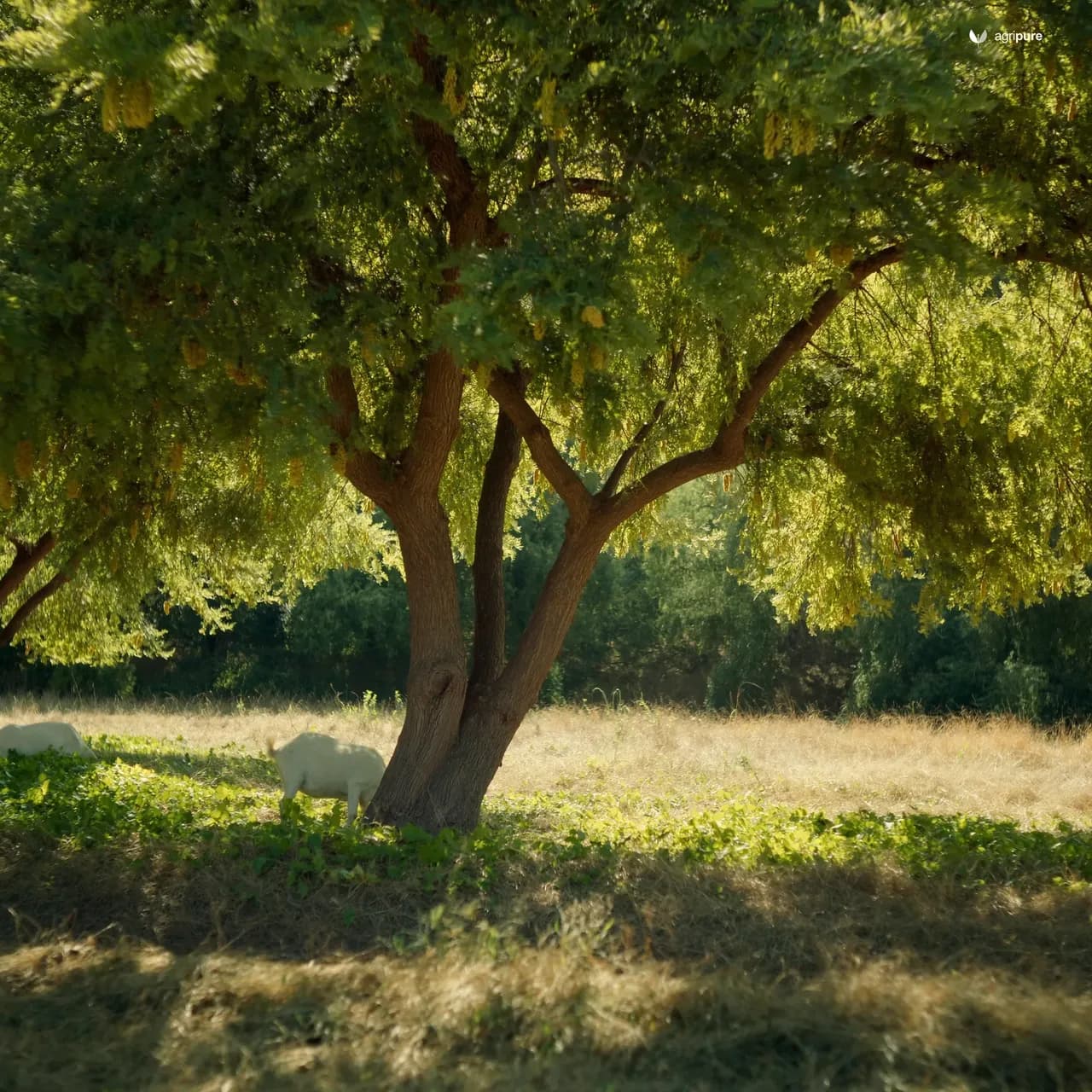
Animals belong in a mature agroforest — but on terms the trees can survive. Done well, livestock in the climax canopy close the nutrient loop: they graze the understorey you cannot sell, drop fertility where the trees can use it, and turn fallen fruit and prunings into milk and meat. Done badly, the same animals strip bark, compact roots, and undo a decade of work in a season. The whole art of silvopasture in a Pakistani orchard is the set of rules that keep the first outcome and prevent the second.
Related Agripure guides

Livestock integrated into a mature agroforest system, grazing the understorey without damaging the trees.
Stocking rate: start lower than you think
The first rule is restraint. A mature orchard understorey produces a fraction of the forage of an open pasture, and overstocking is the fastest route to damage. Smallholder herds in Pakistan are small by nature (two to eight buffalo, goats, or sheep), and that scale is an advantage: it is far easier to match a handful of animals to what the understorey can actually carry than to manage a large herd’s appetite. Stock to the forage, not to the ambition; when the animals start reaching for bark or browsing the trees themselves, you are already over the line.
Source: [1] FAO — silvopastoral systems: stocking & tree-protection guidelinesSource: [2] Pakistan Dairy Development Board / PARC Livestock Programme — buffalo & small-ruminant management (institutional reference)
Rotation is the rule that protects the trees
Continuous grazing is what ruins orchards; rotation is what saves them. The principle, drawn from Joel Salatin’s mob-grazing work and validated across silvopastoral systems, is to concentrate animals briefly on a small area, then move them on and let it fully recover before they return. For a smallholder this means simple movable fencing, even a few electric or rope paddocks, dividing the orchard into cells the herd visits in turn. Short, intense grazing followed by long rest prevents the repeated nibbling that kills understorey plants and the constant traffic that compacts soil over the root zone. The rest period is the active ingredient; without it, rotation is just slow continuous grazing.
What is safe to browse, and what must be fenced off
Match the animal to what the canopy can spare. Several agroforestry species are documented as palatable and safe in moderation: leucaena prunings (a supplement, not a staple, because of mimosine), mulberry (Morus alba) leaves and prunings, and fallen Ziziphus (ber) leaves and fruit are all useful fodder. Against that, the fruit trees themselves must be protected: young bark is irresistible to goats in particular, and a single session of bark-stripping can girdle and kill a tree that took years to establish. Trunk guards on young and thin-barked trees, and excluding animals entirely from newly grafted or newly planted sections, are non-negotiable. The general rule: animals graze the floor and the dropped material, never the standing crop.
Timing the animals to the orchard calendar
Bring the herd in when their grazing helps and keep them out when it hurts. After harvest, animals cleaning up fallen fruit reduce the pest and disease carry-over that windfalls cause — a genuine service. During flowering and fruit set, and through the establishment of any new planting, exclude them. Used as a seasonal tool rather than a permanent presence, livestock become part of the orchard’s sanitation and fertility cycle instead of a standing threat to it. That is the difference between silvopasture that compounds the system and grazing that quietly dismantles it.
Source: [1] Salatin, J. — mob/rotational grazing principles (Polyface Farm)Source: [2] Feedipedia — fodder-tree palatability & anti-nutritional factors (leucaena, mulberry, ziziphus)
References
- Silvopasture — USDA Forest Service, National Agroforestry Center. Defines silvopasture as the deliberate integration of trees and grazing livestock, and supports the claims on rotational grazing, reduced heat stress, and combined forest-and-forage income.
- Chapter 4: Silvopasture — University of Missouri Center for Agroforestry. Backs the practical guidance on early tree protection, grazing timing, forage shade tolerance, water competition, and managing grazing intensity to avoid harming trees.
- Overstory #190: Silvopasture, An Agroforestry Practice — USDA National Agroforestry Center. Supports the point that young trees need protection from livestock, with electric fencing and seasonal exclusion recommended during establishment.
- AgroforestryNotes: Silvopasture — USDA National Agroforestry Center. Supports the claim that livestock are more likely to damage young trees than mature ones and that younger stock cause more damage, justifying stock control during establishment.
- Agroforestry for Livestock Systems — Agricology / Organic Research Centre. Backs the point that tree fodder can supplement livestock diets with protein and minerals, adding feed and income streams.