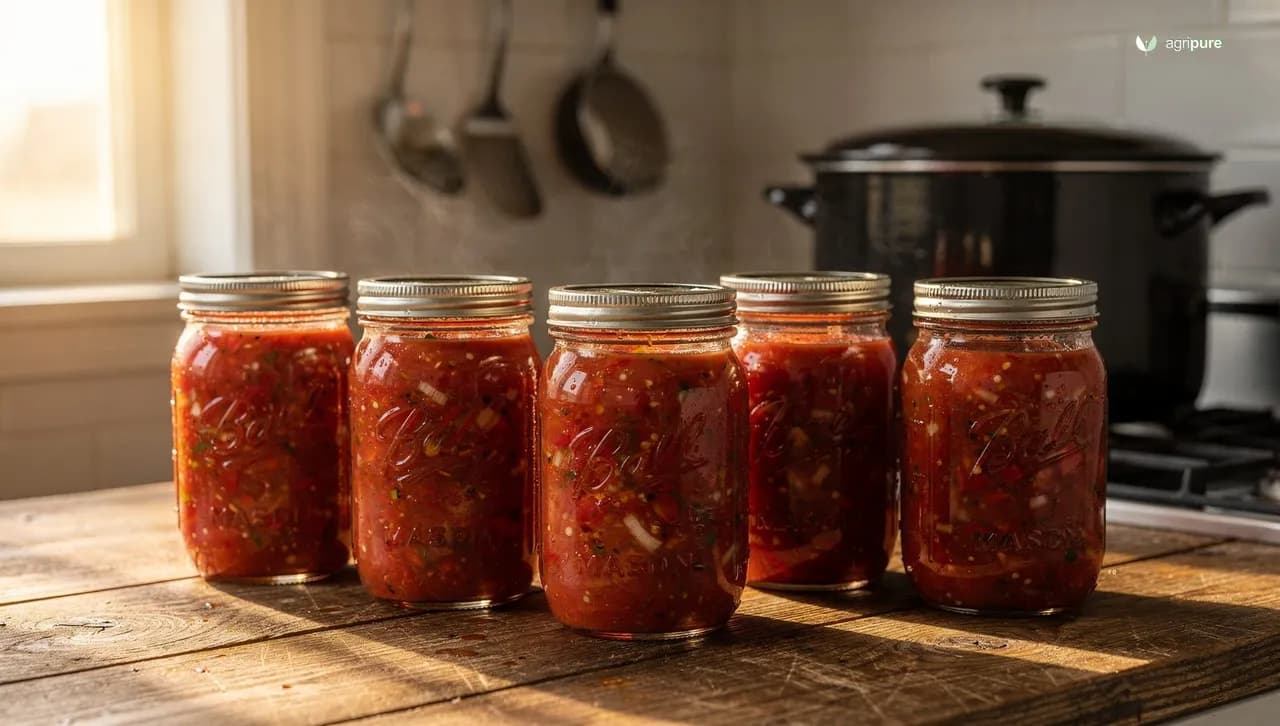
“The recipe is not the place to improvise — the acid ratio is the difference between a pantry staple and a public-health risk.”
Every August, gardeners face the same beautiful problem: more tomatoes than they can eat. Salsa is the obvious answer — fresh, bright, and ready to eat in twenty minutes. Canning it is the step that turns a weekend batch into a year’s worth of flavor. It is also the step where food safety depends on correct acidity.
Clostridium botulinum, the bacterium behind botulism, thrives in moist, low-acid, anaerobic environments — which is exactly what the inside of a sealed jar becomes if the pH climbs above 4.6. A University of Maine study found that 70% of salsa recipes on food blogs failed to meet USDA home canning safety standards, with most providing less than half the acid required to reliably hit that threshold. The rules are straightforward: use a tested recipe, keep the vegetable-to-acid ratio intact, and use commercially bottled lemon or lime juice instead of fresh-squeezed.
This guide covers the food-safety logic, walks through the NCHFP “Choice Salsa” tested recipe step by step, explains what you can safely customize and what you cannot touch, and gives you a troubleshooting table for the problems most home canners run into. If you are new to preserving, you may want to read our complete home canning guide and the primer on water bath canning alongside this one.
Key takeaways

Following tested recipes and acidity guidelines keeps canned salsa safe on the pantry shelf.
- Salsa must reach pH 4.6 or lower to be safe for water bath canning — botulism spores cannot survive in properly acidified salsa.
- Use a tested recipe from the NCHFP, USDA, or university Extension; do not improvise ratios or add extra low-acid vegetables.
- Use commercially bottled lemon or lime juice only — never fresh-squeezed juice, and never substitute vinegar for lemon juice.
- The NCHFP “Choice Salsa” recipe (6 cups tomatoes, 9 cups onions and peppers, 1½ cups bottled lemon juice) yields about six pints and is a reliable starting point.
- Process pint jars for 15 minutes at sea level, 20 minutes at 1,001–6,000 feet, and 25 minutes above 6,000 feet.
- You may adjust spices and herbs freely. You may not change the vegetable-to-acid ratio, add unauthorized ingredients, or increase the total pepper volume.
Why salsa acidity is not optional
The safety of water bath canning rests entirely on one number: pH 4.6. Below that threshold, Clostridium botulinum cannot produce its toxin, so boiling-water processing is sufficient to sterilize the jar. Above it, the organism can germinate and manufacture toxin in the anaerobic environment of a sealed jar, even at room temperature, within three to four days. You cannot smell it, see it, or taste it. The only protection is proper acidification before the lid goes on.
Tomatoes occupy a borderline position in the acidity spectrum: their pH ranges from about 4.0 to 4.6 depending on variety, growing conditions, and ripeness, and a ripe, low-acid slicing tomato can tip above 4.6 on its own. Adding onions, peppers, garlic, and other low-acid vegetables pushes the pH up further. That is why every research-tested salsa recipe mandates added acid (commercially bottled lemon juice, lime juice, or 5% acidity vinegar) in a fixed ratio relative to the low-acid ingredients.
The University of Maine researchers who evaluated 56 blog recipes found the mean acidification level across those recipes was 0.94 tablespoons of acid per cup of peppers and onions. The benchmark tested recipe used 2.33 tablespoons per cup — more than twice as much. Most of those blog recipes looked plausible on a plate. They were not safe in a jar on a shelf.

Acidity is invisible to the palate. Only a tested ratio, or a calibrated pH meter, confirms the salsa is safe.
The practical implication is simple: follow a tested recipe from the NCHFP, USDA, or a university Extension service, and do not deviate from its vegetable-to-acid ratio. If you want to make your own creation, make refrigerator salsa or freeze it. The jar on the pantry shelf is not the place to experiment.
Equipment and jar preparation
Before you dice the first tomato, you need the right equipment clean and ready. Water bath canning does not require expensive gear (a large stockpot with a rack to keep jars off the bottom works fine), but everything in contact with the food must be clean.
Here is what you need:
- A water bath canner or large stockpot with a lid and a rack or folded dish towel in the bottom (keeps jars from rattling directly on the heat). The pot must be deep enough to cover the jars with at least one inch of water.
- Mason-type canning jars — pint or half-pint only. No quart-jar process has been tested for salsa; do not scale up to quarts. Inspect each jar rim for chips or cracks; discard any with damage.
- New canning lids (the flat disc with the sealing compound). Bands (screw rings) may be reused if rust-free.
- Jar lifter, wide-mouth funnel, bubble remover or thin spatula, and clean cloths.
Jar sterilization note: Because the salsa processes for 15 minutes or more, you do not need to pre-sterilize jars — the NCHFP specifies that jars processed for 10 or more minutes are effectively sterilized during processing. Do wash jars in hot soapy water or run them through the dishwasher, and keep them hot until you fill them (cold jars can crack when filled with hot salsa). Lids should be warmed in hot but not boiling water to soften the gasket.
Fill your canner with enough water to cover the jars by one inch and begin heating it so it is hot, but not boiling yet, when you are ready to load.
The tested recipe: NCHFP choice salsa
The “Choice Salsa” recipe from the National Center for Home Food Preservation is the most flexible tested salsa for home canning. The name signals the key feature: you can choose any combination of peppers (sweet bell peppers, hot jalapeños, serrano, Anaheim, or a mix) as long as the total volume stays fixed. It yields approximately six pint jars.

Every ingredient has a role in the tested recipe: tomatoes for body, peppers and onion for flavor, bottled lemon juice for the acid that makes it shelf-safe.
Ingredients
- 6 cups peeled, cored, seeded, and chopped ripe tomatoes
- 9 cups diced onions and/or peppers of any variety (this is your flavour dial: go all sweet bell pepper for mild, all hot pepper for fire, or any ratio between)
- 1½ cups commercially bottled lemon or lime juice (never fresh-squeezed)
- 3 teaspoons canning or pickling salt
Optional but freely adjustable: garlic, cumin, oregano, cilantro, black pepper. These are spices; their amounts do not affect the pH math.
Step-by-step process
1. Prepare the tomatoes. Blanch each tomato in boiling water for 30 to 60 seconds, until the skin splits, then plunge into cold water. Slip off the skins. Core and seed the tomatoes, then chop into ¼- to ½-inch pieces. Paste tomatoes (Roma, Amish Paste, San Marzano) hold their shape better and yield a thicker salsa; slicing types work fine but produce more liquid.
2. Prepare the peppers and onions. Wash bell peppers, remove cores and seeds, and dice into ¼-inch pieces. For hot peppers, wash and dice; include or remove seeds depending on desired heat. Wear disposable gloves when handling hot peppers and keep your hands away from your face. Peel and dice onions to roughly the same size.
3. Combine and cook. Put all ingredients (tomatoes, peppers, onion, lemon juice, and salt) into a large, heavy-bottomed pot. Bring to a boil over medium-high heat, stirring frequently. Reduce to a simmer and cook for three minutes, stirring to prevent scorching. Do not extend cooking time to thicken: that concentrates flavour but also concentrates heat unevenly and can scorch. If you want a thicker texture, choose paste tomatoes or drain some liquid after opening.
4. Fill the jars. Ladle the hot salsa into hot jars, leaving ½-inch headspace. Run a bubble remover or thin spatula around the inside edge of each jar to dislodge air pockets. Wipe each jar rim with a clean damp cloth: any residue can prevent a proper seal. Place a warmed lid on each jar, then apply the screw band fingertip-tight (snug but not cranked down hard; overtightening prevents air from venting).
5. Process. Lower jars into the canner with the jar lifter. The water must cover the jars by at least one inch; add boiling water if needed. Put the lid on, return to a full rolling boil, then start timing.
Altitude | Processing time (half-pint or pint jars) |
|---|---|
0 – 1,000 ft | 15 minutes |
1,001 – 6,000 ft | 20 minutes |
Above 6,000 ft | 25 minutes |
No tested process exists for quart jars. Process only half-pints or pints.
6. Cool and check seals. Turn off the heat. Remove the canner lid and let the jars sit in the water for five minutes; this helps prevent siphoning caused by sudden temperature change. Lift jars straight up and set them on a towel or rack at least one inch apart. Do not tilt, re-tighten, or press on the lids. Cool undisturbed for 12 to 24 hours. Check the seal on each lid: it should be concave and firm when pressed. If any lid flexes up and down, the jar did not seal.
What you can and cannot change
This is the section most online recipes skip entirely. Understanding the rules is the difference between a customised salsa and an unsafe one.
Element | Can you change it? | Notes |
|---|---|---|
Pepper type (hot vs sweet) | Yes | Any variety or mix, in the same total volume |
Onion variety | Yes | White, yellow, red — same volume |
Tomato variety | Yes | Paste types yield thicker results; volume stays fixed |
Spices and dried herbs | Yes | Cumin, oregano, chilli powder, salt — amounts are flexible |
Fresh cilantro | Yes — omit or add | Does not affect acidity |
Total pepper volume | No | Do not increase low-acid vegetables above tested ratio |
Acid type: lemon juice for vinegar | Yes | Lemon is more acidic than vinegar; safe substitution |
Acid type: vinegar for lemon juice | No | Vinegar is less acidic; makes salsa potentially unsafe |
Fresh-squeezed lemon juice | No | Acidity of fresh citrus is variable; bottled only |
Added corn, beans, or zucchini | No | Low-acid additions dilute acid ratio; danger zone |
Thickeners (cornstarch, flour) | No — before canning | After opening, thicken as desired and refrigerate |
Jar size: quarts | No | No tested process exists for quart salsa jars |
If your family salsa recipe adds roasted corn, black beans, or a full extra cup of garlic, that recipe is not safe to water bath can. Make it fresh, refrigerate it for up to one week, or freeze it. Those are both practical options, but not for pantry-shelf storage.
Troubleshooting common problems

A concave, firm lid means a good seal. A lid that flexes or bounces back means the jar did not seal and must be refrigerated or reprocessed.
Even with a correct recipe and careful technique, things occasionally go wrong. Here are the four problems home canners encounter most with salsa.
Problem | Likely cause | What to do |
|---|---|---|
Lid did not seal | Dirty jar rim, nicked rim, loose band, lid gasket damaged | Refrigerate and use within one week, or reprocess within 24 hours with a new lid |
Siphoning (liquid loss during processing) | Temperature fluctuation in canner, inadequate headspace, cooling too fast, overfilling | If lid sealed, safe to store — the salsa is fine, just drier; do not open to add liquid |
Salsa too watery | High-moisture slicing tomatoes, not draining enough | Drain chopped tomatoes in a colander for 30 minutes before cooking, or switch to paste varieties next batch |
Discoloured salsa | Overly tight screw band prevented venting, or oxidation from too-slow cooling | If sealed and no off odour, safe to eat — the flavour is unaffected; check band tension next batch |
Spoilage warning: Never taste-test a jar that shows any of the following: a bulging or loose lid, spurting liquid when opened, cloudy brine, visible mould, bubbling when undisturbed, a foul or off odour. Discard the contents without tasting, and do not compost them — bag and bin. If a jar is suspect, treat it as contaminated and wash everything it touched in hot soapy water.
Storage, shelf life, and using the jars
Store sealed jars in a cool, dark location, ideally between 50°F and 70°F (10–21°C). A basement or insulated pantry is ideal; avoid storing near a stove, water heater, or in direct sunlight. Properly sealed and stored jars will hold quality for one year. The NCHFP and University of Minnesota Extension both recommend using within 12 months, not because the food becomes unsafe after that, but because colour, texture, and flavour degrade gradually.
Label each jar with the date and recipe name before storing; memory is unreliable when a shelf holds ten batches from three seasons.
Once you open a jar, refrigerate it and use within one to two weeks. At that point you can freely thicken it with a cornstarch slurry, add fresh lime juice or cilantro, or warm it on the stove; none of that matters for safety once the jar is open and refrigerated.
A six-jar batch of Choice Salsa is a practical starting point for one season of snacking, but the recipe scales linearly: double the batch, keep the ratios, and you double the yield. Many homesteaders run two or three batches in August when the tomato glut peaks, and canned whole and crushed tomatoes alongside salsa means the pantry carries through February without a grocery run.
Connecting salsa to a broader preservation pantry
A batch of salsa is rarely the only thing a busy August garden demands. Once the water bath canner is on the stove and the jars are hot, it makes sense to run it hard. The canning tomatoes guide covers whole, crushed, and sauce (all high-acid and water-bath safe), and canning peaches uses the same equipment and many of the same techniques. For low-acid crops like green beans and potatoes, the process changes entirely: those require a pressure canner, not a water bath, and the same principle applies: the method is determined by the food’s acidity, not by convenience.
Salsa sits at a useful juncture in the preservation spectrum: it is high-acid enough to water bath can, flavourful enough to motivate the work, and practical enough to use all year. Get the ratio right and the canning process is straightforward.
Frequently asked questions
Can I use fresh lemon juice instead of bottled for canning salsa?
No. The acidity of fresh-squeezed lemon or lime juice varies too much between fruits to guarantee the pH stays at or below 4.6. Commercially bottled lemon and lime juice is standardised to a known acid level, which is why every tested recipe specifies it. Using fresh juice may produce salsa that looks and tastes fine but is not safely acidified.
Can I double the peppers in my salsa recipe for canning?
No. Peppers are low-acid vegetables. Increasing their volume relative to the tomatoes and acid raises the overall pH of the salsa, potentially pushing it above 4.6, into the danger zone for botulism. You can swap pepper types (hot for sweet, etc.) in the same total volume, but not add more.
Why can’t I use quart jars for salsa?
No tested processing time exists for quart jars of salsa. Processing time accounts for how long it takes heat to penetrate to the centre of the jar; a larger jar requires more time, and without a validated test that determines the minimum safe time, there is no way to know the jar is fully processed. Use only half-pint or pint jars.
My salsa jar lost liquid during processing. Is it safe?
If the lid sealed properly (it is concave and does not flex when pressed), the salsa is safe to eat. Siphoning (liquid loss) is a quality issue, not a safety one, as long as the seal held. The salsa will be drier, but the flavour is unaffected. Do not open the jar to add liquid. Next time, maintain a steady boil in the canner, ensure proper headspace, and let the jars rest in the water five minutes before lifting them out.
References
- Choice Salsa — tested recipe — National Center for Home Food Preservation
- Ingredients for salsa recipes — what can and cannot be changed — National Center for Home Food Preservation
- Ensuring safe canned foods — National Center for Home Food Preservation
- Canning tomato-based salsa — University of Minnesota Extension
- Food preservation and canning troubleshooting guide — University of Minnesota Extension
- Canning salsa (preserve the harvest) — Utah State University Extension
- How safe is your salsa? — Penn State Extension