Key takeaways

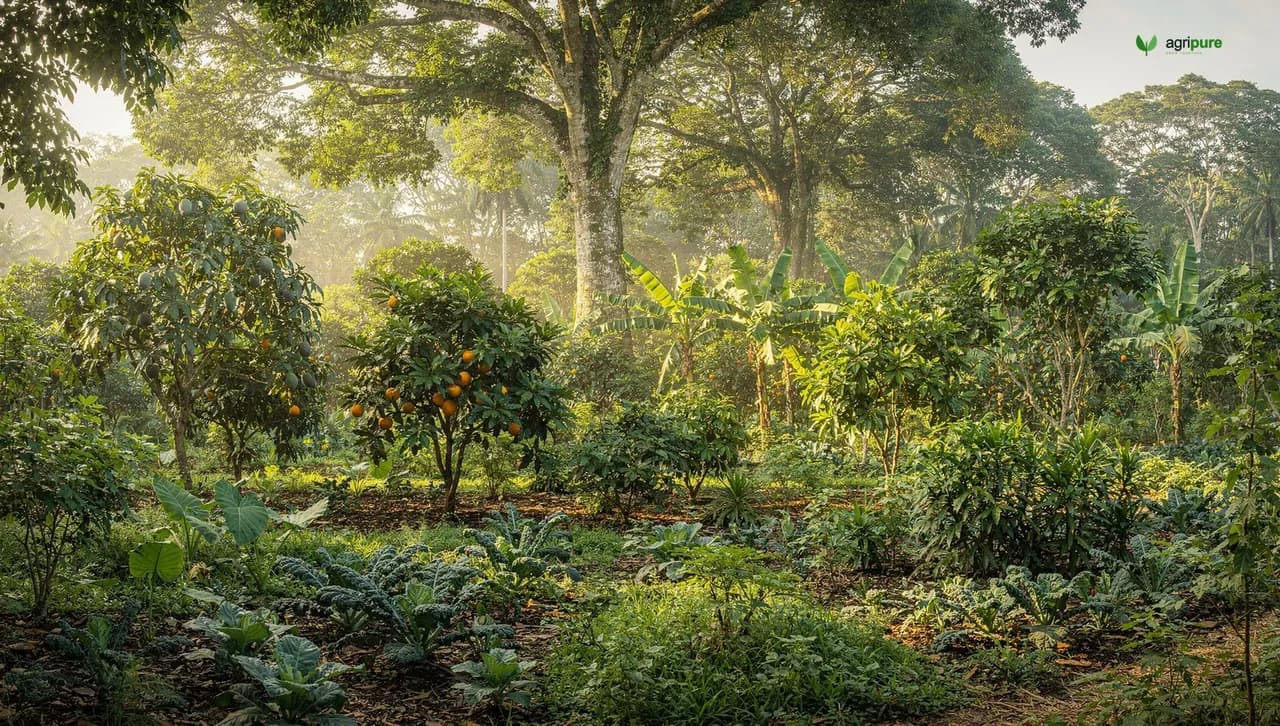
Syntropic farming uses dense, multi-layered planting that mimics natural forest ecosystems. This approach, pioneered by Ernst Gotsch, builds soil fertility and biodiversity while producing abundant food.
- Syntropic farming, developed by Ernst Gotsch, farms by accelerating natural forest succession.
- Plants are stacked in both space (strata) and time (succession), so 1 plot grows many layers at once.
- Heavy, regular pruning, not fertilizer, drives fertility by feeding the soil with biomass.
- Soil is kept covered and planted densely, with selective weeding rather than clearing.
- The system moves from accumulation toward abundance as it matures.
Syntropic farming is what happens when you stop fighting the forest and start farming like one. Developed by Swiss geneticist and farmer Ernst Gotsch, it is the most intensive form of agroforestry, a system that reads how nature regenerates land and speeds that process up. Where a permaculture design arranges elements, syntropic farming choreographs them through time, with the pruning saw doing the work a fertilizer bag usually does.
What syntropic farming is
At its heart, syntropic farming aligns with natural succession, the way bare ground heals itself into forest. Rather than importing nutrients, it mimics and accelerates that process to build soil, capture carbon, and grow food at the same time. Gotsch proved it on degraded land in Brazil, turning bare pasture into productive forest in under 2 decades.
Conventional farming | Syntropic farming |
|---|---|
Fights succession with tillage and spray | Accelerates succession with planting and pruning |
Imports fertility in bags | Generates fertility from pruned biomass |
One crop, bare soil | Many layers, soil always covered |
Stratification: stack the layers
The first idea is stratification: every plant occupies a layer of light. A syntropic plot stacks an emergent canopy over high, medium, and low strata down to ground cover, so 4 or more layers share the same ground, each taking the light it wants. This is the same logic as a 7-layer food forest, run at high density.

Succession: plant the whole timeline at once
The second idea is succession in time. You plant fast pioneers and slow climax species together on day 1, so quick crops yield while the long-lived trees establish underneath. As each wave matures and is cut, it hands fertility and light to the next, moving the system from an accumulation phase toward 1 of abundance.

Successional wave | Its job |
|---|---|
Pioneers and quick crops | Cover soil fast, yield in months |
Secondary species | Fruit and biomass for years |
Climax canopy | The long-term forest and its harvest |
Pruning is the engine
Those layers are driven by 1 counter-intuitive tool: heavy pruning. Cutting back growth hard and dropping it as mulch feeds the soil, opens the canopy to light, and signals the remaining plants to surge, exactly as a falling tree resets a forest gap. Pruning, not a fertilizer bag, is how a syntropic plot stays fertile.
The chop-and-drop rule: in syntropic farming, every cut stays on the plot. Prunings become the mulch that feeds the next wave, so nothing leaves and nothing is bought in. It is the same chop-and-drop that powers other agroforestry systems, turned up to the maximum.
The takeaway
Those 3 ideas, stratification, succession, and pruning, make syntropic farming the densest, most regenerative end of growing food. It is farming with succession, not against it: stack the layers, plant the timeline at once, and let the pruning saw build your soil. Start with 1 dense bed of mixed layers, learn the rhythm of cutting, and let the system climb toward abundance.
Frequently asked questions
What is syntropic farming?
It is a regenerative form of agroforestry developed by Ernst Gotsch that farms by accelerating natural succession. Instead of importing fertilizer, it stacks plants in layers and over time, then uses heavy pruning to build soil, so a single plot grows food while regenerating itself.
How is syntropic farming different from permaculture?
They share roots, but permaculture is a broad design framework while syntropic farming is a specific, intensive practice focused on succession and stratification. Syntropic systems are planted denser, pruned harder, and managed more actively to push the land toward forest.
What does stratification mean in syntropic farming?
Stratification is stacking plants by their light needs: an emergent canopy over high, medium, and low layers down to ground cover. Four or more strata share the same ground, each taking the light it wants, so the plot produces far more than a single-layer field.
Why is pruning so important in syntropic farming?
Heavy pruning is the engine of the system. Cutting growth and dropping it as mulch feeds the soil, opens the canopy to light, and stimulates the remaining plants to grow, mimicking how a forest gap resets growth. Pruning replaces the fertilizer bag.
Can I do syntropic farming on a small plot?
Yes. Start with a single dense bed that stacks a small tree, shrubs, and ground crops, planted with both fast and slow species. Learn the rhythm of pruning and chop-and-drop, then expand. The principles scale from a garden bed to many acres.
References
- Agenda Gotsch. “What Is Syntropic Farming?” agendagotsch.com
- Wikipedia. “Ernst Gotsch.” en.wikipedia.org
- Wikifarmer. “What Is Syntropic Farming?” wikifarmer.com
- Bosque de Niebla. “Syntropic Farming Guide.” bosquedeniebla.com.mx
- Growback. “Syntropic Farming: Principles and Techniques.” growback.net