Key takeaways

The first step in permaculture design is thorough observation of the land across seasons. Understanding natural flows and features before planting leads to a better-functioning property.
- Permaculture design is a process: observe, map, analyze sectors, then place by zone.
- Observe the land across seasons first; even a few months beats none, and a full year is ideal.
- A base map records contours, water, structures, and existing vegetation.
- Sector analysis maps the wild energies, sun, wind, water, fire, that flow in from outside.
- Zones then place each element by how often you visit it.
Where permaculture gardening is the hands-on craft, permaculture design is the thinking that comes first. It is a deliberate process, not a layout you copy: observe, map, analyze, then place. Skip it and you plant a fruit tree in the 1 spot that floods, or a windbreak where it blocks your winter sun. Done well, the design makes the whole property work with itself.
Start with observation
The first and longest phase is simply watching. Spend time on the land across different seasons and times of day, noting where water pools, where frost settles, and how the sun tracks. Some designers recommend up to 2 years of observation; even a few months beats rushing in, because the land tells you things no map can.

Observe across | To learn |
|---|---|
The seasons | Where water, frost, and shade move |
Times of day | How sun and wind shift |
Heavy rain | Where water flows and pools |
Draw the base map
Those observations need a place to live, which is the base map. Gather every fixed fact about the site, contours and elevation, existing structures, access roads, fences, utilities, waterways, and vegetation, from satellite imagery and on-site visits. This 1 drawing becomes the canvas every later decision is laid over.
Map the sectors
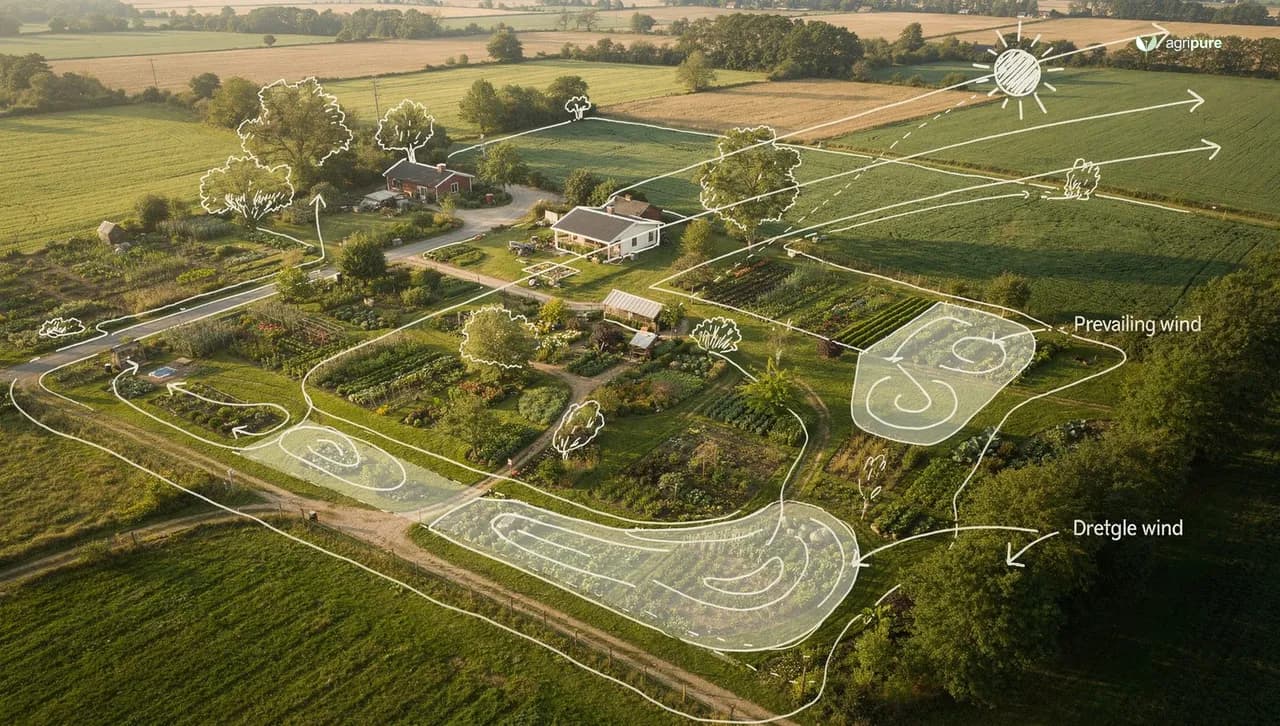
On top of that base map go the sectors, the wild energies that flow onto the site from outside. Map the summer and winter sun angles, prevailing wind, water flow, fire risk, noise, and wildlife paths, using arrows whose thickness shows intensity. Sectors tell you what to block, what to catch, and what to channel, before you place a single element.

Sector | Design response |
|---|---|
Summer and winter sun | Place gardens and glazing to catch it |
Prevailing wind | Site windbreaks to soften it |
Water flow | Catch and slow it with swales |
Place by zones, then go slow
Only now do you place elements, using zones to sort them by how often you visit, the same 0-to-5 scheme behind a permaculture garden. Put the daily kitchen garden in zone 1 and the orchard in zone 2, then implement gradually over 2 to 3 years rather than all at once.
The observe-first rule: resist the urge to plant in your first season. A year of watching where water, frost, and sun actually move will change your plan more than any book, and it costs nothing but patience. The cheapest mistake to fix is the 1 you never make because you observed first.
The takeaway
Permaculture design front-loads the thinking so the land does the work later. The process is always the same 4 moves: observe, map, analyze sectors, place by zone, then implement slowly. Watch your site for a season, draw it, overlay the wild energies, and let the design tell you where everything goes.
Frequently asked questions
What is permaculture design?
It is the process of designing a whole property using permaculture principles: observing the land, mapping it, analyzing the external energies (sectors), and placing elements by zone according to use. The planting comes last; the thinking and observation come first.
How long should I observe before designing?
As long as you can, ideally a full year to see every season, though even a few months is far better than none. Some designers recommend up to two years. Observation reveals where water pools, frost settles, and sun and wind move, which reshapes any plan.
What is sector analysis in permaculture?
Sector analysis maps the wild energies that flow onto a site from outside: summer and winter sun, prevailing wind, water flow, fire risk, noise, and wildlife. You draw them as arrows on a base map, then design to block, catch, or channel each one.
What is the difference between zones and sectors?
Zones organize elements by how often you visit them, placing frequent tasks close to home (zones 0 to 5). Sectors map external energies flowing onto the site, like sun and wind. Zones are about your movement; sectors are about nature’s movement.
Do I need a professional to make a permaculture design?
No. The process, observe, base-map, sector analysis, then zone placement, is learnable and works at any scale. A professional can speed up complex sites, but a homesteader who observes carefully and maps honestly can design a small property themselves.
References
- TreeYo Permaculture. “Assessment Phase (PDC Handbook).” treeyopermacultureedu.com
- Permaculture Practice. “Permaculture Site Analysis and Design.” permaculturepractice.com
- Permalogica. “Permaculture Design by Sectors.” permalogica.com
- Tenth Acre Farm. “6 Maps to Draw for Your Permaculture Site Design.” tenthacrefarm.com
- Free Permaculture. “Permaculture Sector Analysis and Mapping.” freepermaculture.com