“Garlic is deceptively simple: plant a clove in fall, forget about it all winter, and pull a full bulb in July — but the details between those steps decide whether you get a fist-sized head or a marble.”
Garlic asks for very little and pays back generously. One clove goes in the ground in October; ten to 15 come out in June or July. The harvest keeps in a cool, dry corner for months. For the home gardener, that math is hard to argue with, and garlic fits almost every bed — from a dedicated row in a raised bed to a handful of cloves tucked at the edge of a square-foot garden plot. The challenge is not the growing but the timing: garlic is one of the few vegetables that goes in the ground in fall, overwinters, and spends the following spring bulking up before a summer harvest.
This guide covers the full arc — picking the right type for your climate, preparing the soil, planting correctly in fall, managing the spring flush, harvesting at exactly the right moment, and curing and storing the bulbs so they last. Where the steps matter, the numbers come from university Cooperative Extension research rather than gardening lore.
Garlic pairs well with other kitchen-garden staples in a companion planting scheme — onion-family plants at the bed edges deter a range of pests — and it fits naturally into a rotation where legumes or brassicas occupied the ground the previous season.
Key takeaways
A detailed, photorealistic close-up shows several plump, unpeeled garlic cloves, their papery off-white and purple-tinged skins visible, partially buried in dark, nutrient-rich soil. Soft, diffused natural light illuminates the organic textures, with a gentle blur of green and warm earth tones in the background, conveying a sense of preparation for planting.
Planting healthy garlic cloves in well-prepared soil during the fall ensures robust root development before winter dormancy, setting the stage for a successful summer harvest.
- Plant garlic cloves in fall — one to two weeks after the first killing frost, or six to eight weeks before the ground freezes — for a June or July harvest.
- Hardneck types suit cold winters and complex flavor; softneck types store six to eight months and braid well. Pick by climate first.
- Space cloves six inches apart and 2–3 inches deep, pointed side up, and mulch immediately with three to four inches of straw.
- Cut scapes as soon as they start to curl — early removal can increase bulb size by up to 9%.
- Harvest when roughly half the leaves have browned. Cure four to six weeks in a shaded, ventilated spot before storage.
- Store cured bulbs at 32–40°F (hardneck) or at 60°F/50% humidity (softneck) — never in plastic bags or the refrigerator.
Hardneck vs. softneck garlic: which type to grow
Every garlic on the market belongs to one of two groups, and the choice shapes everything from flavor to how long the harvest will last on the shelf. University of Minnesota Extension describes the split plainly: hardneck types produce a flowering stalk called a scape, while softneck types do not — and that one structural difference cascades into flavor, cold tolerance, and storage life.
Hardneck garlic (sub-types: Rocambole, Purple Stripe, Porcelain) wraps four to twelve cloves around a central woody stalk. The cloves are easy to peel, the flavor tends toward complexity — spicy, sometimes with a hint of heat — and the types are reliably cold-hardy through USDA zones 3–7. That winter toughness is the main reason hardneck dominates small farms in Maine, Minnesota, and the Canadian prairies. The downside is shelf life: properly cured hardneck stores for about three to four months, which means the January supply runs out by February if you did not plant enough. Popular named varieties include Music, German Extra Hardy, Russian Red, and Chesnok Red.
Softneck garlic (sub-types: Artichoke, Silverskin) produces more cloves per bulb — sometimes 12 to 20 — arranged in layers rather than a single ring. It lacks a flowering stalk, which is why the neck stays pliable and braids so easily. Softneck is the type sold in most grocery stores and thrives in mild-winter climates (zones 5–9). Properly cured softneck stores six to eight months — through spring, if kept cool. The flavor is milder and less layered than a good hardneck, but the storage arithmetic often wins.
Elephant garlic looks like garlic but is more closely related to leeks. Its oversized cloves are mild enough to eat raw, but it stores poorly and does not substitute 1:1 in cooked dishes. Treat it as a separate crop rather than a garlic variety.
Type | Sub-types | Cloves per bulb | Cold hardiness | Storage life | Produces scape? |
|---|---|---|---|---|---|
Hardneck | Rocambole, Porcelain, Purple Stripe | 4–12 | Zones 3–7 | 3–4 months | Yes |
Softneck | Artichoke, Silverskin | 12–20 | Zones 5–9 | 6–8 months | Rarely |
Elephant garlic | (separate species) | 4–6 | Zones 5–9 | 3–4 months | Yes |
The practical rule: if your winters are reliably cold and you want the best flavor, grow hardneck. If you want long storage and live in a mild climate, grow softneck. Many gardeners grow a few rows of each.
A split display of hardneck and softneck garlic bulbs side by side on a wooden surface, showing the central stalk in the hardneck variety and the layered cloves in the softneck
Hardneck (left) has fewer, easier-to-peel cloves around a central woody stalk; softneck (right) packs more cloves in layers and braids well for long storage.
Soil, sun, and site preparation
Garlic is not fussy about site but it is adamant about drainage. Waterlogged soil in winter — when the cloves are sitting dormant — is one of the fastest paths to basal rot and white rot, the two fungal diseases that hollow out a bulb before you ever lift it. The ideal is well-drained, moisture-retentive soil with a pH between 6.5 and 7.0, as Rutgers Cooperative Extension specifies. At a pH below 6.0, nutrient uptake falls off; above 7.0, the risk of common scab increases.
Full sun — six or more hours of direct light — is non-negotiable. Garlic will grow in partial shade, but the bulbs will be noticeably smaller. The leaf canopy the plant puts on in spring is essentially a solar panel converting sunlight into the carbohydrates that fatten the bulb.
Prepare the bed three to four weeks before planting so the soil has time to settle. Work in a generous layer of well-rotted compost or aged manure — fresh manure can burn the emerging roots and introduces weed seeds. The soil biology that breaks down organic matter will also cycle nutrients to the garlic through the long growing season. Rutgers NJAES recommends pre-plant applications at roughly 1 lb of nitrogen, 3–4 lbs of phosphorus, and 2 lbs of potassium per 1,000 square feet, based on a soil test; skip the phosphorus and potassium if your soil already tests adequate.
Garlic does well in raised beds precisely because drainage is built into the design. If your native soil is heavy clay, a raised bed filled with a blended growing mix is the single most effective upgrade you can make.
When and how to plant garlic cloves
Timing is the hinge. Plant too early and the tops grow tall before winter, wasting energy on foliage that will die back; plant too late and the cloves do not establish enough root mass to overwinter well. University of Minnesota Extension puts the target at one to two weeks after the first killing frost — the soil is cool enough to slow shoot growth but not yet frozen solid. In practical terms that translates to:
- Zones 3–4 (northern Minnesota, Vermont, Maine interior): late September to mid-October
- Zones 5–6 (most of the Midwest and Mid-Atlantic): mid-October to early November
- Zones 7–8 (Pacific Northwest, mid-South, Pacific coast): November to early December
The University of Illinois Extension notes a useful rule of thumb: aim for six to eight weeks before the ground is expected to freeze hard. Roots and shoots emerge from the cloves by the first hard freeze, but the shoots usually do not break the surface until the following spring — that is normal.
Choose the largest, firmest cloves from your stock. Clove size is strongly correlated with bulb size at harvest; the smallest cloves from the center of a bulb are worth eating rather than replanting. Separate cloves no more than 24 hours before planting to reduce desiccation.
Plant each clove pointed side up, with the base sitting 2–3 inches below the soil surface. Spacing: six inches between cloves in the row, with rows 12–18 inches apart (or 30 inches apart if you are working in double rows and need to walk between them). In a square-foot or intensive bed, a six-by-six-inch grid fits nine cloves per square foot and produces well. Each clove reliably produces one bulb; each bulb should yield 10–15 cloves at harvest, which is the seed stock for next year’s crop.
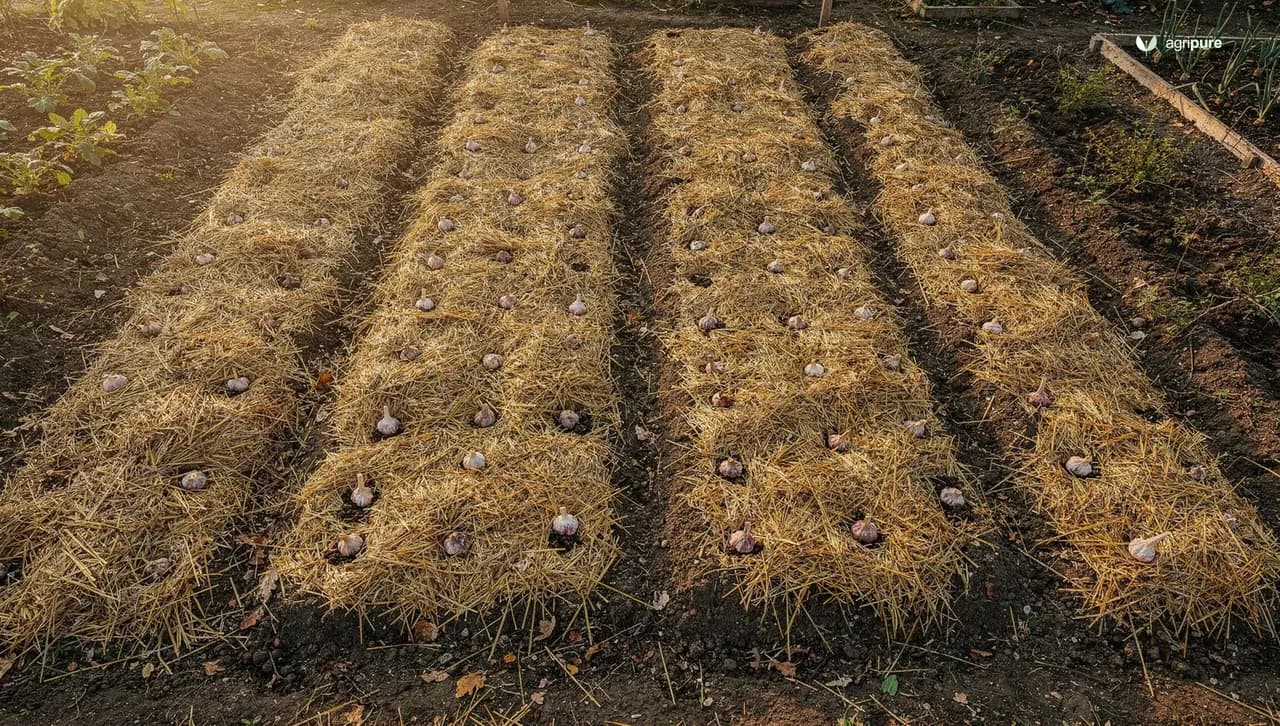
Immediately after planting, spread three to four inches of straw or shredded-leaf mulch across the bed. The mulch moderates soil temperature through winter freeze-thaw cycles, prevents frost heaving of the cloves, and suppresses the early spring weed flush that competes with emerging garlic.
Spring and summer care: watering, feeding, and scapes
Garlic plants growing vigorously in spring in raised garden rows, showing the curled green scape emerging from the centre of the plant
Hardneck garlic sends up a scape — the curling flower stalk — in late spring. Harvest it early and redirect the plant’s energy into bulb growth.
Garlic breaks dormancy in early spring, often before the last frost date, and the push from mid-April to late June is when the bulb does most of its growing. The plant’s needs shift in three phases.
Phase 1 — root establishment (fall through early spring): The mulched bed needs no water from rain-free periods; winter precipitation usually covers it. Do not fertilize through winter.
Phase 2 — spring flush (emergence through late May): Once shoots emerge, begin watering to maintain approximately one inch per week total, subtracting rainfall. Apply a nitrogen top-dressing — blood meal, feather meal, or a balanced granular fertilizer — at emergence, then again two to three weeks later at half the first rate. University of Minnesota Extension warns against applying nitrogen after the first week of May in northern gardens: late nitrogen keeps the plant in vegetative mode and delays the hormonal signal that triggers bulbing.
Phase 3 — bulbing (June): Stop watering two to four weeks before expected harvest. Dry conditions in the final weeks allow the outer wrapper leaves to dry and tighten around the bulb, which is what protects it during curing and storage. Continuing to irrigate through June produces bulbs with wet, loose wrappers that rot faster.
Scapes are the curling flower stalks that hardneck types send up in late May or early June. They are edible — use them anywhere you would use a mild green onion — and removing them early matters for yield. University of Maine Cooperative Extension research found that delaying scape removal until the stalk had fully curled reduced bulb size by up to 9% compared with removing it as soon as the curl appeared. Cut the scape at its base as soon as you see the first loop forming.
Keep the bed weed-free, particularly in May and June when the competition for nutrients and water directly reduces bulb size. The straw mulch handles most of this, but hand-pull anything that pushes through.
Common pests and diseases
Garlic is not pest-heavy by vegetable standards, but a handful of problems are worth knowing before they arrive.
Onion thrips are the most common insect pest — tiny, pale insects that rasp the leaf surface and leave a characteristic silvery stippling. Heavy thrips pressure in a dry spring can reduce yields by 20–30%. Overhead irrigation washes thrips off plants; insecticidal soap or spinosad handles severe infestations. Keep volunteer onion-family plants out of the bed, as they harbor thrips over winter.
Onion maggot larvae tunnel into roots and bulbs, particularly in cool, wet springs. The adult fly resembles a small housefly and lays eggs at the soil surface near host plants. Row cover placed immediately after planting and removed in spring is the most reliable barrier. Crop rotation — Rutgers Extension and OSU Extension both recommend a minimum three-year rotation away from any Allium family crop — breaks the soil-dwelling larva cycle.
White rot (Stromatinia cepivora) is the most damaging soilborne disease. It produces a fluffy white mycelium at the bulb base and small black sclerotia that persist in soil for up to 20 years. There is no cure once established; the only management is prevention through rotation, clean seed stock, and avoiding infected transplants. If you see it in one part of the bed, do not compost the affected plants — bag and bin them.
Basal rot and pink rot are fungal diseases favored by warm, wet soils in late spring. Both cause the root plate to soften and the wrapper leaves to discolor. Well-drained soil and avoiding late-season irrigation significantly reduce their incidence.
The good news: a healthy stand of garlic with adequate drainage, proper rotation, and certified or trusted seed stock rarely encounters serious disease pressure. Most garlic problems trace back to poorly drained soil or planting cloves from a diseased parent bulb.
Container and small-space growing
Garlic adapts well to containers, making it viable for apartment balconies, rooftop gardens, and tiny plots where row crops are not practical. The minimum container depth is 8 inches — garlic roots extend 12 inches or more when conditions allow, so deeper is better. A 12-inch-deep half-barrel or large fabric pot works well; standard 6-inch nursery pots are too shallow.
Use a well-draining potting mix rather than garden soil, which compacts in containers and impedes drainage. Plant cloves at the same depth and spacing as in the ground — six inches apart — which means a 12-inch-diameter pot holds roughly four cloves comfortably. Place the container where it receives at least six hours of direct sun.
Container garlic dries out faster than in-ground beds, particularly in spring when the plants are actively growing, so check soil moisture every two to three days and irrigate before the top 2 inches dry completely. Feed every two to three weeks with a half-strength liquid nitrogen fertilizer from emergence through the end of May, then stop to allow bulbing. Stop watering three to four weeks before expected harvest.
Yield per plant is usually slightly smaller in containers than in the ground, but the quality is comparable. Hardneck varieties are the better container choice because their fewer, larger cloves are easier to manage in limited space than a densely layered softneck. This approach also integrates well with the kitchen herb garden concept — a pot of hardneck garlic alongside chives, thyme, and flat-leaf parsley covers the allium and herb bases in minimal footprint.
Harvesting garlic: reading the signals
Harvest timing is the most common point of failure for new garlic growers. Pull too early and the bulbs are small with underdeveloped wrappers; pull too late and the wrappers split and the individual cloves separate, making the bulbs impossible to store for more than a few weeks.
The reliable indicator is leaf count. University of Minnesota Extension states the rule clearly: harvest when the lower leaves have turned brown and roughly half or slightly more than half of the upper leaves remain green. University of Maine Cooperative Extension sharpens it further: when the lower three leaves have turned brown, you have about two weeks to harvest. Each leaf on the plant corresponds to one wrapper layer on the bulb — three to four green leaves remaining means three to four intact wrapper layers, which is what you need for good storage.
Timing in practice: in most of the northern United States (zones 4–6), hardneck garlic is ready from late June to mid-July; softneck and southern-grown garlic may be ready from mid-June onward.
To harvest, use a digging fork or flat spade rather than pulling by the tops. Insert the fork 4–6 inches away from the plant and lever upward; pulling straight on the stalk can separate the neck from the bulb, which shortens storage life sharply. Shake loose soil gently from the roots — do not wash the bulbs, as wet bulbs are far more susceptible to fungal disease during curing.
Freshly harvested garlic bulbs laid out on a wooden drying rack in a shaded outdoor barn, with their roots and stalks still attached, curing in warm dry air
Garlic cures best in a shaded, well-ventilated space — a barn, covered porch, or shed — for three to six weeks before the tops and roots are trimmed.
Curing and storing your harvest
Curing is not optional. Freshly pulled garlic has a water content in the wrappers and neck that will rot the bulb within weeks if not dried down. Curing drives off that moisture, tightens the outer layers into the papery shell that protects the cloves, and converts some of the raw starch to the sugars and sulfur compounds that develop full garlic flavor.
Hang bulbs in loose bunches of eight to ten, or lay them in a single layer on a slatted rack or screen. The location should be shaded — direct sun bleaches the wrappers and can cook the outer cloves — but warm and dry, with active air movement. A barn, covered porch, shed, or garage with the door open all work well. Avoid enclosed, humid spaces; without airflow, the moisture trapped in the necks encourages mold.
Rutgers Extension recommends curing for four to six weeks. OSU Extension specifies a shady, dry, well-ventilated location for the same period. The bulbs are fully cured when the outer wrappers are completely papery and crackle when touched, the neck above the bulb is dry and tight (not soft or green), and the roots are desiccated. At that point, trim the roots to about half an inch and cut the stalks two to three inches above the bulb — or, for softneck varieties, braid the stalks before they dry completely.
Storage conditions differ by type:
- Hardneck garlic: stores best at 32–40°F with 65–70% relative humidity (Rutgers NJAES). A cool basement, root cellar, or unheated pantry in winter. Expect three to four months of viable storage.
- Softneck garlic: University of Maine Cooperative Extension recommends approximately 60°F with 50% relative humidity — a cool, dry room rather than refrigerator temperature. Expect six to eight months.
In both cases: use a mesh bag, paper bag, or open basket that allows airflow. Never use a sealed plastic bag or airtight container — trapped moisture accelerates rot within days. Never refrigerate garlic you plan to use for cooking; the cold-and-then-room-temperature cycle triggers sprouting rapidly. Reserve refrigerator storage only for peeled cloves submerged in oil (which then must be used within two weeks for food safety).
Save your best, largest bulbs for replanting in fall. Each saved bulb replanted as individual cloves regenerates your supply — and after two or three seasons of selecting the biggest bulbs, your seed stock adapts progressively to your specific soil and microclimate.
Frequently asked questions
Can I grow garlic from a clove bought at the grocery store?
Technically yes, but the results are often disappointing. Commercial garlic is frequently a softneck variety selected for shelf life rather than flavor, is often treated to inhibit sprouting, and may carry viruses that reduce yield. Buying certified seed garlic from a reputable nursery or regional farm gives you disease-free stock, named varieties matched to your climate, and cloves selected for replanting size.
When should I plant garlic in spring?
Spring planting is possible but produces consistently smaller bulbs than fall planting. Garlic needs a vernalization period — several weeks of cold — to trigger bulb formation. Without it, the plant stays in vegetative mode and produces a single, dense “round” rather than a segmented bulb. If you missed fall planting, plant as early as the soil can be worked in spring and accept a reduced harvest. Fall planting in October is the reliable path to full-sized bulbs.
What are garlic scapes and should I eat them?
Scapes are the curling flower stalks that hardneck garlic sends up in late spring or early June. They taste like a mild, slightly garlicky green onion and are excellent sautéed, grilled, puréed into scape pesto, or used raw in salads. Remove them as soon as the scape completes its first curl — waiting until it straightens or fully curls a second time reduces bulb size measurably.
Why are my garlic bulbs small?
Small bulbs usually trace to one of four causes: planting small cloves (size of input correlates strongly with size of output), planting too late in fall so the plant lacks root mass to overwinter, leaving scapes on too long in hardneck types, or continuing irrigation through June when the plant should be drying down. Nitrogen applied too late in spring — past early May in northern gardens — also delays bulbing. Address each factor the following season and bulb size typically improves significantly.
References
- Growing garlic in home gardens — University of Minnesota Extension
- Growing Garlic in the Home Garden (FS1233) — Rutgers University NJAES Cooperative Extension
- How to Grow Garlic in Your Garden — Utah State University Extension
- Bulletin #2063, Growing Garlic in Maine — University of Maine Cooperative Extension
- Growing Garlic in the Garden — Ohio State University Extension (CFAES)
- How to grow garlic — University of Illinois Extension