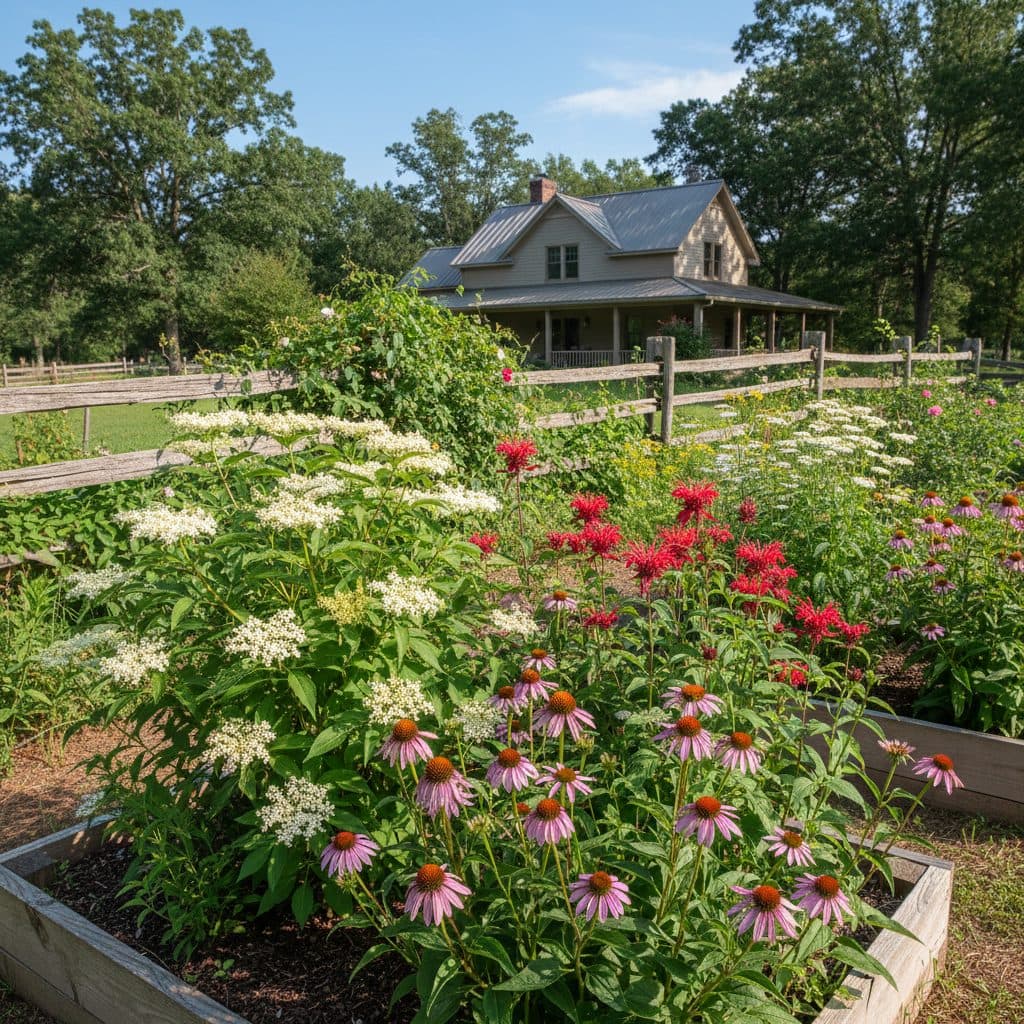
Key takeaways
- Cultivating US-native medicinal plants like Echinacea, Elderberry, Monarda, and Yarrow supports local ecosystems and provides accessible herbal remedies.
- These resilient species thrive in their native USDA zones, often requiring less water and fewer inputs than non-native alternatives.
- Echinacea purpurea, or Purple Coneflower, is an immune-supporting herb, with roots harvested from two to three-year-old plants in the fall.
- American Elderberry (Sambucus canadensis) offers nutrient-rich berries for syrups and teas, growing up to 12 feet tall in full to partial sun.
- Wild Bergamot (Monarda fistulosa) is a versatile perennial, providing antiseptic and digestive benefits while attracting pollinators to your garden.
- Yarrow (Achillea millefolium) is a hardy, widespread native known for its traditional use in wound care and fever reduction, thriving in diverse conditions.
Quick answer: Growing US-native medicinal plants supports local ecosystems by boosting biodiversity and provides accessible, resilient herbal remedies for a home apothecary. These species often require less water and fewer inputs than non-native alternatives, thriving in their native USDA zones.
Across the United States, from the humid southeast to the arid west, more gardeners are growing native medicinal plants. These resilient species often thrive with minimal intervention and offer a practical path to a home apothecary rooted in traditional knowledge [4]. Cultivating them gives access to their beneficial properties, supports local biodiversity, and protects the genetic integrity of these plants [2].
In states like Pennsylvania and Ohio, where Purple Coneflower (Echinacea purpurea) is native, home growers can easily establish a medicinal herb garden that requires less water and fewer inputs than non-native alternatives. This approach helps conserve at-risk species and supports self-sufficiency in herbal remedies [2]. Many of these plants are simple to grow, making them excellent choices for gardeners in USDA zones 3 to 9 looking to start or expand their herbal practice.
Echinacea purpurea: the purple coneflower
Echinacea purpurea, commonly known as Purple Coneflower, is a quintessential American native, thriving across a broad swath of the central and eastern United States, specifically in USDA zones 3 to 9 [6]. This hardy perennial is celebrated for its immune-supporting properties, with traditional uses dating back centuries among various indigenous cultures [4]. Establishing a patch of Echinacea is straightforward; it prefers full sun exposure, meaning at least six hours of direct sunlight daily, and well-drained soil. In its native range, it can reach heights of 3 to 4 feet, and produces purple-pink flowers from early summer into fall that draw many pollinators.
Cultivating and harvesting Echinacea
To successfully grow Echinacea, consider starting from seed indoors about eight weeks before the last frost, or directly sowing seeds in late fall for spring germination. Once established, these plants are remarkably drought-tolerant, requiring supplemental watering only during extended dry periods, typically less than one inch per week. The roots, leaves, and flowers all contain beneficial compounds, but the roots are generally considered the most potent part for medicinal preparations, with peak potency often observed in plants that are at least two to three years old. Harvesting roots is best done in the fall after the plant has gone dormant, usually when soil temperatures drop below 50°F. For optimal growth, ensure proper soil moisture, which can be monitored with a 3-in-1 Soil pH, Moisture & Light Meter, especially during the first 30 days after planting [1].
- Plant seeds 1/4 inch deep in well-drained soil.
- Space plants 12 to 18 inches apart for optimal growth.
- Ensure at least 6 hours of direct sunlight daily.
- Harvest roots from mature plants (2-3 years old) in late fall.
- Expect flowers from June to September in most regions.
Sambucus canadensis: American elderberry
American Elderberry (Sambucus canadensis) is a versatile deciduous shrub native to a wide range of the eastern and central United States, thriving in USDA zones 3 to 9 [6]. This plant is highly valued for its dark purple berries, which are rich in antioxidants and traditionally used to support immune health, especially during cold and flu season. Elderberry shrubs can grow quite large, reaching up to 12 feet tall and wide, forming dense thickets if left unpruned. They prefer full sun to partial shade and moist, well-drained soil, often found along stream banks or forest edges in their natural habitat.
Growing and processing elderberries
To establish elderberry, plant bare-root stock or cuttings in early spring, spacing them 6 to 10 feet apart to allow for mature growth. These plants are relatively low-maintenance once established, requiring consistent moisture, particularly during fruit development. The white, fragrant flowers appear in late spring to early summer, followed by clusters of berries that ripen from late summer into early fall, typically between August and September. Raw elderberries contain compounds that can cause digestive upset, so they must be cooked before consumption. The flowers can also be used for teas and infusions. Consider starting your herb garden with a variety of native plants like elderberry to maximize your apothecary’s diversity.
- Plant elderberry in full sun to partial shade.
- Space plants 6 to 10 feet apart for mature growth.
- Ensure consistent soil moisture, especially during fruiting.
- Harvest berries when dark purple, typically August to September.
- Always cook elderberries before consumption to neutralize harmful compounds.
Monarda fistulosa: wild bergamot
Wild Bergamot (Monarda fistulosa), also known as Bee Balm, is a delightful perennial herb native to nearly all of North America, flourishing in USDA zones 3 to 9 [6]. This aromatic plant is a magnet for pollinators, including bees and butterflies, thanks to its striking lavender-pink, tubular flowers that bloom from mid-summer to early fall. Beyond its aesthetic appeal and ecological benefits, Wild Bergamot has a long history of traditional medicinal use, particularly for its antiseptic and digestive properties [4]. It typically grows 2 to 5 feet tall and spreads readily, forming attractive clumps in a garden setting.
Medicinal uses and garden care for Monarda
Monarda fistulosa prefers full sun to partial shade and well-drained to moderately moist soil. It is remarkably adaptable, tolerating a range of soil types, including clay, as long as drainage is adequate. The leaves and flowers can be harvested throughout the growing season for making teas, tinctures, or poultices. Traditionally, it was used for respiratory ailments, fevers, and skin conditions. To encourage bushier growth and more blooms, consider pinching back the stems in late spring when they are about 6 to 8 inches tall. This plant is also relatively deer-resistant, making it a practical choice for gardens in areas with wildlife pressure. A soil moisture meter can help ensure the plant receives adequate, but not excessive, water.
- Plant in full sun to partial shade for optimal flowering.
- Space plants 18 to 24 inches apart to allow for spread.
- Harvest leaves and flowers throughout summer for medicinal use.
- Pinch back stems in late spring for bushier growth.
- Expect blooms from July through September in most northern regions.
Achillea millefolium: yarrow
Yarrow (Achillea millefolium) is an incredibly hardy and widespread perennial herb, native to much of North America, thriving across USDA zones 3 to 9 [6]. Its finely dissected, fern-like leaves and flat-topped clusters of white or sometimes pink flowers make it easily recognizable. Historically, Yarrow has been revered for its wound-healing and fever-reducing properties, with its scientific name, Achillea, referencing Achilles, who supposedly used it to treat his soldiers’ wounds [4]. This plant is exceptionally resilient, tolerating a wide range of soil conditions, from sandy to clay, and is highly drought-tolerant once established.
Growing and utilizing yarrow in your home apothecary
Yarrow is one of the easiest medicinal plants to grow, often requiring minimal care. It prefers full sun, at least six hours daily, and well-drained soil, but it can adapt to less ideal conditions. It typically grows 1 to 3 feet tall and spreads vigorously through rhizomes, so consider planting it where it has room to expand or in a contained bed. The leaves and flowers can be harvested throughout the blooming season, from late spring to fall, and used fresh or dried for teas, poultices, or salves. For a thriving herb garden, yarrow offers a low-maintenance option that provides consistent medicinal value. To prevent it from becoming overly aggressive, divide clumps every three to four years in early spring or fall.
- Plant in full sun (at least 6 hours daily) for best results.
- Ensure well-drained soil, though it tolerates many types.
- Harvest leaves and flowers from late spring to fall.
- Divide plants every 3-4 years to manage spread.
- Expect mature plants to reach 1 to 3 feet in height.
Comparison of Easy US-Native Medicinal Plants
Plant Name | USDA Zones | Sunlight Needs | Mature Height | Primary Medicinal Use |
|---|---|---|---|---|
Echinacea purpurea (Purple Coneflower) | 3-9 | Full Sun (6+ hours) | 3-4 feet | Immune Support |
Sambucus canadensis (American Elderberry) | 3-9 | Full Sun to Partial Shade | 6-12 feet | Immune Support (Berries) |
Monarda fistulosa (Wild Bergamot) | 3-9 | Full Sun to Partial Shade | 2-5 feet | Antiseptic, Digestive Aid |
Achillea millefolium (Yarrow) | 3-9 | Full Sun (6+ hours) | 1-3 feet | Wound Healing, Fever Reduction |
Echinacea Root Potency: Echinacea roots reach peak medicinal potency when harvested from plants that are at least two to three years old, typically in the fall when soil temperatures drop below 50°F.
Elderberry Growth: American Elderberry shrubs can grow up to 12 feet tall and wide, providing abundant berries for harvest from late summer into early fall, usually between August and September.
Frequently asked questions
What USDA zones are suitable for these native medicinal plants?
The US-native medicinal plants discussed—Echinacea, American Elderberry, Wild Bergamot, and Yarrow—are all hardy perennials that thrive across a broad range of USDA zones, typically from zone 3 to zone 9. This wide adaptability makes them suitable for cultivation in many regions of the United States.
How much sunlight do these plants need to grow well?
Most of these native medicinal plants, including Echinacea and Yarrow, prefer full sun, meaning at least six hours of direct sunlight daily for optimal growth and flowering. American Elderberry and Wild Bergamot can tolerate partial shade, but generally produce more flowers and fruits with more sun exposure.
Can I grow these plants from seed, and when should I start?
Yes, all these plants can be grown from seed. For Echinacea, starting seeds indoors about eight weeks before the last frost is recommended. For Elderberry, starting from cuttings or bare-root stock in early spring is often more common, while Wild Bergamot and Yarrow seeds can be sown directly in the fall or stratified and sown in spring.
Are there any specific soil requirements for these native herbs?
While adaptable, these native herbs generally prefer well-drained soil. Yarrow and Echinacea are particularly tolerant of various soil types, including poorer soils, as long as drainage is good. Elderberry and Wild Bergamot appreciate moderately moist soil, especially during dry periods, but still require good drainage to prevent root rot.
How long does it take for these plants to become medicinally potent?
The time to medicinal potency varies by plant and part used. For Echinacea, the roots are typically harvested from plants that are at least two to three years old for peak potency. Elderberry berries are harvested in their first or second year, while the leaves and flowers of Wild Bergamot and Yarrow can be harvested throughout their first growing season and subsequent years.
References
- Chapter 1 Growing Australian Native Plants (2013). Chapter 1 Growing Australian Native Plants.
- BOOK REVIEW:<b>Richo Cech, illustrated by Sena Cech</b>GROWING AT-RISK MEDICINAL HERBS: CULTIVATION, CONSERVATION, AND ECOLOGY. (2005). BOOK REVIEW:<b>Richo Cech, illustrated by Sena Cech</b>GROWING AT-RISK MEDICINAL HERBS: CULTIVATION, CONSERVATION, AND ECOLOGY..
- CHAPTER 2 GROWING NATIVE PLANTS (1993). CHAPTER 2 GROWING NATIVE PLANTS.
- MEDICINAL PLANTS IN NATIVE CULTURES (2005). MEDICINAL PLANTS IN NATIVE CULTURES.
- Some customary edible plants of incredible medicinal worth (2019). Some customary edible plants of incredible medicinal worth.
- USDA Natural Resources Conservation Service (2024). USDA Natural Resources Conservation Service.