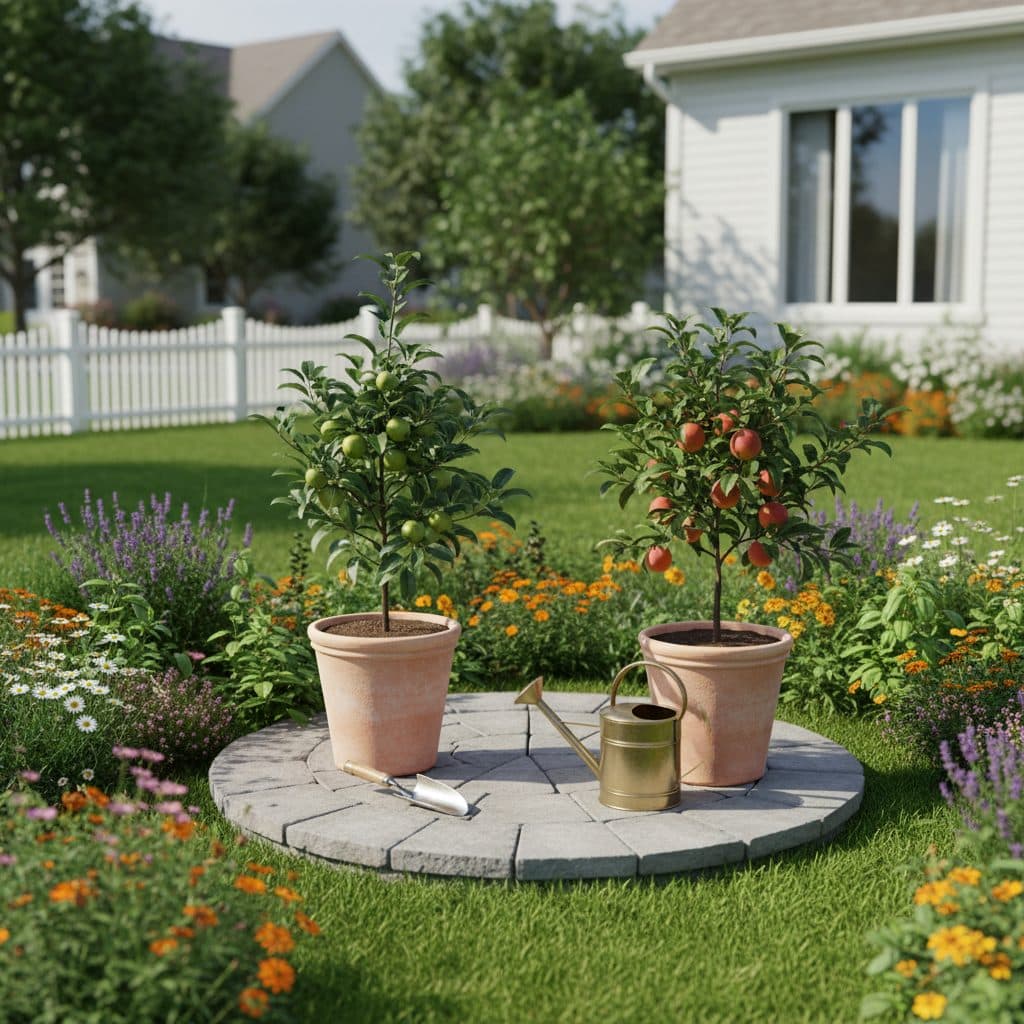
Key takeaways
- Dwarf fruit trees, often grown on specific rootstocks, remain under 10 feet tall, while columnar varieties grow vertically, typically 8-12 feet tall and 2-3 feet wide.
- Selecting varieties suited to your USDA hardiness zone and meeting chill hour requirements, typically between 400 and 1,000 hours below 45°F, matters for fruit production.
- Container-grown dwarf trees require pots at least 15-25 gallons in volume, well-draining soil, and consistent moisture monitoring, especially in warmer regions like USDA zone 8.
- Proper pruning, including central leader or modified central leader systems for dwarf trees and minimal pruning for columnar types, is essential for maintaining size and promoting fruit set.
- Regular fertilization, pest monitoring, and winter protection for container plants in zones colder than their hardiness rating can ensure healthy growth and consistent yields of 10-20 pounds per tree.
- Many dwarf apple, pear, cherry, and peach varieties are available, offering fresh fruit even in compact urban gardens or on small patios across the United States.
Quick answer: Dwarf and columnar fruit trees are compact varieties ideal for small spaces. Choose trees suited to your USDA hardiness zone and chill hour needs to ensure proper container size and pruning for successful fruit production.
For many growers across the United States, from a small urban balcony in Seattle, Washington, to a modest backyard in Orlando, Florida, the dream of fresh, home-grown fruit often seems out of reach due to limited space. However, dwarf and columnar fruit trees offer a practical solution, allowing you to cultivate a productive mini-orchard even on a patio or in a narrow garden bed. These specialized trees are bred or grafted to remain significantly smaller than their standard counterparts. This makes them ideal for containers or tight planting areas..
The concept of managing fruit tree size for specific growing conditions is not new; growers have been developing and utilizing dwarf rootstocks for centuries. For example, by 1906, nurseries were already cataloging various dwarf fruit trees, recognizing their utility for smaller properties and specialized cultivation techniques [2]. Today, with advancements in horticulture, a wider range of dwarf and columnar varieties is available, offering fruit production in spaces as small as 40 square feet.
Understanding dwarf and columnar fruit trees
Dwarf and columnar fruit trees are distinct forms that address space limitations, but they achieve their compact size through different horticultural methods. Dwarf fruit trees are typically created by grafting a desired fruit variety onto a specific rootstock that restricts its growth. These rootstocks, like the ‘Malling’ series for apples, can reduce a tree’s mature size to 8-10 feet tall and wide, compared to a standard tree that might reach 20-30 feet [1]. This size reduction is a real benefit for home growers in areas like California’s Central Valley, where backyard space is often at a premium.
The role of rootstock in tree size
The rootstock determines the ultimate size, vigor, and often the disease resistance of the grafted tree. For instance, an apple tree grafted onto an M27 rootstock might only grow to 6 feet tall, while the same apple variety on an M7 rootstock could reach 12-15 feet. Columnar fruit trees, on the other hand, are genetically predisposed to grow vertically with very short side branches, resembling a narrow column. These trees, often called ‘ballerina’ apples, typically mature to 8-12 feet tall but only 2-3 feet wide, making them perfect for planting along a fence or in a tight corner in a USDA zone 6 garden. Both types offer significant advantages for growers with limited square footage, allowing for yields of 10-20 pounds of fruit per tree in a small footprint.
- Dwarf trees: Achieved through grafting onto dwarfing rootstocks.
- Columnar trees: Genetically programmed for narrow, upright growth.
- Mature height: Dwarf trees typically 8-10 feet; columnar trees 8-12 feet.
- Mature width: Dwarf trees 8-10 feet; columnar trees 2-3 feet.
- Space saving: Ideal for patios, balconies, and small garden beds.
Selecting the right varieties for your climate
Choosing the correct dwarf or columnar fruit tree for your specific location matters most for success. The first consideration is your USDA hardiness zone, which indicates the average annual extreme minimum winter temperature. For instance, a ‘Honeycrisp’ apple on a dwarfing rootstock is hardy in USDA zones 3-8, making it suitable for much of the northern and central United States. Planting a tree outside its recommended zone, such as a zone 9 peach in zone 5, will likely result in winter damage or death.
Chill hour requirements and pollination
Beyond hardiness, fruit trees require a certain number of chill hours (hours below 45°F/7°C but above 32°F/0°C) to break dormancy and set fruit. Many apple varieties need 800-1,000 chill hours, while some peach varieties might need only 400-600 hours, making them better suited for warmer climates like USDA zone 8 or 9. Always check the specific chill hour requirement for your chosen variety against your region’s average. Also, most fruit trees require cross-pollination from another compatible variety to produce fruit. For example, two different apple varieties planted within 50 feet of each other will usually give good fruit set, provided their bloom periods overlap and neither is a triploid that produces sterile pollen. Some varieties, like ‘Stella’ cherry, are self-fertile, meaning a single tree can produce fruit, which is a significant advantage for a small patio garden in a region like the Pacific Northwest, where space is often limited. You can find more details on suitable varieties for colder climates in our guide to Best Cold-Hardy Fruit and Nut Trees for USDA Zones 4-6.
- USDA hardiness zone: Match tree hardiness to your local zone (e.g., zone 5-9).
- Chill hours: Ensure your climate meets the variety’s specific chill hour needs (e.g., 400-1,000 hours).
- Pollination: Choose self-fertile varieties or plant two compatible varieties.
- Disease resistance: Select varieties known for resistance to common local diseases.
- Sunlight: Ensure at least 6-8 hours of direct sunlight daily.
Planting and initial care for container-grown trees
When planting dwarf or columnar fruit trees in containers, the choice of pot size and growing medium is critical. A minimum container size of 15-25 gallons is recommended for most dwarf fruit trees to allow for adequate root development and moisture retention. For columnar trees, a 10-15 gallon pot may suffice initially, but they will likely need larger containers as they mature. In regions like USDA zone 7, where summers can be hot, larger pots help prevent the soil from drying out too quickly. Ensure your chosen container has ample drainage holes—at least three 1-inch holes are a good starting point.
Soil, watering, and sunlight
Use a high-quality potting mix that drains well but also retains moisture. A blend of compost, perlite, and peat moss or coco coir often works well, providing a slightly acidic to neutral pH (6.0-7.0). Avoid heavy garden soil, which can compact and suffocate roots in a container. After planting, water thoroughly until water drains from the bottom of the pot. Consistent watering is essential, especially during dry spells and fruit development. A soil moisture meter can be a useful tool, helping you maintain optimal moisture levels without overwatering, which can lead to root rot. Place your containerized tree in a location that receives at least 6-8 hours of direct sunlight daily. In hotter climates, like parts of Arizona (USDA zone 9), some afternoon shade might be beneficial to prevent scorching, especially for young trees.
- Container size: Use 15-25 gallon pots for dwarf trees, 10-15 gallons for columnar.
- Drainage: Ensure pots have multiple 1-inch drainage holes.
- Potting mix: Use a well-draining, moisture-retentive mix (e.g., compost, perlite, coco coir).
- Watering: Water regularly, checking soil moisture with a meter to prevent over or under-watering.
- Sunlight: Provide 6-8 hours of direct sun; consider afternoon shade in hot climates.
Pruning and ongoing maintenance for compact fruit trees
Pruning is a fundamental aspect of maintaining dwarf and columnar fruit trees, influencing their shape, size, and fruit production. For dwarf trees, common pruning styles include the central leader system or a modified central leader, aiming for a balanced structure with good air circulation. Initial pruning often involves removing any branches below 18-24 inches from the ground and selecting 3-5 strong scaffold branches. Regular annual pruning, typically performed in late winter or early spring before bud break, helps remove dead, diseased, or crossing branches, and encourages new fruiting wood [1]. For columnar trees, pruning is minimal; focus on removing any side branches longer than 6-12 inches to maintain their narrow form. You can learn more about general pruning techniques at How to prune fruit trees: by season, by species, and by tree age.
Feeding, pest management, and winter protection
Fertilize your containerized trees annually with a balanced, slow-release fertilizer, or apply a liquid feed every 4-6 weeks during the growing season. Follow the container rate printed on the fertilizer label rather than a garden-bed rate; confined roots are easily burned by a heavy dose of quick-release granules. Monitor for pests and diseases regularly. A small irrigation system can help deliver water efficiently, reducing fungal issues from overhead watering. If you notice issues, consult your local extension office; for example, the University of California Cooperative Extension provides excellent regional advice for growers in USDA zone 9. In colder USDA zones (e.g., zone 5 or 6), container-grown trees need winter protection. Move pots to an unheated garage or shed, or wrap them in burlap and insulation. Even trees hardy to zone 5 can suffer root damage in a container if temperatures drop below 20°F for extended periods, as container roots are more exposed than those in the ground.
- Pruning dwarf trees: Use central leader or modified central leader systems.
- Pruning columnar trees: Remove side branches longer than 6-12 inches.
- Fertilization: Apply balanced fertilizer annually or liquid feed every 4-6 weeks.
- Pest & disease: Monitor regularly; use appropriate, targeted treatments.
- Winter protection: Move containers indoors or insulate in zones colder than the tree’s hardiness.
Harvesting and enjoying your compact orchard
The reward for your careful planning and consistent care is, of course, the fruit itself. Dwarf and columnar trees can be surprisingly productive, often yielding 10-20 pounds of fruit per tree once mature. The exact harvest time will vary significantly by fruit type and variety, as well as your specific climate. For instance, early apple varieties in USDA zone 6 might ripen in late August, while later varieties could extend into October. Pears often ripen off the tree, requiring careful timing to pick them when they are mature but still firm, then allowing them to soften indoors at room temperature for 5-10 days.
Succession planting and long-term yields
To ensure a continuous supply of fresh fruit, consider succession planting—choosing varieties that ripen at different times throughout the growing season. For example, planting an early-season dwarf peach, a mid-season dwarf plum, and a late-season dwarf apple can provide fresh fruit from June through October in many temperate regions. With proper care, dwarf fruit trees can remain productive for 15-20 years, while columnar types are generally replaced sooner. Regular soil testing every 2-3 years can help you adjust nutrient levels and maintain optimal growing conditions for sustained yields. Enjoy the satisfaction of picking fresh, ripe fruit right from your patio, knowing you’ve maximized your small space.
- Yields: Expect 10-20 pounds of fruit per mature dwarf tree.
- Harvest timing: Varies by fruit type, variety, and local climate.
- Ripeness indicators: Color, firmness, ease of detachment from the branch.
- Succession planting: Choose varieties with staggered ripening times for continuous harvest.
- Lifespan: Dwarf trees typically productive for 15-20 years; columnar for 10-15 years.
Comparison of Dwarf and Columnar Fruit Tree Characteristics
Characteristic | Dwarf Fruit Tree | Columnar Fruit Tree |
|---|---|---|
Mature Height | 8-10 feet | 8-12 feet |
Mature Width | 8-10 feet | 2-3 feet |
Primary Method of Compactness | Dwarfing rootstock | Genetic trait |
Space Requirement (approx.) | 64-100 sq ft | 16-36 sq ft |
Pruning Needs | Moderate (shaping, thinning) | Minimal (remove long side shoots) |
Container Size (Min.) | 15-25 gallons | 10-15 gallons |
Historical Context: By 1906, nurseries were already offering dwarf fruit trees, part of a long history of compact fruit cultivation for home growers [2].
Space Efficiency: A columnar apple occupies a footprint only 2-3 feet wide, so it fits where a spreading dwarf tree cannot.
Pruning Benefits: Annual pruning keeps dwarf trees structurally sound and productive by removing dead and crossing wood and letting light into the canopy.
Frequently asked questions
What is the main difference between dwarf and columnar fruit trees?
Dwarf fruit trees achieve their small size through specific dwarfing rootstocks, typically growing 8-10 feet tall and wide. Columnar trees are genetically bred for a narrow, upright growth habit, reaching 8-12 feet tall but only 2-3 feet wide, making them very space-efficient for small areas like a 4×4 foot patio.
How much fruit can I expect from a dwarf tree?
A mature dwarf fruit tree, with proper care and pollination, can typically produce 10-20 pounds of fruit per season. This yield can vary based on the specific variety, growing conditions, and the tree’s age, with some trees providing consistent harvests for 15-20 years.
Do dwarf fruit trees need special soil or fertilizer?
For container-grown dwarf trees, a high-quality, well-draining potting mix is essential, differing from garden soil. They benefit from annual fertilization with a balanced, slow-release granular fertilizer, or a liquid feed every 4-6 weeks during the growing season, to support their fruit production in a confined root space.
Can I grow dwarf fruit trees in cold climates?
Yes, many dwarf fruit tree varieties are cold-hardy, suitable for USDA zones 3-8. However, container-grown trees in zones colder than their hardiness rating (e.g., a zone 5 tree in a zone 4 container) will need winter protection, such as moving them to an unheated garage or insulating the pot, to prevent root damage below 20°F.
How often should I prune my dwarf or columnar fruit tree?
Dwarf fruit trees generally require annual pruning in late winter or early spring to maintain shape, promote air circulation, and encourage fruit production, often removing 20-30% of the previous year’s growth. Columnar trees need less frequent pruning, mainly to snip back any side branches exceeding 6-12 inches in length to preserve their narrow form.
References
- Pruning Dwarf Fruit and Nut Trees (2018). Pruning Dwarf Fruit and Nut Trees.
- Dwarf fruit trees; (1906). Dwarf fruit trees;.
- Espalier Dwarf Fruit Trees (1941). Espalier Dwarf Fruit Trees.
- Tunnel Sprayer for Dwarf Fruit Trees (1994). Tunnel Sprayer for Dwarf Fruit Trees.