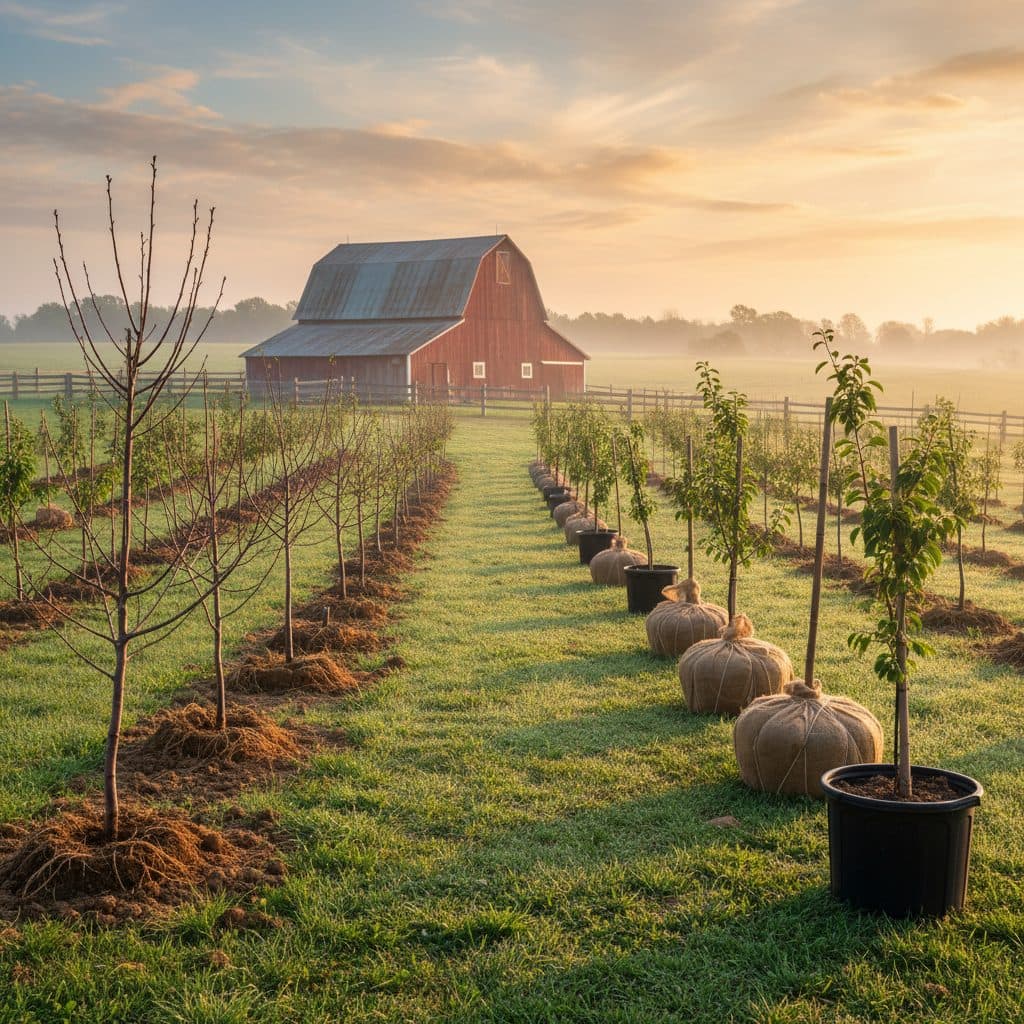
Key takeaways
- Bare-root trees offer the lowest cost and easiest transport, ideal for early spring planting in dormant state.
- Container-grown trees provide planting flexibility across seasons and a more established root system, but check for root circling.
- Balled-and-burlapped (B&B) trees are larger and more mature, offering immediate impact but come with higher cost and greater planting challenges.
- Root loss during transplanting is significant for B&B trees, with 90-95% of the root system often left behind in the nursery [1].
- Consider your budget, planting season, desired tree size, and local climate (USDA zone) when selecting a tree type.
- Proper planting techniques and consistent post-planting care, especially watering, matter most for a fruit tree’s success.
Quick answer: Choosing fruit trees involves selecting bare-root, container-grown, or balled-and-burlapped (B&B) types based on budget, planting season, desired size, and local USDA zone. Each type offers distinct advantages for establishment, with proper planting and care being essential for success.
In the vast landscapes of the United States, from the apple orchards of Washington State to the citrus groves of Florida, home growers face a fundamental decision when starting or expanding their fruit tree collection: how to buy the trees themselves. This choice isn’t just about species or cultivar; it’s about the form the tree takes when it arrives at your property. The three primary options are bare-root, container-grown, and balled-and-burlapped (B&B).
Each method presents distinct advantages and disadvantages in terms of cost, planting time, transplant success, and the immediate impact on your landscape. Understanding these differences can significantly influence the long-term health and productivity of your orchard, helping you avoid the common pitfall where up to 30% of newly planted trees fail to establish in their first year [6]. Let’s break down each type to help you make an informed decision for your specific growing conditions.
Bare-root fruit trees: economical and easy to plant
Bare-root fruit trees are exactly what they sound like: dormant trees dug from the nursery field with no soil around their roots. They are typically sold in late winter or early spring, before they break dormancy, making them ideal for planting across USDA zones 4 through 9 during this narrow window. These trees are usually one to two years old and are often the most cost-effective option, with prices sometimes 30-50% lower than their containerized counterparts. Their light weight and compact size also make them much easier and cheaper to ship across states, which is a significant advantage for growers in rural areas of places like Montana or North Dakota.
the advantages of bare-root planting
One of the main benefits of bare-root trees is their unrestricted root system at planting. When you receive a bare-root tree, you can inspect the roots for damage and spread them naturally in the planting hole, which promotes rapid establishment. Studies have shown that bare-root trees can establish more quickly than B&B trees in some contexts, as they suffer less root disturbance during the digging process compared to B&B trees [1]. For instance, in an Oklahoma study, bare-root trees showed better growth in the first year compared to B&B trees [2]. When planting, it’s often recommended to prune back the top growth by 25-50% to balance it with the reduced root system, a technique you can learn more about at How to prune fruit trees.
- Lower purchase cost, often 30-50% less than container trees.
- Easier to transport and ship due to lighter weight.
- Allows for thorough inspection and proper spreading of roots.
- Often establishes faster with less transplant shock if planted correctly.
- Wide variety of cultivars available from specialized nurseries.
Container-grown fruit trees: flexibility and established roots
Container-grown fruit trees are grown in pots, typically ranging from one to five gallons for young trees, and sometimes up to 15 gallons for more mature specimens. This method allows for a much broader planting window, as the tree’s roots are undisturbed when moved from the pot to the ground. In milder climates, such as USDA zones 8 and 9 in California or the Pacific Northwest, container trees can be planted almost year-round, as long as the ground isn’t frozen and extreme heat is avoided. This flexibility in planting time is a major advantage for many home growers who might miss the bare-root season.
understanding container tree benefits and drawbacks
When you buy a container tree, you’re getting a plant with an intact root ball, which reduces transplant shock and often leads to a quicker start in growth. However, inspect the roots before planting. Sometimes, roots can become root-bound or circled within the pot, which can lead to long-term girdling issues. If you find circling roots, gently tease them apart or make a few vertical cuts with a clean knife to encourage outward growth. After planting, monitoring soil moisture matters; a tool like a soil moisture meter can be invaluable to ensure consistent hydration, especially during the first growing season when 10-15 gallons of water per week might be needed for a young tree.
- Wider planting window, often spring through fall in many zones.
- Reduced transplant shock due to an intact root ball.
- Immediate visual impact in the landscape.
- Easier to handle than B&B trees, especially smaller sizes.
- Can be kept in pots for a period before final planting.
Balled-and-burlapped (B&B) fruit trees: mature trees with specific needs
Balled-and-burlapped, or B&B, trees are mature specimens dug from the nursery field with a large ball of soil around their roots, which is then wrapped in burlap and often secured with a wire basket. These trees are typically larger, with trunk calipers ranging from 1.5 to 4 inches, and can provide a more immediate landscape impact. They are often chosen for instant gratification in new orchards or for replacing a significant tree. However, their size and weight are substantial; a 3-inch caliper tree can have a root ball weighing over 300 pounds, requiring specialized equipment for transport and planting, especially in regions like the humid Southeast where soil can be heavy [4].
the challenges of b&b trees
Despite their established appearance, B&B trees experience significant root loss during the digging process. Research indicates that 90-95% of the tree’s root system can be left behind in the nursery field when a B&B tree is dug [1]. This severe root reduction can lead to transplant shock and a slower establishment period compared to bare-root trees. A study in Oklahoma found that B&B trees had lower survival rates and less growth in the first year than bare-root trees [2]. Furthermore, the burlap and wire basket, while designed to protect the root ball, must be properly handled during planting. While some biodegradable burlap can be left, it’s generally recommended to remove as much as possible, especially from the top and sides, to prevent root girdling and moisture wicking away from the root ball [3]. For larger trees to ensure adequate water delivery can be a challenge; a garden irrigation hose system can be beneficial.
- Higher cost, often 2-3 times more than bare-root or container trees.
- Significant root loss during digging, up to 95% of the root system [1].
- Heavy and difficult to transport and plant without machinery.
- Increased risk of transplant shock and slower establishment.
- Wire baskets and burlap can cause issues if not properly removed.
Making the right choice for your home orchard
The best choice among bare-root, container, and B&B fruit trees depends largely on your specific circumstances, including your budget, planting schedule, local climate, and desired tree size. For growers in colder regions, like USDA zones 4-6 in the Northeast or Midwest, bare-root trees planted in early spring are often the most practical and successful option for species like apples, pears, and cold-hardy plums. You can find more information on suitable varieties at Best Cold-Hardy Fruit and Nut Trees for USDA Zones 4-6. If you’re looking to plant a tree outside the bare-root season, or desire a slightly more mature plant with less immediate root work, a container-grown tree is a solid choice, especially in zones 7-9 where the planting window is longer.
factors to consider for long-term success
When selecting any fruit tree, consider the long-term implications. While B&B trees offer immediate size, their higher cost and increased risk of transplant shock mean they require more careful consideration and often a larger initial investment in labor and resources. Studies show that proper post-planting care, particularly consistent watering for the first one to two years, is more critical to success than the initial tree form [6]. For example, a young tree in its first year might need 10-15 gallons of water per week during dry periods. Regardless of the tree type to ensure good soil drainage and proper planting depth will give your fruit tree the best chance to thrive and produce fruit for many years to come.
- Budget: Bare-root trees are the most economical, B&B are the most expensive.
- Planting Season: Bare-root is dormant season only, container offers flexibility.
- Desired Size: B&B provides instant size, bare-root and container start smaller.
- Climate (USDA Zone): Influences planting window and species suitability.
- Labor/Equipment: B&B trees require significant effort and potentially machinery.
Comparison of Fruit Tree Types for Home Growers
Feature | Bare-Root | Container-Grown | Balled-and-Burlapped (B&B) |
|---|---|---|---|
Typical Cost | Lowest (e.g., $20-40) | Medium (e.g., $40-80) | Highest (e.g., $100-300+) |
Planting Season | Late winter to early spring (dormant) | Spring, summer, fall (non-frozen ground) | Spring or fall (cooler weather) |
Root System | Exposed, 100% visible | Intact, contained in soil ball | Large soil ball, 5-10% original roots [1] |
Transplant Shock | Low if planted dormant | Moderate, if roots not circling | High, due to significant root loss [1] |
Size at Purchase | Small (1-2 years old) | Small to medium (1-5 years old) | Medium to large (3-10+ years old) |
Ease of Transport | Very easy, light | Easy to moderate | Difficult, heavy (e.g., 300+ lbs for a 3-inch caliper tree) |
Establishment Rate | Often quicker if planted correctly [2] | Good, steady growth | Slower, more recovery needed [2] |
Root Loss: Balled-and-burlapped trees can lose 90-95% of their root system during digging, impacting initial establishment [1].
Survival Rate: In some urban landscapes, 30% of newly planted trees, regardless of type, fail to survive their first year [6].
Frequently asked questions
What is the best time to plant bare-root fruit trees?
The optimal time to plant bare-root fruit trees is in late winter to early spring, typically from February to April in most USDA zones, before the tree breaks dormancy. This allows the roots to establish before the demands of leaf-out and summer heat.
Can I plant container-grown fruit trees in summer?
Yes, container-grown fruit trees can be planted in summer, especially in USDA zones 7-9, but it requires diligent watering. Ensure the tree receives 10-15 gallons of water per week and consider mulching to retain soil moisture and regulate temperature.
How much root loss occurs with balled-and-burlapped trees?
Balled-and-burlapped (B&B) trees can experience significant root loss, with studies indicating that 90-95% of the tree’s original root system may be left behind in the nursery during digging [1]. This can lead to increased transplant shock.
Are bare-root trees cheaper than other types?
Yes, bare-root trees are generally the most economical option, often costing 30-50% less than comparable container-grown or balled-and-burlapped trees. Their lower weight also reduces shipping costs, making them a budget-friendly choice for many growers.
What are the risks of leaving burlap and wire baskets on B&B trees?
Leaving burlap and wire baskets on B&B trees can lead to several issues, including root girdling, moisture wicking away from the root ball, and restricted root growth. It’s recommended to remove at least the top one-third of the burlap and any wire from the top of the root ball during planting to prevent these problems [3].
How much water does a newly planted fruit tree need?
A newly planted fruit tree, regardless of type, typically needs 10-15 gallons of water per week during its first growing season, especially in dry periods. Consistent moisture matters most for root establishment, and a soil moisture meter can help monitor levels.
References
- Transplanting Success of Balled-And-Burlapped Versus Bare-Root Trees in the Urban Landscape (2000). Transplanting Success of Balled-And-Burlapped Versus Bare-Root Trees in the Urban Landscape.
- Growth of Balled-and-Burlapped versus Bare-Root Trees in Oklahoma, U.S. (2008). Growth of Balled-and-Burlapped versus Bare-Root Trees in Oklahoma, U.S..
- The balled-and-burlapped pack for ornamental shrubs and trees (1959). The balled-and-burlapped pack for ornamental shrubs and trees.
- 312 balled and burlapped [loc] (2010). [312 balled and burlapped \loc].
- Humate-based Biostimulants Affect Early Post-transplant Root Growth and Sapflow of Balled and Burlapped Red Maple (1998). Humate-based Biostimulants Affect Early Post-transplant Root Growth and Sapflow of Balled and Burlapped Red Maple.
- A review of nursery production systems and their influence on urban tree survival (2017). A review of nursery production systems and their influence on urban tree survival.