Key takeaways
- Hedgerow planting puts far more fruiting wood into the same ground area, which is where the yield gain on a small lot comes from.
- High-density spacing requires specific dwarf or semi-dwarf rootstocks and consistent annual pruning.
- Proper row orientation, typically north-south, maximizes sunlight exposure for better fruit quality and yield.
- Drip irrigation systems are essential for precise water delivery and nutrient management in closely spaced hedgerows.
- Annual structural pruning is key to maintaining tree size, fruit production, and overall tree health.
- A 0.25-acre suburban lot can support dozens of fruit trees with strategic high-density planning.
Quick answer: High-density hedgerow planting allows suburban lots, even as small as 0.25 acres, to support numerous fruit trees by utilizing dwarf rootstocks and close spacing. This method maximizes sunlight, yield, and variety in limited spaces.
In many US suburbs, a typical residential lot might span 0.25 to 0.5 acres, often leaving just a small backyard for gardening. For growers in USDA zone 7, like those in central North Carolina or parts of Oregon, the dream of a productive home orchard can seem out of reach due to space constraints. However, even a modest 5,000 square foot yard can yield a substantial harvest of various fruits with strategic planning.
This approach, known as high-density hedgerow planting, allows for significantly more trees per square foot, turning a small plot into a highly efficient fruit-producing system. Research shows that high-density olive orchards, for example, can achieve yields 30% higher than traditional plantings, demonstrating the potential for increased productivity in confined spaces [1]. This method also adapts well to home gardens where growers want high yields from a small footprint.
The promise of a packed plot: why hedgerows work
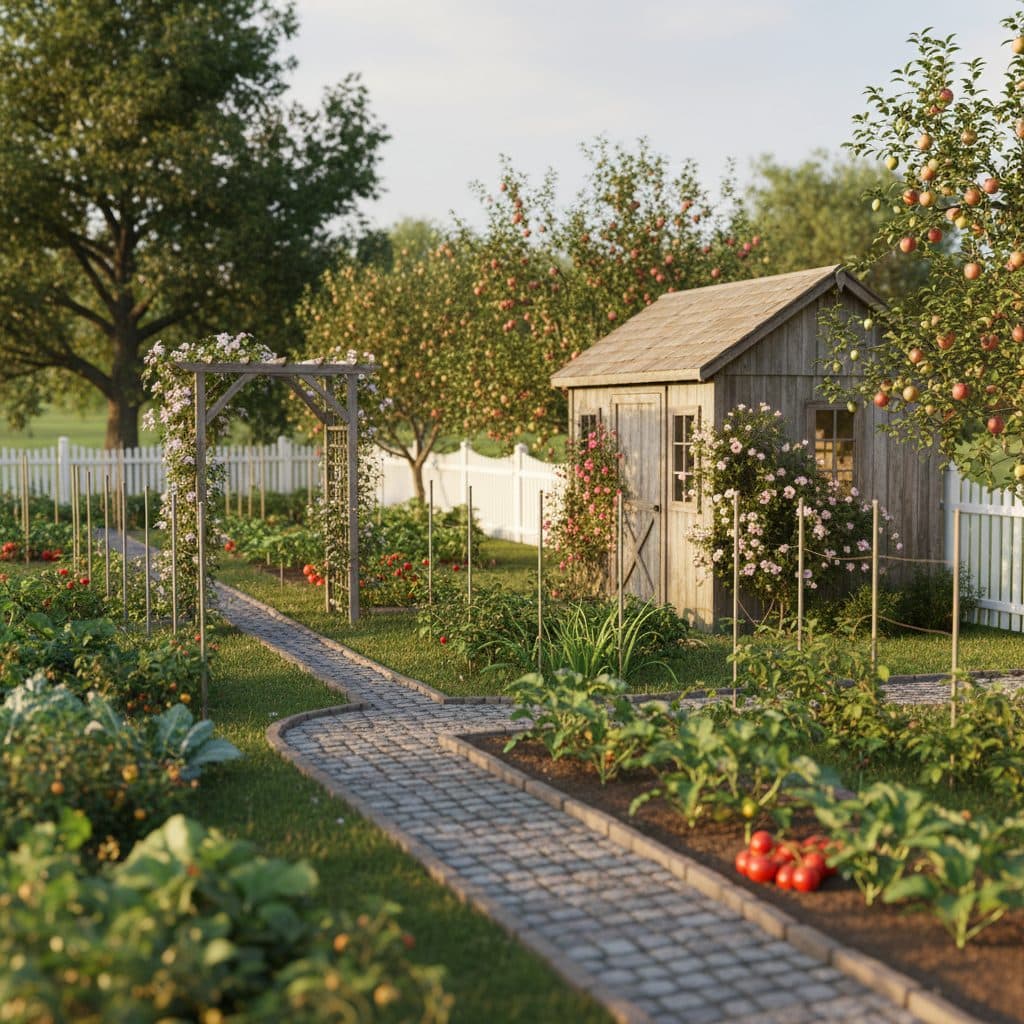
The concept of a fruit tree hedgerow is simple: plant trees closer together in a linear fashion, forming a living fence or wall of fruit. This method is particularly effective for suburban lots, where space is a premium, often less than 10,000 square feet. By reducing the footprint of each tree, you can plant a greater diversity of species and varieties to ensure a longer harvest season and a wider array of fruits for your family. For instance, a 0.25-acre lot, roughly 10,890 square feet, can transition from supporting just five or six standard-sized fruit trees to hosting 30 to 50 dwarf trees.
Maximizing sunlight and efficiency
One of the primary benefits of hedgerow systems is their ability to capture sunlight efficiently. By orienting rows north-south, each tree receives optimal sun exposure throughout the day, which is essential for fruit development and sugar content. This systematic approach also simplifies management tasks like pruning and harvesting, as trees are kept at a manageable height, typically 8 to 10 feet. High-density walnut hedgerows have shown higher yields per acre in trials, demonstrating the production efficiency of the system [2].
- More fruiting wood per square foot of ground, and so more fruit from the same area.
- Easier access for pruning and harvesting due to smaller tree size.
- Greater variety of fruit species and cultivars in a limited area.
- More efficient use of water and nutrients with targeted irrigation.
- Enhanced aesthetic appeal, functioning as an edible landscape feature.
Selecting the right trees and rootstocks for success
The foundation of a successful high-density hedgerow lies in choosing the correct tree varieties and, more importantly, their rootstocks. For suburban growers in USDA zones 5 through 9, dwarf and semi-dwarf rootstocks are necessary, along with permanent support. M27 and M9 have brittle, shallow root systems: a tree on either needs a stake or trellis wire for its whole life, not just the first few years. An unstaked dwarf apple leans progressively and eventually goes over once it starts carrying a crop. These rootstocks control the tree’s ultimate size, allowing you to plant trees as close as 3 to 6 feet apart within the row, while still maintaining vigor and productivity. Without these growth-controlling rootstocks, standard trees would quickly outgrow their allotted space, leading to shading and reduced fruit production.
Understanding rootstock compatibility
Different fruit species have specific rootstocks that perform best in hedgerow systems. For apples, M27 gives a true dwarf at roughly 20-30% of standard size; M9 is also classed as dwarfing, at roughly 30-40% of standard. Pears often do well on Quince A or C rootstocks, which impart dwarfing characteristics. Stone fruits like peaches and plums can be grown on ‘Citation’, which genuinely controls size. Do not use ‘Lovell’ in a hedgerow: it is a full-vigor peach seedling rootstock that produces a standard-size tree and will overrun 3-6 ft spacing within a few years. When selecting, consider your specific USDA zone and soil conditions, as some rootstocks tolerate heavy clay better than others.
- Dwarf rootstocks like M27 or Bud.9 for apples, reducing size by 70-90%.
- Semi-dwarf rootstocks such as M26 or Geneva 11 for apples, reducing size by 50-70%.
- Quince A or C rootstocks for pears, providing significant dwarfing.
- ‘Citation’ rootstock for peaches and plums, which is size-controlling; ‘Lovell’ is a full-vigor seedling rootstock and is unsuitable for hedgerows.
- Consider disease resistance and soil adaptability of chosen rootstocks.
Designing and planting your hedgerow orchard
Careful planning is necessary when establishing a high-density hedgerow on a small suburban lot, perhaps 60 feet by 80 feet. Begin by mapping out your space, considering sunlight patterns throughout the day. Rows should ideally run north-south to maximize light interception for each tree, promoting even ripening and reducing disease pressure. For apples and pears on dwarf rootstocks, plant trees 3 to 5 feet apart within the row, with 10 to 12 feet between rows to allow for maintenance and light penetration. Stone fruits may require slightly more space, perhaps 4 to 6 feet apart in the row.
Irrigation and soil preparation
Before planting, prepare your soil by amending it with organic matter to improve drainage and nutrient retention. A soil test through your county extension office will tell you about pH and nutrient levels, guiding your amendments. A 3-in-1 probe meter is handy for tracking soil moisture, but it does not measure nutrients at all and its pH reading is not accurate enough to base liming decisions on. Most fruit trees prefer a pH between 6.0 and 7.0. Once planted, a drip irrigation system is highly recommended for hedgerows. This delivers water directly to the root zone, minimizing waste and ensuring consistent moisture, which is critical for closely spaced trees. A simple Garden PE Irrigation Hose with emitters can be installed inexpensively for a 50-foot row, providing efficient water delivery.
- Orient rows north-south for optimal sunlight exposure and fruit development.
- Space dwarf trees 3 to 6 feet apart within the row, depending on species and rootstock.
- Maintain 10 to 12 feet between rows for accessibility and light.
- Amend soil to achieve a pH between 6.0 and 7.0, and improve organic content.
- Install a drip irrigation system for efficient and consistent water delivery.
Pruning for production and health in a hedgerow
Pruning is central to managing a high-density hedgerow. Unlike traditional orchards where trees grow large, hedgerow trees are continuously managed to maintain a compact, productive form, typically 8 to 10 feet tall. The goal is to balance vegetative growth with fruit production to ensure sunlight penetrates the canopy and encourages fruiting spurs. Pruning begins at planting, with a heading cut to establish the tree’s height and encourage branching.
Annual maintenance pruning
Each year, dormant pruning in late winter or early spring removes dead, diseased, or crossing branches and takes back roughly a fifth to a third of the previous season’s growth. Summer pruning, often done in July or August in USDA zone 7, is lighter and focuses on removing vigorous upright shoots (water sprouts) and thinning out excessive growth to improve light penetration and air circulation. This consistent pruning prevents trees from becoming overgrown and unproductive, a common issue in neglected high-density systems. Research on high-density olive orchards shows that annual pruning maintains productivity and yields in young trees [4].
- Establish a central leader or modified central leader system for most hedgerow trees.
- Perform dormant pruning annually to remove 20-30% of the previous year’s growth.
- Conduct summer pruning to manage vigorous shoots and improve light exposure.
- Remove any branches growing into the row spacing to maintain a narrow canopy.
- Sanitize pruning tools between trees to prevent disease spread, especially after cutting diseased wood.
Ongoing care and harvest for your compact orchard
Beyond pruning, consistent care ensures the long-term health and productivity of your hedgerow orchard. Regular monitoring for pests and diseases is important, as closely spaced trees can allow problems to spread quickly. Implement integrated pest management (IPM) strategies, which include beneficial insects and targeted treatments only when necessary. Nutrient management also requires attention: test the soil every two to three years to assess nutrient levels and adjust fertilization accordingly. The USDA Natural Resources Conservation Service provides excellent resources on sustainable soil and water management practices.
Watering and mulching strategies
Even with drip irrigation, regular checks of soil moisture are important, especially during dry spells or fruit development. A Soil Moisture Meter can help you determine exactly when to water, preventing both over and under-watering. Apply a 3 to 4 inch layer of organic mulch around the base of each tree, keeping it a few inches away from the trunk. This helps conserve soil moisture, suppress weeds, and regulate soil temperature. Harvesting in a hedgerow is typically easier due to the smaller tree size, often requiring only a step stool instead of a tall ladder, making a 30-pound harvest from a single dwarf apple tree a manageable task for a home grower.
- Monitor trees weekly for signs of pests or diseases, especially in spring and summer.
- Apply balanced organic fertilizers based on soil test results, typically in early spring.
- Maintain a 3-4 inch layer of organic mulch to conserve moisture and suppress weeds.
- Check soil moisture regularly, especially during dry periods, to ensure adequate hydration.
- Harvest fruit frequently as it ripens, which is easier with smaller, accessible trees.
Hedgerow vs. traditional orchard for suburban lots
Feature | Hedgerow system | Traditional orchard |
|---|---|---|
Tree spacing (in-row) | 3-6 feet | 15-25 feet |
Trees per 0.25 acre | 30-50 dwarf trees | 5-8 standard trees |
Yield potential | High, efficient per square foot | Moderate, lower density |
Management intensity | High (pruning, irrigation) | Moderate (less frequent pruning) |
Tree size | Small (8-10 feet tall) | Large (15-30 feet tall) |
Harvest ease | Easy, often from ground or step stool | Requires ladders, more difficult |
Lot Potential: A 0.25-acre suburban lot can support up to 50 dwarf fruit trees in a hedgerow system, yielding hundreds of pounds of fruit annually.
Yield Increase: High-density olive orchards have demonstrated yields 30% higher than traditional plantings, demonstrating the efficiency of hedgerow systems [1].
Frequently asked questions
What is the ideal spacing for hedgerow fruit trees?
For most dwarf fruit trees in a hedgerow, the ideal spacing is 3 to 6 feet apart within the row, and 10 to 12 feet between rows. This allows for adequate sunlight and air circulation, essential for fruit development and disease prevention in a small space.
How much fruit can I expect from a small hedgerow orchard?
A well-managed hedgerow on a 0.25-acre lot can produce a significant amount of fruit. A single dwarf apple tree can yield 20 to 40 pounds annually, meaning 30 to 50 trees could produce hundreds of pounds of diverse fruits each season.
What are the best fruit tree varieties for high-density planting?
The best varieties are those grafted onto dwarf or semi-dwarf rootstocks. Apples on M27 or M9, pears on Quince A or C, and peaches/plums on ‘Citation’ are good choices for maintaining a compact size, typically 8 to 10 feet tall.
Is special pruning required for hedgerow trees?
Yes, special annual pruning is essential. This includes dormant pruning in late winter to remove 20-30% of growth and summer pruning to manage vigorous shoots. This maintains tree size, encourages fruiting, and ensures light penetration throughout the canopy, impacting yields as shown in olive orchards [4].
Can I mix different fruit types in a hedgerow?
Yes, you can mix different fruit types in a hedgerow, provided they have similar cultural requirements for sunlight, soil, and water. For example, apples and pears can often be planted in the same row, maintaining 3 to 5 feet spacing, but consider bloom times for cross-pollination.
What kind of irrigation is best for high-density planting?
Drip irrigation is highly recommended for high-density hedgerows. It delivers water precisely to the root zone, minimizing waste and ensuring consistent moisture levels, which is critical for closely spaced trees to thrive and produce a good yield.
References
- Long-term Effect of Intra-Row Spacing on Growth and Productivity of Super-High Density Hedgerow Olive Orchards (cv. Arbequina) (2017). Long-term Effect of Intra-Row Spacing on Growth and Productivity of Super-High Density Hedgerow Olive Orchards (cv. Arbequina).
- HEDGEROW VS. STANDARD HIGH-DENSITY MANAGEMENT SYSTEMS FOR WALNUTS (1997). HEDGEROW VS. STANDARD HIGH-DENSITY MANAGEMENT SYSTEMS FOR WALNUTS.
- SubUrban Dream: Reinterpreting the suburban dream in Auckland’s medium density housing (2023). SubUrban Dream: Reinterpreting the suburban dream in Auckland’s medium density housing.
- PRUNING TECHNIQUE IN YOUNG HIGH DENSITY HEDGEROW OLIVE ORCHARDS (2014). PRUNING TECHNIQUE IN YOUNG HIGH DENSITY HEDGEROW OLIVE ORCHARDS.