Key takeaways
- Separate capital startup expenses (land, wells, fencing) from recurring operational costs (feed, seed, fuel).
- Budget between $5,000 and $15,000 for basic initial infrastructure if you already own land and a dwelling.
- Prioritize water security and perimeter predator fencing before acquiring any livestock.
- Avoid debt by bootstrapping in phases: begin with vegetable gardens and poultry before adding large livestock.
- Account for hidden costs including utility hookups, soil testing, veterinary care, and equipment maintenance, plus permits and inspections (perc test, well permit, building permits) and the zoning check that tells you whether the build is allowed at all.
- Understand that homesteading provides food security and self-reliance rather than immediate grocery bill savings.
Quick answer: Establishing a homestead in the United States typically costs between $5,000 and $15,000 for basic infrastructure (gardens, chicken coop, tools, basic fencing) on existing land, while developing raw, off-grid land with a well, septic, solar, and barns can easily exceed $80,000 to $150,000 before land purchase prices.
Families moving toward a self-reliant, rural homestead run into the same obstacle: the financial reality of getting started.
Asking how much does it cost to start a homestead rarely produces a simple, single figure. Total investment varies widely depending on whether you are retrofitting an existing suburban property, purchasing a turnkey rural farmhouse, or developing raw acreage from scratch with off-grid utilities.
Break down capital costs, plan your bootstrapping in phases, and track ongoing expenses honestly, and you can build a homestead debt-free.
+--------------------------------------------------------------------------+
|                  HOMESTEAD STARTUP INFRASTRUCTURE TIERS                  |
+-------------------+-----------------------------+------------------------+
| Investment Tier   | Infrastructure Scope        | Estimated Cost Range   |
+-------------------+-----------------------------+------------------------+
| Tier 1: Frugal    | Hand tools, DIY coop, basic | $5,000 to $15,000      |
| (Existing House)  | garden fencing, rain barrels| (Excludes Land)        |
+-------------------+-----------------------------+------------------------+
| Tier 2: Moderate  | Drilled well, field fencing,| $25,000 to $60,000     |
| (Small Farmstead) | run-in shed, tiller/mower   | (Excludes Land)        |
+-------------------+-----------------------------+------------------------+
| Tier 3: Off-Grid  | Deep well, solar array,     | $80,000 to $150,000+   |
| (Raw Land Build)  | septic system, barn, tractor| (Excludes Land)        |
+-------------------+-----------------------------+------------------------+
Figures below are US material-and-contractor estimates as of 2026, drawn from national averages. Regional variation is large — treat them as a starting point for your own three quotes, not as a price list.
Category 1: Land acquisition and site development
Land is the single largest financial outlay for any new homestead. Prices per acre fluctuate dramatically based on state, proximity to metropolitan centers, water rights, soil quality, and topography.
Key site development variables:
- Turnkey property with existing home: Purchasing a rural home on 3 to 10 acres bundles water, electricity, septic, and shelter into a single mortgage. While the purchase price is higher upfront, it eliminates the unpredictable costs and delays of rural construction.
- Raw, unimproved land: Raw acreage offers a lower purchase price per acre, but requires substantial capital for development:
- Driveway access and clearing: $3,000 to $10,000 depending on terrain and gravel depth.
- Septic system installation: $6,000 to $15,000 for standard gravity systems, higher for engineered mound systems.
- Grid power drop: Electric utilities often charge $5 to $15 per linear foot to run power poles and lines from the main road.
When evaluating land across different regions, explore our detailed state guides on homesteading-in-michigan, homesteading-in-ohio, and homesteading-in-idaho.
Category 2: Water security and utilities
Reliable water is non-negotiable on a homestead. Gardens, livestock, dairy animals, and household needs demand hundreds of gallons of clean water daily.
Primary water options and costs:
- Drilled water well: Drilling a new residential well typically costs $35 to $65 per foot, including casing, pump, pressure tank, and electrical controls. A 200-foot well generally costs between $7,000 and $13,000.
- Rainwater catchment: Installing heavy-duty gutters, first-flush diverters, and food-grade storage cisterns costs $1,500 to $4,000 for basic outbuilding setups.
- Off-grid solar power: A robust off-grid solar system capable of powering household appliances, well pumps, and freezers (5 kW to 10 kW with lithium iron phosphate batteries and backup inverter) costs between $15,000 and $35,000 if self-installed, or higher with professional contractors.
Category 3: Fencing, predator security, and animal housing
Fencing is frequently the most underestimated capital expense on a new homestead. Inadequate fencing leads to lost livestock, garden devastation from deer, and predator attacks from coyotes, dogs, and raccoons.
Fencing budget breakdown:
- Garden deer fencing: An 8-foot poly or woven wire perimeter fence enclosing a quarter-acre vegetable garden costs $800 to $2,000 in materials.
- Perimeter field fencing: High-tensile woven wire fencing with T-posts and braced wooden corner posts costs approximately $2.00 to $4.50 per linear foot in materials. Fencing a 5-acre perimeter (roughly 1,870 linear feet) costs roughly $3,700 to $8,400 in materials alone, assuming a square parcel — a long, narrow 5 acres can need 2,500 ft or more of fence.
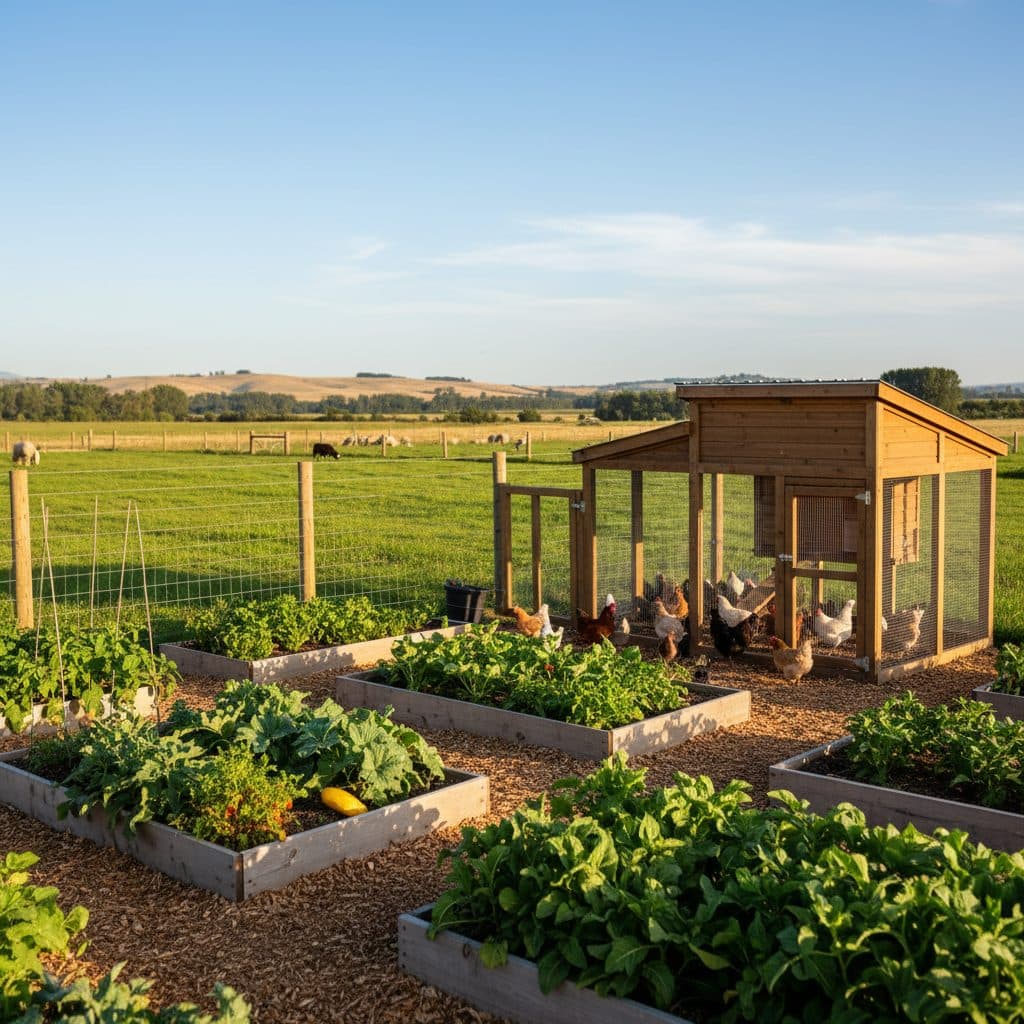
- Poultry housing: A secure, predator-proof chicken coop housing 10 to 15 laying hens costs $300 to $800 using salvaged lumber and hardware cloth, or $1,200 to $2,500 for commercial prefab models.
- Livestock run-in shelters: A simple three-sided timber pole barn for goats, sheep, or pigs costs $1,500 to $4,000 in materials.
To reduce ongoing poultry feed costs, consider raising high-protein supplemental feeds as detailed in our guide on black-soldier-fly-larvae-for-chickens.
+--------------------------------------------------------------------------+
|                     PHASED HOMESTEAD BOOTSTRAPPING PLAN                  |
+--------------------------------------------------------------------------+
|  Year 1 ($3,000 - $6,000) : In-ground garden, compost, flock of 10 hens  |
|  Year 2 ($4,000 - $8,000) : Perimeter fence segment, fruit tree orchard |
|  Year 3 ($5,000 - $12,000): Small livestock (goats/pigs), high tunnel    |
|  Year 4 ($8,000 - $20,000): Outbuilding workshop, expanded water storage|
+--------------------------------------------------------------------------+
Category 4: Garden establishment and orchard planting
Producing a significant portion of your family's fresh produce requires an initial investment in soil building, seed stock, and hand tools.
Garden startup expenses:
- Soil conditioning and bulk amendments: If native soil is depleted or heavy clay, bringing in bulk compost, aged manure, lime, and minerals for a 2,000 sq ft garden costs $400 to $1,000.
- Irrigation setup: Drip tape, mainline tubing, pressure regulators, and timers cost $200 to $500 for a homestead-scale plot.
- High tunnel / Hoop house: A 14 ft x 50 ft unheated hoop house extends the growing season by two months, costing $1,500 to $3,500 in materials.
- Orchard trees and berry bushes: Planting 10 bare-root fruit trees, 20 berry bushes (raspberries, blackberries, blueberries), and perennial herbs costs $500 to $1,200.
Category 5: Tools, machinery, and equipment
Having the right tools makes physical homestead maintenance sustainable over decades.
- Essential hand tools: Quality shovels, digging forks, broadforks, wheelbarrows, rakes, pruning shears, and axes cost $600 to $1,200.
- Walk-behind power equipment: A reliable rear-tine rototiller, heavy-duty chainsaw, and string trimmer cost $1,200 to $2,500.
- Tractors and heavy machinery: While beginners often assume a tractor is mandatory on Day 1, many successful homesteaders manage 2 to 5 acres for years with a walk-behind two-wheel tractor (such as a BCS) costing $3,500 to $7,000 with attachments, avoiding the $20,000 to $45,000 expense of a 4WD compact diesel tractor.
Does homesteading actually save money?
A common myth is that moving to a homestead immediately slashes household grocery expenses to zero. In practice, the economic reality is more nuanced.
During the first three to five years, the capital amortization of infrastructure (fencing, coops, soil amendments, fruit trees, irrigation) means your homegrown eggs and tomatoes will cost significantly more per pound than store-bought equivalents.
However, homesteading provides real financial and personal value over a 10-year horizon:
- Quality and freshness: You decide what goes on your crops, and you eat them hours rather than weeks after harvest.
- Reduced exposure: A share of your food comes off the property, which softens — it does not remove — the effect of supply disruptions and food-price inflation. Feed, fuel and parts are still bought at market.
- Low ongoing costs once established: Once infrastructure is paid off and soil fertility is built through compost, annual operating expenses drop to seeds, livestock minerals, and supplemental feed.
To evaluate which regions offer the most favourable tax structures, agricultural exemptions, and land values, explore our comprehensive national analysis of the best-states-for-homesteading.