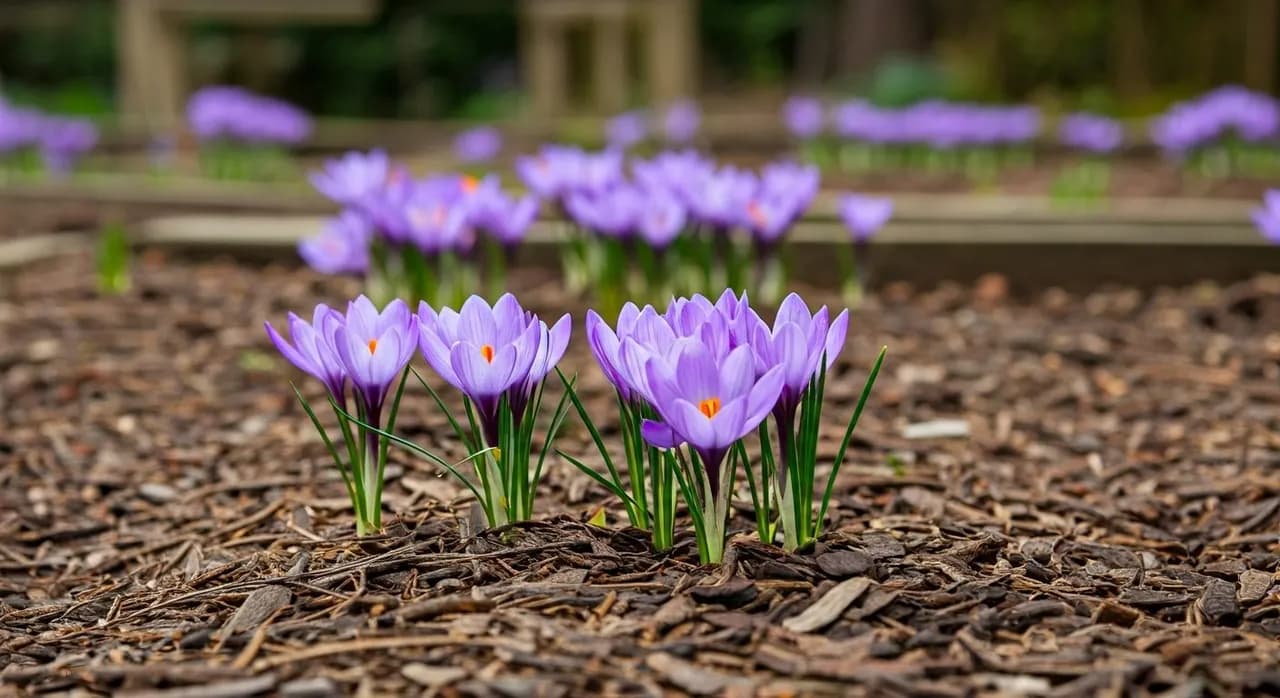
Key takeaways
- Saffron thrives in USDA zones 6-9, needing cold winters and hot, dry summers.
- Well-drained soil with a pH of 6.0-7.0 is necessary to prevent corm rot.
- Plant saffron corms 4-6 inches deep to protect them from temperature swings and pests.
- Space corms 3-6 inches apart for optimal growth and future cormlet production.
- Amend heavy clay soils with generous organic matter, or build raised beds, to get the drainage saffron needs.
- Harvest saffron flowers in the morning after they open, carefully extracting the three red stigmas.
Quick answer: Growing saffron in USDA zones 6-9 requires well-drained soil with a pH of 6.0-7.0, corms planted 4-6 inches deep, and late-summer planting. It wants a cool winter rest and a hot, dry summer dormancy, which many US regions provide.
In the high desert regions of New Mexico, where summer temperatures regularly exceed 90°F and winters dip below 20°F, some growers are successfully cultivating saffron, the world’s most expensive spice. This crocus, Crocus sativus, also grows outside Mediterranean climates. With suitable planting depth, spacing, and well-drained soil, it grows across USDA zones 6 through 9, producing aromatic culinary threads.
Cultivating saffron requires attention to detail, especially when it comes to site selection and initial planting. Saffron corms rot readily in wet ground, and a poorly drained site is the single most common reason a home saffron patch fails. For a successful saffron patch, we need to mimic its native conditions as closely as possible, focusing on soil structure, nutrient availability, and protection for the corms during their dormant and active phases. Site preparation requires matching native conditions for soil structure, aeration, and corm protection during dormant and active phases.
Saffron’s climate and soil needs in the US
Saffron, derived from the stigmas of Crocus sativus, is a surprisingly resilient crop, capable of growing in diverse regions across the United States. While often associated with Iran or Spain, its adaptability means it can be a viable crop for growers in USDA zones 6 through 9. This range covers a significant portion of the country, from the Pacific Northwest to the Mid-Atlantic states, and parts of the Southwest. Success depends on providing its specific environmental cycle: a cool, moist autumn and winter rest, followed by a hot, dry summer dormancy. Saffron does not need hard freezes (it is grown commercially across mild Mediterranean climates), but it does need summers dry enough that the dormant corms do not rot. These conditions support dormancy followed by regular flowering.
Beyond climate, soil conditions determine saffron success. Saffron corms are highly susceptible to rot in wet conditions. This means excellent drainage is non-negotiable. Research from 1960 on loblolly pine, for example, showed that even slight improvements in drainage on poorly drained sites significantly increased seedling survival [1]. For saffron, a well-drained sandy loam is ideal, with a pH ranging from 6.0 to 7.0 [6]. This slightly acidic to neutral range is common in many agricultural soils across the US. If your soil is heavy clay, you will need to amend it significantly to achieve the necessary drainage and aeration. Without proper drainage, your saffron corms are unlikely to establish or produce well.
Identifying suitable US regions
Many US regions fit the bill for saffron cultivation. For example, parts of Central Virginia, with its hot summers and cold winters, offer promising conditions. Similarly, areas in the Columbia Basin of Washington State, known for its dry summers, can be suitable. Even parts of the Midwest, like southern Illinois or Missouri, within USDA zone 6, could support saffron with proper site preparation. The main challenge is often ensuring adequate drainage and managing soil moisture, especially during spring rains. A soil test is a valuable first step, providing data on pH and nutrient levels, which can guide your amendments. Aim for a loamy soil texture that drains freely but still retains some moisture and nutrients.
- USDA zones 6-9 are generally suitable for saffron.
- Saffron needs a cool winter rest and a hot, dry summer dormancy.
- Hot, dry summers are necessary for corm development.
- Soil pH should be between 6.0 and 7.0.
- Excellent soil drainage prevents corm rot.
Preparing your soil for optimal drainage
Once you’ve identified a suitable site in your garden, the next step is to prepare the soil. This is where many saffron growers either succeed or fail. Saffron corms simply will not tolerate standing water or consistently soggy soil. In fact, poorly drained soils can significantly reduce plant establishment and survival rates, sometimes by over 50% in species like black cohosh [2]. To ensure excellent drainage, you’ll likely need to amend your existing soil. Start by digging down at least 12-18 inches in your chosen bed. If you encounter heavy clay, you’ll need to work in substantial amounts of organic matter and coarse sand.
For heavy clay soils, aim to incorporate 3-4 inches of compost, well-rotted manure, or other organic materials. Resist the temptation to add a little sand: mixed into clay at anything under roughly half the total soil volume, sand tightens the structure instead of opening it. If drainage is genuinely poor, a raised bed is the reliable fix. This blend helps to break up the clay particles, creating larger pore spaces for water to drain through and air to circulate. While you may not have naturally sandy soil, you can replicate some of those benefits. Raised beds are an excellent option for areas with notoriously poor drainage, providing an immediate improvement in soil structure and elevation. A raised bed 8-12 inches high filled with a custom soil mix can solve many drainage issues.
Soil amendments and pH adjustment
After incorporating amendments, conduct another soil test to confirm your pH is within the ideal range of 6.0 to 7.0. If your soil is too acidic (below 6.0), you can raise the pH by adding agricultural lime. If it’s too alkaline (above 7.0), elemental sulfur can help lower it. These adjustments should be made several weeks before planting to allow them to take effect. The goal is a friable, well-aerated soil that drains quickly after a rain but still holds enough moisture for the corms to draw upon. A simple drainage test involves digging a 12-inch deep hole, filling it with water, and observing how quickly it drains. If it takes more than 4-6 hours, further amendments are needed.
- Dig beds 12-18 inches deep to assess soil type.
- Amend heavy clay with 3-4 inches of compost or other organic matter; skip the sand, which tightens clay at these proportions, and use a raised bed where drainage is genuinely poor.
- Consider raised beds for areas with poor natural drainage.
- Adjust soil pH to 6.0-7.0 using lime or sulfur.
- Perform a drainage test; water should drain within 4-6 hours.
Optimal planting depth for saffron corms
Timing matters as much as depth. Plant saffron corms in late summer, from mid-August to early September, so they root before the autumn bloom; corms planted in spring will not flower that year, and corms left in the bag past September flower poorly in their first season. The depth at which you plant them affects survival and productivity. Unlike many spring-flowering bulbs, saffron corms need planting 4-6 inches deep from the top of the corm to the soil surface. This depth offers protection from temperature fluctuations, insulating corms from both freezing winter temperatures and summer heat. In regions like USDA zone 6, where winter temperatures can drop to 0°F or lower, this insulation prevents frost injury. Secondly, deeper planting helps protect the corms from rodents and other pests that might otherwise dig them up.
Planting depth matters for any geophyte: too shallow and the corm dries out or heaves; too deep and it exhausts its reserves reaching the surface. For saffron the principle holds: an optimal depth promotes strong root development and reduces stress. Planting too shallow, say 1-2 inches deep, leaves the corms vulnerable to drying out, frost heave, and predation. Conversely, planting too deep, beyond 7-8 inches, can delay emergence and flowering, and may even lead to corm rot if drainage isn’t perfect. Aiming for 4-6 inches allows healthy root formation and cold protection.
Planting technique and orientation
When planting, ensure the corm is oriented correctly. Saffron corms are typically somewhat flattened, with a slightly pointed top where the sprout emerges and a flatter, sometimes root-scarred bottom. Plant them with the pointed side facing up. Gently place each corm into its hole, then backfill with your prepared soil, ensuring no air pockets remain. Water thoroughly after planting to settle the soil around the corms. This initial watering is important for establishing good soil-to-corm contact. For larger plantings, consider using a bulb planter tool that can consistently create holes at the desired 4-6 inch depth, speeding up the process significantly for hundreds of corms.
- Plant saffron corms 4-6 inches deep.
- Deeper planting protects corms from temperature extremes.
- Optimal depth deters rodents and other pests.
- Orient corms with the pointed side facing up.
- Water thoroughly after planting to settle soil.
Optimal spacing for saffron corms
Spacing between saffron corms directly affects yield and long-term patch health. While it might be tempting to plant corms closely together to maximize immediate harvest, proper spacing allows for optimal air circulation, nutrient uptake, and the development of new cormlets. We recommend a spacing of 3-6 inches between individual corms. This range provides enough room for the corms to grow, produce flowers, and multiply without undue competition.
Closer spacing, for example, 2 inches apart, can lead to overcrowding. This results in smaller corms, fewer flowers, and reduced saffron yields over time. It also increases the risk of fungal diseases due to poor air circulation and higher humidity around the plants. Conversely, spacing corms too far apart, say 8-10 inches, wastes valuable garden space and reduces the overall yield per square foot. Spacing corms 3-6 inches balances these considerations, supporting steady cormlet production so the planting expands each season. A 4-inch spacing is a good general guideline for most growers, allowing for about nine corms per square foot.
Row planting versus block planting
For larger plantings, you might consider planting in rows or blocks. If planting in rows, maintain 3-6 inches between corms within the row and 6-12 inches between rows. This allows for easier weeding and harvesting. However, block planting, where corms are spaced evenly in a grid pattern, can maximize space utilization and create a more uniform microclimate. For example, a 3×3 foot block could hold 81 corms if spaced 4 inches apart in a grid. Block planting helps create a dense canopy that can suppress weeds. Pollination is not a consideration here: Crocus sativus is a sterile triploid that sets no seed and is propagated only from its corms. You can read more about block planting techniques for other crops at https://agripure.org/articles/how-to-grow-corn. Regardless of the pattern, consistent 3-6 inch spacing works best for saffron. Consider a planting density of 4-9 corms per square foot.
- Space saffron corms 3-6 inches apart.
- Optimal spacing supports cormlet development.
- Avoid overcrowding to prevent disease and small corms.
- Block planting can maximize space and yield.
- A 4-inch spacing allows for about nine corms per square foot.
Ongoing care and harvesting saffron threads
After planting, saffron corms require relatively low maintenance, but consistent care will ensure a healthy, productive patch. During the active growing season (fall through spring in most areas), ensure the soil remains moist but never waterlogged. Once the foliage begins to yellow and die back in late spring or early summer, typically around May or June in USDA zone 7, reduce watering significantly. The corms enter a dormant phase during the hot, dry summer, and excess moisture during this period is a primary cause of rot. A light, dry mulch, such as straw or pine needles, can help suppress weeds and maintain consistent soil temperature without holding too much moisture. This also helps protect the corms from extreme summer heat.
Fertilization is usually not heavily required if your soil was well-amended prior to planting. However, a light application of a balanced, low-nitrogen fertilizer (e.g., 5-10-10) in the early fall, just as new growth emerges, can support flower and cormlet production. Avoid high-nitrogen fertilizers, which promote leafy growth at the expense of flowers. Weeding is important, especially during the active growth phase, as saffron foliage is delicate and can be easily outcompeted. Hand-weeding is often the best approach to avoid disturbing the shallow roots and corms. You can learn more about general garden care for other crops, like green beans, at https://agripure.org/articles/how-to-grow-green-beans.
Harvesting saffron stigmas
Saffron flowers typically emerge in the fall, usually from late September through November, depending on your climate zone. Each purple flower contains three deep-red stigmas: these are the saffron threads. Harvest only from corms you planted yourself as Crocus sativus. Autumn crocus or meadow saffron (Colchicum autumnale) is a widely sold garden bulb that flowers leafless from bare ground at the same time of year and looks very similar, but it contains colchicine and is lethal in small quantities with no ready antidote. Crocus sativus carries three stamens and three deep-red stigmas; Colchicum carries six stamens and pale styles. Harvest is a time-sensitive task; flowers open in the morning and begin to wilt by afternoon. Pick the flowers gently by hand, or carefully pluck the stigmas directly from the open bloom. The best time is early morning, after the dew has dried but before the sun gets too intense. Once harvested, the stigmas need to be dried immediately. Dry them promptly: spread them thin on a fine mesh screen and hold at 110-120°F for 10-15 minutes in a dehydrator or low oven, until brittle but not scorched. Drying slowly over several days risks mould and costs colour and aroma. Store dried saffron in an airtight container in a cool, dark place for up to two years. A single corm may produce 1-3 flowers. Each corm flowers once and is then spent, replaced by the daughter corms it forms, so the same patch of ground yields steadily more flowers year on year as the clump multiplies.
- Keep soil moist but not waterlogged during active growth.
- Reduce watering significantly during summer dormancy.
- Apply a low-nitrogen fertilizer (e.g., 5-10-10) in early fall.
- Hand-weed to avoid disturbing corms and roots.
- Harvest flowers in the early morning for best quality.
Saffron pH: Saffron prefers a soil pH between 6.0 and 7.0, a slightly acidic to neutral range common in many agricultural soils across the US [6].
Corm Depth: Plant saffron corms 4-6 inches deep to protect them from temperature fluctuations and pests for healthy root development.
Corm Spacing: Space saffron corms 3-6 inches apart for optimal growth and cormlet production, yielding more saffron threads per square foot [4].
Frequently asked questions
What USDA zones are best for growing saffron in the US?
Saffron (Crocus sativus) thrives in USDA zones 6 through 9, requiring a cool winter rest and hot, dry summers. These conditions let the corms establish and flower well; saffron does not need hard freezes, and it is grown commercially across mild Mediterranean climates.
How important is soil drainage for saffron corms?
Good soil drainage is necessary for saffron corms. They are highly susceptible to rot in wet conditions, and a poorly drained site is the most common reason a home saffron patch fails. A well-drained sandy loam with a pH of 6.0-7.0 is ideal.
What is the recommended planting depth for saffron corms?
Saffron corms should be planted 4-6 inches deep, measured from the top of the corm to the soil surface. This depth protects against temperature extremes and deters pests, which improves survival rates [1].
How far apart should I space saffron corms?
For optimal growth and cormlet production, saffron corms should be spaced 3-6 inches apart. This spacing allows for adequate air circulation, nutrient uptake, and reduces competition, leading to higher yields of saffron threads [4].
When is the best time to harvest saffron flowers?
Saffron flowers typically emerge in the fall, from late September through November. The best time to harvest is in the early morning, just after the flowers open and before the sun becomes too intense, to preserve the quality of the three red stigmas.
Can saffron be grown in a raised bed?
Yes, saffron can be successfully grown in raised beds, especially if your native soil has poor drainage. A raised bed 8-12 inches high filled with a custom-blended, well-draining soil mix can provide ideal conditions and prevent corm rot.
References
- Exposure and Planting Depth Effects on Loblolly Pine Planting Stock on Poorly Drained Sites (1960). Exposure and Planting Depth Effects on Loblolly Pine Planting Stock on Poorly Drained Sites.
- Effect of Planting Depth, Planting Season, and Fungicide Treatment on Establishment of Black Cohosh in a Poorly Drained Soil (2006). Effect of Planting Depth, Planting Season, and Fungicide Treatment on Establishment of Black Cohosh in a Poorly Drained Soil.
- Effect of Planting Methods on Survival and Growth of Plantations on Well-Drained Sandy Soils of Central Wisconsin (1942). Effect of Planting Methods on Survival and Growth of Plantations on Well-Drained Sandy Soils of Central Wisconsin.
- Effects of planting spacing and mixed plant types on root characteristics and soil suction (2023). Effects of planting spacing and mixed plant types on root characteristics and soil suction.
- Comparison of the planting success and risks of pine weevil damage on mineral soil and drained peatland sites three years after planting (2021). Comparison of the planting success and risks of pine weevil damage on mineral soil and drained peatland sites three years after planting.
- USDA Natural Resources Conservation Service (2024). USDA Natural Resources Conservation Service.