Key takeaways
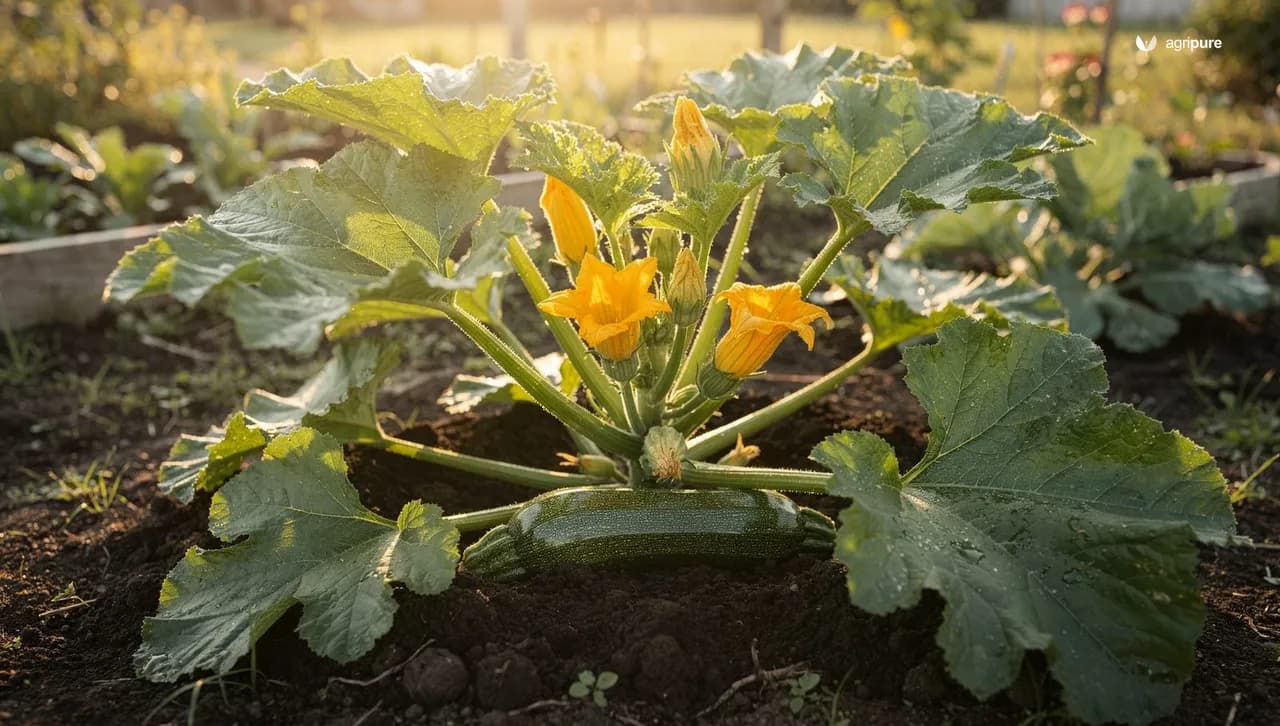
A healthy zucchini plant in warm soil, with open male and female yellow blossoms and a 7-inch zucchini fruit ready for picking.
From seed to harvest, zucchini’s rapid growth demands attention to soil temperature, pollination, and timely picking for a continuous yield.
- Zucchini is fast (about 55 days from sowing to the first pick) but only after the soil at a 2 inch depth holds 70 F.
- Each plant carries separate male and female flowers; males open 1 to 2 weeks first, so an early run of blossoms with no fruit is normal.
- Bees must move pollen for fruit to set; in cold or rainy weather, hand-pollinate at dawn to rescue a poor set.
- Scout leaf undersides for squash bug egg clusters of about 20 and watch for white powdery mildew once humidity climbs.
- Pick at 6 to 8 inches and harvest daily or every other day, or the plant slows and the glut runs away from you.
A single zucchini plant can go from a seed in warm June soil to a 7 inch fruit on your counter in roughly 8 weeks, and then keep handing you one every day or two until frost. That speed is the main appeal, but also the main challenge, because two healthy plants will out-produce most kitchens by mid-July.
The trick is matching 3 hard numbers: a 70 F soil floor to sow into, enough bees (or your own hand) to set the fruit, and a 6 to 8 inch picking window that keeps the plant producing instead of coasting on one giant marrow. Here is the full sequence, from a warm hill of seed through the pest watch to the harvest-small-and-often reality that keeps the glut in check.
Sow into warm soil, not a date on the calendar
Zucchini is a frost-tender summer crop with a fast clock. Clemson Cooperative Extension puts the harvest at about 55 days after planting, and University of Maryland Extension lists 50 to 65 days from transplant, quick enough that a single early-summer sowing carries you to frost. But the seed rots in cold ground, so the planting date is set by soil temperature, not the calendar.
University of Minnesota Extension is specific: sow after the last frost only once soil reaches at least 70 F at the two-inch depth, measured with a soil thermometer. Clemson sets a floor of 60 F at a 4 inch depth as the bare minimum. Sowing into cool, wet soil below that costs you the seed and a week of the season you can use better by waiting.
Hills, spacing, and seed depth
Zucchini is grown on low hills that warm and drain faster than flat ground. Get the spacing right at sowing and you avoid crowding that invites disease later.
- Build a low hill and sow seed about a half-inch deep, dropping 4 to 5 seeds per hill, then thinning to the 2 strongest seedlings once they have a true leaf.
- Set hills 3 to 4 feet apart in-row with rows 4 to 6 feet apart, per Maryland Extension; bush zucchini still wants a 3 foot footprint to keep air moving.
- Start seed indoors only 2 to 3 weeks early if your season is short, since zucchini resents root disturbance and sulks for days after a rough transplant.
Wait for the soil, not the forecast: a $5 soil thermometer pays for itself the first season. Seed dropped into 55 F mud usually rots; the same seed into 70 F soil is up in 5 to 7 days. The same warm-soil rule governs its cousin the cucumber.
Young zucchini seedlings with broad cotyledon leaves emerging from a low mound of dark soil in a garden bed, lit by soft early morning light.
Male flowers, female flowers, and why the first ones drop
Most “my zucchini flowers but makes no fruit” panic is just the plant running ahead of its own schedule. Maryland Extension notes that squash produce male flowers for 1 to 2 weeks before female flowers appear, and Minnesota Extension confirms the first blossoms to open are male and often drop, which is normal, not a failure.
Telling the 2 apart takes one glance at the base of the bloom. A female flower sits on top of a tiny immature zucchini, a swollen ovary about 1 inch long. A male flower rides on a plain straight stem with nothing behind it. Fruit sets only when pollen moves from a male bloom to that female one, and Minnesota Extension is clear that bees must carry the pollen: the plant cannot do it alone.
Hand-pollinating when the set is poor
If female flowers shrivel and drop without swelling, the set has failed and you can step in. Minnesota Extension lists the usual cause: poor fruit set from cold, rainy or cloudy weather that keeps bees grounded for days. Work in the first 1 to 2 hours after sunrise, when blooms are open and pollen is fresh.
- Pick a fresh male flower, peel its petals back, and you have a pollen-loaded stamen ready to use.
- Dab the pollen straight onto the stigma inside a newly opened female flower, or move it with a soft brush.
- Work at dawn: squash flowers open near sunrise and often close by midday, so a single morning hour is your window.
When heat itself stalls the fruit
Even with bees around, a heat wave can shut down fruit set on its own. Minnesota Extension reports that high temperatures over 90 F by day and 70 F at night develop more male flowers than female ones, so a plant covered in blooms during a hot spell may simply have very few females to pollinate. The same heat works against the insects, too.
Once the thermometer hits 90 F, many bees slow down and pollinate less, which means even open female flowers may not get a full pollen load. The result is a familiar mid-summer complaint: lots of flowers, few fruit, and the misshapen, pinched zucchini that signals a partial pollination. There is no spray for it: the fix is shade cloth on the worst afternoons, steady water, and hand-pollinating at dawn until the weather breaks.
Read the fruit shape: a zucchini that swells at the blossom end but stays pinched and skinny near the stem was only partly pollinated. It is still edible picked young, but it tells you the bees came up short that morning.
A pest and disease watch through the season
A zucchini plant stays in the ground for 2 to 3 months, long enough for squash bugs and powdery mildew to find it. The two need different scouting habits, so it helps to sort them side by side before the season gets away from you.
Threat | What you see | When | First response |
|---|---|---|---|
Squash bug eggs | Bronze clusters of about 20 under leaves, in a V | Early to mid summer | Scrape and crush eggs by hand |
Squash bug adults | Gray-brown shield bugs, wilting leaves | All season | Drop into soapy water |
Powdery mildew | White powder on upper and lower leaves | Mid to late summer | Improve spacing and airflow |
Poor pollination | Tiny fruit yellows, pinches, and rots | Through flowering | Hand-pollinate at dawn |
On the insect side, Minnesota Extension reports that female squash bugs lay small clusters of about 20 eggs on leaf undersides, especially between the veins where they form a V, and that the yellowish-to-bronze eggs are easiest to beat by crushing the clusters as soon as you spot them. Catching eggs is far simpler than fighting the fast nymphs they hatch into, which feed in groups and can wilt a whole runner.
For disease, the watch is white powder. Minnesota Extension notes that powdery mildew forms white spots on both upper and lower leaf surfaces and favors humid conditions around 68 to 81 F, slowed by good air movement through proper spacing. That is one more reason to hold zucchini hills 3 to 4 feet apart rather than crowding them, the same logic that keeps mildew off a pumpkin patch.
Harvest small, harvest often
The single habit that separates a productive zucchini plant from an exhausted one is picking early and often. Maryland Extension puts the immature size at 6 to 8 inches and 1.5 to 2 inches across, and Minnesota Extension advises picking before the fruit grows over-large with hard skin and big seeds. At that size the seeds are soft, the skin is thin, and the flavor is at its best.
A glossy dark-green zucchini fruit and a bright yellow open blossom on a leafy plant in a sunny garden, with broad leaves and a low soil hill behind.
Frequency is the other half. Once the plant bears, check it daily and pick every day or every other day, because a fruit you miss for 4 days becomes a seedy 14 inch marrow that tells the plant to stop. Removing oversized fruit (even ones you will not eat) keeps the plant setting new zucchini instead of pouring its energy into ripening seed.
Managing the glut you will have
Two plants is plenty for a family of four, and even that lands you in a July glut. Plan for it rather than fighting it. Harvesting at standing height from a raised bed saves your back during the daily pick, and a 2 to 3 inch straw mulch under the leaves keeps fruit clean and the soil evenly moist.
- Pick at 6 to 8 inches for the table, and snap off any that ran to 12 inches or more to keep the plant producing.
- Grate and freeze the overflow in 2 cup portions for winter breads and soups; raw frozen zucchini keeps for months.
- Eat the blossoms: the surplus male flowers are edible, so a heavy male run early on is dinner, not waste.
Two plants, not six: beginners almost always overplant. A pair of healthy zucchini plants can hand you well over a dozen pounds across a summer, more than most households can eat fresh. Sow a second succession in midsummer only if the first one fails.
Conclusion
Growing zucchini comes down to respecting a few hard numbers: a 70 F soil floor for sowing, a 55 day clock to the first pick, a 1 to 2 week head start for male flowers, and a 6 to 8 inch harvest window you cannot let slip. Sow into warm hills, help the bees when cold or 90 F heat keeps them home, crush the squash bug eggs early, and pick every day or two. Do that, and a single planting of two plants keeps your kitchen in zucchini from midsummer to frost.
Frequently asked questions
How long does zucchini take to grow?
Zucchini is fast: about 55 days from sowing to the first harvest, or 50 to 65 days from a transplant. Sow only after the last frost once the soil holds at least 70 F at a two-inch depth, since cold ground rots the seed.
Why does my zucchini flower but not make fruit?
Male flowers open 1 to 2 weeks before females, so early blooms have no female to pollinate yet and simply drop. Once females appear, bees must move pollen to them; in cold, rainy, or over-90 F weather, hand-pollinate at dawn to set fruit.
How do I hand-pollinate zucchini?
In the first 1 to 2 hours after sunrise, pick a fresh male flower, peel back its petals, and dab the pollen onto the stigma inside a newly opened female flower. A female flower sits on top of a tiny immature zucchini, while a male rides a plain stem.
What size should I pick zucchini?
Pick zucchini at 6 to 8 inches long and about 1.5 to 2 inches across, when seeds are soft and skin is thin. Check plants daily and harvest every day or every other day, because oversized fruit left on the vine tells the plant to slow down.
How do I deal with squash bugs on zucchini?
Scout leaf undersides for bronze egg clusters of about 20, laid in a V between the veins, and crush them by hand as soon as you see them. Drop adult bugs into soapy water; catching eggs early is far easier than fighting the fast-feeding nymphs.
References
- University of Minnesota Extension — Growing Summer Squash and Zucchini
- University of Maryland Extension — Growing Summer Squash (Zucchini) in a Home Garden
- Clemson Cooperative Extension — Summer Squash
- University of Minnesota Extension — Squash Bugs in Home Gardens
- University of Minnesota Extension — Powdery Mildew of Cucurbits
- University of Minnesota Extension — How Excessive Heat Affects the Vegetable Garden