secondary
Arabica coffee plant
coffee
Coffea arabica
International hardiness
- USDA 10-11
- RHS H1b
- AU: Tropical, Subtropical, Warm temperate
Where it grows — regional guide
| Zones / rating | Regional notes |
|---|---|
USDA 10-11 | Thrives outdoors in Hawaii (Kona and Maui) and frost-free microclimates of southern California and Florida; unhardened tissue is damaged below 0 °C (32 °F). |
| Zones / rating | Regional notes |
|---|---|
H1b (10 to 15C) | Treated strictly as a containerised conservatory or houseplant rated RHS H1b; requires bright indirect light, consistent humidity, and winter warmth above 12 °C (54 °F). |
| Zones / rating | Regional notes |
|---|---|
Tropical, Subtropical, Warm temperate | Cultivated along the subtropical eastern seaboard, notably the Atherton Tablelands in Queensland and northern New South Wales; irrigate during dry springs. |
| Zones / rating | Regional notes |
|---|---|
USDA 10-11 (USDA scale) Canada uses its own zone system; Canadian zones run roughly one lower than USDA. | No region-specific data yet |
| Zones / rating | Regional notes |
|---|---|
No region-specific data yet | No region-specific data yet |
Arabica coffee plant (Coffea arabica) is an evergreen shrub or small understorey tree in the madder family (Rubiaceae). Indigenous to the humid montane cloud forests of southwestern Ethiopia and the Boma Plateau of South Sudan, the species is the historical ancestor of global coffee culture. Accounts trace its beverage preparation to Sufi monasteries in fifteenth-century Yemen, from where global trade dispersed it across the equatorial belt. Today, Arabica accounts for roughly sixty percent of worldwide commercial coffee output, celebrated for its complex floral aromas, bright acidity, and refined cup quality.
In syntropic agroforestry and permaculture orchards, Coffea arabica serves as an exemplary secondary-stratum perennial shrub. Adapted to the filtered illumination of moist forests, the plant prospers when integrated beneath light-canopied climax trees or fast-growing mid-tier companions like banana and nitrogen-fixing pigeon pea. The dense lateral branches provide living soil cover, capturing rainfall and cycling organic mulch. However, homestead cultivation demands an understanding of its climatic envelope and strict safety measures to protect pets from toxic methylxanthines.
Growing arabica coffee plant
Coffea arabica thrives in subtropical highland and tropical montane environments within USDA Zones 10 through 11, holding an RHS rating of H1b. The plant is cold-sensitive; temperatures dropping to 0 °C (32 °F) cause severe leaf scorching and dieback, while sub-zero freezes kill mature bushes. Optimum growth and fruit set occur between 15 and 24 °C (59 and 75 °F). Temperatures exceeding 30 °C (86 °F) cause physiological distress and premature cherry ripening, while cool nights down to 10 °C (50 °F) slow maturation and enhance aromatic sugar synthesis. Annual precipitation should measure 1,500 to 2,000 mm (59 to 79 in), ideally paired with a drier spell of two to three months that triggers synchronous flowering.
Shade management is fundamental to quality and tree longevity. While monoculture plantations grow dwarf varieties in full sun with chemical inputs, agroforestry plantings benefit from 30 to 50 percent dappled shade. Overstorey shade buffers the shrub against temperature extremes and conserves soil moisture. Soils must be deep, friable, volcanic loams or sandy loams with an acidic pH of 5.0 to 6.0. The species is susceptible to iron chlorosis in alkaline soils above pH 6.8. Superior drainage is mandatory; stagnating water leads swiftly to root suffocation and fungal rot.
Propagation relies on seed or cuttings. Seeds extracted from ripe cherries must be sown while fresh, as viability declines sharply after two to three months. Sow parchment beans with the flat side facing downward in well-aerated seedbeds at 20 to 25 °C (68 to 77 °F). Germination requires 40 to 60 days. When propagating clonally, take semihardwood cuttings exclusively from vertical (orthotropic) shoots; cuttings taken from horizontal branches develop prostrate bushes that fail to grow upright. Space shrubs 1.8 to 2.5 m (6 to 8 ft) apart within rows, with 2.5 to 3 m (8 to 10 ft) between rows. Seedlings begin bearing in their third or fourth year.
Harvest and uses
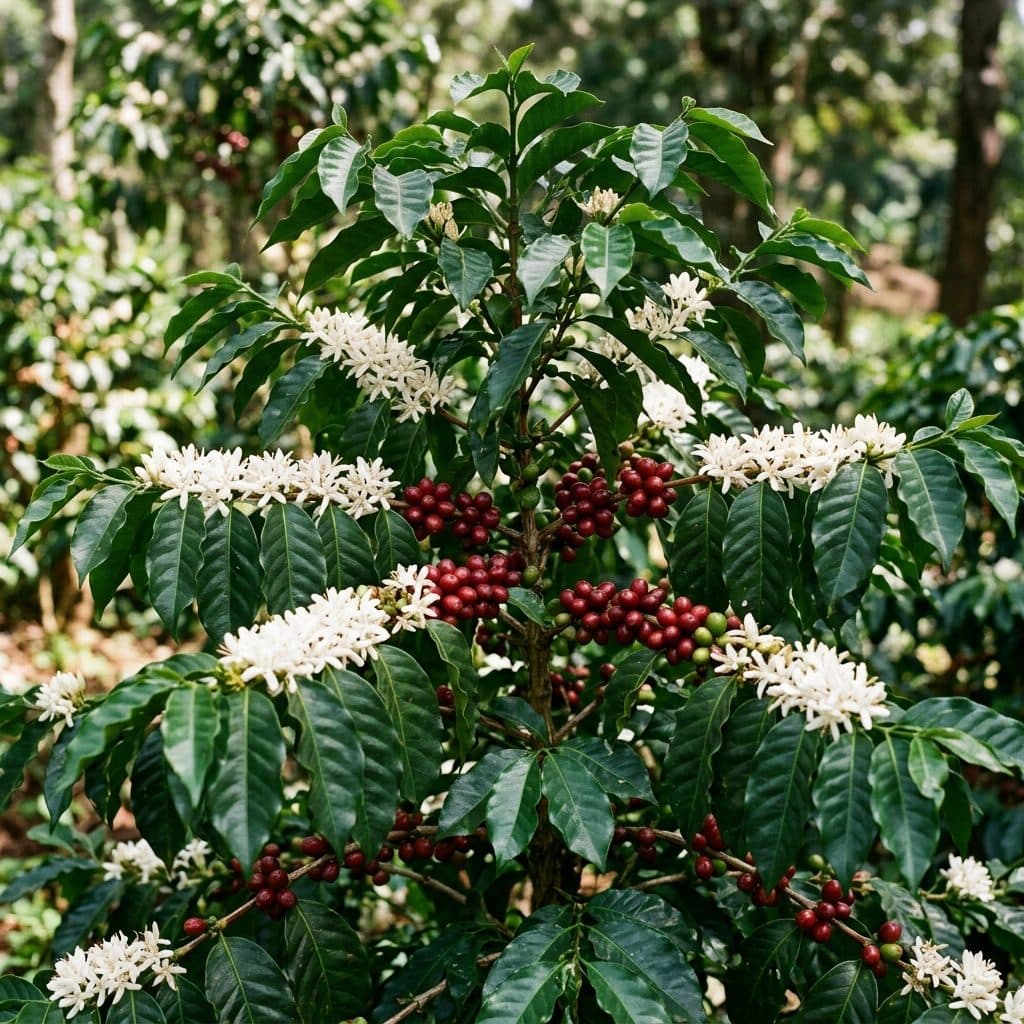
Coffea arabica produces fragrant white flowers that open synchronously following rainfall. Self-fertile Arabica sets fruit reliably without obligate insect pollinators. Cherries mature seven to nine months after pollination, transitioning from green to yellow, red, and finally deep glossy crimson.
Harvesting demands selective hand-picking. Only fully ripe crimson cherries possess the high sucrose concentrations required for fine coffee; harvesting green fruit introduces astringency and bitterness. A mature bush produces multiple ripening flushes over a two- to three-month window, requiring pickers to revisit plants every ten to fourteen days.
Post-harvest processing separates the seeds from the fruit pulp:
- Wet processing: Ripe cherries are depulped within twenty-four hours to expose mucilage-covered parchment beans. The beans ferment in water tanks for 12 to 36 hours while natural enzymes degrade the sticky pectin layer. Once clean, wash beans thoroughly and spread them on raised mesh drying tables under sun until moisture drops to 10 to 12 percent.
- Natural dry processing: Whole cherries are spread directly onto raised drying patios and turned hourly for three to four weeks until husks become brittle and black.
The dried beans remain enclosed in a papery endocarp (pergamino). Hulling removes this shell to yield raw green coffee beans. Roasting at 200 to 230 °C (392 to 446 °F) triggers the Maillard reaction, developing aromatic oils and flavours.
Beyond traditional beans, dried cherry husks (cascara) are steeped with hot water to produce a refreshing fruit tea reminiscent of hibiscus. A mature bush yields 2 to 4 kg (4.4 to 8.8 lb) of fresh cherries annually, producing roughly 400 to 800 g (0.88 to 1.76 lb) of roasted beans.
Identifying arabica coffee plant
Coffea arabica exhibits characteristic vegetative and reproductive traits:
- Form: A compact evergreen shrub growing 2 to 4 m (6.6 to 13 ft) tall in cultivation, with dimorphic branching. The vertical trunk (orthotropic stem) bears horizontal, paired lateral branches (plagiotropic shoots) that produce foliage, flowers, and fruit.
- Leaves: Opposite, simple, dark green, lustrous leaves measuring 8 to 15 cm (3 to 6 in) long and 3 to 6 cm (1.2 to 2.4 in) wide. The blade is elliptic to oblong-ovate with an acuminated apex, undulating margins, and sunken lateral veins creating a corrugated surface.
- Flowers: Pure white, star-shaped, sweetly fragrant flowers measuring 1.5 to 2 cm (0.6 to 0.8 in) across, clustered in axillary cymes of two to nine blossoms. They emit a sweet, jasmine-like scent and last two to three days.
- Fruit: An oval, fleshy drupe measuring 10 to 15 mm (0.4 to 0.6 in) in length, turning from green to bright red and deep purple-crimson. Each cherry contains two hemispherical seeds pressed flat against each other, surrounded by sweet pulp and parchment.
Arabica is distinguished from Robusta coffee (Coffea canephora) by its self-fertile habit, smaller cherries, narrower corrugated leaves with undulating margins, and finer acidity compared to Robusta's larger, rounder fruit and thicker foliage.
Cautions
Growers cultivating Coffea arabica must observe critical toxicological and pathological cautions:
- Severe caffeine toxicity in household pets: All parts of the coffee plant—including green and roasted beans, pulp, cherry skins, leaves, and processing runoff—contain significant quantities of the stimulant methylxanthine alkaloid caffeine. Domestic dogs, cats, and birds cannot metabolise caffeine effectively. Ingestion results in acute caffeine toxicosis within one to two hours, manifesting as restlessness, panting, hyperthermia, vomiting, tachycardia, cardiac arrhythmias, muscle rigidity, seizures, and death. Never use fresh coffee pulp or spent grounds as mulch in areas accessible to pets. Dispose of processing residues securely.
- Coffee leaf rust: The fungus Hemileia vastatrix is the most devastating disease of Coffea arabica worldwide. Symptoms appear as powdery, bright orange-yellow circular pustules on lower leaf surfaces, accompanied by chlorotic spots above. Infection causes rapid defoliation, preventing photosynthesis and causing branch dieback. Maintain open canopies, avoid excessive overhead moisture, and plant rust-tolerant varieties in vulnerable humid regions.
- Coffee berry borer: The small beetle Hypothenemus hampei bores directly into the apical disc of cherries, depositing larvae that consume the internal beans. Prevent infestations through rigorous harvest sanitation: strip every residual cherry from bushes and collect fallen fruit to break the insect's reproductive cycle.
- Temperature vulnerability: Sub-zero freezes cause irreversible structural damage to saplings and kill mature canopies. Conversely, unshaded heat above 32 °C (90 °F) in dry locations scorches leaves and induces flower abortion.
Sources
- Royal Botanic Gardens, Kew. Coffea arabica L. Plants of the World Online.
- Missouri Botanical Garden. Coffea arabica
- USDA PLANTS Database. Coffea arabica L.
- Plants For A Future. Coffea arabica - L.