secondary
American groundnut
Apios americana
International hardiness
- USDA 3-9
- RHS H6
- AU: Cool temperate, Warm temperate
Where it grows — regional guide
| Zones / rating | Regional notes |
|---|---|
USDA 3-9 | Native across eastern and midwestern states; thrives in moist, rich bottomlands and edges of sunny swales. |
| Zones / rating | Regional notes |
|---|---|
H6 (-20 to -15C) | Performs best in damp, fertile garden soil in southern Britain; requires full sun to develop sweet, harvestable tubers. |
| Zones / rating | Regional notes |
|---|---|
Cool temperate, Warm temperate | Suited to cool-temperate and moist tablelands of Victoria and Tasmania; provide steady moisture throughout the summer growing season. |
| Zones / rating | Regional notes |
|---|---|
USDA 3-9 (USDA scale) Canada uses its own zone system; Canadian zones run roughly one lower than USDA. | Indigenous to southern Ontario, Quebec, and New Brunswick; exceptionally cold-hardy down to Zone 3 with reliable snow cover. |
| Zones / rating | Regional notes |
|---|---|
No region-specific data yet | No region-specific data yet |
American groundnut (Apios americana), historically known as hopniss or Indian potato, is a perennial herbaceous climbing vine in the legume family (Fabaceae). Indigenous to damp meadows, stream banks, and rich alluvial bottomlands throughout eastern and central North America, from southern Canada down to the Gulf of Mexico, this native perennial was a foundational winter food staple for Indigenous peoples. Unlike annual root crops, Apios americana produces chains of edible, nutrient-dense tubers along its root system that persist in the soil across severe winters.
In a homestead food forest or permaculture guild, American groundnut serves as a dual-purpose vertical climber and nitrogen-fixer. In symbiosis with Rhizobium soil bacteria, its roots fix atmospheric nitrogen, nourishing adjacent fruit trees and perennial shrubs. While the common potato offers carbohydrate bulk, groundnut tubers provide roughly three times the protein content by dry weight, typically averaging 14 to 17 percent crude protein, accompanied by an array of dietary minerals and essential amino acids.
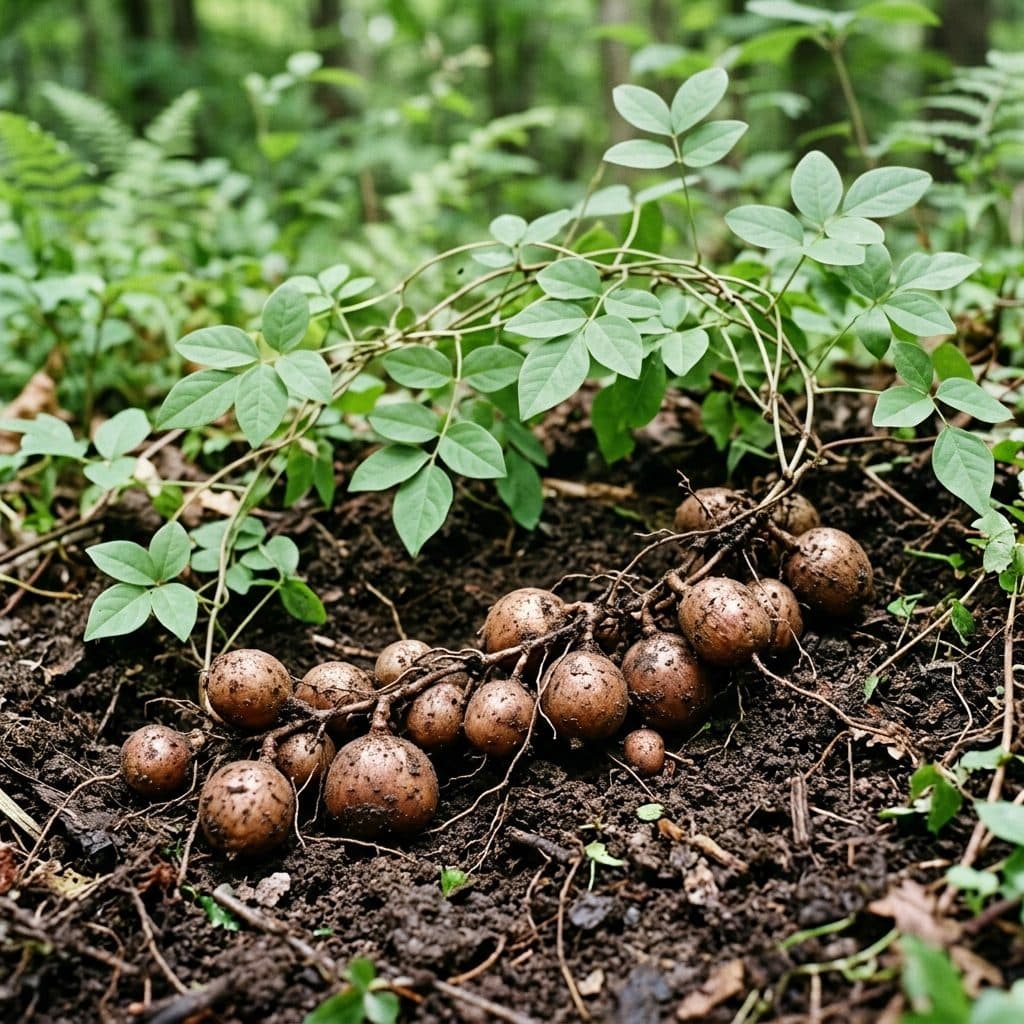
The plant produces slender twining vines that ascend nearby vegetation, bearing dense, fragrant clusters of chocolate-maroon to dusky pink blossoms in midsummer. Beneath the soil, it forms strings of rounded, fibrous tubers connected by slender runners like beads on a necklace. For temperate homesteaders seeking perennial food security, it represents one of North America's most promising indigenous starch and protein crops.
Growing American groundnut
American groundnut is remarkably adaptable across a broad climatic spectrum, flourishing from USDA Hardiness Zones 3 through 9. Fully dormant tubers withstand winter soil freezes down to -35 °C (-31 °F) without protection, while established vines tolerate hot, humid summer conditions without wilting. It requires a frost-free growing season of at least 110 to 120 days to develop substantial underground tubers.
In its natural habitat, the species colonizes moist, low-lying ground, riverbanks, and woodland edges. In cultivation, it performs best in loose, sandy loam or rich, humusy garden soil with a pH between 5.5 and 7.0. While it tolerates seasonal saturation and high water tables far better than most root crops, it develops the largest, easiest-to-harvest tubers in moist, well-drained ground. Heavy, compacted clay restricts tuber expansion and makes digging difficult. Full sunlight produces the heaviest tuber yields and profuse flowering, though plants tolerate light afternoon shade.
Provide regular moisture throughout the growing season. The vine's natural adaptation to riparian floodplains means it has low tolerance for prolonged summer droughts. Incorporating composted organic matter and maintaining a 5 to 8 cm (2 to 3 in) organic mulch conserves root-zone moisture during hot spells. Because it fixes its own nitrogen, supplemental high-nitrogen fertilizers should be avoided; excess nitrogen stimulates excessive vine growth while suppressing tuber development.
Propagation is accomplished primarily by dividing dormant tuber strings. Plant whole tubers 2 to 5 cm (0.8 to 2 in) in diameter, or cut strings into individual segments ensuring each tuber has sound connecting root tissue. Plant tubers 5 to 7.5 cm (2 to 3 in) deep in early spring or autumn. Space individual planting stations 30 to 45 cm (12 to 18 in) apart within rows spaced 1 to 1.5 m (3.3 to 5 ft) apart. Groundnut can also be grown from true seed harvested from mature pods, but seeds possess tough, impermeable seed coats requiring nicking or hot-water scarification before sowing.
Provide a sturdy support structure for the twining vines, which reach 2 to 4 m (6.5 to 13 ft) in length. A standard wire cattle panel, bamboo tepee, or post-and-twine trellis works well. Alternatively, plant groundnut along the base of sturdy perennial stalks like the sunflower, which can serve as a living climbing support. Groundnut is a slow starter during its first season, focusing energy on root establishment; major tuber expansion accelerates during the second and third years.
Harvest and uses
While a modest harvest of small tubers can be lifted at the end of the first season, maximum yields occur after two or three full seasons of undisturbed growth. In established plantings, expect yields of 1 to 2 kg (2.2 to 4.4 lb) of tubers per square meter. Harvest begins in late autumn after killing frosts have withered the vines, and can continue throughout winter and early spring whenever the ground is workable.
Use a sturdy broadfork or spading fork to loosen the soil roughly 30 cm (12 in) away from the plant base. Lift the root mass gently to reveal the strings of connected tubers. Individual tubers measure 2 to 6 cm (0.8 to 2.4 in) in diameter, featuring fibrous, pale brown skin and firm, crisp white flesh. Separate harvestable tubers from the string, replanting the smaller immature tubers and runner tips immediately to ensure continuous production for the following seasons.
Tubers store exceptionally well. Because they possess living root tissue, they can simply be left in the ground and dug as needed throughout the winter. If harvested, wash gently, air-dry the skin, and store in perforated containers filled with damp sand or peat moss at 0 to 4 °C (32 to 39 °F) and high humidity, where they hold for several months.
American groundnut must always be cooked prior to consumption. Raw tubers contain heat-sensitive anti-nutritional factors that interfere with digestion. Thorough boiling, steaming, or roasting neutralizes these compounds. Boiled for 20 to 25 minutes, peeled tubers have a rich, starchy, nutty flavor and dense texture reminiscent of roasted sweet potatoes combined with roasted chestnuts. They can be sliced into soups, mashed with butter, or roasted alongside autumn root vegetables. In addition to the tubers, the tender young green seed pods can be cooked and eaten like green beans, and mature dried seeds can be cooked as dry pulses.
Identifying American groundnut
American groundnut is recognized by its twining vine habit, pinnate foliage, distinctive floral clusters, and subterranean anatomy:
- Habit: Herbaceous, perennial twining vine ascending 2 to 4 m (6.5 to 13 ft), with slender, green to reddish-brown stems that exude a milky sap when broken.
- Leaves: Alternate, pinnately compound, 10 to 20 cm (4 to 8 in) long, consisting of 5 to 7 ovate to lanceolate leaflets. Each leaflet measures 4 to 8 cm (1.6 to 3.2 in) long, with entire margins and pointed tips.
- Flowers: Borne in dense, short, axillary racemes 3 to 8 cm (1.2 to 3.2 in) long during July and August. The pea-like flowers are uniquely colored, exhibiting shades of chocolate-brown, maroon, and dusky purplish-pink, emitting a sweet, violet-like fragrance.
- Fruit: Straight or slightly curved, flattened, slender green legume pods measuring 5 to 12 cm (2 to 4.7 in) long, containing small, bean-like brown seeds.
- Tubers: Subterranean strings of rounded, bead-like tubers measuring 2 to 6 cm (0.8 to 2.4 in) across, connected at intervals of 5 to 15 cm (2 to 6 in) along thin fibrous rhizomes.
The species is distinguished from wild yam (Dioscorea villosa) by its pinnately compound leaves and pea-like flowers, whereas wild yam bears simple, heart-shaped leaves with prominent arcuate veins. It differs from the commercial peanut (Arachis hypogaea) by its climbing vine habit, subterranean strings of stem tubers, and erect racemes of maroon flowers.
Cautions
Growers should observe several culinary and horticultural precautions when working with American groundnut:
- Toxicity of raw tubers: Raw groundnut tubers contain protease inhibitors (specifically trypsin inhibitors) and lectins that inhibit protein digestion in humans. Eating uncooked tubers causes nausea, stomach cramps, and gastrointestinal distress. Always cook tubers thoroughly through boiling, baking, or steaming before consumption.
- Smothering vine growth: The climbing vines twine aggressively around adjacent vegetation. In young orchards or shrub plantings, unmanaged vines can girdle tender tree saplings or smother smaller companion plants under dense vegetative mats. Direct vines onto dedicated trellises away from fragile woody crops.
- Long-term garden persistence: Groundnut spreads underground through runners, and any tuber fragment left behind will sprout in spring. Once introduced to rich, loose soil, it is difficult to eradicate entirely without thorough, systematic digging. Plant in designated perennial zones rather than rotational annual beds.
- Regulatory note: The plant is regulated in some jurisdictions; check your local list before planting.
Sources
- Royal Botanic Gardens, Kew. Apios americana Medik. Plants of the World Online.
- NC State Extension Plant Toolbox. Apios americana
- USDA NRCS Plant Guide. Groundnut (Apios americana)
- Plants For A Future. Apios americana - Medik.
- Missouri Botanical Garden. Apios americana