secondary
Damson
Prunus domestica subsp. insititia
International hardiness
- USDA 5-9
- RHS H6
- AU: Cool temperate, Warm temperate
Where it grows — regional guide
| Zones / rating | Regional notes |
|---|---|
USDA 5-9 | Hardy across USDA Zones 5 to 8; thrives in the Pacific Northwest, Northeast, and mid-Atlantic states with cool, moist summers. |
| Zones / rating | Regional notes |
|---|---|
H6 (-20 to -15C) | Superbly suited to the British climate, particularly the damp valleys of Cumbria and the West Midlands; highly wind-hardy and self-fertile. |
| Zones / rating | Regional notes |
|---|---|
Cool temperate, Warm temperate | Grown successfully in cool-temperate areas of Victoria, Tasmania, and the southern highlands of New South Wales where winter chilling exceeds 700 hours. |
| Zones / rating | Regional notes |
|---|---|
USDA 5-9 (USDA scale) Canada uses its own zone system; Canadian zones run roughly one lower than USDA. | No region-specific data yet |
| Zones / rating | Regional notes |
|---|---|
No region-specific data yet | No region-specific data yet |
The damson tree (Prunus domestica subsp. insititia, often classified as Prunus insititia) is a compact deciduous fruit tree in the rose family (Rosaceae). The damson has been grown throughout Britain and northern Europe for centuries and is one of the hardiest and most dependable stone fruits in cultivation. While closely related to the dessert plum, damsons are distinguished by their smaller, oval fruits, clinging stones, and sharp, astringent flesh that softens into deep, complex spicy sweetness upon cooking.
Historically traced to ancient Damascus, from which the name derives, damsons were widely dispersed across the Roman Empire and naturalised along hedgerows across the British Isles. In temperate food forests and smallholdings, the damson occupies a vital secondary or canopy-edge niche. Its rugged constitution allows it to tolerate wet soils, exposure to prevailing winds, and cool maritime summers that cause tender stone fruits to drop their crop. Often planted alongside apple or sour cherry, a row of damson trees doubles as an effective fruiting windbreak and a dependable annual preserve supply.
Unlike modern hybrid plums bred primarily for fresh dessert eating, the culinary value of the damson lies in its high pectin and tannin concentrations. When simmered with sugar, the dark purple skins dissolve to impart an intense crimson colour and wine-like flavour that makes damson jam, damson cheese, fruit chutneys, and infused gins traditional orchard staples.
Growing damsons
Damsons are adaptable trees that perform across a range of soil types, coping far better with heavy clay and moisture-retentive ground than most other stone fruits. They prefer deep, fertile, moisture-retentive loams with a neutral to slightly alkaline soil pH between 6.0 and 7.0. While they endure damp subsoils, stagnant waterlogged ground should be avoided, as it suffocates roots and predisposes trees to collar rot.
Full sun produces the heaviest crops and highest sugar levels, but damsons also fruit reliably in partial shade and cooler, windier aspects where other plums fail. They require approximately 700 to 1,000 hours of winter chilling below 7 °C (45 °F) to break dormancy and trigger uniform spring blossom.
Trees establish quickly when planted as bare-root specimens during late autumn or winter dormancy. Prepare a planting hole twice the width of the root spread, incorporate well-rotted garden compost into the backfill, and stake the young tree firmly for its first two seasons to prevent wind-rock in exposed locations. Space trees 3.5 to 5 m (12 to 16 ft) apart on semi-vigorous rootstocks such as St Julien A, or 2.5 to 3 m (8 to 10 ft) apart on dwarfing rootstocks such as Pixy.
Most damson cultivars, including the esteemed 'Shropshire Prune' (also known as 'Prune Damson') and 'Merryweather Damson', are self-fertile and fruit reliably without a cross-pollination partner. However, planting alongside compatible plum or gage varieties flowering in the same pollination group will noticeably enhance fruit set.
Pruning requirements differ sharply from pip fruits like apples and pears. All pruning must be performed exclusively in midsummer, between June and August, during dry weather. Pruning stone fruits in autumn or winter creates open wounds that expose the vascular system to airborne spores of silver leaf fungus (Chondrostereum purpureum) and bacterial canker (Pseudomonas syringae). Summer pruning maintains an open, goblet-shaped canopy, encourages fruiting spur renewal, and allows sun to penetrate the interior foliage while natural sap flow seals cut surfaces.
Young trees typically begin bearing fruit within three to four years of planting. Once established, damsons crop heavily and are notorious for biennial bearing if heavy fruit loads are left unmanaged. While individual fruits are too small to thin individually by hand, shaking branches gently in June to dislodge excess fruitlets helps balance the crop and prevents branch breakage under heavy autumn yields.
Harvest and uses
Damsons ripen in late summer and autumn, usually between late August and October depending on regional climate and cultivar. Knowing when to pick damsons depends upon culinary intent. For pectin-rich jams and jellies, harvest fruit while still firm and slightly underripe, as pectin concentration declines as fruit softens. For bottling, baking, and wine making, allow plums to hang on the tree until they turn deep blue-black with a frosty natural bloom, yielding slightly to gentle thumb pressure. A light early autumn frost often softens the tartness of late-hanging fruit.
Harvest by gently twisting individual fruits from the branch, keeping the short stalks intact to extend shelf life. Freshly picked fruit will store in a cool pantry or refrigerator for up to a week. Because of high natural acidity, damsons preserve exceptionally well through freezing; wash and freeze whole fruit on trays before transferring them to bags for winter cooking.
In the kitchen, damsons are cooked whole; the heat causes skins to split and pulp to soften, allowing stones to float to the surface of the preserving pan for easy skimming. Cooked with sugar, damsons produce firm-setting jams and damson cheese, a traditional dense fruit paste sliced to accompany aged cheeses. Steeping pricked damsons in gin or vodka with sugar for three months yields a rich, ruby-tinted cordial prized during winter holidays.
Identifying damsons
The damson is distinguished from other stone fruits by several morphological features:
- Tree habit: Small, compact, spreading deciduous tree reaching 3 to 5 m (10 to 16 ft) in height, often producing a dense, twiggy canopy with short, spur-like branches that may terminate in blunt thorns.
- Foliage: Alternate, ovate to elliptic leaves measuring 4 to 8 cm (1.6 to 3.2 in) long, with finely serrated margins, dark green upper surfaces, and finely pubescent undersides.
- Flowers: Small white, five-petalled blossoms roughly 2 to 2.5 cm (0.8 to 1.0 in) across, borne singly or in pairs along short spurs in early spring before or alongside emerging leaves.
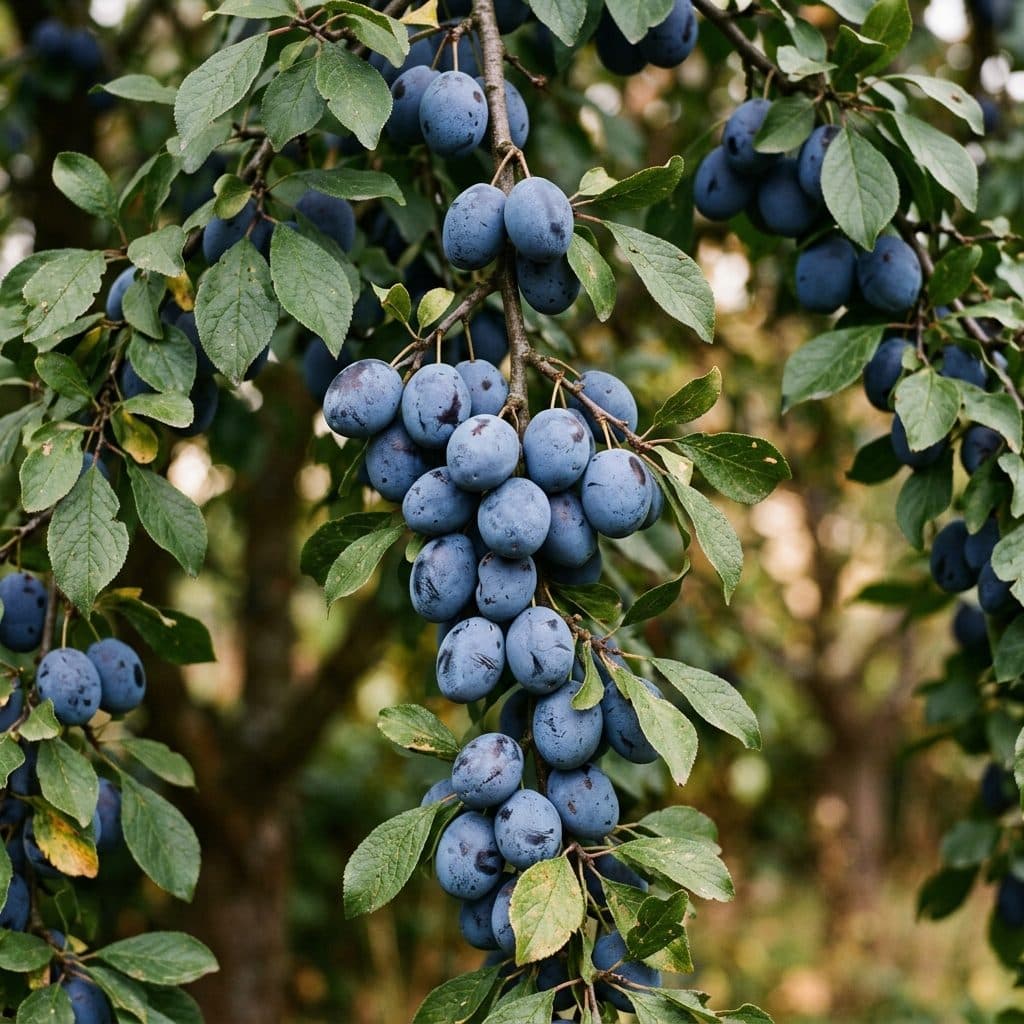
- Fruit: Small, oval or slightly necked drupes measuring 2.5 to 4 cm (1.0 to 1.6 in) long and 2 to 3 cm (0.8 to 1.2 in) wide, significantly smaller than dessert plums. Skin is deep purple to blue-black, coated in a powdery, waxy, glaucous bloom.
- Stone and flesh: Flesh is firm, greenish-yellow, and sharply acidic when raw; the stone (endocarp) is clingstone, remaining tightly attached to the pulp.
The damson is distinguished from the true plum (Prunus domestica subsp. domestica) by its smaller, distinctly oval fruit, clingstone nature, and marked astringency. It differs from the bullace (Prunus domestica subsp. insititia var. insititia), which produces spherical, marble-shaped fruit that ripens later in November, and from the wild blackthorn (Prunus spinosa), which possesses fiercely spiny branches and smaller, round, inedibly bitter sloes measuring barely 1 to 1.5 cm (0.4 to 0.6 in).
Cautions
Cultivating and processing damsons requires attention to several safety and arboricultural considerations:
- Stone toxicity: Damson stones contain kernels rich in amygdalin, a cyanogenic glycoside that enzymatic action hydrolyses into toxic hydrogen cyanide upon ingestion. While cooking whole fruit in preserves poses no risk because stones remain intact, kernels should never be cracked open, crushed, or eaten. Remove stones from children's portions.
- Silver leaf disease: The silver leaf fungus (Chondrostereum purpureum) is the primary killer of damson trees in damp climates. It enters through fresh wounds in autumn and winter, turning foliage an abnormal leaden or silvery sheen and killing infected branches. Never prune damson trees during wet or dormant winter periods; restrict pruning strictly to dry midsummer days.
- Bacterial canker: Wet, cool spring weather encourages Pseudomonas syringae, which causes sunken bark lesions that exude amber-coloured gum, leading to branch girdling and shoot dieback. Plant in well-drained sites and treat persistent wounds.
- Heavy branch loading: Mature trees frequently set excessive fruit loads that snap unpruned lateral limbs. Support heavy branches with wooden props in late summer to prevent structural splitting.
- Root suckering: Trees grown on their own roots or vigorous rootstocks produce numerous root suckers around the base. Remove suckers at their point of origin on the root to prevent the tree from forming an unmanageable bramble thicket.
Sources
- Royal Botanic Gardens, Kew. Prunus domestica subsp. insititia (L.) Bonnier & Layens Plants of the World Online.
- Royal Horticultural Society. Plums, damsons and gages: grow your own
- Plants For A Future. Prunus insititia - L.