secondary
Greengage
Prunus domestica subsp. italica
International hardiness
- USDA 5-9
- RHS H6
- AU: Cool temperate, Warm temperate
Where it grows — regional guide
| Zones / rating | Regional notes |
|---|---|
USDA 5-9 | Performs well in USDA Zones 5 to 8 across the Pacific Northwest and northern California; avoid areas with extreme spring frost or intense humid summers. |
| Zones / rating | Regional notes |
|---|---|
H6 (-20 to -15C) | Best planted against a warm south- or west-facing wall in southern England or sheltered gardens; requires warmth to develop high sugar content. |
| Zones / rating | Regional notes |
|---|---|
Cool temperate, Warm temperate | Grown in cool-temperate areas of Victoria, Tasmania, and the Adelaide Hills with at least 600 hours of winter chilling and dry late-summer ripening. |
| Zones / rating | Regional notes |
|---|---|
USDA 5-9 (USDA scale) Canada uses its own zone system; Canadian zones run roughly one lower than USDA. | No region-specific data yet |
| Zones / rating | Regional notes |
|---|---|
No region-specific data yet | No region-specific data yet |
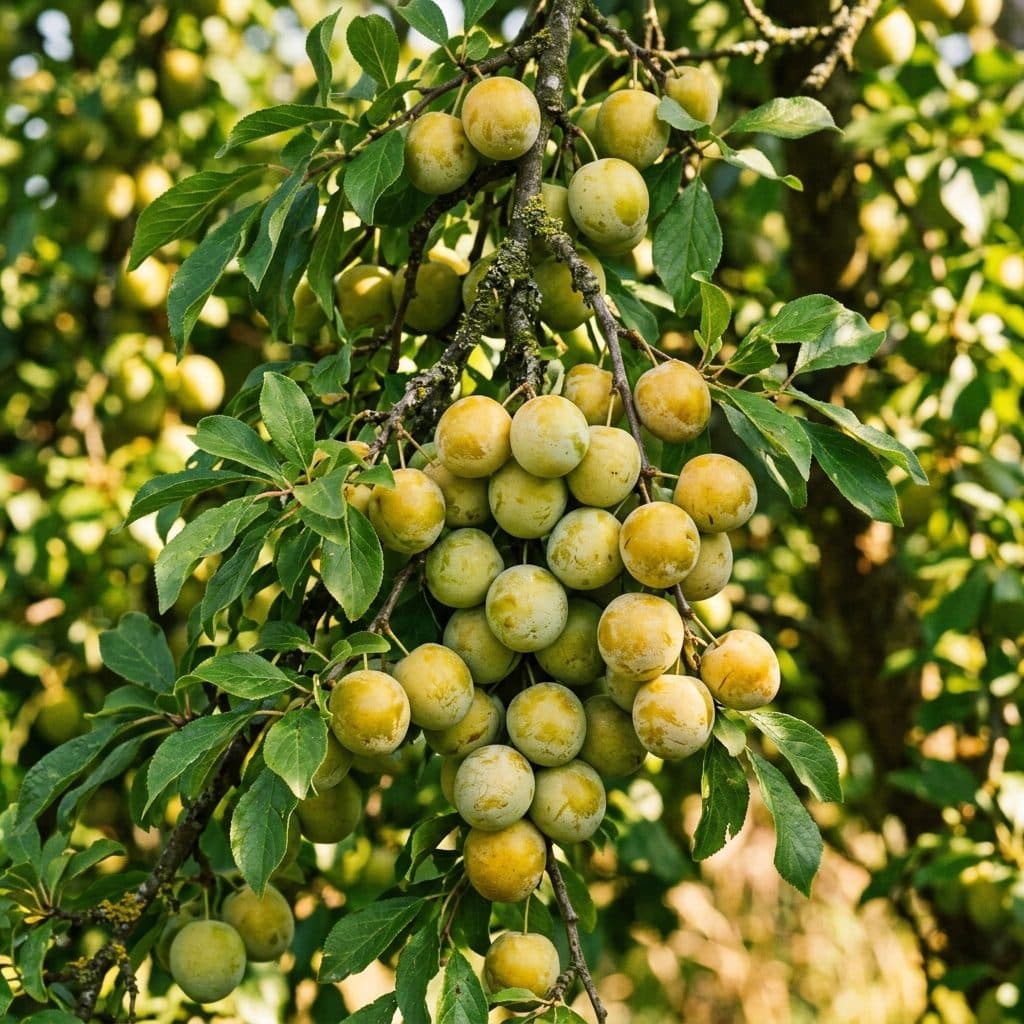
The greengage tree (Prunus domestica subsp. italica, historically known as Prunus domestica var. claudiana) is a deciduous stone fruit tree in the rose family (Rosaceae). Widely regarded by horticulturists as the finest dessert plum, the greengage is celebrated for its honey-like sweetness and melting texture. The tree produces round, greenish-yellow fruits that retain their distinctive green tint even when ripe, often developing subtle red speckles and a delicate powdery bloom where exposed to afternoon sun.
Originating in the Near East and cultivated in France since the Renaissance under the name Reine Claude, the variety was introduced to Britain in the eighteenth century by Sir William Gage. In homestead orchards and permaculture guild designs, the greengage tree fills a sheltered sub-canopy role. While standard European plum trees exhibit greater cold resilience in exposed orchards, greengages reward protected microclimates with dessert fruit of unmatched quality. Planting greengages alongside stone and pip fruits such as sour cherry and pear establishes a diverse sequence of harvest throughout late summer and autumn.
The culinary distinction of the greengage lies in its balance of sugars, aromatic volatiles, and tender skin. While other green plums are acidic and reserved for stewing, a tree-ripened greengage is consumed fresh as a dessert fruit, eaten whole from the branch. Surplus harvests yield delicately flavoured jams, fruit tarts, and poached compotes that preserve the fruit's floral essence.
Growing greengages
Greengages demand more warmth and sun than culinary plums or damsons. To achieve full sugar development, trees require a sheltered site receiving at least six to eight hours of direct light daily. In cooler northern maritime regions, training greengage trees as espaliers or fans against a heat-retaining masonry wall maximises ambient warmth and protects early spring blossoms from cold winds.
Soil requirements are specific: greengages perform best in deep, fertile, moisture-retentive loams with excellent drainage and a neutral pH of 6.5 to 7.0. Heavy, waterlogged clay suffocates feeder roots and induces root rot. Incorporating organic matter and sharp grit into heavy soils prior to planting improves aeration and drainage.
Establish bare-root trees during winter dormancy, from November through March, when the soil is frost-free. Space trees 3.5 to 4.5 m (12 to 15 ft) apart on semi-vigorous rootstocks such as St Julien A, or 2.5 to 3 m (8 to 10 ft) apart on dwarfing rootstocks such as Pixy.
Pollination is a critical factor when growing greengages. Many traditional varieties, including 'Old Greengage' (true Reine Claude), are self-sterile or partially self-fertile, setting sparse crops in isolation. To guarantee heavy fruit set, plant a compatible pollination partner flowering in the same pollination group, such as 'Victoria' plum or 'Denniston's Superb' gage. For gardens with space for only one tree, self-fertile cultivars such as 'Cambridge Gage', 'Oullins Golden Gage', or 'Denniston's Superb' are recommended, as they crop reliably without cross-pollination.
Trees require roughly 600 to 800 hours of winter chilling below 7 °C (45 °F). Blossom emerges in early April, making the tree vulnerable to late frosts. In frost-prone sites, cover wall-trained trees with fleece on freezing nights.
Pruning must be carried out exclusively during midsummer, from June to early August, in dry weather. Pruning stone fruit trees in winter leaves open cuts susceptible to airborne spores of silver leaf fungus (Chondrostereum purpureum) and bacterial canker (Pseudomonas syringae). Summer pruning maintains an open centre, removes water shoots, and allows sunlight to ripen fruit while active sap flow seals wounds naturally.
Harvest and uses
Determining when greengages are ripe requires close observation. As harvest approaches in late August or early September, skin softens from pale lime-green to translucent golden-amber, often adorned with tiny crimson freckles on the sunward side. The waxy bloom turns chalky white, and fruit yields slightly to gentle pressure near the stalk, releasing a honeyed aroma.
Harvest fruit with stalks attached by gently lifting and twisting the plum upward. Handle greengages with care, as thin skins bruise easily. Eat fresh dessert fruit within three to five days, as greengages do not keep long once fully ripe.
Fresh greengages are an incomparable dessert fruit, eaten out of hand. In the kitchen, the fruit can be halved and baked into tarts, poached in syrup, or simmered into pale, fragrant jam. Greengages also freeze well; halve the fruit, discard stones, and freeze raw halves on parchment before bagging for winter baking.
Identifying greengages
The greengage tree exhibits several diagnostic botanical characteristics:
- Habit: Small to medium deciduous tree reaching 3 to 4.5 m (10 to 15 ft) in height, forming a rounded crown with smooth grey-brown bark that fissures with age.
- Leaves: Alternate, ovate to broadly elliptic, 5 to 9 cm (2 to 3.5 in) long and 3 to 5 cm (1.2 to 2 in) wide, with finely crenate margins and bright green upper surfaces.
- Flowers: Five-petalled white flowers measuring 2 to 2.5 cm (0.8 to 1.0 in) across, appearing in small clusters on short spurs in early spring before or with emerging foliage.
- Fruit: Globose (spherical) drupes measuring 3 to 4.5 cm (1.2 to 1.8 in) in diameter, with a shallow suture line. Skin is translucent yellowish-green to golden-green, dusted with a whitish bloom and occasional red russet dots.
- Stone and flesh: Flesh is green to pale golden, exceptionally juicy and sweet; the stone is free to semi-clingstone with a smooth endocarp.
Greengages are distinguished from standard European plums (Prunus domestica subsp. domestica) by their spherical shape, green skin colour at maturity, and higher sugar content. They differ from damsons (Prunus domestica subsp. insititia) in having round, sweet dessert fruits rather than small, oval, astringent culinary plums.
Cautions
Growers should observe several management considerations and health caveats:
- Kernel toxicity: Greengage pits contain seeds rich in amygdalin, a cyanogenic compound that releases toxic hydrogen cyanide when chewed and digested. Discard stones when preparing fruit, and ensure children never crack open the internal seed.
- Rain splitting and brown rot: Thin skins absorb moisture rapidly. Heavy rain immediately prior to harvest can cause fruits to split open, allowing brown rot fungus (Monilinia fructigena) to infect the crop within hours. Remove and destroy split fruits promptly to prevent spore spread.
- Silver leaf susceptibility: Pruning during damp or winter weather invites infection by silver leaf (Chondrostereum purpureum), causing foliage to turn silver and killing branches. Always prune strictly between June and August in dry weather.
- Wasp and bird damage: High sugar levels attract wasps, hornets, and songbirds as fruit softens. Protect prized crops with fine netting or install wasp traps around the orchard perimeter.
- Pollination requirements: Planting a self-sterile cultivar without an appropriate pollinator results in sparse crops. Always verify the pollination requirements of your chosen cultivar before planting.
Sources
- Royal Botanic Gardens, Kew. Prunus domestica subsp. italica (Borkh.) Gams Plants of the World Online.
- Royal Horticultural Society. Plums, damsons and gages: grow your own
- Plants For A Future. Prunus domestica italica