Ask whether you can grow Phaseolus vulgaris (the common bean) and most hardiness charts will mislead you. Plant databases, ours included, often file the common bean as USDA zones 10–11, RHS H2, suited to warm-temperate, subtropical and tropical climates. That band describes where the plant could survive year-round, but the common bean is grown almost nowhere as a perennial. It is a fast, frost-tender summer annual, and that single fact rewrites the map: gardeners from Scotland to Scandinavia to southern Canada grow excellent crops every year, despite living far outside zone 10.
You can almost certainly grow common beans in your zone, provided you time planting to your frost window instead of your hardiness number. This guide shows you how to read that window, and why slipping a row of beans into a regenerative bed pays you back in living soil as well as dinner.
Hardiness zones vs. the growing window: read this first
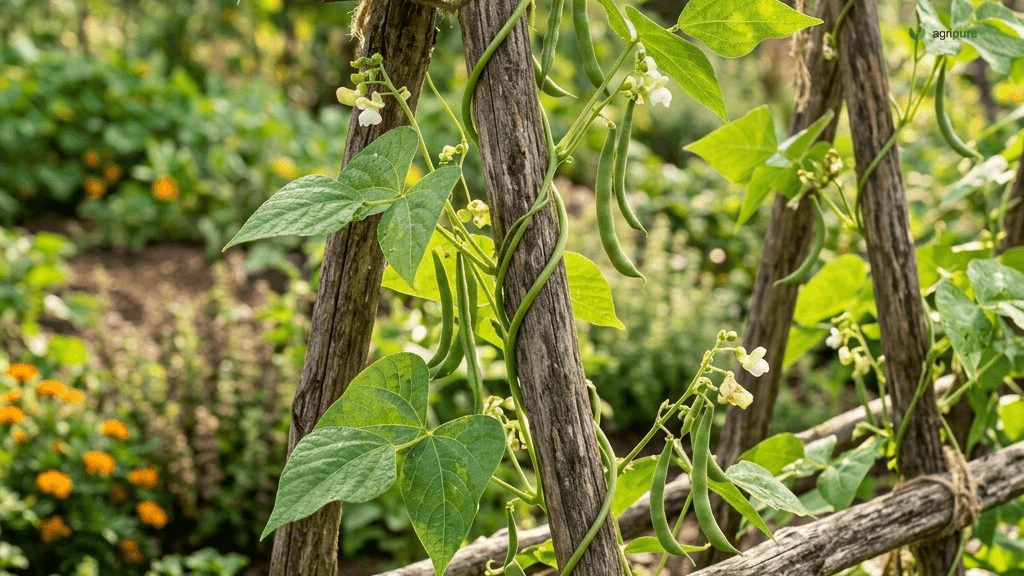
Plump green snap beans hang from climbing vines in a sunny backyard vegetable garden.
Climbing common bean pods mature on a trellis, providing fresh food and soil nitrogen.
Hardiness ratings (USDA, the UK’s RHS H-scale, and Australia’s climate-zone system) answer one question: how much winter cold can a plant survive? For a tender annual that completes its whole life cycle between two frosts, that question is almost irrelevant. The common bean is killed outright by frost and its seedlings sulk or rot in cold, wet soil, so what matters is the length and warmth of your frost-free season, not your winter minimum.
The common bean (Phaseolus vulgaris) was domesticated in the Americas; genetic and archaeological evidence points to two centres, Mesoamerica and the Andes, with domestication dated roughly 5,000 to 2,000 years BC. Its wild ancestors were warm-season vines, which is why the crop carries that tropical-leaning database band but behaves as an annual everywhere.
The practical translation for international readers:
- USDA 10–11 (true year-round band): beans can be grown across two or even three sowings a year, often pausing only in the hottest weeks.
- USDA 7–9 / RHS H4–H3 / warm-temperate and Mediterranean Australia: a long single summer season, sometimes a spring and an autumn crop.
- USDA 3–6 / RHS H7–H5 / cool-temperate Australia and most of the UK: one reliable summer crop, started after the last frost.
In every case you are growing the same plant the same way, as a summer annual keyed to frost dates.
The frost window: timing that actually works
Two temperatures govern success, and neither appears on a hardiness map.
Soil temperature drives germination. Bean seed sown into cold ground germinates slowly and erratically, leaving it prey to rot and soil-borne pathogens. Reputable guidance is consistent: seed may sprout from about 10°C (50°F), but emergence is unreliable until soil holds around 15–16°C (60°F), and the ideal range for fast, even emergence is roughly 16–29°C (60–85°F). Plant according to soil temperature rather than relying on the calendar.
Frost ends the crop. Both the spring and autumn frost dates are hard boundaries; a light frost will flatten beans. Young plants are also checked by cold spells well above freezing, struggling below about 5°C (41°F). The reliable rule is to sow only after your last expected spring frost, once the soil has warmed to at least 12–15°C (55–60°F), and to count back from your first autumn frost to be sure the variety can finish.
Counting back from your first autumn frost
Most common beans mature quickly, which is exactly why they fit short seasons. Bush types typically crop in about 50–65 days from sowing; pole (climbing) types take longer, often 60–90 days, and keep producing once they start. Add a safety margin of 10–14 days for cool weather, then check that interval fits between your soil-warm sowing date and your first autumn frost.
Your situation | When to sow | Best bet |
|---|---|---|
Short cool-temperate season (UK, cool AU, USDA 3–5) | 1–2 weeks after last frost, soil 15°C+ | Fast bush beans; start under cover to gain 2–3 weeks |
Long warm-temperate / Mediterranean season | After last frost; optional second sow midsummer | Pole beans for a long harvest; succession-sow bush types |
Subtropical / tropical (USDA 10–11) | Cooler, drier months; avoid peak heat and monsoon | Two or three crops; watch heat-induced flower drop |
Stretching a short season
Cool-climate growers are not stuck with the soil-temperature wall. Start seed indoors 2–3 weeks before your last frost and transplant carefully (beans dislike root disturbance, so use deep cells or soil blocks). Warming the bed with black plastic or a cloche for a week before sowing lifts soil temperature into the reliable range and brings emergence forward.
The soil-building bonus: beans as a regenerative pioneer
The common bean earns a place in a regenerative bed as well as a vegetable plot. Like all legumes, it forms a partnership with Rhizobium bacteria in root nodules that convert atmospheric nitrogen into a plant-available form. In our plant database the common bean is classed as a nitrogen-fixing pioneer, a quick-establishing species that begins feeding the soil while slower perennials get going.
Be realistic about the numbers, though. Among legumes the common bean is a modest fixer. Field studies typically report fixation in the range of about 25–70 kg of nitrogen per hectare (commonly under 50 lb N per acre), well below specialists like clover or vetch, and highly variable with genotype and soil. In practice, most of that nitrogen leaves the plot inside the harvested grain, so the gift to the next crop is real but limited.
Three practices turn that modest fixation into genuine soil building:
- Inoculate the seed. If your soil has not grown beans recently, coat the seed with the correct Rhizobium strain. Better nodulation means more fixation and stronger plants.
- Return the residues. Pick the pods and chop the leafy, root-bearing plants back into the bed instead of discarding them. The nitrogen-rich roots, nodules and foliage feed the soil food web and add organic matter.
- Undersow and rotate. Follow beans with a leafy or fruiting crop that appreciates the residual nitrogen, and let beans break up cereal-heavy rotations.
A regenerative role in the garden
Common beans work best as a contributor to a guild alongside other crops. Pair them with deep-rooted or hardier legumes so the planting covers more of the year. Where you need a tougher or longer-lived fixer, look to relatives that suit different niches: the cold-hardy broad bean (USDA 6–10, RHS H4) sown in autumn or very early spring; the heat- and drought-tough cowpea for hot, dry summers; the heat-loving lima bean in long warm seasons; and the shrubby, semi-perennial pigeon pea for a multi-year nitrogen source in frost-free zones. Rotating and combining these spreads both your harvest and your soil benefit across the calendar and the temperature range.
Quick-start checklist for any zone
- Find your last spring and first autumn frost dates; these define your window.
- Wait until soil reaches 15°C (60°F); sow direct, or start indoors to gain a few weeks.
- Match variety to season: fast bush beans for short summers, pole beans for long ones.
- Inoculate seed if beans are new to the bed.
- Harvest pods regularly to extend cropping; chop spent plants back into the soil.
Frequently asked questions
My zone is listed as 6: can I really grow Phaseolus vulgaris?
Yes. The zone-10–11 rating describes year-round survival, which is irrelevant for an annual that lives and dies between frosts. In zone 6 you grow common beans as a summer crop, sown after the last frost when the soil hits about 15°C, and harvested before the first autumn frost. Cool-zone gardeners do this routinely.
Do common beans really improve my soil, or is that overstated?
They help, modestly. They fix their own nitrogen with Rhizobium bacteria, but they are weaker fixers than clovers or vetches, and most of the fixed nitrogen leaves in the harvested beans. The lasting benefit comes from inoculating the seed, returning the roots and foliage to the bed, and rotating beans with hungry crops.
What is the difference between bush and pole beans for timing?
Bush beans are compact, need no support, and mature fast (about 50–65 days) in a concentrated flush, making them well suited for short seasons and succession sowing. Pole beans climb to 2–5 m, take longer to start (around 60–90 days) but crop steadily for weeks, making the most of a long warm season.
Sources
- Phaseolus vulgaris — Wikipedia (botany, growth habits, domestication and gene pools)
- Mesoamerican origin of the common bean (Phaseolus vulgaris L.) revealed by sequence data — PMC/PNAS
- Growing Beans: Planting, Growing, and Harvesting — The Old Farmer’s Almanac (frost timing, soil temperature, bush vs. pole)
- Nitrogen Fixation by Legumes (Guide A-129) — New Mexico State University Extension
- Seedling Emergence and Phenotypic Response of Common Bean Germplasm to Different Temperatures — PMC