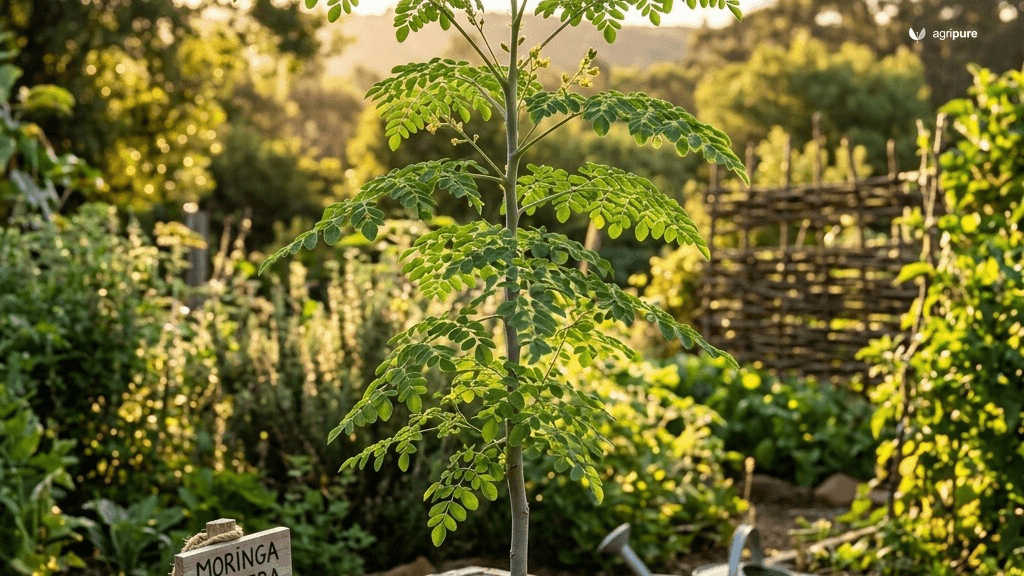
Moringa (Moringa oleifera), the so-called “miracle tree,” is one of the most asked-about plants in temperate gardening circles. The leaves carry roughly 9.4 grams of protein per 100 grams plus vitamin C, vitamin K, beta-carotene, calcium and iron, and the young pods, the “drumsticks” of South Asian kitchens, are a vegetable in their own right. No wonder gardeners in Manchester, Melbourne and Minnesota all want one. The honest question is not whether moringa is worth growing, but whether your winter will let you. This guide gives the real answer by zone.
The short answer: where moringa actually survives
Delicate compound leaflets of a Moringa tree silhouetted against a warm cream background.
Moringa oleifera (miracle tree) foliage demonstrating tender, highly nutritious leaf growth.
Moringa is a true tropical and subtropical species. In the AgriPure database it sits at USDA zones 9-12, RHS hardiness H1c, and is suited to Australian tropical, subtropical and arid climates. In plain terms, it is comfortable outdoors year-round only where frost is rare or absent.
The cold thresholds are well documented and worth memorising:
- Below about 4 C (40 F): leaves yellow and drop, and the tree slides into dormancy. This is not death, it is the plant shutting down.
- Around -1 C to -3 C: the danger zone. Research on freezing tolerance puts moringa’s LT50, the temperature that kills half of exposed tissue, at roughly -2.8 C, and the species shows essentially no cold acclimation, meaning a gradual chill does not toughen it up.
- A hard freeze or snow: unprotected top growth dies. Whether the plant returns depends entirely on whether the roots stayed warm enough.
That last point is the whole game for cooler-climate growers. The visible tree is expendable; the rootstock is what you are trying to carry through winter.
Why moringa is worth the trouble: a fast pioneer
Moringa earns its keep with speed. It is a short-lived, drought-tolerant pioneer that can put on three to four metres in its first year from seed, and it responds to hard cutting like few other trees, several new shoots flush from below the cut. In a young, warm food-forest system it is a textbook pioneer: it sprints up, casts light shade, and produces harvestable leaf within months while slower climax trees establish underneath. In AgriPure’s classification it is a pioneer grown for food, fodder and medicine.
If you garden in genuinely warm climates, pair moringa with other fast tropical support and food species rather than treating it as a specimen. Leucaena and Quickstick (Gliricidia) are nitrogen-fixing support trees in the same USDA 9-12 / H1c band that feed the system as moringa drives the canopy. Vegetable Hummingbird (Sesbania grandiflora) is another fast nitrogen-fixing pioneer with edible flowers, and Pigeon pea is a shrubby nitrogen-fixer that, usefully, stretches into warm-temperate zones where moringa struggles. Use these to build a guild; moringa alone is a sprinter, not a system.
Zone-by-zone playbook
Your climate | Strategy | What winter looks like |
|---|---|---|
USDA 10-12 / RHS H1c / AU tropical-subtropical | Grow in the ground as a permanent tree or coppiced shrub. | No real winter problem; harvest year-round or near it. |
USDA 9 / warmer 8 / AU warm-temperate fringe | In-ground but cut back and heavily mulch the root crown each autumn. | Top dies in a frost; roots resprout in spring. |
USDA 7-8 / RHS H3-H4 zones | Large container, or in-ground with a chicken-wire-and-mulch “jacket” over the cut stump. | Borderline. Root protection is mandatory and not guaranteed. |
USDA 1-6 / most of the UK / AU cool-temperate | Container only, moved indoors or to a heated greenhouse for winter. | True freeze and snow; outdoors is fatal. |
Warm zones (USDA 10-12, H1c, AU tropical/subtropical)
This is moringa’s home turf. Plant it in the ground, give it full sun and free-draining soil, and let it grow. Most growers coppice rather than let it tower: cut it back to roughly one metre annually and it rebounds with leaf and pods within easy reach. Cut harder, to the ground, and you get a multi-stemmed bush. Either way you are working with the plant’s natural vigour, not against it.
The frost-fringe (USDA 8-9, AU warm-temperate edge)
Here moringa can live outdoors but will not sail through winter untouched. The reliable method exploits the root-versus-top split: in late autumn, cut the tree down to a 60-90 cm stump, then build an insulating collar. Wrap chicken wire around the stump and pack it with wood mulch, fallen leaves, packed straw, or even old blankets. Plant against a south- or west-facing wall to bank daytime heat. The top growth is sacrificed; the goal is keeping the crown above the lethal -3 C so it resprouts when soil warms.
Cold zones (USDA 1-6, most of the UK, AU cool-temperate)
Where it freezes and snows, grow moringa in a pot, full stop. Start in a container of at least 50 cm diameter, or a 40-60 litre tub for a tree you intend to keep multiple years, and use a free-draining mix. The annual rhythm is simple:
- Spring-summer: outdoors in the sunniest spot you have, watered freely and pinched at the growing tip to force a bushier, denser plant that fits indoors.
- Autumn: bring it in before nights drop below roughly 10-13 C; many growers move it once daytime temperatures fall below about 18 C to avoid any chill check.
- Winter: expect it to drop its leaves and go dormant. This is normal. Keep it in the warmest, brightest room you have, or under a grow light, and water sparingly, just enough that the rootball does not bone-dry, because overwatering a dormant, cold plant rots the roots.
- Late winter: prune to shape just before spring, which stimulates the new flush.
A dwarf or container strain bred for compactness makes this far more manageable than wrestling a full-sized tree through your living room each November.
Common mistakes that kill overwintered moringa
- Watering a dormant plant like an active one. Cold, wet, leafless moringa is the classic root-rot casualty. Cut water back hard in winter.
- Waiting for frost before acting. By the time you see frost damage, you may already be at or past the -3 C lethal point. Move or wrap on the forecast, not on the symptom.
- Assuming a dead-looking stick is dead. A leafless, shrivelled top is often just dormant. Scratch the bark, if there is green underneath, or the roots were protected, wait until late spring before giving up.
- Letting it get pot-bound and starved. A vigorous pioneer in a small pot stalls. Pot up and feed during the growing season.
FAQ
Will moringa come back after a frost?
Often yes, if the roots stayed warm. A light frost typically kills the top growth but not a well-mulched or potted root system, and the plant resprouts from the base in spring. A hard freeze reaching the roots, or temperatures near -3 C at the crown, will kill it outright. The rule of thumb: protect the root, write off the top.
Can I grow moringa indoors all year in the UK?
You can keep it alive indoors, but it will not thrive the way it does in tropical sun, and it will likely go dormant in the darkest months regardless. The best UK approach is a container that summers outdoors and overwinters in a bright, heated space. Treat the winter as survival, not production.
How cold is too cold for moringa?
Leaves drop and dormancy begins below about 4 C (40 F). The plant can shrug off a brief touch of frost, but sustained temperatures around -1 to -3 C cause severe damage, with about -2.8 C being the point at which half the tissue dies. Anything colder, or any snow on unprotected growth, should be treated as fatal.
Sources
- Yan, F. et al. Chilling and freezing stress tolerance in Moringa oleifera Lam. Scientia Horticulturae (ScienceDirect). sciencedirect.com
- Moringa oleifera. Wikipedia (growth habit, coppicing, drumstick pods, leaf nutrition: 9.4 g protein per 100 g). en.wikipedia.org
- Can You Grow Moringa In Cold Climates? Morning Gardens (dormancy thresholds, root protection, container overwintering). morningardens.com
- Health Benefits, Nutrition, Uses and Side Effects of Drumstick (Moringa). Netmeds Health Library. netmeds.com