Key takeaways
- Monitor codling moth activity with pheromone traps starting when evening temperatures consistently reach 50°F.
- Apply kaolin clay as a protective barrier to fruit and foliage, beginning at petal fall and reapplying every 7 to 14 days.
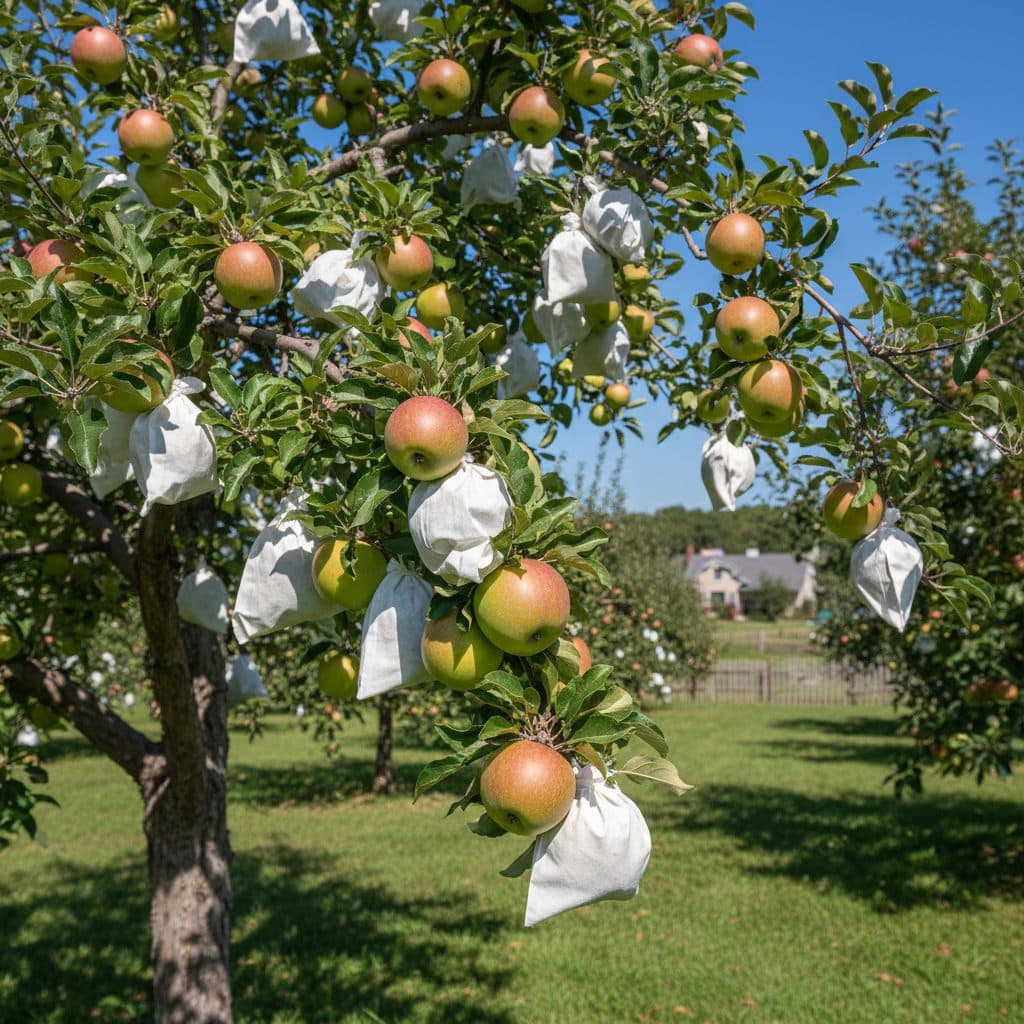
- Bag individual fruit when apples or pears are 0.5 to 1 inch in diameter to prevent larval entry.
- Implement orchard sanitation by promptly removing and disposing of fallen fruit and scraping loose bark where mature larvae pupate.
- Target the first and second generations of codling moth for the most effective control throughout the growing season.
Quick answer: To control codling moth in backyard apples and pears, use a multi-pronged approach including monitoring with pheromone traps, applying kaolin clay, and bagging individual fruit, especially targeting the first two generations.
In California’s Central Valley, codling moth (Cydia pomonella) has been a persistent challenge for apple and pear growers for over 80 years, documented as early as 1944 [1]. This small, mottled brown moth can cause significant damage, leading to wormy fruit that is unmarketable or inedible. For backyard growers across USDA zones 4 through 9, managing this pest without harsh synthetic chemicals requires a combination of vigilance and timely intervention.
Successfully protecting your backyard apples and pears from codling moth involves understanding its life cycle and employing a multi-pronged approach. This guide focuses on practical, accessible methods for the home grower, including monitoring with pheromone traps, creating physical barriers with fruit bags, and applying kaolin clay, all grounded in effective, proven strategies for orchards ranging from a single tree to a small acre.
Understanding the codling moth life cycle
Effective codling moth control begins with understanding its life cycle, which typically involves two to four generations per year in temperate climates like USDA zone 6 [2]. The first generation of moths emerges in spring, but sustained flight and mating need warmer evenings than the 50°F base temperature used for degree-day tracking. These adult moths mate, and females lay tiny, disc-shaped eggs on leaves or developing fruit. After 7 to 14 days, larvae hatch and bore into the fruit, feeding near the core for 3 to 5 weeks. A single larva can damage multiple fruits, causing significant loss.
Key stages and timing for control
Once larvae mature, they exit the fruit, drop to the ground, or crawl down the tree trunk to pupate in protected locations, such as under bark scales or in soil. This pupation period can last 10 to 30 days, after which a new generation of adult moths emerges. In regions with long, hot growing seasons, a third or partial fourth generation can occur, which makes continuous monitoring and management important. Targeting the first two generations is often the most critical for reducing overall population levels and preventing widespread damage, which can exceed 50% of an unprotected crop.
- Egg hatch: Occurs 7-14 days after egg laying.
- Larval entry: Young larvae bore into fruit within 24-48 hours of hatching.
- Pupation: Larvae pupate in cocoons, often in bark crevices or soil.
- Adult emergence: New moths emerge to mate and lay eggs for the next generation.
- Generations per year: Typically 2-4, depending on climate and degree days accumulated.
Monitoring with pheromone traps
Pheromone traps are an indispensable tool for backyard growers, providing an accurate indication of codling moth activity and helping to time control measures. These traps release a synthetic female codling moth sex pheromone, attracting male moths. By counting the number of moths caught, you can determine when the moths are flying and when to apply treatments. Place traps in your orchard when evening temperatures consistently reach 50°F, typically in early spring in regions like the Mid-Atlantic, before bloom. For best results, hang traps in the upper third of the tree canopy, away from direct sunlight, and at least 30 feet apart if using multiple traps.
Trap placement and interpretation
Check traps every 2 to 3 days, especially during peak flight periods. A sustained catch of one to two moths per trap per week indicates significant activity, signaling the need for intervention. Pheromone traps are a monitoring tool, not a control method. Mating disruption is a separate technique that uses pheromone dispensers rather than traps, and extension guidance consistently reports that it works poorly in small blocks, so a backyard grower cannot rely on it in place of barriers and sanitation. Replace pheromone lures every 3 to 4 weeks, as their effectiveness diminishes over time. Consider using a soil moisture meter to ensure your trees are not stressed, as stressed trees can be more susceptible to pest damage.
- Trap type: Delta traps or sticky wing traps are common.
- Placement height: Eye level, in the upper third of the tree canopy.
- Spacing: At least 30 feet apart for multiple traps.
- Monitoring frequency: Check every 2-3 days during active flight.
- Lure replacement: Every 3-4 weeks for optimal attraction.
Physical barriers: bagging and kaolin clay
Physical barriers offer a direct and effective way to protect individual fruits from codling moth larvae. Fruit bagging, while labor-intensive for large orchards, is highly practical for a few backyard trees. Begin bagging apples and pears when they are about 0.5 to 1 inch in diameter, typically 2 to 3 weeks after petal fall. Use specialized fruit protection bags made of paper, nylon, or fine mesh, securing them tightly around the stem to prevent moth entry. This method can provide nearly 100% protection for the bagged fruit.
Applying kaolin clay for protection
Another physical barrier option is kaolin clay, a naturally occurring white clay that forms a protective film on fruit and foliage. This film irritates moths, discouraging them from laying eggs, and also camouflages the fruit. For effective control, mix 1 pound of kaolin clay with 2.5 gallons of water and apply it as a fine spray to all fruit and foliage for complete coverage. Start applications at petal fall, before the first generation of moths begins laying eggs, and reapply every 7 to 14 days, or after heavy rainfall, to maintain coverage. Kaolin clay reduces codling moth damage in trials, but the level of protection varies widely with spray coverage, rainfall and pest pressure.
- Bagging timing: When fruit is 0.5-1 inch in diameter.
- Bag materials: Paper, nylon, or fine mesh bags.
- Kaolin clay mixing ratio: 1 pound clay per 2.5 gallons water.
- Kaolin clay application: Start at petal fall, reapply every 7-14 days.
- Coverage: Ensure complete coverage of fruit and foliage with kaolin clay.
Orchard sanitation and cultural practices
Good orchard sanitation and cultural practices are fundamental to codling moth management, reducing overwintering sites and breaking the pest’s life cycle. Regularly inspect your trees for signs of infestation, such as small entry holes with frass (larval droppings). Promptly remove and destroy any fallen fruit, as these often contain developing larvae. Burying fallen fruit at least 6 inches deep in the soil or placing it in sealed bags for disposal prevents larvae from completing their development and emerging as adults. This simple practice can significantly reduce the number of moths emerging in subsequent generations.
Pruning and tree health
Proper pruning also matters. Remove dead, diseased, or damaged branches, as these can provide shelter for pupating larvae. Thinning the tree canopy to improve air circulation and sunlight penetration can reduce humidity, which is less favorable for codling moth activity, and make it easier to spot and remove infested fruit. Keeping your trees healthy and well-watered, perhaps with a targeted irrigation system, makes them more resilient to pest pressure. Consult resources like how to prune fruit trees for species-specific guidance.
- Fallen fruit removal: Collect and dispose of fallen fruit daily.
- Burying depth: Bury infested fruit at least 6 inches deep.
- Pruning: Remove dead or damaged branches, thin canopy for air circulation.
- Bark scraping: Scrape loose bark during winter to remove pupae.
- Tree health: Maintain vigorous trees through proper watering and nutrition.
Integrated strategies for long-term success
No single method provides complete protection against codling moth; an integrated approach combining several strategies yields the best results for backyard growers. By combining monitoring with pheromone traps, physical barriers like bagging and kaolin clay, and diligent orchard sanitation, you create multiple layers of defense. Growers who layer these methods consistently report far cleaner fruit than any single tactic delivers on its own. This layered strategy is particularly important in regions with multiple generations of codling moths each year, such as the warmer parts of USDA zone 9.
Seasonal application schedule
Consider the timing of each intervention throughout the growing season. Start with pheromone traps in early spring when temperatures reach 50°F. Apply kaolin clay at petal fall, and begin bagging fruit when they are 0.5 to 1 inch in diameter. Continue to monitor traps and reapply kaolin clay every 7 to 14 days, or after rain. Consistent removal of fallen fruit and periodic pruning are year-round tasks. For those in colder regions, exploring cold-hardy fruit and nut trees can help your orchard hold up against local challenges, including pests.
- Early spring: Deploy pheromone traps and begin orchard cleanup.
- Petal fall: Apply first coat of kaolin clay.
- Fruit set (0.5-1 inch): Begin bagging individual fruits.
- Throughout growing season: Reapply kaolin clay, monitor traps, remove fallen fruit.
- Winter: Scrape bark and prune to remove overwintering sites.
Comparison of Codling Moth Control Methods for Backyard Growers
Method | Best Use | Effort Level | Cost | Effectiveness |
|---|---|---|---|---|
Pheromone Traps | Monitoring moth flights, small orchard control | Low to Moderate | Moderate (lures need replacement) | Good for monitoring and timing; not a stand-alone control |
Fruit Bagging | Protecting individual fruits on a few trees | High (labor-intensive) | Low (bags are reusable) | Excellent for protected fruits (nearly 100%) |
Kaolin Clay | Preventing egg laying and larval entry | Moderate (requires reapplication) | Low to Moderate | Good (deters egg laying; protection varies with coverage) |
Orchard Sanitation | Reducing overwintering populations | Moderate (ongoing task) | Low | Good (interrupts life cycle) |
Pheromone Trap Use: Pheromone traps tell you when moths are flying so you can time your other interventions. Mating disruption is a different technique using pheromone dispensers, and it does not work reliably in plantings this small.
Kaolin Clay Protection: When applied correctly and consistently, kaolin clay deters egg laying and larval entry, though the protection achieved varies with coverage and rainfall.
Fruit Bagging Timing: For optimal protection, bag apples and pears when they are approximately 0.5 to 1 inch in diameter, typically 2 to 3 weeks after petal fall.
Frequently asked questions
When should I start monitoring for codling moth?
Start monitoring with pheromone traps when evening temperatures consistently reach 50°F, typically in early spring in USDA zone 6. This usually coincides with the emergence of the first generation of moths.
How often do I need to reapply kaolin clay?
Reapply kaolin clay every 7 to 14 days, or after any significant rainfall, to maintain a consistent and effective protective barrier on both fruit and foliage. A mix of 1 pound of clay per 2.5 gallons of water is recommended.
Can I use pheromone traps alone to control codling moth?
Pheromone traps are excellent for monitoring but are not a control method on their own. Mating disruption, which uses pheromone dispensers rather than traps, performs poorly in plantings this small, so pair your trap counts with bagging, kaolin clay and sanitation.
What size should apples be before bagging?
Bag apples when they are about 0.5 to 1 inch in diameter, which is usually 2 to 3 weeks after petal fall. This timing ensures the fruit is protected before larvae can bore into it.
How deep should I bury fallen fruit to prevent moth emergence?
Bury fallen fruit at least 6 inches deep in the soil to prevent codling moth larvae from completing their life cycle and emerging as adult moths. This is an important sanitation step.
How many generations of codling moth occur each year?
Codling moths typically complete two to four generations per year in temperate climates, depending on the length of the growing season and accumulated degree days. The upper end of that range belongs to long, hot growing seasons rather than cool maritime ones.
References
- Xanthone in the Control of Codling Moth and Mites on Apples and Pears in California1 (1944). Xanthone in the Control of Codling Moth and Mites on Apples and Pears in California1.
- Project Happy Apples: Assisting Backyard Growers in Codling Moth Management (2019). Project Happy Apples: Assisting Backyard Growers in Codling Moth Management.
- CODLING MOTH CONTROL IN PEARS, 2006 (2007). CODLING MOTH CONTROL IN PEARS, 2006.
- CODLING MOTH CONTROL IN PEARS, 2007 (2008). CODLING MOTH CONTROL IN PEARS, 2007.
- CODLING MOTH CONTROL IN PEARS, 2005 (2006). CODLING MOTH CONTROL IN PEARS, 2005.