Key takeaways
- Blueberries require acidic soil, ideally pH 4.5-5.5, which is often not found in native alkaline soils across the US.
- Containers allow precise control over soil pH, moisture, and nutrients, making blueberry cultivation possible in unsuitable native soil conditions.
- Southern Highbush varieties are suitable for container growing in warmer climates (USDA zones 7-10), while Northern Highbush suit colder areas (USDA zones 4-7).
- Proper watering with acidified water and consistent application of acid-forming fertilizers are essential for maintaining plant health and fruit production.
- Regular pruning to remove about one-third of old canes annually and repotting every 2-3 years maintain plant vigor and optimize yields.
Quick answer: Blueberries can be successfully grown in alkaline soils by cultivating them in containers, which allows for precise control over soil pH, moisture, and nutrients. This method creates the necessary acidic environment (pH 4.5-5.5) that blueberries require for optimal growth and fruit production.
In many regions across the United States, particularly in parts of the Western US like California’s Central Valley or sections of Texas, native soils often present a significant challenge for blueberry growers. These soils frequently exhibit an alkaline pH, often above 7.0, which is far from the acidic conditions blueberries need to thrive. Blueberries, members of the Vaccinium genus, are acid-loving plants, requiring a soil pH range of 4.5 to 5.5 for optimal nutrient uptake and strong growth. Attempting to grow them directly in high-pH native soil typically leads to stunted plants, yellowing leaves, and poor fruit production.
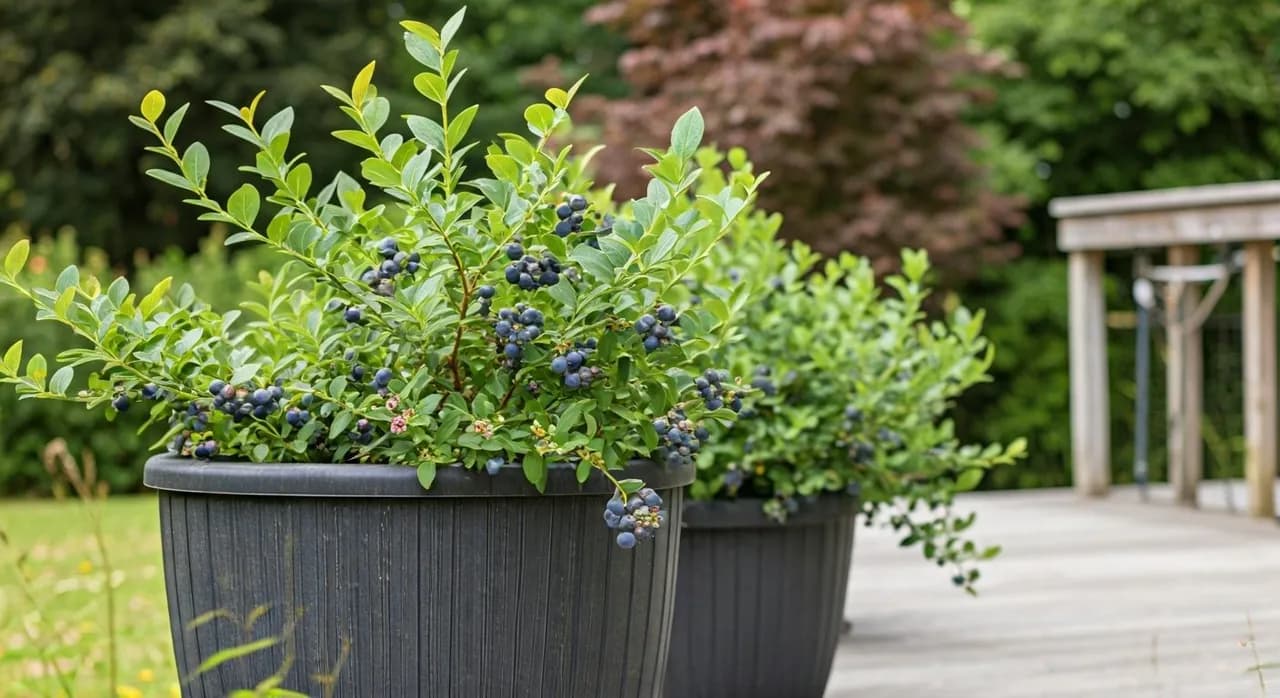
However, an increasing number of growers are discovering a practical and effective solution: cultivating blueberries in containers. This method bypasses the limitations of native soil entirely, allowing you to create the ideal growing environment for these delicious berries, even if your backyard soil registers a pH of 8.0. Container growing offers precise control over the soil mix, watering, and fertilization, making it a viable option for home growers from USDA zone 4 through USDA zone 10. This approach not only yields fruit but also provides an attractive “ornamental edible” for your patio or garden space.
The challenge of alkaline soil for blueberries
Blueberries are notoriously particular about their soil pH. For these plants, a range of 4.5 to 5.5 is essential for their ability to absorb vital nutrients like iron, manganese, and nitrogen. When soil pH rises above 6.0, these essential elements become chemically bound and unavailable to the plant, leading to nutrient deficiencies. In many areas of the US, including large swaths of the Midwest and Southwest, native soils are naturally alkaline due to underlying limestone bedrock or arid conditions, making direct cultivation of blueberries nearly impossible without extensive, often impractical, soil amendments. In the arid Southwest in particular, soils are frequently well above pH 7.5, which puts blueberries far outside their workable range.
why containers are the answer
This is where containers become invaluable. By growing blueberries in pots, growers gain complete command over the growing medium, allowing them to formulate a soil mix with the exact pH and composition blueberries demand. This method isolates the plant from the native alkaline soil, so it avoids nutrient lockout and keeps consistent access to essential minerals. Furthermore, container production has proven effective for commercial operations, even utilizing high tunnels to extend growing seasons and protect crops, as demonstrated in studies on Southern Highbush blueberries in USDA zone 8 [2]. This controlled environment minimizes variables, leading to healthier plants and more reliable harvests. A soil moisture meter is useful for judging when to water; for pH, use a calibrated pH pen or a laboratory test, since probe-style meters are not accurate enough to manage a 4.5 to 5.5 window.
- Soil pH directly impacts nutrient availability.
- Alkaline native soils (pH > 6.0) lock up essential nutrients.
- Container growing provides a controlled, acidic environment.
- This method is effective for both home growers and commercial operations.
- It protects plants from unsuitable native soil conditions.
Selecting appropriate containers and growing media
The choice of container matters for the long-term health of your blueberry plants. Ideally, select pots that are at least 15 to 20 gallons in volume for a mature bush, providing ample space for root development and reducing the frequency of repotting. For younger plants, a 5-gallon pot can serve for the first year or two. Material matters too: plastic containers retain moisture better than terra cotta, which can dry out quickly in hot climates like USDA zone 9. Ensure chosen containers have adequate drainage holes—at least three to five 0.5-inch holes are recommended to prevent waterlogging, which can lead to root rot. Air-pruning pots or fabric grow bags can also be excellent choices, promoting a healthier root system by preventing roots from circling.
crafting the ideal soil mix
The growing medium is the heart of your container blueberry operation. A standard garden soil or potting mix will not suffice due to its typically neutral or alkaline pH. Instead, you need a custom blend that is acidic, well-draining, and moisture-retentive. A common and effective recipe includes 50% peat moss, 30% pine bark fines, and 20% perlite or coarse sand. Peat moss is naturally acidic, with a pH around 3.5-4.5, and holds moisture effectively. Pine bark fines contribute to drainage and aeration while slowly decomposing to release beneficial organic matter. Perlite ensures good aeration and prevents compaction. This mix provides the ideal environment for blueberry roots to ensure they can access the nutrients they need to produce fruit. For example, a 15-gallon container will require approximately 2 cubic feet of this specialized mix.
- Choose containers of 15-20 gallons for mature plants.
- Ensure containers have multiple 0.5-inch drainage holes.
- Use plastic pots for moisture retention; fabric pots give better root structure but dry out faster and need more frequent watering.
- Mix 50% peat moss, 30% pine bark fines, 20% perlite.
- Avoid standard garden soil or potting mix.
Maintaining optimal conditions: water and nutrients
Consistent moisture and proper nutrition are paramount for container-grown blueberries. Unlike in-ground plants, containers dry out more quickly, especially in warmer climates like Florida or southern California. Blueberries prefer consistently moist, but not waterlogged, soil. This often means watering every day or two during hot summer months, and less frequently in cooler weather. The key is to check the soil moisture regularly; sticking your finger 2 inches into the soil or using a soil moisture meter can guide you. Crucially, tap water in many areas has a neutral or alkaline pH, which can gradually raise the pH of your potting mix. To counteract this, acidify your water by adding 1-2 tablespoons of white vinegar per gallon of water, or use citric acid, aiming for a pH of around 5.0 in your irrigation water.
fertilization for acidic plants
Blueberries are light feeders but require specific nutrients. Use acid-forming fertilizers formulated for acid-loving plants like azaleas, rhododendrons, or camellias. Look for fertilizers with a higher first number (nitrogen) in the NPK ratio, such as 10-5-5 or 12-4-8. Apply fertilizer sparingly, typically once every 4-6 weeks during the growing season (spring through mid-summer). Organic options like cottonseed meal or fermented soybean meal can also be used, as they break down slowly and contribute to soil acidity. Avoid fertilizers containing nitrates, as blueberries are sensitive to them. A slow-release granular fertilizer can simplify the process, often requiring only one application per season in early spring.
- Water daily or every other day in warm weather.
- Acidify tap water to about pH 5.0 — the amount of vinegar needed depends on your water’s alkalinity, so measure rather than assume a fixed dose.
- Use acid-forming fertilizers (e.g., 10-5-5 NPK).
- Fertilize every 4-6 weeks during the growing season.
- Avoid nitrate-based fertilizers.
Best blueberry varieties and long-term care
Choosing the right blueberry variety is critical for success, especially when considering your local USDA hardiness zone. For growers in warmer climates, such as USDA zones 7-10, Southern Highbush varieties like ‘Sunshine Blue’, ‘Misty’, or ‘Emerald’ are excellent choices. These varieties have lower chilling hour requirements, often less than 500 hours below 45°F (7°C), and are well-suited for container growing due to their compact size and heat tolerance. In contrast, growers in colder regions, like USDA zones 4-7, should opt for Northern Highbush varieties such as ‘Bluecrop’, ‘Duke’, or ‘Patriot’. These require 800-1000 chilling hours and are more cold-hardy in the ground, but a container root ball has none of the soil’s insulation, so see the winter protection section below before leaving one outdoors. Rabbiteye varieties (‘Climax’, ‘Premier’) are also good for containers in USDA zones 7-9, known for their vigor and heat tolerance, often requiring cross-pollination for best yields.
pruning and repotting for continued vigor
To maintain productivity and plant health, regular pruning is essential. For established plants (three years or older), aim to remove about one-third of the oldest, weakest, or crossing canes each dormant season, typically in late winter or early spring. This encourages new, fruitful growth. You can find detailed guidance on how to prune fruit trees for specific techniques. Repotting is another vital aspect of long-term care. Every 2-3 years, carefully remove the plant from its container, prune any circling roots, and replenish the potting mix with fresh, acidic material. If the plant has outgrown its current pot, move it to a container that is 2-5 gallons larger. This ensures the roots have adequate space and access to fresh nutrients, preventing the plant from becoming root-bound and declining in vigor.
- Choose Southern Highbush for USDA zones 7-10 (low chill).
- Select Northern Highbush for USDA zones 4-7 (high chill).
- Consider Rabbiteye for USDA zones 7-9 (vigorous, often need cross-pollination).
- Prune one-third of old canes annually in late winter.
- Repot every 2-3 years, trimming circling roots and adding fresh soil.
Winter protection for container blueberries
While container growing offers flexibility, it also means your blueberry plants are more susceptible to extreme winter temperatures than their in-ground counterparts. The soil in containers freezes more quickly and to a greater depth. For growers in colder regions, like USDA zones 4-6, providing winter protection is essential to prevent root damage. One common strategy is to move the containers to an unheated garage, shed, or basement once temperatures consistently drop below 20°F (-6°C). In these protected spaces, the plants will remain dormant but safe from harsh freezes. Ensure they receive minimal watering, just enough to keep the soil from completely drying out, about once every 2-3 weeks.
mulching and insulation for outdoor plants
If moving large containers isn’t feasible, especially for mature plants in 20-gallon pots, outdoor insulation can be effective. Group containers together in a sheltered spot against a south-facing wall. Surround the pots with insulating materials like straw bales, burlap, or even bags of fallen leaves. A thick layer of pine bark mulch, 4-6 inches deep, on the soil surface of each pot will also help regulate soil temperature and retain moisture. For varieties like those discussed in Best Cold-Hardy Fruit and Nut Trees for USDA Zones 4-6, this added protection can mean the difference between survival and winter kill. In milder climates, such as USDA zone 7, simply moving pots to a more sheltered location or applying a thick layer of mulch might be sufficient, as temperatures rarely stay low enough to cause significant root damage.
- Move containers to an unheated garage below 20°F (-6°C).
- Water dormant plants sparingly, every 2-3 weeks.
- Group containers together in sheltered outdoor spots.
- Insulate pots with straw bales or burlap.
- Apply 4-6 inches of pine bark mulch to the soil surface.
Comparison of Popular Blueberry Varieties for Container Growing
Variety Type | Example Varieties | USDA Hardiness Zone | Chilling Hours | Key Characteristics |
|---|---|---|---|---|
Northern Highbush | Bluecrop, Duke, Patriot | 4-7 | 800-1000 | Cold-hardy, large fruit, upright growth, good for colder climates. |
Southern Highbush | Sunshine Blue, Misty, Emerald | 7-10 | 150-500 | Low chill requirement, compact, heat tolerant, often evergreen in mild climates. |
Rabbiteye | Climax, Premier, Tifblue | 7-9 | 350-700 | Vigorous, heat tolerant, drought resistant, often requires cross-pollination. |
Optimal pH: Blueberries thrive in soil with a pH range of 4.5 to 5.5, a critical factor for nutrient uptake and healthy growth.
Container Size: A 15-gallon container is a good starting point for a mature blueberry bush, allowing ample root development and consistent moisture.
Browse blueberry plants
Frequently asked questions
How often should I water container blueberries?
Container blueberries generally need watering every one to two days during warm weather, especially in USDA zones 8-10. Check the soil moisture by feeling 2 inches deep; water when the top inch or two begins to dry out to maintain consistent moisture without waterlogging.
What kind of fertilizer is best for container blueberries?
Use acid-forming fertilizers specifically formulated for acid-loving plants, such as azaleas or rhododendrons, with an NPK ratio like 10-5-5. Apply it sparingly, typically once every four to six weeks during the active growing season from spring to mid-summer.
How often do I need to repot container blueberries?
Blueberry bushes in containers should be repotted every two to three years. This allows you to refresh the acidic potting mix, prune any circling roots, and potentially move the plant to a larger container, perhaps a 20-gallon size, to accommodate its growth.
Can I grow blueberries in containers in USDA zone 3?
Growing blueberries in containers in USDA zone 3 is challenging but possible with significant winter protection. You would need extremely cold-hardy Northern Highbush varieties and must move the containers to an unheated, protected space like a garage once temperatures consistently drop below 20°F (-6°C).
What are the signs of pH imbalance in container blueberries?
Signs of pH imbalance, typically too high, include yellowing leaves (chlorosis) with green veins, stunted growth, and reduced fruit production. This indicates nutrient lockout, often iron or manganese deficiency, which can be confirmed with a soil pH test showing levels above 6.0.
How much sun do container blueberries need?
Container blueberries require at least six to eight hours of direct sunlight per day for optimal fruit production. Placing them in a south-facing location in your yard or patio in USDA zone 7 or higher will generally provide sufficient light.
References
- Container blueberries as an “ornamental edible” (2017). Container blueberries as an “ornamental edible”.
- Container Production of Southern Highbush Blueberries Using High Tunnels (2019). Container Production of Southern Highbush Blueberries Using High Tunnels.
- Three New Blueberries Introduced for New Jersey
Growers (1952). [Three New Blueberries Introduced for New Jersey
Growers](https://doi.org/10.71318/apom.1952.7.2.31a).