Key takeaways
- Espalier is the practice of training fruit trees flat against a support, saving up to 80% of ground space.
- Apples and pears are ideal for espalier due to their flexible wood and spur-bearing habits, often fruiting within two to three years.
- Selecting appropriate dwarfing rootstock and a site with at least six hours of direct sunlight daily is essential for success.
- A sturdy support structure, such as wires spaced 12-18 inches apart, must be installed before planting.
- Consistent winter and summer pruning is essential for maintaining the espalier form and encouraging fruit production.
- Counter-espalier offers a freestanding option, often oriented north-south for optimal light exposure in open areas.
Quick answer: Espaliering apples and pears involves training them flat against a support, which puts far more fruiting wood into a narrow strip of ground and makes a productive tree possible in a bed as shallow as 18 inches.
In many US regions, from the humid summers of USDA zone 7 in the Mid-Atlantic to the drier climates of zone 5 in the Mountain West, home gardeners face a common challenge: limited space. Traditional fruit trees can quickly dominate a backyard, making it difficult to grow a diverse orchard. However, a centuries-old horticultural technique offers a solution: espalier. This method, originating in Europe, allows you to grow productive apple and pear trees in areas as narrow as 18 inches, transforming a simple fence or wall into a living work of art and a bountiful food source.
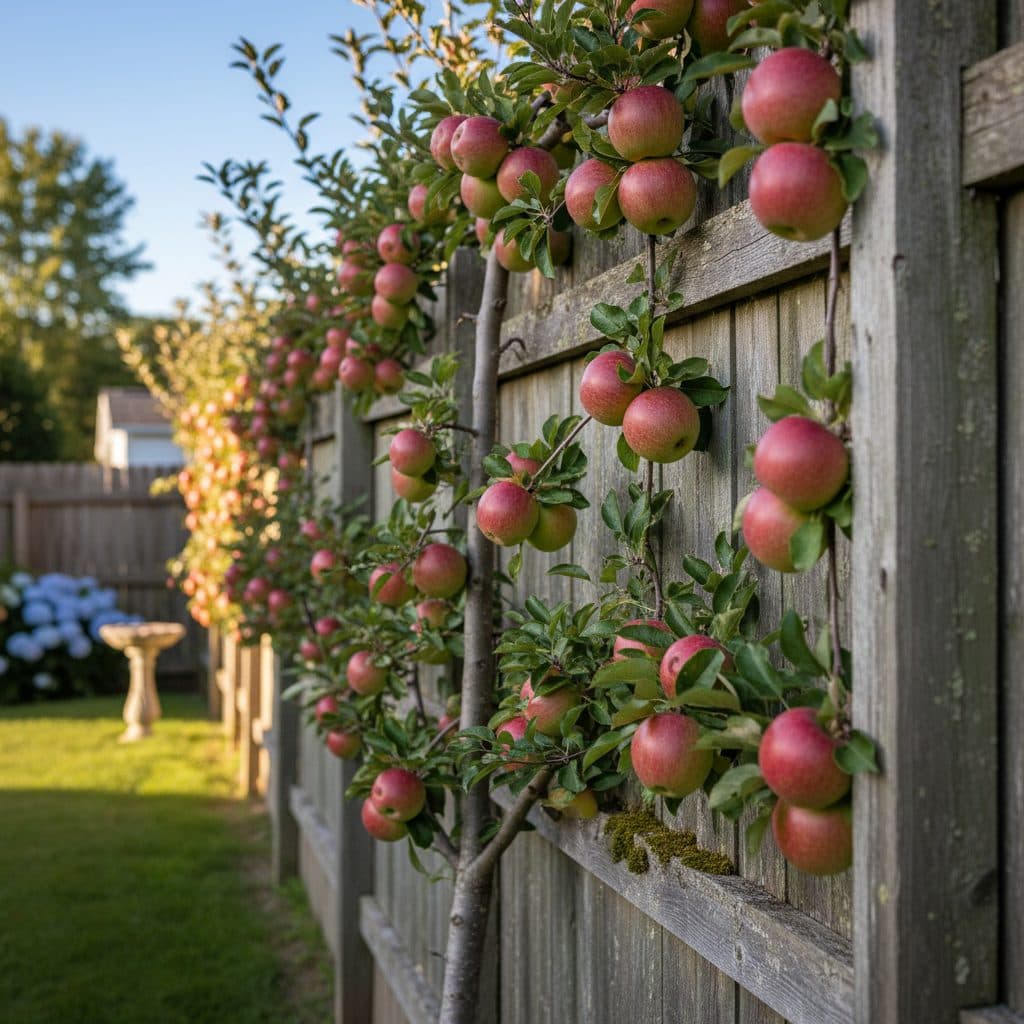
Espalier involves training trees to grow in a two-dimensional plane, typically against a flat surface like a wall or a sturdy fence. This practice reduces the footprint of a fruit tree by 80% or more while improving fruit production and simplifying harvesting. For apples and pears, which are well-suited to this technique, the careful shaping and pruning can lead to higher fruit yields per square foot compared to free-standing trees.
The art and science of espalier
Espalier is the horticultural practice of training trees or shrubs to grow flat against a support, creating a living sculpture that is both beautiful and productive. The term “espalier” can also refer to the plant itself, trained in this manner. This technique has been refined over hundreds of years, allowing gardeners in various climates, from USDA zone 4 to zone 9, to cultivate fruit in compact spaces. The primary benefit for home growers is maximizing yield in small areas, as an espaliered tree can produce a significant amount of fruit within a footprint of just 2-3 feet wide and 6-8 feet tall.
why espalier your fruit trees?
Beyond space-saving, espalier offers several practical advantages. By growing fruit trees against a wall or fence, they benefit from reflected heat, which can extend the growing season by several weeks in cooler climates and promote better fruit ripening. This can be especially beneficial in USDA zone 5, where early frosts are a concern. Furthermore, the open structure of an espaliered tree improves air circulation, which helps reduce the incidence of fungal diseases, a common issue in humid regions like the Southeast. This method also makes pest inspection and harvesting much simpler, as all parts of the tree are easily accessible from one side.
- space efficiency: reduces the footprint of a fruit tree by 80% or more.
- increased fruit production: more fruiting wood per square foot of ground.
- extended growing season: benefits from reflected heat, especially on south-facing walls.
- easier maintenance: simplifies pruning, pest management, and harvesting tasks.
- enhanced aesthetics: creates a visually appealing garden feature.
Selecting species, rootstock, and location
The success of your espalier project begins with careful selection of your fruit trees and their planting site. Apples and pears are excellent choices for espalier due to their flexible wood and tendency to bear fruit on spurs, which makes them amenable to training. For colder regions, such as USDA zones 4-6, consider cold-hardy varieties like ‘Honeycrisp’ or ‘Liberty’ apples, or ‘Anjou’ pears. If you want ‘Bartlett’, buy it on an interstem rather than directly on quince, and in zone 4 choose a pear seedling or OHxF rootstock instead; quince is not reliably hardy that far north. You can find more options suitable for these climates at Best Cold-Hardy Fruit and Nut Trees for USDA Zones 4-6.
choosing the right rootstock
Rootstock selection is paramount for espaliered trees. You’ll want to choose a dwarfing or semi-dwarfing rootstock, which controls the tree’s overall size and vigor. For apples, M.27 (super-dwarfing) or M.9 (dwarfing) are excellent for smaller forms, while M.26 or G.11 (semi-dwarfing) are suitable for larger espaliers, typically reaching 6-8 feet in height. For pears, Quince A or Quince C are common dwarfing rootstocks that will keep the tree manageable, usually under 10 feet tall. These rootstocks ensure the tree remains compact and its growth can be easily managed within the espalier framework, often producing fruit within 2-3 years.
- dwarfing rootstock: M.27 or M.9 for apples, Quince A or C for pears.
- full sun exposure: at least six to eight hours of direct sunlight daily.
- well-drained soil: critical for root health; apple and pear roots suffer quickly if water stands in the planting hole.
- sheltered location: protects from strong winds and harsh weather.
- south or west-facing wall: maximizes warmth and light for fruit ripening in cooler zones. In hot regions (zone 8 and warmer) choose an east-facing wall instead; a south or west wall bakes the fruit and pushes bloom early into late-frost risk.
Building the support and planting your trees
Before planting your chosen apple or pear trees, you must install a sturdy support structure. This framework will guide the tree’s growth and bear the weight of its branches and fruit for many years, often 15-20 years or more. For a wall or fence, you can use galvanized wire, which is resistant to rust, stretched horizontally between eye bolts or turnbuckles. These wires should be spaced 12-18 inches apart vertically, with the lowest wire about 18 inches from the ground. Ensure the wires are held 2-4 inches away from the wall to allow for air circulation behind the tree, preventing moisture buildup and potential disease issues.
initial planting and training
Plant your dormant bare-root trees in late winter or early spring, typically February to April in most US zones to ensure the graft union is 2-4 inches above the soil line. After planting, make your initial heading cut. For a candelabra or fan espalier, cut the central leader back to about 18-24 inches above the ground, just above a strong bud or two buds that will form your first tier of branches. For a cordon, you might only head back the tip by 10-15% to encourage lateral growth. As new shoots emerge, select the strongest ones to form your primary framework, gently tying them to the support wires using soft ties that won’t girdle the stem as it grows. This initial training is critical for establishing the desired form over the first 1-3 years.
- galvanized wire: durable and rust-resistant, often 12-gauge.
- sturdy posts or eye bolts: for anchoring wires securely into the ground or wall.
- turnbuckles: for tensioning wires to keep them taut over long spans, up to 20 feet.
- soft plant ties: flexible material like jute or fabric strips to prevent stem damage.
- pruning shears: sharp bypass pruners for clean cuts during initial shaping.
Ongoing care: pruning and maintenance
Maintaining an espaliered fruit tree requires consistent attention, primarily through regular pruning. There are two main pruning seasons: winter and summer. Winter pruning, performed when the tree is dormant (typically December to February in zones 6-8), focuses on establishing and maintaining the structural framework. During this time, you’ll remove any dead, diseased, or crossing branches, and cut back vigorous shoots to build up the spur systems that carry the crop. This structural pruning maintains the tree’s long-term health and productivity, often for 15-25 years.
seasonal pruning techniques
Summer pruning, usually done from June to August, controls growth and promotes fruit bud formation. During this period, you’ll shorten new lateral shoots that are not part of your framework to about 6 inches, cutting just above a leaf or a developing fruit bud. This directs the tree’s energy into fruit production instead of vegetative growth. For specific guidance on different pruning cuts and techniques, refer to How to prune fruit trees: by season, by species, and by tree age. Consistent watering is also critical, especially for trees against walls, which can dry out quickly. Aim for about 1 inch of water per week, either from rainfall or irrigation. A 3-in-1 Soil pH, Moisture & Light Meter can help monitor soil moisture levels effectively.
- winter pruning: structural cuts, removes dead wood, sets the framework; dormant cuts stimulate regrowth instead of reducing vigor.
- summer pruning: controls growth, promotes fruit spurs by shortening new shoots to 6 inches.
- watering: 1 inch per week, especially during dry spells and fruit development.
- fertilization: balanced fertilizer in early spring, based on soil test results every 2-3 years.
- pest and disease monitoring: regular inspection to catch issues early, preventing widespread damage.
Exploring complex forms and freestanding structures
Once you are comfortable with basic espalier forms like the cordon or candelabra, you might consider more complex patterns such as the Belgian fence, which involves multiple trees planted 18-24 inches apart with their branches woven into a diamond lattice. This detailed design can create a stunning living fence, often reaching 6-8 feet in height, and is particularly effective for apples. These advanced techniques require more time and precision, typically taking 3-5 years to fully establish a strong framework. The reward is a highly productive and visually striking feature in your garden.
counter-espalier: freestanding options
For gardeners with more open space who still desire the benefits of two-dimensional training, counter-espalier offers a compelling alternative. This technique involves training plants on a freestanding structure, typically in a north-south orientation for optimal sun exposure throughout the day. Unlike traditional espalier against a wall, counter-espalier allows for air circulation on both sides of the tree, which can further reduce disease pressure. These freestanding structures can be built using robust posts and wires, with spacing set by the form you choose: 18-24 inches apart for a Belgian fence, or close enough for tiered cordons that the arms of neighboring trees meet along the wires. This method is excellent for creating living screens or dividing garden areas, and it can be particularly advantageous in regions like the Central Valley of California (USDA zone 9), where maximizing sun exposure for ripening is key. While a south-facing wall provides useful reflected heat, counter-espalier gives you flexibility on sites without suitable walls.
- belgian fence: interwoven diamond pattern, requires multiple trees 18-24 inches apart.
- fan espalier: branches radiate from a short trunk, ideal for pears and peaches.
- cordon variations: double or triple cordons, increasing fruit production along a single line.
- palmette verrier: a formal, multi-tiered candelabra with upward-curving branches.
- counter-espalier: freestanding structure, often 6-8 feet tall, oriented north-south for maximum light.
Espalier vs. Standard Fruit Tree
Feature | Espaliered Tree | Standard Tree |
|---|---|---|
Space Required | 18-36 inches wide, 6-10 feet tall | 10-20 feet wide, 10-25 feet tall |
Time to First Fruit | 2-3 years | 3-5 years |
Fruit Yield per Area | High | Moderate |
Maintenance Effort | High (regular pruning, training) | Moderate (less frequent, larger scale pruning) |
Pest & Disease Management | Easier due to open structure and accessibility | More challenging due to dense canopy |
Aesthetic Value | High, acts as an architectural feature | Moderate, natural tree form |
Space Savings: Espalier can reduce the footprint of a fruit tree by over 80%, allowing a productive apple or pear tree to grow in a space as narrow as 18 inches.
Increased Yield: A well-maintained espaliered apple or pear concentrates its crop into a narrow strip of ground, often yielding 20-30 pounds of fruit from a single tree.
Shop Espalier Trees
Frequently asked questions
What are the best apple and pear varieties for espalier?
For apples, ‘Honeycrisp’, ‘Fuji’, ‘Gala’, and ‘Liberty’ are excellent choices due to their good spur production and manageable vigor. For pears, ‘Anjou’ and ‘Comice’ perform well on quince rootstock. ‘Bartlett’ and ‘Bosc’ are graft-incompatible with quince and need an interstem such as ‘Old Home’ (check the nursery listing before buying). Always choose varieties suited to your specific USDA zone that can withstand local temperatures, down to 0°F or below in colder regions.
How long does it take to establish an espaliered tree?
Establishing a basic espalier form, such as a cordon or a simple candelabra, typically takes 3-5 years of consistent pruning and training. More complex forms like a Belgian fence may require 5-7 years to fully develop their detailed patterns and reach a height of 6-8 feet.
Can I espalier an existing, mature fruit tree?
While it’s possible, it is much more challenging to espalier a mature tree than to start with a young, whip-like tree. Mature trees have rigid branches that are difficult to bend without breaking, and their established root systems often lead to excessive vigor. It’s generally recommended to begin with a one-year-old tree on dwarfing rootstock for the best results, as these are much more pliable and responsive to training.
What kind of support structure is best for espalier?
The best support structure involves horizontal wires, typically 12-gauge galvanized steel, stretched taut between sturdy posts or eye bolts anchored into a wall. Wires should be spaced 12-18 inches apart vertically, with the lowest wire 18 inches from the ground. This setup can reliably support a tree for 15-20 years.
How often should I prune an espaliered tree?
Espaliered trees require two main pruning sessions annually: a dormant winter prune (December-February) for structural shaping and removing 20-30% of old wood, and a summer prune (June-August) to control new growth and promote fruit bud formation by shortening shoots to about 6 inches. This consistent pruning is key to maintaining the tree’s form and productivity.
References
- espalier (2022). espalier.