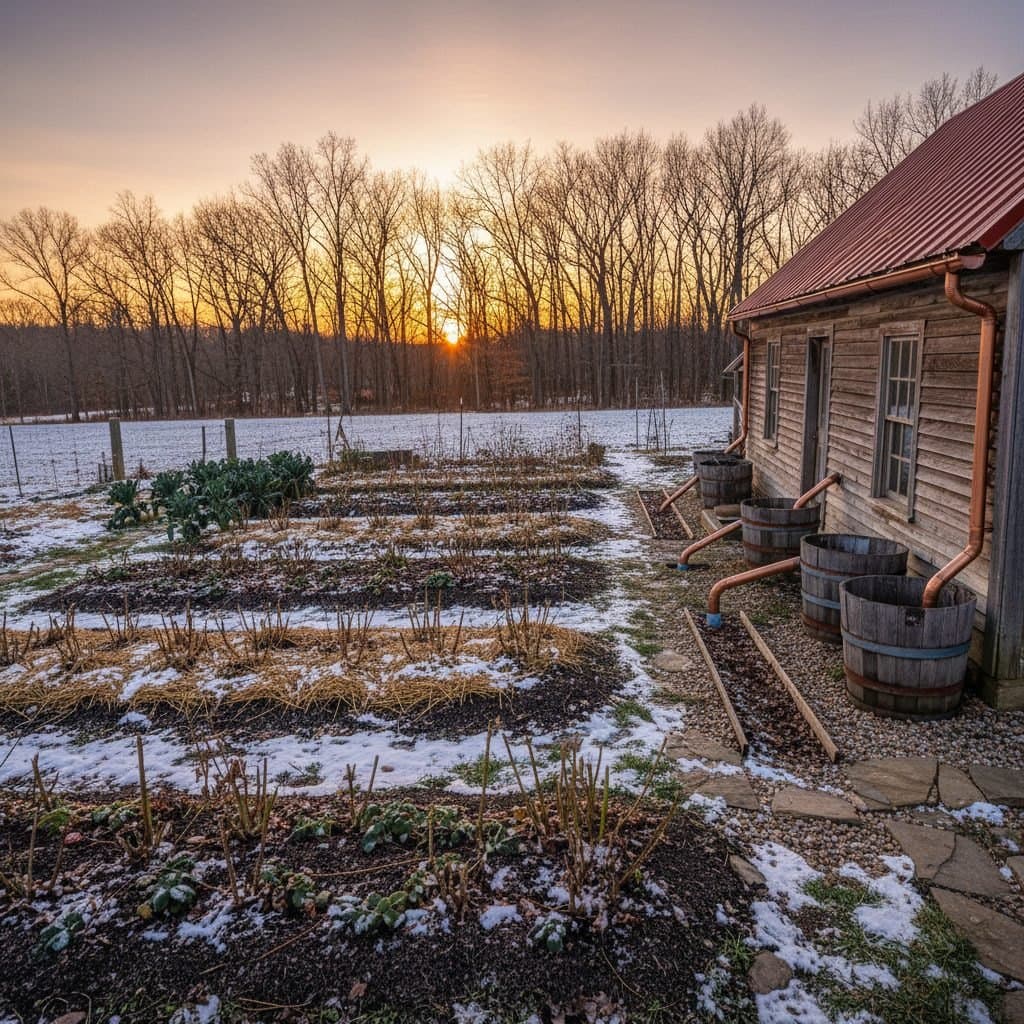
Key takeaways
- Empty rainwater barrels completely when temperatures consistently drop below 32°F to prevent ice expansion damage.
- Disconnect all hoses, pumps, and diverters, storing them indoors or in a protected shed where temperatures remain above freezing.
- Consider insulating above-ground pipes with foam insulation rated for R-3 or higher to delay freezing in marginal conditions.
- Inspect barrels for cracks or leaks during the draining process, making repairs with food-grade silicone sealant rated for outdoor use.
- Redirect downspouts to direct water away from foundations or into passive earthworks like swales for winter ground absorption.
- Maintain passive irrigation systems like ollas and wicking beds by ensuring they are not overfilled and have adequate drainage.
Quick answer: To protect cold-climate rainwater storage from freezing, completely drain barrels and disconnect all components when temperatures consistently drop below 32°F. Redirect downspouts and insulate vulnerable pipes to prevent ice expansion damage.
For growers in regions like the Upper Midwest or New England, where winter temperatures regularly plunge below 20°F for extended periods, preparing rainwater storage for a hard freeze is essential. Water expands by approximately 9% when it freezes, a force strong enough to rupture even robust 55-gallon plastic barrels or crack concrete cisterns if not properly managed. This annual winterization process protects your investment and ensures your system is ready to capture precious spring rains, which can amount to 10-15 inches in many areas by late March.
Ignoring winterization can lead to significant financial setbacks, potentially requiring hundreds of dollars in repairs or replacements for damaged components. From the simple task of draining a single barrel to managing a complex array of interconnected tanks, understanding the science behind water’s expansion and applying practical, timely steps will save you effort and expense. Growers in USDA Zone 5, for instance, typically need to complete their winterization by late October or early November, well before the first sustained hard freeze event.
Understanding the freeze threat: why water expands
Water’s unique property of expanding as it freezes is the primary reason for winterizing rainwater systems. Unlike most liquids that contract when they get colder, water reaches its maximum density at about 39.2°F (4°C) and then begins to expand as it cools further towards 32°F (0°C), increasing its volume by roughly 9% when it turns to ice [1]. This expansion generates immense pressure, easily exceeding the structural integrity of most rainwater barrels, pipes, and pumps. A standard 55-gallon barrel, for example, can experience internal pressures of several thousand pounds per square inch if completely frozen solid.
The cost of inaction in cold climates
Failing to drain your rainwater barrels in regions like the northern Great Plains, where winter temperatures can drop to -20°F or lower, can result in burst barrels, cracked pumps, and fractured PVC piping. Replacing a single 55-gallon food-grade barrel might cost $50-$100, while a damaged submersible pump could set you back $150-$300. Beyond the immediate financial cost, a damaged system means lost water collection capacity for the early spring, a critical period for establishing new plantings. According to the USDA Natural Resources Conservation Service, many areas in USDA Zone 4 and 5 receive 20-30% of their annual precipitation as snow, which melts into valuable water in spring [6].
- Pressure buildup: Ice expands by 9% in volume, creating significant force.
- Material damage: Plastic, metal, and concrete can crack or burst.
- Component failure: Pumps, filters, and diverters are particularly vulnerable.
- Financial loss: Replacement costs for barrels and equipment can be substantial.
- Lost collection: Damaged systems cannot capture spring meltwater.
Draining your rainwater barrels and cisterns
The most straightforward and effective method to protect your rainwater storage is to drain it completely before the first hard freeze. In USDA Zone 6, this typically means by mid-November, while in USDA Zone 3, you might need to act as early as late September. Begin by disconnecting the downspout diverter from the barrel, ensuring no more water can enter. Next, open the spigot at the bottom of the barrel and allow all water to flow out. If your barrel has a large capacity, such as a 200-gallon cistern, this draining process can take several hours, so plan accordingly on a day when temperatures are above 35°F.
Redirecting winter flow and cleaning
Once the barrel is empty, redirect the downspout to its original position or towards an alternative winter destination, such as a passive irrigation earthwork like a swale or rain garden. This ensures that winter precipitation, whether rain or melting snow, is directed away from your home’s foundation and can infiltrate the ground. While the barrel is empty, it’s an opportune time to clean out any sediment or debris that has accumulated at the bottom. A quick rinse with a garden hose and a stiff brush can remove sludge, improving water quality for the next season. Ensure the barrel is completely dry before sealing it for winter, preventing any residual moisture from freezing and causing damage.
- Disconnect diverter: Stop water inflow from the downspout.
- Open spigot: Allow all water to drain completely from the barrel.
- Redirect downspout: Send winter precipitation away from the barrel or into earthworks.
- Clean sediment: Remove accumulated debris from the barrel’s interior.
- Ensure dryness: Verify the barrel is fully dry to prevent residual freezing.
Protecting pumps, filters, and accessories
Beyond the barrels themselves, the ancillary components of your rainwater harvesting system are equally vulnerable to freezing temperatures. Submersible pumps, external filters, and connecting hoses all contain water that can freeze and expand, leading to costly damage. In colder regions like Minnesota or Montana, where winter lows can reach -30°F, even a small amount of trapped water can destroy a pump or crack a filter housing. Disconnect all hoses, including any expandable hose you might use for irrigation, and drain them thoroughly. Store these items indoors, ideally in a heated basement or garage where temperatures consistently stay above 40°F.
Winterizing diverters and spigots
Downspout diverters, often made of plastic or thin metal, should also be removed and stored. While some are designed to withstand minor freezing, repeated cycles of freezing and thawing can weaken the material, causing cracks or leaks by spring. If your system includes a first-flush diverter, ensure it is completely empty and dry. For spigots attached to the barrels, leave them in the open position after draining to ensure any residual moisture can escape. Consider covering the spigot with a small piece of cloth or a plastic bag to prevent insects from nesting inside during the winter months. This comprehensive approach protects your entire system, extending its lifespan by many years.
- Disconnect hoses: Remove all irrigation and connecting hoses, draining them fully.
- Store pumps: Bring submersible pumps and external filters indoors to a heated space.
- Remove diverters: Detach downspout and first-flush diverters for indoor storage.
- Open spigots: Leave barrel spigots open to allow for complete drying and drainage.
- Protect outlets: Cover spigots to deter pest nesting during winter dormancy.
Winter considerations for passive irrigation systems
While rainwater barrels require complete draining, passive irrigation systems like ollas and wicking beds handle winter differently. Ollas, unglazed clay pots buried in the soil, slowly release water to plant roots. In regions with mild winters, such as USDA Zone 8 in the Pacific Northwest, ollas can often remain in place, especially if they are empty or contain very little water. However, in colder climates like USDA Zone 4, where the ground freezes several feet deep, full ollas can crack due to the soil’s expansion and contraction, as well as the water freezing inside them. It’s best to empty and remove them, or at least ensure they are completely dry.
Wicking beds and earthworks in winter
Wicking beds, which feature a water reservoir below the growing medium, also need attention. If the reservoir is full of water in a freezing climate, it can freeze and potentially damage the bed’s liner or structure. For wicking beds in USDA Zone 5 or colder, it’s advisable to drain the reservoir completely. Earthworks like swales, berms, and rain gardens, designed to capture and infiltrate rainwater, are generally robust in winter. They are meant to hold water and allow it to slowly seep into the ground, recharging local aquifers [5]. In areas with heavy snowmelt, such as the Rocky Mountain states, these earthworks matter for managing spring runoff, potentially holding thousands of gallons of water over several days.
- Empty ollas: Ensure buried clay pots are dry to prevent cracking in freezing soil.
- Drain wicking beds: Remove water from reservoirs to protect liners from ice expansion.
- Inspect earthworks: Check swales and berms for erosion or blockages before winter.
- Consider winter crops: Some cold-hardy nitrogen fixers can be grown in wicking beds even in winter.
- Monitor snowmelt: Observe how earthworks handle spring runoff, making adjustments as needed.
Year-round maintenance and future planning
Winterization is part of year-round maintenance that extends the life and efficiency of your rainwater harvesting system. Regular inspections throughout the growing season can identify minor issues, like small leaks or clogged filters, before they become major problems. For instance, checking your downspout screens monthly can prevent debris buildup that reduces collection efficiency by 10-15%. In the spring, after the last hard freeze (typically late April in USDA Zone 5), reconnect your system, inspect all components for wear, and conduct a full system test with the first spring rain.
Planning for colder climates and larger systems
For growers in the coldest regions, such as USDA Zone 2 or 3, or those managing larger cisterns, consider more robust solutions. Underground cisterns, buried below the frost line (which can be 4-6 feet deep in some northern states), are naturally protected from freezing. While the initial installation cost is higher, potentially thousands of dollars, they offer year-round storage capacity without the need for seasonal draining. Research into solar-driven thermal energy storage systems is also showing promise for maintaining above-freezing temperatures in cold-climate residential applications, potentially reducing the need for extensive draining in the future [4]. For now, diligent draining and protection remain the most reliable strategies for most homesteaders.
- Regular inspections: Check screens, filters, and connections monthly for issues.
- Spring reconnection: Reassemble the system after the last freeze, typically in April.
- System testing: Verify all components function correctly with the first significant rain.
- Consider underground storage: Explore buried cisterns for year-round, freeze-proof capacity.
- Research new technologies: Stay informed about advancements like solar-driven thermal storage for cold climates.
Winter preparation for different rainwater systems
System Type | Cold Climate Winter Prep (USDA Zone 5 and colder) |
|---|---|
Above-ground barrels | Completely drain, disconnect all hoses and diverters, store components indoors. Redirect downspouts. |
Underground cisterns | Generally freeze-proof if buried below frost line (4-6 ft deep); ensure access points are sealed. |
Ollas | Empty and remove from ground, or ensure completely dry if left in place to prevent cracking. |
Wicking Beds | Drain the water reservoir completely to protect the liner from ice expansion. |
Passive Earthworks (Swales) | Clear debris to maintain capacity; designed to handle winter precipitation and snowmelt. |
Water expansion: Water expands by approximately 9% when it freezes, generating immense pressure that can burst containers.
Coldest zones: In USDA Zone 3, winterization of rainwater systems should be completed by late September to avoid damage.
Frequently asked questions
When should I drain my rainwater barrels in a cold climate?
You should drain your rainwater barrels completely before the first sustained hard freeze, typically when temperatures consistently drop below 32°F. In USDA Zone 5, this often occurs by late October or early November, but it can be as early as late September in USDA Zone 3.
What happens if I don’t drain my rainwater barrels?
If you don’t drain your rainwater barrels, the water inside will freeze and expand by about 9%, creating immense pressure. This pressure can cause the barrel to crack or burst, leading to costly repairs or replacement of the barrel, which can range from $50 to $100 for a 55-gallon unit.
How do I protect my rainwater pump and hoses?
Disconnect all pumps and hoses, including any expandable hose, from your rainwater system. Drain them thoroughly to remove all water, then store them indoors in a heated space like a basement or garage where temperatures remain above 40°F to prevent freezing damage.
Can I leave my ollas in the ground during winter?
In USDA Zone 4 and colder, it’s generally best to empty and remove ollas from the ground, or at least ensure they are completely dry. Full ollas can crack due to freezing water and soil expansion, potentially damaging your passive irrigation system.
What should I do with my downspouts after draining the barrels?
After draining your barrels, redirect your downspouts to their original position or towards a designated area like a rain garden or swale. This ensures that winter precipitation is directed away from your home’s foundation and can infiltrate the ground, managing runoff effectively.
Are underground cisterns freeze-proof?
Yes, underground cisterns are generally freeze-proof if they are buried below the local frost line, which can be 4-6 feet deep in many northern US states. This natural insulation protects the stored water from freezing temperatures year-round, offering reliable storage.
References
- Rainwater Harvesting under a Warming Climate and Effects of Algae on Changes to Water Storage Levels (2019). Rainwater Harvesting under a Warming Climate and Effects of Algae on Changes to Water Storage Levels.
- Rainwater Storage (2017). Rainwater Storage.
- WITHDRAWN: Instrumentation and Climate Management in Cold Storage (2015). WITHDRAWN: Instrumentation and Climate Management in Cold Storage.
- Modelling and Simulation of Seasonal, Solar Driven Sorption Thermal Energy Storage in Cold Climate Residential Application (2023). Modelling and Simulation of Seasonal, Solar Driven Sorption Thermal Energy Storage in Cold Climate Residential Application.
- Urban Rainwater Management Using the Aquifer for Storage as One Measure to Confront Changed Water Availability (2011). Urban Rainwater Management Using the Aquifer for Storage as One Measure to Confront Changed Water Availability.
- USDA Natural Resources Conservation Service (2024). USDA Natural Resources Conservation Service.