Key takeaways
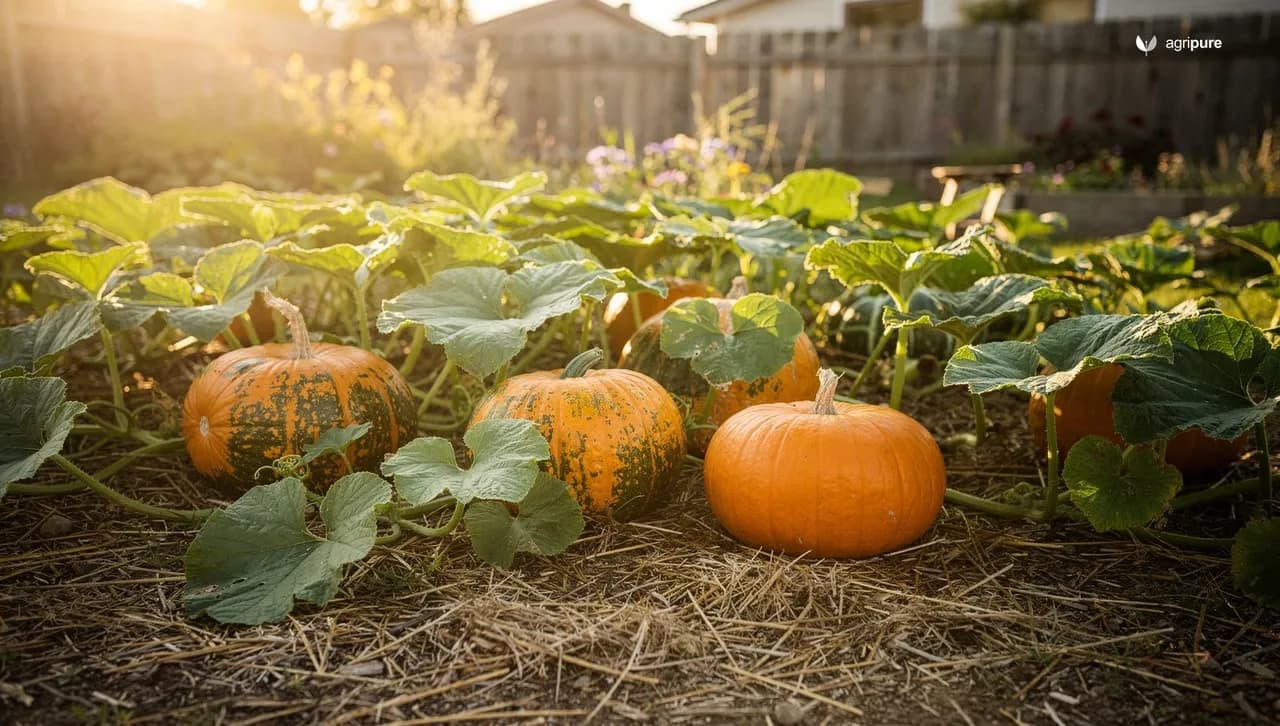
Several deep-orange pumpkins with varying shapes and sizes resting on a bed of golden straw in soft sunlight, ready for late autumn harvest.
Growing pumpkins requires attention to timing, space, and care. A successful harvest culminates in curing, which allows the fruit to be stored and kept for weeks.
- Pumpkins take 70 to 120 days to mature, so count back from your first frost to land a crop in time for Halloween.
- Vining types need room: plan on 50 to 100 square feet per hill, with hills 5 to 6 feet apart.
- Each plant carries separate male and female flowers; males open 1 to 2 weeks first, and bees must move pollen for fruit to set.
- Scout leaf undersides for squash bug egg clusters of about 20 and watch for white powdery mildew from mid-summer on.
- Cure ripe pumpkins at 80 to 85 F for about 10 days, then store cool to keep them eight weeks or more.
A pumpkin seed dropped into warm June soil can become a 20 foot vine and a 15 pound fruit by October, but only if the calendar cooperates. Pumpkins need somewhere between 70 and 120 days from sowing to a hard, deep-orange rind, and they are killed outright by frost at both ends of the season.
That makes pumpkin growing an exercise in counting backward and giving the vines space to run. Get the timing, the spacing, the pollination, and the pest watch right, and the 10 day curing step at the end turns a fragile field fruit into one that sits on the porch for 2 months. Here is the full sequence, across 5 stages, with the numbers that matter at each one.
Counting back from frost to nail the harvest
Pumpkins are a long-season crop with a hard deadline. Clemson Cooperative Extension puts maturity at 70 to 120 days depending on the variety and the weather, so the planting date is set by working backward from when you want ripe fruit. For a Halloween display in a zone with an early-October frost, a 100-day variety needs to be in the ground by late June at the latest.
The other end of the calendar is just as firm. Pumpkins are frost-tender seedlings, and Clemson advises seeding only after frost danger has passed and the soil at a 4 inch depth holds above 60 F. Sowing into cold, wet ground rots the seed instead of sprouting it, which costs you a week or more you cannot spare on a 100-day clock.
A simple countback method
Work the dates in 3 steps so the harvest lands on target rather than a frosty week too late.
- Find your variety’s days to maturity on the seed packet (usually 90 to 110 for a standard carving pumpkin).
- Find your average first fall frost, then subtract 2 weeks as a safety buffer for slow ripening and curing time.
- Count back the maturity days from that buffered date to fix your sowing window, and start seed indoors only 2 to 3 weeks early since pumpkins resent root disturbance.
Indoor head start: in short-season areas, sow into 3 to 4 inch pots about 3 weeks before transplanting and harden off carefully; pumpkins sulk for days if their roots are torn. The same direct-sow-after-warmth logic applies to heat-loving fruit like tomatoes.
Young pumpkin seedlings with broad cotyledon leaves emerging from dark soil in a garden hill, lit by early morning sun.
Space, hills, and soil the vines actually want
The single most common pumpkin mistake is underestimating the sprawl. University of Illinois Extension is blunt about it: vining pumpkins need a minimum of 50 to 100 square feet per hill, with hills set 5 to 6 feet apart in rows 10 to 15 feet apart. A single full-size vine can easily cover a 10 by 10 foot patch, so 3 hills is already a sizable corner of the garden.
Pumpkins are traditionally grown on hills (low mounds of soil 4 to 6 inches high that warm faster and drain better than flat ground). Drop 4 to 5 seeds per hill about 1 inch deep, then thin to the 2 strongest seedlings once they have a true leaf. The plants are heavy feeders, so work several inches of compost into each hill before sowing; building living soil with steady organic matter does more for fruit size than any mid-season feed.
Bush types for tight plots
If 100 square feet per hill is out of the question, choose a bush or semi-bush variety. These hold to a 4 to 6 foot footprint and still set full-size fruit, trading a little yield per plant for a much smaller land claim. A pumpkin’s growth habit is largely fixed by its genetics, so read the packet for “bush” or “vining” before you plan the bed.
Mulch the runners: a 2 to 3 inch straw mulch under the vines keeps fruit off wet soil, blocks weeds, and holds moisture during the heavy fruit-swelling weeks. See our guide to mulching an organic garden for materials.
Pollination: male flowers, female flowers, and the bees between them
Pumpkins set fruit only when pollen moves from a male flower to a female one, and understanding that split solves most “my plant flowers but never fruits” complaints. University of Maryland Extension notes that pumpkins, like other squash, produce male flowers for 1 to 2 weeks before female flowers appear, so a vine that is all blooms and no fruit early on is usually just running ahead of its own schedule.
Telling the 2 apart is easy once you look at the base of the bloom. The female flower sits on top of a tiny immature pumpkin, a swollen ovary the size of a marble. The male flower has only a plain straight stem. Maryland Extension is clear that pollen must be carried by bees from the male to that female flower, and that poor fruit-set is common in rainy weather when bees stay home for days at a time.
Hand-pollinating when bees fall short
If you see female flowers shrivel and drop without swelling, take over the bees’ job in the first 1 to 2 hours after sunrise, when the blooms are open and the pollen is fresh.
- Pick a fresh male flower, peel back its petals, and you have a pollen-loaded stamen ready to use.
- Dab the pollen directly onto the stigma in the center of a newly opened female flower, or use a soft brush to transfer it.
- Work early: squash flowers open near dawn and often close by midday, so a 1 hour window after sunrise is your best chance.
A pest and disease watch for the long season
A pumpkin vine is in the ground for 3 to 4 months, which gives squash bugs and powdery mildew plenty of time to find it. The two are different problems and need different scouting habits, so it helps to sort them side by side before the season gets away from you.
Threat | What you see | When | First response |
|---|---|---|---|
Squash bug eggs | Bronze clusters of 15 to 40 under leaves | Early to mid summer | Scrape and crush eggs by hand |
Squash bug adults | Gray-brown shield bugs, wilting leaves | All season, 2 to 3 generations | Drop into soapy water |
Powdery mildew | White powder on upper and lower leaves | Mid to late summer | Improve spacing and airflow |
Poor pollination | Tiny fruit yellows and rots | Through flowering | Hand-pollinate at dawn |
On the insect side, University of Minnesota Extension reports that female squash bugs lay small clusters of about 20 eggs on leaf undersides, while UC Integrated Pest Management describes the same eggs as bronze to brick red in groups of 15 to 40 and recommends picking off and destroying egg masses as soon as you spot them. Catching eggs is far easier than fighting the fast nymphs they hatch into.
For disease, the watch is white powder. Minnesota Extension notes that powdery mildew favors humid conditions around 68 to 81 F and is slowed by good air movement through proper spacing. Cornell University adds the reason it matters for jack-o’-lanterns: badly mildewed plants give fruit with poor rind color and shriveled, discolored handles, which is exactly the cosmetic damage a carving pumpkin can’t afford.
Harvest, cure, and store for the long haul
Pick pumpkins when the rind has turned a deep, uniform orange and is hard enough that your thumbnail can’t pierce it. Cut the fruit free with shears and leave a 3 to 4 inch stem handle attached; a pumpkin whose stem snaps off loses its seal and rots from the top. Harvest before any hard freeze, since a freeze below 28 F weakens the rind and invites bacteria.
Several deep-orange ripe pumpkins with thick stem handles resting on straw in a sunlit garden at harvest time, vines drying in the background.
Curing is the step most home growers skip, and it is what separates a 2 week pumpkin from a 2 month one. Clemson Extension specifies curing at 80 to 85 F with 75 to 80% humidity for about 10 days, which hardens the rind and heals small cuts. After curing, store the fruit at 50 to 55 F with good ventilation, where it will keep eight weeks or more.
The same logic as curing alliums
Winter squash rewards patience the same way drying alliums does: a warm, airy 10 day spell before storage roughly doubles shelf life. Growers who already cure their crop for 2 to 3 weeks after harvesting garlic will find the pumpkin routine familiar: warmth, airflow, and time, then a cool dark room near 50 F.
Handle by the body, not the stem: the woody handle looks like a built-in grip, but lifting a 15 pound pumpkin by it tears the seal and cuts storage life to days. Carry from underneath every time.
Conclusion
Growing pumpkins is mostly a matter of respecting a few hard numbers: a 70 to 120 day clock, 50 to 100 square feet of room per hill, a 60 F soil floor for sowing, and a 10 day cure at the end. Get those right, scout the leaf undersides for squash bug eggs, help the bees when the weather sulks, and a single early-summer planting carries you from a warm hill of seed to a porch full of pumpkins that last well past the holiday.
Frequently asked questions
When should I plant pumpkins for Halloween?
Count back from your first fall frost. Most carving pumpkins need 90 to 110 days, so subtract that plus a 2 week buffer from your frost date; in much of the US that means sowing from late May through June.
How much space does a pumpkin plant need?
Vining pumpkins need 50 to 100 square feet per hill, with hills 5 to 6 feet apart in rows 10 to 15 feet apart. Bush varieties hold to a 4 to 6 foot footprint if your plot is small.
Why does my pumpkin flower but not make fruit?
Male flowers open 1 to 2 weeks before females, so early blooms simply have no female to pollinate yet. Once females appear, bees must move pollen to them; in rainy weather, hand-pollinate at dawn to set fruit.
How do I get rid of squash bugs on pumpkins?
Scout leaf undersides for bronze egg clusters of 15 to 40 and crush them by hand, since catching eggs beats fighting nymphs. Drop adults into soapy water; the pest runs 2 to 3 generations a season.
How do I cure pumpkins for storage?
Cure pumpkins at 80 to 85 F with high humidity for about 10 days to harden the rind, then store them at 50 to 55 F with good ventilation. Properly cured fruit keeps eight weeks or more.
References
- Clemson Cooperative Extension — Pumpkins & Winter Squash
- University of Illinois Extension — Growing Pumpkins
- University of Maryland Extension — Growing Pumpkins in a Home Garden
- University of Minnesota Extension — Squash Bugs in Home Gardens
- UC Statewide IPM Program — Squash Bugs
- Cornell University — Cucurbit Powdery Mildew
- University of Minnesota Extension — Powdery Mildew of Cucurbits