Key takeaways
- Standard hexagonal chicken wire only keeps chickens in; it fails to stop raccoons, foxes, coyotes, or dogs from tearing through.
- Fortify all coop windows, ventilation openings, and run enclosures with 1/2-inch 19-gauge galvanized welded wire hardware cloth.
- Prevent digging canines and rodents by installing a 12 to 18-inch outward-flaring hardware cloth apron around the entire coop perimeter.
- Secure all coop access doors, clean-out hatches, and nesting boxes with two-step locking latches, such as spring-loaded carabiners.
- Protect pastured flocks from daytime aerial raptors (hawks) using heavy-duty overhead aviary netting or mobile roofed pasture shelters.
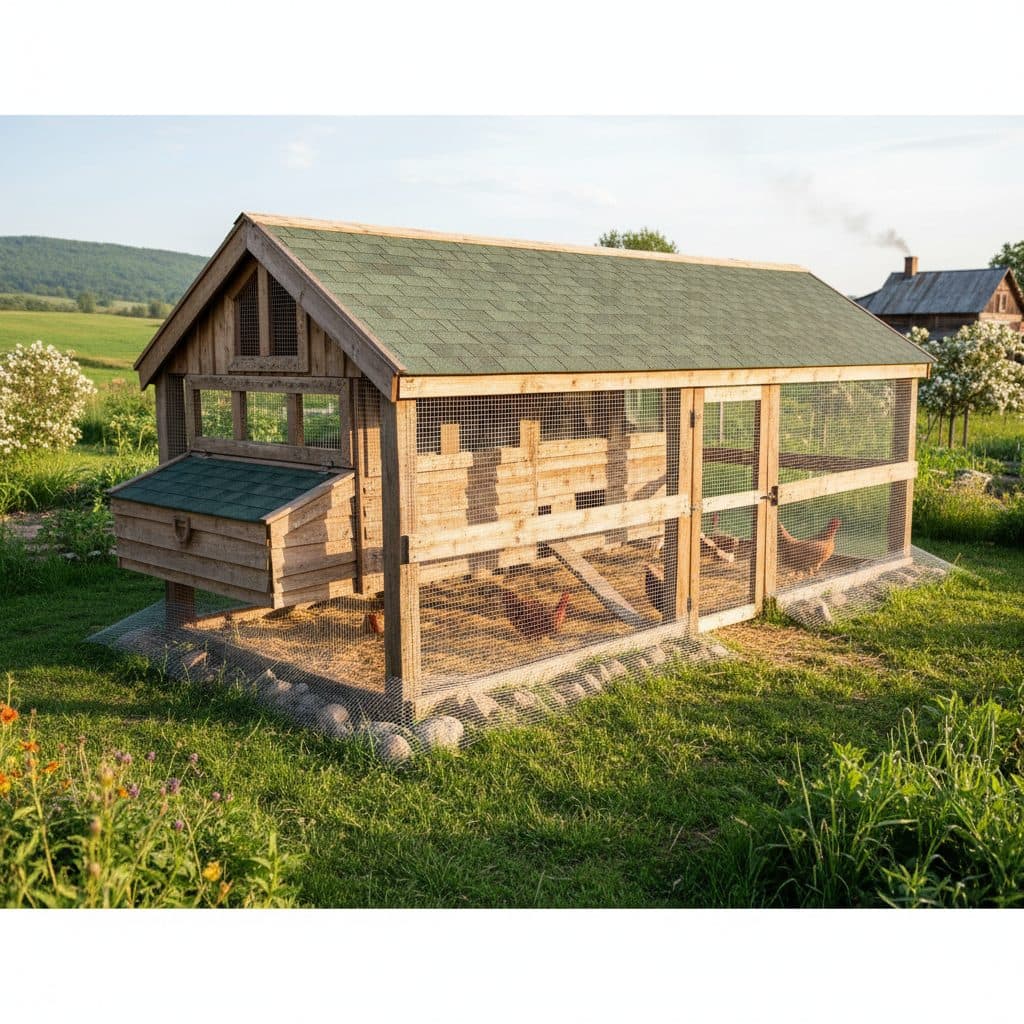
Quick answer: To protect chickens from predators, replace chicken wire with 1/2-inch welded wire hardware cloth on all coop openings and runs, install an outward-laid 12 to 18-inch predator apron around the perimeter to stop digging, and secure doors with spring-loaded carabiner latches that raccoons cannot open.
Losing birds to wildlife is one of the most disheartening experiences for backyard flock keepers and homesteaders. Almost every North American predator (including raccoons, foxes, coyotes, hawks, owls, weasels, opossums, and roaming neighborhood dogs) views chickens as an easy meal.
Standard hexagonal chicken wire is designed only to contain poultry; raccoons can easily reach through its wide openings, and hungry canines can rip it apart in seconds. Learning how to protect chickens from predators requires building physical, multi-layered barriers that address subterranean, ground-level, and aerial threats.
By identifying common predator signatures and engineering secure coop perimeters, you can ensure your flock remains safe day and night.
+-------------------------------------------------------------+
|              PREDATOR IDENTIFICATION MATRIX                 |
|                                                             |
|   PREDATOR        PRIMARY ATTACK METHOD       EVIDENCE      |
|   --------        ---------------------       --------      |
|   Raccoon         Reaches through wire        Missing heads |
|   Fox / Coyote    Digs under / rips wire      Birds carried |
|   Weasel / Mink   Squeezes through 1" gaps    Whole flock   |
|   Hawk / Owl      Aerial dive in open run     Feather pile  |
|   Opossum / Snake Eats eggs & young chicks    Shells in nest|
+-------------------------------------------------------------+
What are the most common chicken predators and their attack patterns?
Diagnosing predator sign allows you to reinforce specific vulnerabilities around your coop:
1. Raccoons (Procyon lotor)
Raccoons possess dexterous, hand-like paws capable of turning latches, sliding simple barrel bolts, and reaching through wire mesh to pull roosting birds through openings. Raccoons frequently kill multiple birds in a single night, often consuming only the crop or head and leaving the rest of the carcass inside the coop.
2. Weasels (Mustela spp.) and American mink (Neogale vison)
Weasels are slender, relentless carnivores capable of slipping through any opening larger than a quarter (roughly 1 inch / 2.5 cm). Driven by predatory instinct, a single weasel can kill an entire flock in a single night, leaving small, neat puncture wounds on the back of birds' necks and piling carcasses in a corner.
3. Foxes and coyotes
Canines typically hunt at dawn, dusk, or night, though coyotes and foxes will take free-ranging birds during broad daylight. They dig aggressively beneath coop footings or grab birds in open pastures, carrying whole birds away with only scattered wing feathers left behind.
4. Hawks and owls
Red-tailed hawks and Cooper's hawks are daytime aerial hunters that strike free-ranging birds in open grass, leaving a circular pile of plucked feathers. Great horned owls strike at night, grabbing birds from open runs or through unmeshed roost windows.
5. Opossums, skunks, and rat snakes
These opportunistic scavengers primarily target eggs and small chicks. Opossums may also bite sleeping adult birds on roosts, while large rat snakes swallow whole eggs and nestlings directly from nesting boxes.
+-------------------------------------------------------------+
|              SECURITY FAILURE MODES                         |
|                                                             |
|   - Using hexagonal chicken wire instead of hardware cloth  |
|   - Single-motion sliding barrel bolts on doors             |
|   - Uncovered open top runs leaving birds exposed to hawks  |
|   - Unprotected ground perimeter allowing digging beneath   |
+-------------------------------------------------------------+
How do you build a predator-proof coop and run?
Constructing a fortified perimeter requires closing every potential entry point down to 1/2 inch.
+-------------------------------------------------------------+
|              PREDATOR-PROOF COOP SPECIFICATIONS             |
|                                                             |
|   COMPONENT         MATERIAL REQUIREMENT                    |
|   ---------         --------------------                    |
|   Mesh Openings     1/2-inch 19-gauge welded hardware cloth |
|   Fasteners         Heavy fencing staples or screws+washers |
|   Door Latches      Two-step spring carabiners or padlocks  |
|   Perimeter Base    12-18 inch outward anti-dig wire apron  |
|   Overhead Cover    Aviary netting or solid metal roofing   |
+-------------------------------------------------------------+
1. Install 1/2-inch welded wire hardware cloth
Remove all chicken wire and replace it with 1/2-inch, 19-gauge galvanized welded wire hardware cloth.
- Fasten the mesh to framing studs every 4 to 6 inches using heavy-duty 3/4-inch galvanized fencing staples, or exterior wood screws fitted with broad 1-inch fender washers.
- Cover all roof ventilation soffits, windows, and run walls. The 1/2-inch grid stops weasels, snakes, mice, and raccoon paws completely.
2. Install an outward-laid anti-dig predator apron
Predators instinctively dig right at the base of a wall or fence line:
- Cut a continuous 12 to 18-inch (30 to 45 cm) wide strip of 1/2-inch hardware cloth.
- Fasten one edge to the bottom wooden coop skid or base plate.
- Lay the strip flat on the ground extending outward around the entire perimeter. Secure the mesh to the soil with heavy metal landscape staples (or sink it 5 cm under the turf).
- Over a growing season grass grows through the mesh and hides it. When a fox or coyote attempts to dig at the fence base, its claws hit the horizontal wire and it usually gives up rather than starting again further out.
+-------------------------------------------------------------+
|              OUTWARD PREDATOR APRON SCHEMATIC               |
|                                                             |
|   [ Solid Coop Wall / Hardware Cloth Run ]                  |
|   ========================================================= |
|   | (Base Skid)                                             |
|   +--------------------------+ (12-18" Hardware Cloth Apron)|
|   ---------------------------\ (Pinned flush with turf) --- |
+-------------------------------------------------------------+
3. Install two-step raccoon-proof latches
Raccoons can easily slide a standard horizontal barrel bolt.
- Secure every door, clean-out panel, and egg collection lid with a heavy-duty locking hasp fastened with a spring-loaded metal carabiner or padlock.
- Ensure nesting box lids are heavy or locked from the outside.
How do you protect free-ranging and pastured flocks?
If your birds graze on open pastures outside a stationary coop, stationary fencing must be supplemented with active defenses:
- Heavy-duty overhead aviary netting: Enclose outdoor runs with UV-resistant polyethylene aviary netting (1 to 2-inch mesh) suspended on support poles. Netting creates an impassable barrier for diving hawks and owls.
- Electric poultry netting: For rotational grazing systems, use portable electric netting charged by a solar energizer to at least 5,000 to 7,000 volts. Electric netting delivers an instant, non-lethal shock that trains coyotes, foxes, and neighborhood dogs to avoid the perimeter.
- Automatic light-sensing coop doors: Install a motorized vertical aluminum pop door programmed to close tightly 20 minutes after sunset and open at sunrise. This ensures birds are safely locked inside before nocturnal predators emerge.
- Mobile pasture shelters: House meat birds or pastured layers in mobile pasture pens (chicken tractors) designed from our chicken tractor plans.
+-------------------------------------------------------------+
|              FREE-RANGE FLOCK DEFENSE LAYERS                |
|                                                             |
|   - 5,000V+ solar electric perimeter netting                |
|   - Overhead aviary netting over high-traffic runs          |
|   - Automatic locking pop doors closing at dusk             |
|   - Livestock guardian dogs (Great Pyrenees, Maremma)       |
+-------------------------------------------------------------+
What daily flock management routines prevent predator attacks?
Good management habits reinforce your physical security hardware:
- Lock up at dusk: Never leave birds roosting outside in open runs overnight. Confirm all hens have moved inside the coop before securing latches every evening.
- Remove feed before nightfall: Leaving open troughs of grain inside the run overnight attracts mice, rats, raccoons, skunks, and bears. Store bulk feed in galvanized steel metal garbage cans with tight-fitting lids. To review proper feed ingredients, see what to feed chickens.
- Collect eggs twice daily: Leaving warm eggs in nesting boxes encourages egg-eating snakes, opossums, and crows.
- Maintain clean, odor-free bedding: Manage in-coop manure using the biological deep litter method, which eliminates strong ammonia smells and keeps the coop environment dry and clean.
- Inspect fence lines weekly: Walk the coop perimeter regularly to check for new rodent burrows, loose staples, or fallen branches that could compromise wire mesh.
For comprehensive pasture management and flock husbandry advice, explore our complete guide on raising pastured chickens.