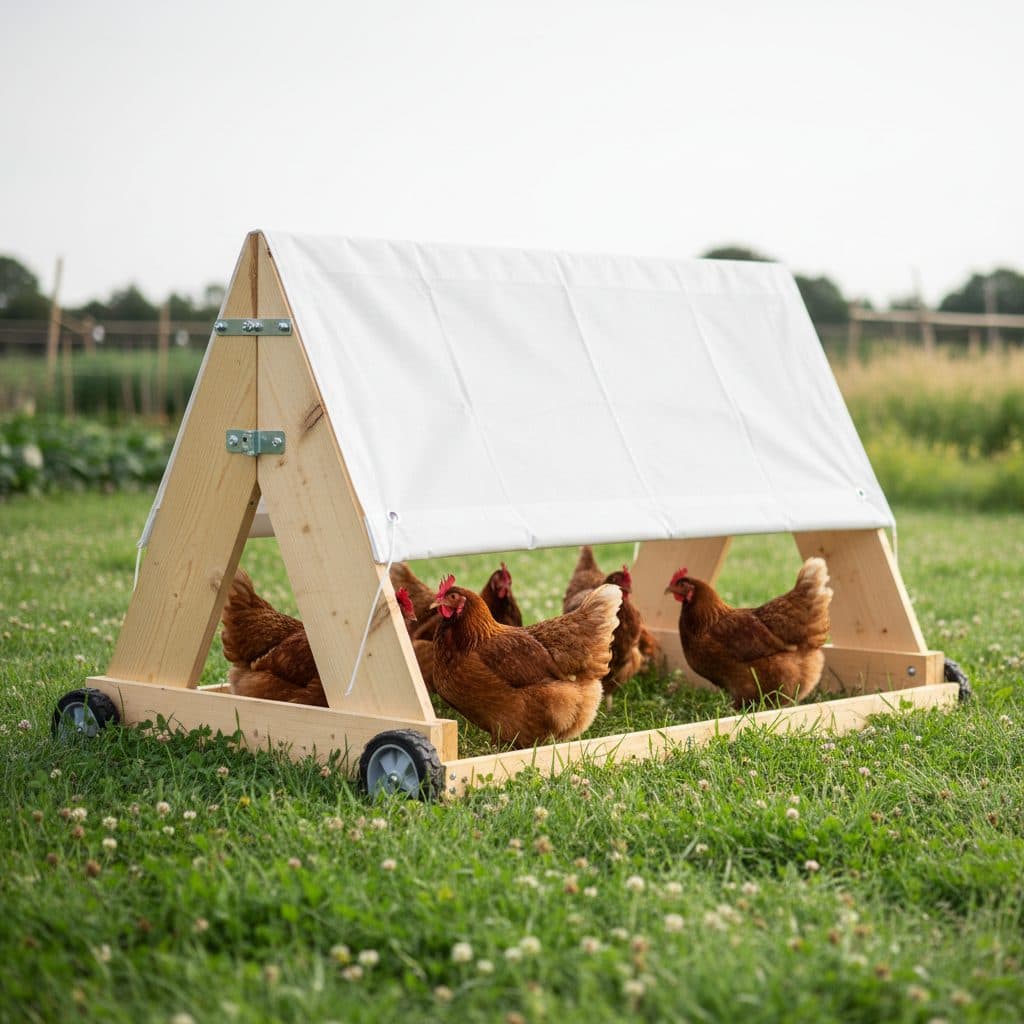
Key takeaways
- A mobile chicken tractor provides fresh forage and insects daily while distributing manure evenly to fertilize pastures without toxic nitrogen accumulation.
- Provide 2 to 3 square feet per bird for fast-growing meat broilers and 4 to 5 square feet per bird for egg-laying hens.
- Construct the frame using lightweight 2x2 dimensional lumber or electrical conduit (EMT) to keep the structure portable for a single operator.
- Line all open ground-level sections with 1/2-inch welded wire hardware cloth instead of standard hexagonal chicken wire to exclude raccoons and foxes.
- Fit the rear base with removable dolly wheels or bevelled skids to slide the coop smoothly across uneven pasture without catching turf.
Quick answer: To build a DIY chicken tractor, construct a lightweight 8x4-foot or 10x10-foot wood or conduit frame, cover the enclosed sleeping section with metal roofing, and wrap the run in 1/2-inch hardware cloth. Equip the base with skids or pneumatic wheels and a tow rope so one person can easily move the tractor to fresh pasture each morning.
Pasturing poultry provides numerous benefits: birds enjoy a continuous diet of fresh greens, seeds, and insects, while your soil receives light, distributed manure that stimulates biological activity. However, allowing chickens to free-range entirely unconfined leaves them vulnerable to aerial and ground predators.
Building from practical chicken tractor plans resolves this challenge. A chicken tractor is a floorless, mobile coop and run that houses a flock securely on grass. By shifting the structure forward onto clean pasture every morning, your birds always have access to clean ground, eliminating the mud, manure buildup, and odour common to fixed coops.
Whether you are raising a batch of fast-growing Cornish Cross meat birds or maintaining a backyard laying flock, building an efficient mobile shelter provides an economical, predator-resistant homestead solution.
+-------------------------------------------------------------+
|              CHICKEN TRACTOR DESIGN MATRIX                  |
|                                                             |
|   STYLE          FLOCK TYPE    ADVANTAGE      PORTABILITY   |
|   -----          ----------    ---------      -----------   |
|   Salatin Box    Meat Birds    Low profile    Excellent skids|
|   A-Frame Coop   4-6 Layers    Compact footprintLightweight |
|   Hoop House     10-20 Birds   Walk-in height Dolly wheels  |
+-------------------------------------------------------------+
Which chicken tractor style matches your homestead needs?
Selecting the best tractor design depends on the size of your flock, your terrain, and whether you are raising broilers or egg layers.
1. The Salatin-style pasture shelter
Popularised by regenerative farmer Joel Salatin, this low-profile 10x12-foot by 2-foot-tall box has an aluminium roof and a lightweight wooden frame.
- Best for: Meat chickens (broilers).
- Benefits: The low profile resists strong pasture winds, while the flat rectangular footprint holds roughly 50 to 60 broilers at the 2 sq ft per bird figure above; Salatin's own pens run closer to 75 birds at about 1.5 sq ft each, which demands twice-daily moves and close attention in heat.
2. The classic A-frame tractor
This design has a triangular cross-section with an enclosed roosting and nesting loft upstairs and an open grazing run beneath.
- Best for: Small backyard laying flocks (3 to 6 hens).
- Benefits: The peaked roof sheds heavy rain and snow, while the compact footprint fits neatly between raised garden beds and orchard rows.
3. The arched hoop house tractor
Constructed using flexible 1/2-inch or 3/4-inch EMT electrical conduit bent over a rectangular base skid.
- Best for: Medium-sized laying flocks (8 to 15 hens) or turkeys.
- Benefits: Provides full walk-in headroom for human access, making feeding, egg collection, and cleaning straightforward.
+-------------------------------------------------------------+
|              SPACE REQUIREMENTS BY BIRD CLASS               |
|                                                             |
|   BIRD TYPE     SHELTER SPACE (SQ FT)  MOVE FREQUENCY       |
|   ---------     ---------------------  --------------       |
|   Broilers      2.0 to 3.0 sq ft / birdOnce to twice daily  |
|   Laying Hens   4.0 to 5.0 sq ft / birdOnce daily           |
|   Turkeys       6.0 to 8.0 sq ft / birdOnce daily           |
+-------------------------------------------------------------+
To compare pastured management with fixed housing systems, explore our guide on raising pastured chickens.
What materials and dimensions build a durable 8x4-foot A-frame tractor?
An 8x4-foot A-frame coop provides 32 square feet of floor grazing space, ideal for a backyard flock of four to six laying hens.
+-------------------------------------------------------------+
|              A-FRAME TRACTOR CUT LIST                       |
|                                                             |
|   PART                DIMENSION            QUANTITY         |
|   ----                ---------            --------         |
|   Base Skids          2x4 x 8 ft (treated) 2                |
|   End Crossmembers    2x4 x 4 ft (treated) 2                |
|   A-Frame Rafters     2x2 x 5 ft lumber    6                |
|   Ridge Beam          2x2 x 8 ft lumber    1                |
|   Loft Floor Supports 2x2 x 22 in lumber   2                |
|   Loft Floor          1/2-in ext plywood   1 sheet (4x4 ft) |
|   Loft Weather Cover  Corrugated metal/tarpTo suit          |
|   Wire Mesh (Run)     1/2-in hardware cloth100 sq ft roll   |
+-------------------------------------------------------------+
Step 1: Assemble the base skid frame
Join the two 8-foot 2x4 skids with the two 4-foot end crossmembers using exterior-grade 3-inch screws to form an 8x4-foot rectangle. Cut a 45-degree bevel on the front underside of the skids so the base glides easily over pasture tussocks without digging in.
Step 2: Erect the A-frame rafters
Cut roughly 66-degree angles on the ends of your six 5-foot 2x2 rafters (24 degrees at the apex). On a 4-foot base this puts the ridge about 4 ft 7 in above the skids. If you prefer a simple 60-degree cut, use 4-foot rafters instead. Fasten them into three triangular pairs (front, middle, back) attached to the base frame. Connect the rafter apexes with the 8-foot 2x2 ridge beam running the full length of the roof peak.
Step 3: Frame the enclosed shelter loft
Install two horizontal 22-inch cross braces 2.5 feet above the ground on the rear half of the A-frame. Fasten a section of 1/2-inch exterior plywood across these braces to create an elevated, dry roosting floor. Place two 12x12-inch nesting boxes end to end along the length of this enclosed section, alongside a 2x2 roosting bar.
Step 4: Install predator-proof wire mesh
Wrap the entire open front half and lower sides of the tractor with 1/2-inch 19-gauge galvanized welded wire hardware cloth. Secure the wire every 4 inches using heavy-duty 3/4-inch galvanized fencing staples or screws with fender washers. Never use thin hexagonal chicken wire, which raccoons can easily rip apart.
+-------------------------------------------------------------+
|              A-FRAME TRACTOR SIDE ELEVATION                 |
|                                                             |
|                 /\  (Ridge Beam 8 ft)                       |
|                /  \                                         |
|               /----\  (Enclosed Loft Floor)                 |
|              /      \                                       |
|             / [Run]  \                                      |
|   ========================== (Bevelled Base Skid)           |
+-------------------------------------------------------------+
How do you predator-proof a mobile chicken tractor?
Because a chicken tractor rests on open grass without concrete footings, predators can attempt to dig underneath or reach through wire openings.
- Hardware cloth skirting: On a tractor, use a loose weighted skirt instead of a fixed apron: hang a 12-inch flap of 1/2-inch hardware cloth from the base rail so it lies flat on the grass under its own weight and rides up when you pull the coop forward. Alternatively, drop a separate hinged apron only when the tractor is parked overnight in an area with active digging predators.
- Raccoon-proof latches: Raccoons possess dexterous paws that easily open standard sliding barrel bolts. Secure all access doors and egg collection hatches with spring-loaded carabiners or two-step safety hasps.
- Solid overhead shelter: Cover at least 50% of the tractor roof with solid corrugated metal or UV-stabilized heavy-duty tarp. This shields birds from aerial hawks, owls, and intense midday sun.
For comprehensive predator deterrence strategies, consult our detailed guide on how to protect chickens from predators.
+-------------------------------------------------------------+
|              PREDATOR DEFENSE MECHANISMS                    |
|                                                             |
|   THREAT            DEFENSE MECHANISM                       |
|   ------            -----------------                       |
|   Digging Canines   12-inch outward hardware cloth apron    |
|   Raccoons          Two-step carabiner latches on doors     |
|   Hawks / Owls      Solid corrugated metal roof canopy      |
|   Weasels / Snakes  1/2-inch hardware cloth (no gaps >1/2") |
+-------------------------------------------------------------+
How do you move and manage a tractor on pasture daily?
Operating a chicken tractor efficiently requires a consistent daily routine:
- Move early every morning: Fasten a rope handle to the front crossmember. Walk backward slowly, gently encouraging the birds forward as the rear wheels or skids glide along the ground.
- Inspect pasture forage: Position the tractor on diverse pasture consisting of mixed grasses, clover, and dandelions. Avoid parking over wet depressions or exposed rocky ground.
- Clean water and feeding: Hang poultry nipple waterers and gravity feeders inside the tractor so they travel with the coop during the morning move without spilling. For balanced flock nutrition, review what to feed chickens.
- Winter housing transition: In severe northern climates, transition pastured birds into a stationary coop before deep snow falls, or manage winter bedding using the deep litter method.