Key takeaways

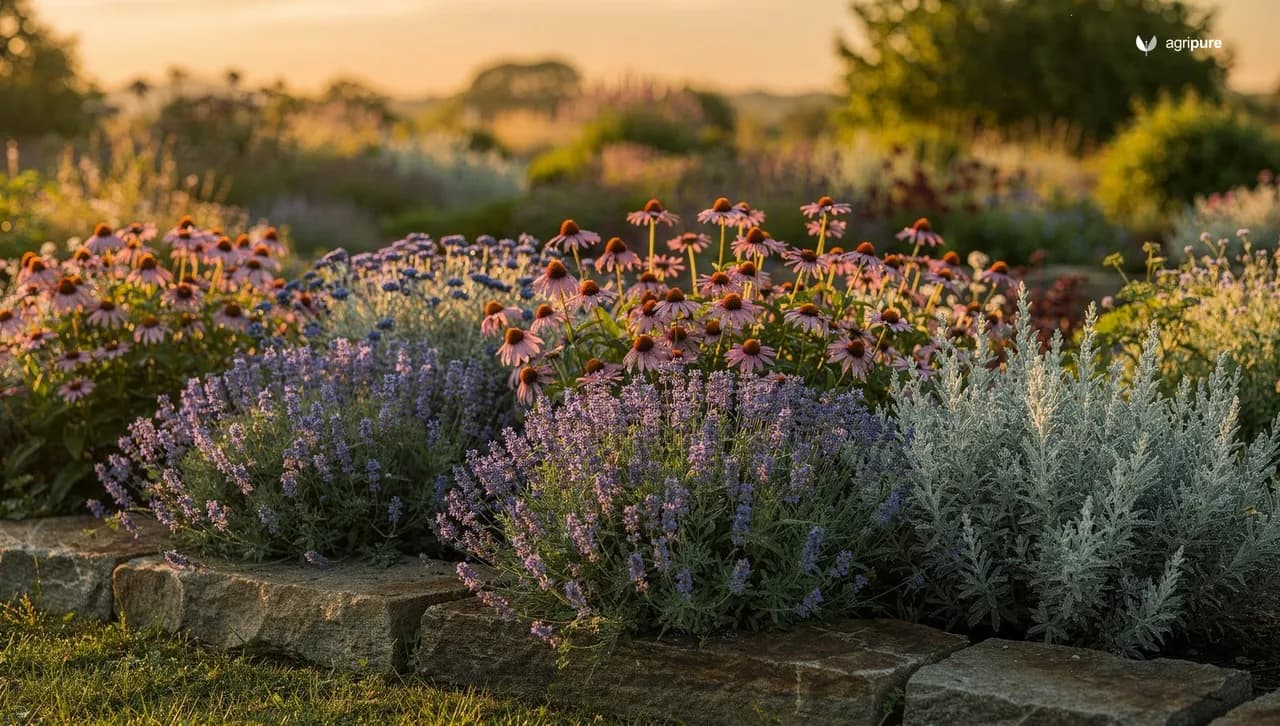
This roundup covers low-maintenance perennials by sun exposure and USDA zone, including purple coneflower, Russian sage, sedum, yarrow, and hostas.
- “Low maintenance” is not “no maintenance” — even drought-tolerant perennials need deep watering of about 1 inch per week through their first season to root in.
- Match the plant to your USDA zone first: the map uses 30-year average winter lows split into 13 zones, and a perennial rated for zones 3 to 8 is a safe bet across most of the country.
- The least-fuss picks combine drought tolerance, disease resistance, and no staking or deadheading — purple coneflower reblooms without deadheading, and Russian sage has essentially no pest problems.
- Group by sun exposure: coneflower, sedum, yarrow, and Russian sage want full sun; hostas and a few others carry the shade.
- Most of these need dividing only every 3 to 4 years, and a single mulch top-up cuts your watering for the whole season.
The phrase “low maintenance” gets stretched past breaking on plant tags. A useful working definition is narrower: a perennial that, once it has rooted in, asks for under 10 minutes of attention a year — no staking, no deadheading to keep it blooming, no spraying for disease, and no aggressive running that forces you to dig it back every spring. By that bar, the list is shorter than the catalogs suggest, but it is real.
The other half of the job is placing the plant where it wants to be. Get the 2 things right (sun exposure and USDA zone) and the plant does the work; get them wrong and even the toughest perennial becomes a chore. Here is what the extension research actually shows, grouped by light and cold-hardiness, with the 1 catch that almost nobody prints on the tag.
What low maintenance actually means
Every drought-tolerant perennial carries the same asterisk: it earns that label only after it establishes. Penn State Extension is direct about it — perennials that are said to tolerate drought are drought tolerant only after they have become established, and the rule of thumb is to add 1 inch of water per week while they get there. Skip that first-season watering and you lose the plant before it ever pays off.
After year one the workload drops sharply. Most perennials benefit from lifting and dividing only every 3 to 4 years, and a layer of mulch reduces how often you water at all. The genuinely low-maintenance species add three more traits on top: they resist disease, they hold themselves up without staking, and they keep blooming without deadheading.
The four traits that separate a chore from a keeper
- Drought tolerance once rooted: deep roots mean you stop hand-watering after the first 1 to 2 seasons.
- Disease and pest resistance: Russian sage, for example, is easy to grow with essentially no disease or insect problems, so there are 0 sprays to schedule.
- No staking or deadheading: purple coneflower reblooms without deadheading, and sturdy 2 to 5 foot stems mean it never flops onto its neighbors.
- Slow, clumping growth: a plant that expands only a few inches a year stays put; a runner becomes next year’s weeding.
Establishment is the whole game: budget for deep weekly watering through the first 12 to 16 weeks. A perennial that gets a real root system in year one will coast for a decade; one that is left to dry out rarely makes it to year two.

Match the plant to your USDA zone first
Before sun, before soil, check the number on your map. The USDA Plant Hardiness Zone Map is the standard for deciding which perennials will survive your winters, and the 2023 version is built on 30-year averages of the lowest annual winter temperatures. It splits the country into 13 zones of 10 degrees Fahrenheit each, further divided into 5-degree “a” and “b” half-zones. A plant rated for your zone or colder is the safe choice.
The widest-adapted low-maintenance perennials carry broad zone ranges, which is part of why they show up on every regional list. Autumn Joy sedum is hardy across zones 3 to 9, purple coneflower across zones 3 to 8, and Russian sage across zones 4 to 9 — between them they cover almost every garden in the lower 48. Plants like English lavender, by contrast, sulk below zone 5, so the zone check saves you from replacing it every spring.
Read the half-zone, not just the number: the difference between 5a and 5b is 5 degrees F of average winter low — enough to decide whether a borderline perennial overwinters or dies. Buy for the colder half if you are unsure.
The best low maintenance perennials compared
Each of these earns its place differently — some for full-sun toughness, some for a long bloom, some for sheer indifference to neglect. This table sorts the 7 dependable performers by zone, light, and the maintenance trait that matters most.
Perennial | USDA zones | Light | Why it is low maintenance |
|---|---|---|---|
Purple coneflower | 3 to 8 | Full sun to part shade | Reblooms without deadheading; tolerates poor soil |
Autumn Joy sedum | 3 to 9 | Full sun | Rated low maintenance; fall bloom; succulent leaves |
Russian sage | 4 to 9 | Full sun | No disease or insect problems; 2-month bloom |
Daylily | 3 to 9 | Full sun to light shade | Tough, drought tolerant, adapts to most soils |
Threadleaf coreopsis | 3 to 9 | Full sun | Long bloom, minimal care, 18 to 24 inches tall |
Yarrow | 3 to 9 | Full sun | Drought tough; 3 to 4 feet; pollinator magnet |
Hosta | 3 to 8 | Shade to part shade | Durable, long-lived, carries the shady bed |
Across all 7 picks, full sun carries the longest-blooming and most drought-proof species, broad zone ranges of 3 to 9 make most of them safe nationwide, and only the hosta is built for deep shade. None of them needs staking, spraying, or deadheading to keep going.
Full-sun perennials that thrive on neglect
Most of the truly carefree perennials want a full-sun bed with well-drained soil, because that is the condition their wild ancestors evolved in. Iowa State Extension lists purple coneflower at 2 to 4 feet tall, Russian sage at a 3 to 4 foot height and spread, and fernleaf yarrow at 3 to 4 feet among its dry-condition perennials — all of them content in lean soil that would starve a fussier plant.
The aromatic, drought-proof herbs belong in this group too. Catmint blooms for roughly 8 weeks from late spring through summer and shrugs off heat once established, while creeping common thyme, a true culinary herb, knits into a 2 to 4 inch drought-proof mat between stepping stones. Plant them where the afternoon sun is strongest and the drainage is sharpest. (The silver-leaved ornamentals are a different story: Russian sage earns its spot on looks and toughness, not flavor: it is grown as an ornamental, not a culinary herb, so do not treat its foliage as edible.)
Designing for a succession of bloom
The trick to a full-sun bed that looks alive from spring to frost is staggering bloom times rather than planting 1 big flush. A simple 3-wave plan keeps color moving across roughly 5 months with no extra work:
- Late spring to early summer: catmint and threadleaf coreopsis open first, carrying the bed for 6 to 8 weeks.
- Midsummer: purple coneflower and yarrow take over from June through August, overlapping the first wave.
- Late summer to fall: Russian sage runs up to 2 months and Autumn Joy sedum closes the season blooming September into October.

Shade and the maintenance you cannot skip
Shade narrows the list, but it does not erase it. Hostas are extremely durable and long-lived and are the backbone of any low-fuss shady border, holding their own where sun-lovers would stretch and flop. The trade-off is that fewer shade perennials are truly drought-proof, so a bed under trees usually needs the help of a 2 to 3 inch mulch layer to hold moisture through a dry August.
No perennial is genuinely zero-effort, and pretending otherwise sets you up to lose plants. The honest maintenance floor is small but non-negotiable: deep watering through the first season, 1 annual cleanup, and a division every 3 to 4 years. Build the bed on healthy living soil and even that shrinks, because vigorous roots resist drought and disease on their own.
One spring cleanup does it: cut last year’s stems back to a few inches in early spring, top up the mulch to 3 inches, and you have done most of the year’s work in a single afternoon.
Conclusion
Low maintenance is a design decision more than a plant choice. Pick species rated for your USDA zone, set the full-sun lovers in full sun and the hostas in shade, water deeply for one season to root them in, and stagger the bloom so the bed carries itself from spring to frost. Do that and a perennial border asks for one cleanup a year and a division every 3 to 4 years — and gives back color for a decade.
Frequently asked questions
What are the easiest perennials to grow?
Purple coneflower, Autumn Joy sedum, Russian sage, daylilies, coreopsis, and yarrow top most extension lists because these 6 tolerate drought once established, resist disease, and bloom without staking or deadheading. Hostas fill the same role in shade.
Do low maintenance perennials still need watering?
Yes, during establishment. Even drought-tolerant perennials need about 1 inch of water per week through their first growing season to build deep roots. After that first year most of them coast on rainfall in all but severe drought.
How do I choose perennials for my USDA zone?
Find your zone on the USDA Plant Hardiness Zone Map, which uses 30-year average winter lows across 13 zones, then pick perennials rated for your zone or colder. Broad ranges like zones 3 to 9 are the safest nationwide choices.
Which low maintenance perennials work in full sun?
Purple coneflower, Russian sage, sedum, yarrow, coreopsis, catmint, and daylilies all want full sun and well-drained soil. These 7 are the longest-blooming and most drought-proof of the carefree perennials.
How often do perennials need dividing?
Most perennials benefit from lifting and dividing every 3 to 4 years, which keeps clumps vigorous and prevents bare centers. Slow-clumping species like Russian sage and sedum can go even longer between divisions.
References
- Penn State Extension — Care and Maintenance of Perennials
- USDA Agricultural Research Service — Updated Plant Hardiness Zone Map
- Missouri Botanical Garden — Echinacea purpurea (Purple Coneflower)
- Missouri Botanical Garden — Autumn Joy Sedum
- University of Wisconsin-Madison Extension — Russian Sage
- Iowa State University Extension — Perennials Tolerant of Dry Conditions
- Iowa State University Extension — Easy to Grow Perennials