Key takeaways

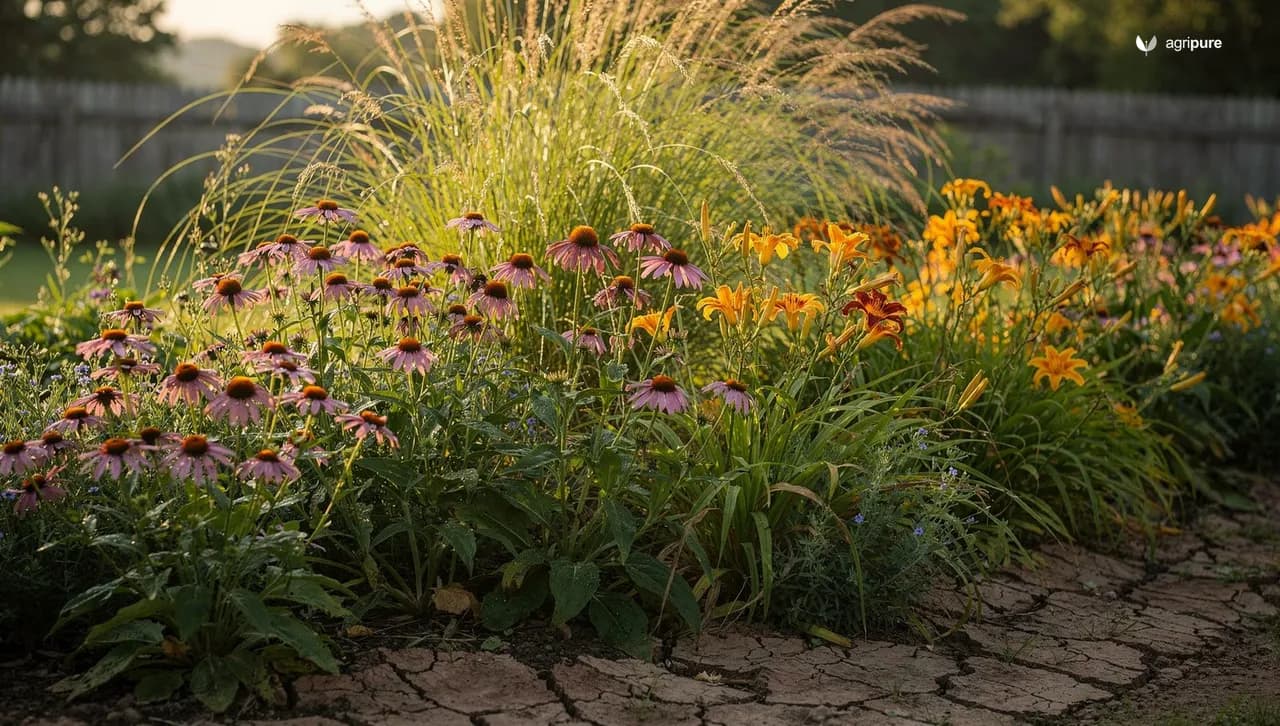
Despite its challenging nature, clay soil, when managed correctly, can be a nutrient-rich foundation for a beautiful and resilient garden. Drought-tolerant perennials thrive in it, showing what heavy ground can support.
- Clay particles are the smallest soil separate (under 0.002 mm), which is why clay holds more water and nutrients than sand or silt.
- Never fix clay with sand: it takes roughly a 1:1 ratio to change the texture, and a poor mix sets up like concrete.
- Organic matter is the real amendment: work 1 to 3 inches into the top 6 to 12 inches, then keep adding it as mulch.
- Tough perennials like coneflower, daylily, and aster, plus shrubs like dogwood and viburnum, root straight through heavy clay.
- Plant slightly high (crown about 2 inches proud) and backfill with native soil, not a rich mix that traps water.
Heavy clay gets a bad name it only half deserves. Dig a fork into it after rain and you get a sticky, airless slab; let it bake in July and it cracks into bricks 2 to 3 inches deep. Yet that same clay holds more water and more plant nutrients per pound than any sand or silt you could truck in.
Working with the clay beats fighting it: feed it organic matter, leave the sand out of the equation entirely, and choose plants whose roots are built to push through it. This guide covers 3 practical points: what the soil science shows, which perennials, shrubs, and trees earn their place in heavy ground, and the planting technique that keeps a new plant from drowning in its own hole.
Why clay is both a challenge and a nutrient bank
Clay frustrates gardeners for one reason: particle size. According to the NC State Extension Gardener Handbook, clay is the smallest soil separate at less than 0.002 mm, with a flat, platelike shape that packs tightly and drains slowly. Those same tiny plates carry an enormous surface area (measured in millions of square centimetres per gram), which is where the upside lives.
All that surface area is why clay holds water and nutrients effectively while sand does not. A clay loam can carry several times the available nutrients of a sandy soil, which is why prairie and bottomland species grow so rank in it. The challenge is air and drainage rather than fertility, because waterlogged clay starves roots of oxygen.
The two faces of heavy ground
Sort your clay into its strengths and its weaknesses before you plant, because the fix for each is different.
- The asset: high water-holding capacity and a deep reserve of nutrients that carry plants through drought once they are established.
- The liability: slow drainage, low oxygen, and a surface that crusts hard, conditions that rot the roots of anything not adapted to it.
- The fix: raise the oxygen and drainage with organic matter and good plant choice, and stop trying to change the texture itself.
Test before you dig: squeeze a moist handful; if it ribbons out 2 inches or more between thumb and finger without breaking, you are working a clay or clay loam, and the advice below applies in full.
The amendment that works, and the one that wrecks it
The single most common clay mistake is reaching for a bag of sand. University of Illinois Extension is blunt about why it backfires: when sand mixes with clay it creates a soil structure akin to concrete, and to genuinely change the texture you would need close to a 1:1 ratio of sand to clay (many tons across a single bed). A half-measure of sand just fills the pore spaces and makes the ground denser.
Organic matter does the opposite. Penn State Extension notes that organic matter keeps small particles like clay from forming a solid mass by binding them into crumb-like aggregates, opening the pore spaces that hold air and move water. The handbook guidance is practical: mix 1 to 3 inches of organic matter into the top 6 to 12 inches of the bed, then keep feeding the surface every season, because clay slowly reverts to its native state.
Compost, not sand, every time. A yearly 1 to 2 inch topdressing of compost will do more for clay drainage in 3 years than any one-time sand dig ever could, and it builds the living soil instead of cementing it.

A field comparison of plants for clay soil
Different plant groups handle clay in different ways: some by sheer root force, some by tolerating the wet, and some by needing the drainage you build first. This table sorts the main options by how they cope and where they fit.
Plant group | Clay strategy | Drainage needed | Examples |
|---|---|---|---|
Prairie perennials | Deep roots break the clay | Low | Coneflower, aster, baptisia |
Moisture-loving perennials | Thrive in the wet | None | Daylily, Joe-Pye weed, iris |
Ornamental grasses | Fibrous roots open the soil | Low | Switchgrass, muhly grass |
Clay-tolerant shrubs | Tolerate heavy, wet ground | Low to moderate | Dogwood, viburnum, ninebark |
Tough trees | Anchor and aerate over years | Low | Oak, river birch, bald cypress |
Drought-prone alpines | Rot in wet clay | High (raised beds) | Lavender, most Mediterranean herbs |
Across these 6 groups, the pattern is clear: native prairie and wetland plants treat clay as home, grasses and deep-rooted perennials actively improve it, and only the Mediterranean dry-lovers need you to build drainage with a raised bed first.
Perennials, shrubs, and trees that thrive in clay
The plants that succeed in clay share one trait: roots strong enough to drive through dense ground, or a tolerance for sitting wet. Proven Winners lists the daylily as one that will tolerate almost any soil type, including clay, and the same holds for a long roster of prairie and bottomland natives that evolved on heavy ground.
For shrubs and small trees, look to species from wet woodland edges. Red-twig dogwood, summersweet, ninebark, and viburnum all take heavy clay, and among trees the tough options (oak, river birch, and bald cypress) help break the soil as their roots expand over the years. Working a fork-load of compost across the planting area first makes every one of them establish faster.
A starter palette for heavy ground
If you are building a clay border from scratch, these 3 layers give you structure, season-long bloom, and roots that improve the soil as they grow.
- Backbone perennials: coneflower, black-eyed Susan, aster, and false indigo (baptisia), which are long-lived, drought-tough once rooted, and untroubled by clay.
- Wet-tolerant fillers: daylily, Siberian iris, bee balm, and Joe-Pye weed for the low, slow-draining corners where most plants sulk.
- Grasses and shrubs: switchgrass and muhly grass for movement, with dogwood or viburnum for winter structure and bird food.
How to plant in clay without drowning the roots
Even a clay-tough plant can die in the first month if you plant it wrong, and the usual mistake is digging a deep hole and backfilling with rich potting mix. Piedmont Master Gardeners are clear on the method: dig the hole just large and deep enough to fit the root ball, elevate the top of the root ball about 2 inches above the soil line, and use the existing native soil for backfill without amendment.
That last point feels wrong but matters most. A hole of fluffy amended soil inside heavy clay becomes a bucket: water runs in, cannot drain out through the clay walls, and the roots sit drowned. Planting slightly high with native backfill lets the crown stay above the waterline, and feeding comes from the top: a layer of mulch and a 3 to 4 inch compost topdressing that earthworms pull down over the season.
Plant in the shoulder seasons. Set new plants in fall or early spring when clay is moist but not saturated; working wet clay smears the pores closed, and bone-dry summer clay is too hard to dig cleanly.

Where drainage is hopeless and the water table is high, stop digging down and build up instead. A raised bed filled 8 to 12 inches deep over the clay gives Mediterranean herbs and alpines the sharp drainage they need, while the clay below still feeds the deeper roots.
Conclusion
Clay rewards patience more than it punishes it. Skip the sand, fold in 1 to 3 inches of organic matter, plant prairie and wetland species that were built for heavy ground, and set every crown about 2 inches high in native backfill. Do that, and the soil that felt like a curse becomes the most fertile and drought-proof ground in the garden within a few seasons.
Frequently asked questions
What plants grow best in heavy clay soil?
Prairie and wetland natives do best: coneflower, aster, daylily, bee balm, Joe-Pye weed, and switchgrass among perennials and grasses, plus shrubs like dogwood, viburnum, and ninebark and trees such as oak, river birch, and bald cypress.
Should I add sand to clay soil?
No. It takes roughly a 1:1 ratio of sand to clay to change the texture, and a partial mix fills the pore spaces and sets up dense, akin to concrete. Add organic matter such as compost instead.
How much organic matter does clay soil need?
Work 1 to 3 inches of compost or other organic matter into the top 6 to 12 inches when you start a bed, then topdress with 1 to 2 inches each year because clay gradually reverts to its native state.
How deep should I plant in clay soil?
Plant slightly high. Dig the hole just big enough for the root ball, set the crown about 2 inches above the soil line, and backfill with native soil so the roots are not sitting in a waterlogged pocket.
Is clay soil good for plants?
Yes, in nutrient terms. Clay’s tiny particles, under 0.002 mm, give it the highest water- and nutrient-holding capacity of any soil texture. Once you improve its drainage and aeration, that fertility carries plants through dry spells.
References
- NC State Extension Gardener Handbook — Soils and Plant Nutrients
- University of Illinois Extension — Does Sand Improve Clay Soil Drainage?
- Penn State Extension — Practical Tips for Healthy Soil in a Home Garden
- Piedmont Master Gardeners — Gardening in Clay
- Proven Winners — 10 Perennials for Clay Soil