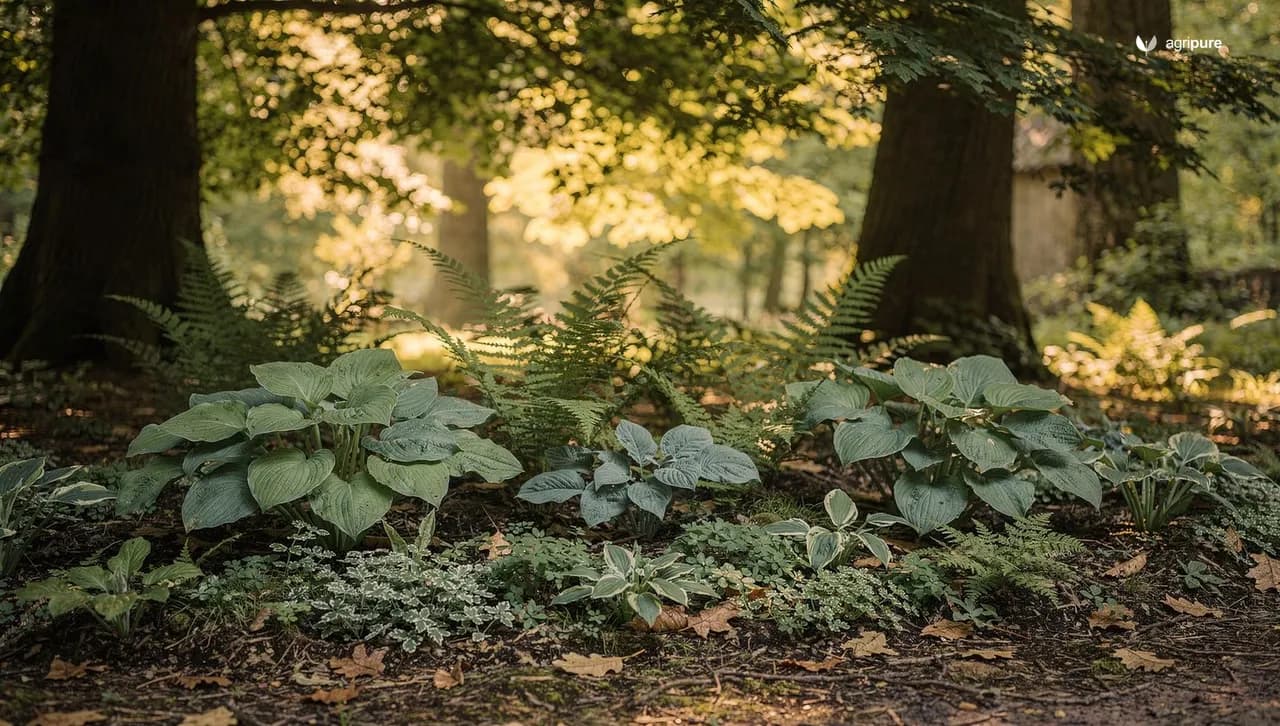
Key takeaways

Plants adapted to full shade rely on leaf color, shape, and texture to build structure and visual interest in low-light garden beds.
- Full shade is less than 2 hours of direct sun a day; dense shade is a spot with no direct sun at all.
- Foliage carries a shade bed: leaf color, shape, and texture do the work that flowers do in sun.
- Dry shade under tree roots is a separate, harder problem than moist shade and needs its own plant list.
- Hostas survive deep shade and are hardy to USDA zones 3 to 4; many ferns run to zone 8.
- Group by type (perennials, groundcovers, ferns, shrubs) and match each to your USDA zone and soil moisture.
A north-facing bed that gets under 2 hours of sun a day will starve most flowering annuals, yet a maple’s understory in the wild is thick with green. The difference is that woodland plants are built to read low light, not to bloom in it. Shade leaves carry more chlorophyll per unit weight than sun leaves, which is how they wring a living out of the 2 or 3 hours of filtered light they get.
That single fact reshapes how you plant a dark corner. You stop hunting for color from petals and start building it from leaves. Sorting candidates by type helps because a 10-inch groundcover and a 4-foot shrub solve different parts of the same problem. Here is how the survivors break down, why dry shade is its own category, and which USDA zones each group covers.
What full shade means
Those plant tags that promise “shade” tell you almost nothing about which USDA zones a plant covers, so it pays to fix the numbers first. Penn State Extension defines shade as less than 2 hours of sunlight a day, with partial shade running 2 to 4 hours and light or dappled shade meaning sun filtered through a tree canopy. The hardest tier is dense shade: a site with no direct sun at all, like the base of a north-facing wall or the ground beneath dense evergreens.
Knowing which tier you have changes the plant list completely. A bed with 3 hours of morning sun will grow things that a true north wall never will, so spend a day watching where the light lands before you buy anything. A cheap light meter removes the guesswork and tells you whether you are working with 90 minutes of weak sun or genuine deep shade.
Reading your site in hours, not labels
Walk the bed at 9 a.m., noon, and 3 p.m. and note when sun touches the soil. Three quick readings sort almost any spot into one of these buckets:
- Partial shade (2 to 4 hours): the widest plant list; most “shade” perennials are happiest here.
- Full shade (under 2 hours): hostas, ferns, and shade groundcovers, but few reliable flowers.
- Dense shade (no direct sun): foliage only, from a short, tough list.
Full shade versus dry shade
The single biggest mistake in a shade bed is treating all shade as one problem. Moist shade (the cool, damp ground a north wall or open canopy throws) is forgiving, and most classic shade plants thrive in it. Dry shade is the opposite: the parched, root-filled soil under a mature tree, where the Missouri Botanical Garden notes that few if any plants prefer to grow and only a handful tolerate it once established.
The reason is underground competition. University of Minnesota Extension points out that trees and shrubs run feeder roots through the top 18 to 20 inches of soil, competing with garden plants for space, water, and nutrients, where mature trees hold the advantage. So before you choose plants, decide which shade you have. Improving the bed with 2 to 3 inches of compost and a steady layer of mulch closes much of the gap between dry and moist.
Plant small under trees: start 1 foot out from the trunk and dig holes as small as you can, so you slip plugs and small divisions between roots without slicing them. A 2-inch division establishes faster in dry shade than a gallon pot you had to hack a hole for.

Foliage perennials and ferns that carry the bed
Whether the bed is dry or moist, flowers are scarce in deep shade, so the backbone of the planting is leaf contrast: broad against fine, gold against deep green, and smooth against crinkled. Hostas are the anchor: University of Minnesota Extension confirms they survive deep shade of under 4 hours of sun, are hardy to USDA zones 3 to 4, and range from 6 inches high to 3 to 4 feet tall and 5 to 6 feet across, so a single genus gives you ground-huggers and bold centerpieces.
Ferns add the fine texture that stops a hosta bed looking heavy. Northern maidenhair fern takes part to full shade in moist soil across zones 3 to 8, with airy fronds to 2 feet, while coral bells run zones 3 to 8 with leaves in burgundy, silver, and lime. A nitrogen-feeding foliage plant like Indian coleus earns its place where you want a jolt of patterned color at eye level.
Pairing leaf shapes for contrast
Aim for at least 3 distinct leaf forms in any group of 5 plants so nothing reads as a green blur:
- Broad and bold: hostas, hardy begonia, bergenia (providing visual weight).
- Fine and feathery: maidenhair and Christmas fern, astilbe foliage (adding fine texture).
- Colored and low: coral bells and spotted deadnettle (tying the tiers together).
Groundcovers and shrubs for the shade layers
Those perennials and ferns fill the middle tier, but a finished shade bed works in tiers, and two of them are not perennials at all. Groundcovers knit the soil together at ankle height and smother the weeds that otherwise colonize bare shade. A vigorous evergreen climber-and-creeper like Nepal ivy blankets a difficult slope, while spotted deadnettle and bishop’s hat hold dry shade where little else will spread.
Above them, shade shrubs give the bed its walls and winter structure. Clemson lists rhododendron and azalea, hydrangea, aucuba, fatsia, and boxwood among the shrubs that take real shade, and many run from zones 5 to 9. Set one or two as the backbone, then let perennials and groundcovers fill in front. This layered approach borrows straight from the understory of a young woodland, where every level of light is doing a job.
Mind the spread: the toughest shade groundcovers are tough because they run hard. Give ivy and yellow archangel a hard edge (a path, a mowed strip, or a buried barrier 6 inches deep) or they will leave the bed within 2 seasons.
A field guide to full-shade plants by type
Each woodland group earns its place for a different reason: height, texture, or sheer toughness in dry soil. This table sorts all 7 main candidates by type, the lowest USDA zone they reliably survive, and whether they hold up in dry shade or insist on moisture.
Plant (type) | Shade tolerance | USDA zones | Dry shade? |
|---|---|---|---|
Hosta (foliage perennial) | Deep shade | 3 to 9 | Tolerates, prefers moist |
Coral bells (foliage perennial) | Part to full shade | 3 to 8 | Moderate |
Maidenhair fern (fern) | Part to full shade | 3 to 8 | No, needs moist |
Christmas fern (fern) | Part to full shade | 3 to 9 | Yes, once established |
Spotted deadnettle (groundcover) | Full shade | 3 to 8 | Yes |
Bishop’s hat (groundcover) | Full shade | 5 to 9 | Yes |
Hydrangea (shade shrub) | Part to full shade | 5 to 9 | No, prefers moist |
Across all 7, only the ferns and hydrangea truly insist on moisture; the groundcovers and Christmas fern are the ones to reach for under thirsty tree roots, and the hostas and coral bells give you the widest zone range from 3 upward.
Designing and planting a full-shade bed
With the plant list sorted by type and zone, the design almost writes itself: build in layers, the way light stacks in a woodland. Set 1 or 2 shade shrubs as the back wall, drop bold hostas and ferns into the middle at roughly 18 to 24 inches apart, and edge the front with low groundcovers and coral bells. Repeat 3 leaf textures through the planting and the bed reads as designed rather than collected.
Get the soil right before the plants go in. Shade beds are often dry and root-bound, so work 2 to 3 inches of compost into the top layer, then mulch to hold moisture and suppress weeds. A no-dig approach suits shade especially well, since it avoids slicing the surface roots that make planting under trees so awkward in the first place. Water new plants through their first full season, because even drought-tolerant shade plants need a year to settle.
A simple planting sequence
Run the job in 4 steps and a shady corner fills in within 2 seasons:
- Test the light: 3 readings across the day to fix your shade tier.
- Amend the soil: 2 to 3 inches of compost, especially in dry shade.
- Plant in layers: shrubs, then perennials and ferns, then groundcovers.
- Mulch and water: 2 to 3 inches of mulch and steady water through season 1.
Spacing for shade: plants grow slower in low light, so resist crowding. Set perennials at the wider end of the label range (18 to 24 inches for big hostas) and let them take 2 to 3 seasons to close the gaps.

Conclusion
Those layers of mulch, foliage, and structure create a distinct palette built around leaves rather than flowers. Fix your shade tier in hours, separate dry shade from moist, and group your plants by type so each tier does its job. With hostas and coral bells from zone 3, ferns and groundcovers for texture, and a shrub or 2 for structure, a corner that grew nothing for years can read as the most restful spot in the garden within 2 seasons.
Frequently asked questions
What counts as full shade?
Full shade means a site that gets less than 2 hours of direct sun a day, according to Penn State Extension. Dense or deep shade is a step further: no direct sun at all, such as the base of a north-facing wall or the ground under dense evergreens.
What is the difference between full shade and dry shade?
Full shade describes how much light a spot gets, while dry shade describes the soil. Dry shade is the parched, root-filled ground under a mature tree, where feeder roots in the top 18 to 20 inches take most of the water, so it needs tougher, drought-tolerant plants than cool, moist shade.
What plants survive in deep, full shade?
Hostas survive deep shade of under 4 hours of sun and are hardy to USDA zones 3 to 4. Ferns such as maidenhair and Christmas fern, coral bells, and groundcovers like spotted deadnettle and bishop’s hat also hold up, carrying the bed on foliage rather than flowers.
Can flowers grow in full shade?
A few do, but bloom is sparse below 2 hours of sun, so most full-shade design leans on foliage. Coral bells, hardy begonia, and some hydrangeas add color, yet leaf shape and texture in 3 contrasting forms carry the planting far more reliably than petals.
What grows in dry shade under trees?
Once established, Christmas fern, spotted deadnettle, bishop’s hat, bergenia, and yellow archangel tolerate dry shade. Start plants small, 1 foot out from the trunk, and add 2 to 3 inches of compost and mulch, since few plants truly prefer dry shade and most need help to settle.
References
- Penn State Extension — Planting in Sun or Shade
- University of Minnesota Extension — Gardening in the shade
- University of Minnesota Extension — Growing hostas
- Wisconsin Horticulture — Northern Maidenhair Fern, Adiantum pedatum
- Missouri Botanical Garden — Plants for Dry Shade
- Missouri Botanical Garden Plant Finder — Heuchera sanguinea
- Lichtenthaler et al., Photosynthesis Research (1981) — Sun and Shade Leaves