Key takeaways
- Summer-bearing raspberries fruit once on second-year canes, requiring specific pruning after harvest to encourage new growth.
- Everbearing raspberries fruit twice, on first-year and second-year canes, offering flexible pruning options for one or two annual crops.
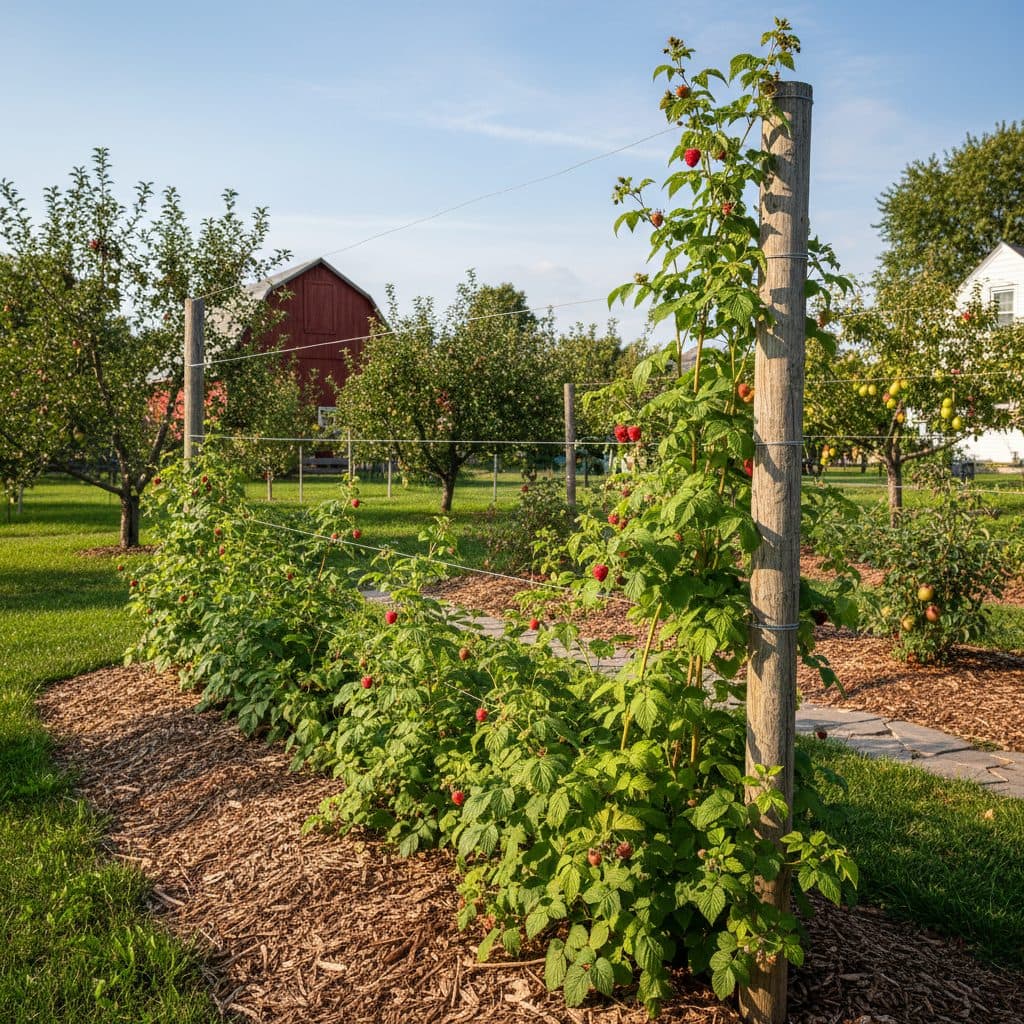
- Trellising supports canes, improves air circulation, increases light penetration, and simplifies harvest.
- The ‘T-trellis’ and ‘V-trellis’ are effective systems for managing raspberry growth, often standing 5 to 6 feet tall.
- Proper soil pH, between 5.5 and 6.5, matters for raspberry health, and floricane (summer) crops depend on the canes accumulating adequate winter chilling.
- Regular pruning prevents disease, removes unproductive wood, and encourages vigorous new growth, essential for consistent fruit production.
Quick answer: Pruning and trellising raspberries involves specific techniques for summer-bearing and everbearing varieties to remove old canes, encourage new growth, improve air circulation, and increase light penetration, ultimately boosting yields and plant health.
Across the United States, from the Pacific Northwest to the Mid-Atlantic, home growers are cultivating raspberries for their sweet, tangy fruit. Whether you are in USDA zone 5 or zone 8, understanding the specific needs of your raspberry type matters for a successful harvest. Raspberry canes typically produce fruit in their second year before dying back, but the timing of that fruit production varies significantly between summer-bearing and everbearing varieties.
This article will detail the distinct pruning and trellising strategies for both summer-bearing and everbearing raspberries, helping you manage your patch for maximum yield and plant health. Proper management makes a large difference to how much a patch produces, so your efforts are rewarded with plenty of berries for fresh eating, jams, and freezing.
Summer-bearing raspberries: the single harvest
Summer-bearing raspberries, also known as ‘floricane-fruiting’ varieties, produce one large crop per year. These canes grow vegetatively in their first year, developing into ‘primocanes’, and then bear fruit on these same canes, now called ‘floricanes’, in their second year. After fruiting, these floricanes die back. In regions like USDA zone 6, a well-managed patch can yield a substantial harvest, with some training systems capable of producing over 10,000 kg/ha (about 8,900 lbs/acre) [3]. The harvest period typically lasts for three to four weeks in mid-summer.
pruning summer-bearing varieties for vigor
Pruning summer-bearing raspberries involves removing the old, unproductive floricanes immediately after their harvest in late summer or early fall. This practice directs the plant’s energy towards developing strong new primocanes for the following year’s crop. Aim to leave the strongest three to five primocanes per linear foot of row. Removing spent canes also improves air circulation within the patch, reducing the risk of fungal diseases. For more general pruning advice, refer to how to prune fruit trees: by season, by species, and by tree age.
- Remove spent floricanes: Cut back all canes that have fruited to the ground level.
- Thin new primocanes: Select the strongest three to five new canes per foot of row, removing weaker ones.
- Sanitize tools: Clean pruning shears with a 10% bleach solution between plants to prevent disease spread.
- Clear debris: Remove all pruned material from the patch to reduce overwintering pests and diseases.
Everbearing raspberries: the double harvest
Everbearing raspberries, also known as ‘fall-bearing’ or ‘primocane-fruiting’ varieties, offer a more extended harvest season. These varieties produce fruit on the tips of their first-year canes (primocanes) in late summer or fall, and then, if left unpruned, the lower parts of these same canes will fruit again as floricanes the following summer. The ‘St. Regis’ everbearing red raspberry, for instance, has been cultivated since at least 1922, demonstrating a long history of this dual-harvest capability [1]. Primocane-fruiting types flower and fruit on current-season growth, so they do not need to bank winter chill before their fall crop. Chilling matters only for the optional second, floricane crop the following summer.
pruning everbearing varieties: one crop or two?
You have two primary pruning options for everbearing raspberries, depending on whether you prefer one large fall crop or two smaller crops. For a single, larger fall crop, cut all canes back to the ground in late winter or early spring, before new growth begins. This method focuses all the plant’s energy into primocane development and a concentrated fall harvest. If you prefer two crops (a smaller fall crop and an earlier summer crop), prune only the top portions of the canes that fruited in the fall. The remaining lower sections will become floricanes and produce fruit the following summer.
- Single Fall Crop: Cut all canes to the ground in late winter (February or March in USDA zone 7).
- Two Crops (Fall and Summer): In late winter, cut back only the tips of canes that fruited last fall, leaving the lower portions for a summer crop.
- Thinning: Regardless of the method, thin new primocanes to four to six per linear foot of row in spring.
- Disease Prevention: Remove any weak, diseased, or damaged canes throughout the growing season to maintain plant health.
Essential trellising systems for optimal production
Trellising is not strictly necessary for all raspberry varieties, but it significantly benefits both summer-bearing and everbearing types, especially in areas with high winds or heavy fruit loads. A well-designed trellis can increase air circulation, reduce disease incidence, and improve light penetration to all parts of the plant. Most raspberry trellises stand 5 to 6 feet tall, providing ample support for mature canes that can reach 7 feet or more in height.
common trellis designs for raspberries
Several trellising systems are effective for raspberries. The T-trellis uses cross-arms at the top of posts, typically 18 to 24 inches wide, with wires strung along them. This system allows canes to be tied to the wires, creating an open canopy. The V-trellis uses two sets of wires angled outwards from the main posts, forming a ‘V’ shape that encourages canes to grow upwards and outwards, making fruit more accessible for harvest. Posts for these systems are usually spaced 15 to 20 feet apart, with wires tensioned to support the weight of the fruit-laden canes. Use durable materials such as high-tensile galvanized wire, which will not stretch under a full fruit load.
- Improved Airflow: Reduces humidity around plants, lowering fungal disease pressure.
- Increased Light Exposure: Helps fruit ripen evenly and develop better flavor.
- Easier Harvesting: Keeps fruit off the ground and at a convenient height.
- Better Pest Management: Allows for easier inspection and treatment of canes.
- Enhanced Plant Vigor: Supports heavy fruit loads, preventing cane breakage and promoting healthier growth.
Maintaining cane health and maximizing yield
Beyond pruning and trellising, several factors contribute to the overall health and productivity of your raspberry patch. Raspberry plants thrive in well-drained soil with a slightly acidic to neutral pH, ideally between 5.5 and 6.5. Regular soil testing, perhaps with a 3-in-1 soil pH, moisture, and fertility meter, can help you monitor these conditions and make necessary amendments. Adequate moisture is critical, especially during fruit development; raspberries require about one inch of water per week, either from rainfall or irrigation, particularly in warmer climates like USDA zone 8.
disease prevention and spacing strategies
Proper spacing is essential to prevent overcrowding, which can lead to reduced air circulation and increased disease susceptibility. Aim for individual plants to be spaced 2 to 3 feet apart within the row, with rows 6 to 8 feet apart. This allows for easier access for pruning, harvesting, and pest management. Regularly inspect your canes for signs of disease, such as wilting, discoloration, or unusual growths. Promptly removing and destroying infected canes can prevent the spread of pathogens, protecting your entire patch. Remember, healthy canes are productive canes.
- Monitor soil pH: Maintain a pH between 5.5 and 6.5 for optimal nutrient uptake.
- Ensure consistent moisture: Provide one inch of water per week, especially during dry spells or fruit development.
- Control weeds: Keep the area around plants free of weeds, which compete for water and nutrients.
- Inspect for pests and diseases: Regularly check canes for any signs of trouble and address them promptly.
- Fertilize appropriately: Apply a balanced fertilizer in early spring based on soil test results, avoiding excessive nitrogen.
Summer-Bearing vs. Everbearing Raspberries
Feature | Summer-Bearing (Floricane-Fruiting) | Everbearing (Primocane-Fruiting) |
|---|---|---|
Fruiting Season | One crop in mid-summer (June-July in USDA zone 6) | One crop in late summer/fall on primocanes, and a second smaller crop in early summer on floricanes (if unpruned) |
Pruning Strategy | Remove all fruited canes (floricanes) to the ground after summer harvest; thin new primocanes. | Option 1: Cut all canes to the ground in late winter for one large fall crop. Option 2: Remove only fruited tips in late winter for two smaller crops. |
Cane Type for Fruit | Second-year canes (floricanes) | First-year canes (primocanes) for fall crop; second-year canes (floricanes) for summer crop |
Yield Potential | Can be very high, over 8,900 lbs/acre with proper management [3] | Often slightly lower per individual crop, but extended season provides consistent harvest; 0.3-0.4 lbs/sq ft in controlled settings [2] |
Chilling Hours | Typically 800-1000 hours below 45°F (7°C) for optimal bud break | Not needed for the fall primocane crop; the optional second summer crop depends on the canes accumulating winter chill |
Chilling and the second crop: fall-bearing raspberries set their primocane crop without needing to bank winter chill first. Chilling matters only if you leave the canes standing for a second, floricane crop the following summer.
Trellis Height Standard: Most raspberry trellises stand 5 to 6 feet tall, providing essential support for canes that can grow over 7 feet in length.
Frequently asked questions
What is the main difference between summer-bearing and everbearing raspberries?
Summer-bearing raspberries produce one crop on second-year canes in mid-summer. Everbearing raspberries can produce two crops: one on first-year canes in the fall, and another on second-year canes the following summer, provided they are pruned appropriately.
How often should I prune summer-bearing raspberries?
Summer-bearing raspberries should be pruned once a year, immediately after their single summer harvest. This involves cutting all spent floricanes to the ground and thinning new primocanes to three to five per linear foot of row.
Can I get two crops from everbearing raspberries in USDA zone 5?
Yes, in USDA zone 5, you can typically get two crops from everbearing raspberries. The first crop will be on primocanes in late summer/fall, and the second, smaller crop will be on the lower parts of those same canes (now floricanes) the following summer. The second crop depends mainly on the canes coming through winter undamaged.
What is the ideal soil pH for raspberries?
Raspberries prefer well-drained soil with a pH between 5.5 and 6.5. Regular soil testing is recommended to ensure these conditions, as proper pH matters for nutrient availability and plant health.
How tall should a raspberry trellis be?
A raspberry trellis should typically be 5 to 6 feet tall to adequately support the canes. This height allows for optimal light exposure and air circulation, while keeping fruit accessible for harvest.
Why is trellising important for raspberry plants?
Trellising is important because it supports the canes, prevents them from sprawling, and improves air circulation, which lowers disease pressure. It also increases light penetration to the fruit, resulting in a higher quality and potentially larger yield.
References
- St. Regis everbearing red raspberries / (1922). St. Regis everbearing red raspberries /.
- SCHEDULING SUMMER-BEARING RED RASPBERRIES IN GREENHOUSES IN ONTARIO (2002). SCHEDULING SUMMER-BEARING RED RASPBERRIES IN GREENHOUSES IN ONTARIO.
- Effect of Training System on Performance of Hand-harvested Summer-bearing Raspberries (1988). Effect of Training System on Performance of Hand-harvested Summer-bearing Raspberries.
- INTERSORT DIFFERENCES IN BIOCHEMICAL PARAMETERS OF BERRIES OF EVERBEARING RASPBERRIES (2023). INTERSORT DIFFERENCES IN BIOCHEMICAL PARAMETERS OF BERRIES OF EVERBEARING RASPBERRIES.
- Chilling Affects Flowering of Fall-bearing Red Raspberries (1995). Chilling Affects Flowering of Fall-bearing Red Raspberries.