secondary
Cashew tree
kaju
Anacardium occidentale
- sindh coast
- punjab plains
International hardiness
- USDA 10-11
- RHS H1b
- AU: Tropical, Subtropical
Where it grows — regional guide
| Zones / rating | Regional notes |
|---|---|
USDA 10-11 | Restricted to USDA Zones 10b to 11 in southern Florida and Hawaii; highly sensitive to cold, suffering irreversible branch dieback below 0 °C (32 °F). |
| Zones / rating | Regional notes |
|---|---|
H1b (10 to 15C) | No region-specific data yet |
| Zones / rating | Regional notes |
|---|---|
Tropical, Subtropical | Grown commercially across tropical Queensland, Northern Territory, and north Western Australia; plant on well-drained sandy loams in high-sunshine belts. |
| Zones / rating | Regional notes |
|---|---|
USDA 10-11 (USDA scale) Canada uses its own zone system; Canadian zones run roughly one lower than USDA. | No region-specific data yet |
| Zones / rating | Regional notes |
|---|---|
Sindh coast, Punjab plains | Pakistan:Known locally as kaju; limited cultivation in frost-free coastal Sindh and Karachi; protect young saplings from dry desiccating summer heatwaves. |
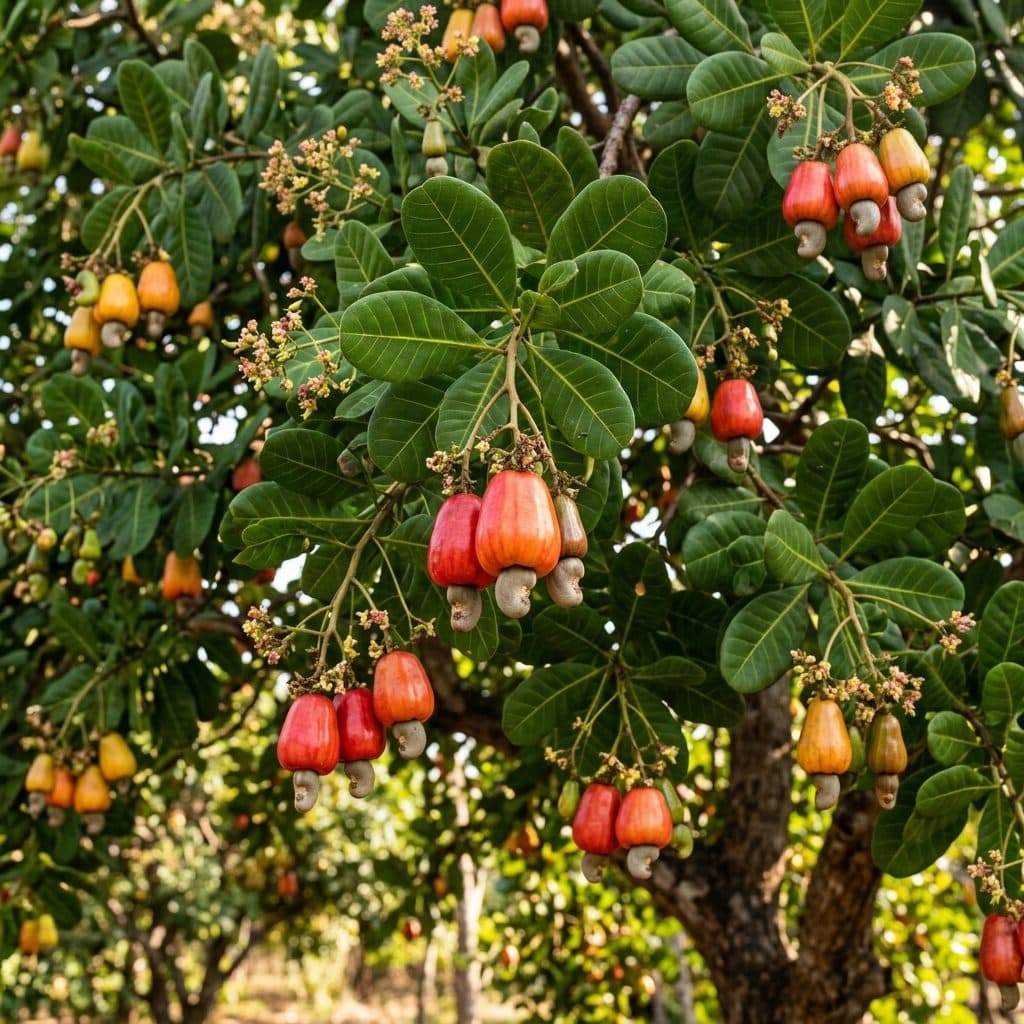
Cashew tree (Anacardium occidentale) is an economically vital tropical evergreen tree in the sumac family (Anacardiaceae). Indigenous to northeastern Brazil, the species was transported by Portuguese traders during the sixteenth century to coastal India and East Africa to combat soil erosion. Over centuries of cultivation, cashew has become one of the world's premier commercial tree nut crops, cultivated widely across tropical Asia, Africa, and the Americas. The tree produces a distinctive harvest: an edible, juicy false fruit known as the cashew apple, crowned by an external, kidney-shaped drupe containing the edible kernel.
Within permaculture systems and agroforestry designs, cashew is a resilient canopy or sub-canopy tree. It establishes in nutrient-poor soils and stabilises sandy ground with its extensive roots. Planted alongside pioneer shrubs like pigeon pea and soil-binding grass like vetiver, cashew provides shelterbelt protection against dry ocean winds. However, because the pericarp surrounding the nut kernel contains caustic resins, growers must master safe processing before handling harvests.
Growing cashew tree
Cashew trees require tropical and warm subtropical climates, thriving within USDA Zones 10 through 11 and holding an RHS rating of H1b. The species is frost-sensitive; temperatures dropping to 0 °C (32 °F) cause severe foliar scorching, while sub-zero freezes kill mature branches. Optimal vegetative growth and fruit set occur between 24 and 30 °C (75 and 86 °F). Prolonged temperatures below 15 °C (59 °F) retard growth. The tree demands an uninterrupted dry period of three to four months to stimulate floral initiation; high humidity during flowering promotes destructive fungal blossom blights.
Soil requirements are modest. Cashew prospers in deep, well-drained sandy loams, red laterites, and coastal plains across a pH range of 5.0 to 7.0. It demonstrates remarkable tolerance for poor soils. However, good drainage is mandatory. Trees cannot tolerate heavy, waterlogged clay soils or hardpans, which restrict taproot penetration and cause root asphyxiation. While mature trees possess deep taproots that impart drought tolerance during extended dry seasons, young saplings require supplemental watering during their first two years.
Propagation is achieved through seed or vegetative grafting. For seedling production, select dense seeds that sink in water. Sow seeds upright in deep nursery containers to accommodate the descending taproot. Germination occurs within two to four weeks at temperatures between 25 and 30 °C (77 and 86 °F). To preserve nut size and early bearing, growers employ cleft grafting or side veneer grafting onto vigorous rootstocks. Space standard orchard trees 8 to 10 m (26 to 33 ft) apart, while dwarf selections can be spaced 6 by 6 m (20 by 20 ft). Grafted trees commence bearing in their second or third year, whereas seedlings require three to five years.
Harvest and uses
Cashew produces harvestable yields across a two- to three-month window during the dry season. The dual harvest consists of the cashew apple (the swollen hypocarp) and the cashew nut (the true drupe). The cashew apple ripens from green to brilliant yellow, orange, or crimson, emitting a distinct sweet fragrance. Because the hypocarp is delicate and bruises easily, fruit intended for fresh eating or juicing must be picked by hand. For nut harvest, commercial practice allows the apples to fall naturally when mature; gather fallen nuts daily to prevent rotting.
After collection, twist the true nut free from the apple. The cashew apple is fibrous, juicy, and rich in vitamin C, though tannin content imparts astringency. The juice is consumed fresh, blended into drinks, clarified into syrups, or fermented into regional beverages like feni in Goa. Cashew apples can also be cooked with sugar to produce jams and chutneys.
Processing the nut requires caution. Sun-dry separated nuts on clean floors for two to three days until moisture drops below 9 percent. The raw shell contains caustic cashew nut shell liquid (CNSL) that must be neutralised before cracking. Traditional methods involve roasting dried nuts in perforated metal pans over open fire or in hot oil baths at 180 to 200 °C (356 to 392 °F). Heat expels the resin, rendering the shell brittle without scorching the kernel. Once cooled, crack the shell with wooden mallets to release the kernel. The thin brown seed coat (testa) is peeled after mild drying at 60 to 70 °C (140 to 158 °F) to yield the creamy edible cashew nut.
Beyond edible nuts, pruned branches provide dense firewood. The pinkish-brown timber is moderately hard and used locally for packing crates and lightweight carpentry.
Identifying cashew tree
Cashew is readily identified by its broad canopy, foliage, and fruiting structure:
- Form and bark: A spreading evergreen tree reaching 6 to 12 m (20 to 40 ft) in height, often developing a short, twisted trunk up to 40 cm (16 in) in diameter. The canopy is wide and umbrella-shaped. The bark is rough, greyish-brown, and marked by shallow longitudinal fissures.
- Leaves: Alternate, leathery, obovate to elliptic leaves measuring 10 to 20 cm (4 to 8 in) in length and 5 to 10 cm (2 to 4 in) in width. Leaf margins are entire and the apex is rounded. Emerging foliage is reddish-purple, maturing to glossy dark green with prominent pale veins. Crushed leaves emit a faint turpentine aroma.
- Flowers: Terminal panicles measuring 10 to 25 cm (4 to 10 in) long, carrying small, fragrant flowers. Each flower possesses five lanceolate, reflexed, yellowish-pink petals striped with crimson.
- Fruit: A dark greyish-brown, kidney-shaped drupe measuring 2.5 to 3.5 cm (1 to 1.4 in) long, suspended from the basal end of a fleshy yellow or red hypocarp (cashew apple) that measures 5 to 11 cm (2 to 4.3 in) in length.
Cashew is distinguished from related sumacs by its external nut borne outside the fleshy apple, and from mango (Mangifera indica) by its rounded obovate leaves rather than lanceolate pointed foliage.
Cautions
Cultivating and processing Anacardium occidentale involves several severe hazards:
- Severe chemical toxicity of shell liquid: The spongy mesocarp of the raw nut shell contains high concentrations of anacardic acids, cardol, and 2-methylcardol. These phenolic lipids are chemically related to urushiol found in poison ivy. Direct contact with raw shell oil causes severe chemical burns, blistering contact dermatitis, and painful mucosal ulceration. Never bite open a raw cashew nut. Always wear heavy rubber gloves when handling unroasted nuts.
- Toxic roasting smoke: When roasting cashew nuts to neutralise shell oils, volatilised cardol and anacardic acids produce dense, irritating smoke. Inhalation of roasting fumes causes respiratory inflammation and coughing spasms. Never roast cashew nuts indoors; always roast outdoors upwind from dwellings, or use commercial roasting equipment with fume scrubbers.
- Tree nut allergies: Cashew nut proteins (specifically allergens Ana o 1, Ana o 2, and Ana o 3) are potent food allergens capable of triggering severe systemic anaphylaxis in sensitised individuals, even in minute traces.
- Anthracnose susceptibility: The fungus Colletotrichum gloeosporioides attacks tender young shoots, inflorescences, and fruitlets during unseasonal rains. Infections manifest as black sunken lesions that cause blossom blight and premature nut drop. Plant in areas with reliable dry seasons and prune canopies to maximise ventilation.
- Windthrow risk: Despite a deep taproot, trees grown over shallow hardpans or saturated sands develop shallow lateral roots vulnerable to windthrow during severe tropical storms.
Sources
- Royal Botanic Gardens, Kew. Anacardium occidentale L. Plants of the World Online.
- Purdue University Center for New Crops & Plant Products. Cashew Apple - Julia F. Morton Fruits of Warm Climates.
- Plants For A Future. Anacardium occidentale - L.
- USDA PLANTS Database. Anacardium occidentale L.