secondary
Noni tree
Morinda citrifolia
- sindh coast
International hardiness
- USDA 11-12
- RHS H1a
- AU: Tropical
Where it grows — regional guide
| Zones / rating | Regional notes |
|---|---|
USDA 11-12 | Grown throughout Hawaii (where it is traditional canoe plant noni) and frost-free coastal South Florida; killed by freezing temperatures below 0 °C (32 °F). |
| Zones / rating | Regional notes |
|---|---|
H1a (above 15C, heated glasshouse) | No region-specific data yet |
| Zones / rating | Regional notes |
|---|---|
Tropical | Indigenous to coastal rainforest and beach scrub of tropical Queensland and Northern Territory; thrives in humid coastal monsoonal belts without irrigation. |
| Zones / rating | Regional notes |
|---|---|
USDA 11-12 (USDA scale) Canada uses its own zone system; Canadian zones run roughly one lower than USDA. | No region-specific data yet |
| Zones / rating | Regional notes |
|---|---|
Sindh coast | No region-specific data yet |
Noni tree (Morinda citrifolia), commonly known as Indian mulberry, great morinda, or cheese fruit, is an evergreen small tree or large shrub in the madder family (Rubiaceae). Indigenous across Southeast Asia, northern Australia, and the western Pacific, the species achieved legendary status throughout Polynesia, where ancient voyagers carried it aboard seafaring voyaging canoes as a primary medicinal crop. The tree is celebrated for its extraordinary physiological resilience: it colonises raw volcanic lava flows, sandy beach dunes, and saline tidal zones where few other fruiting plants survive. While its knobby fruits emit a notoriously foul odour of aged cheese when ripe, they have been utilised for centuries in traditional tonic preparations.
Within tropical homestead agroforestry and coastal windbreak guilds, Morinda citrifolia is an exceptionally tough secondary-stratum fruit and pioneer buffer tree. Its broad, glossy foliage filters onshore ocean gales, and its extensive root network anchors unstable sand dunes. When interplanted alongside hardy coastal companions like aloe vera and understorey crops like banana, noni provides continuous fruit biomass throughout the entire calendar year. However, growers must understand its high potassium concentrations, potential liver interactions, and the strong odour of its ripening fruit.
Growing noni tree
Morinda citrifolia requires an equatorial or maritime tropical climate, thriving within USDA Hardiness Zones 11 through 12 and holding an RHS rating of H1a. The tree is completely intolerant of frost. Exposure to temperatures below 10 °C (50 °F) causes chilling injury, leaf yellowing, and terminal shoot dieback, while any sub-zero freeze kills the tree to the ground. Optimal growth occurs in temperatures between 24 and 32 °C (75 and 90 °F). Noni thrives in areas receiving 1,200 to 3,000 mm (47 to 118 in) of annual rainfall, yet mature specimens demonstrate remarkable drought tolerance, surviving dry spells of several months on exposed coral atolls once established. The tree demands full, unhindered sun for maximum fruit density, though it tolerates moderate understorey shade.
Soil tolerance is extraordinary. Noni prospers in poor coastal beach sands, porous volcanic lava rubble, limestone outcroppings, and heavy coastal clays across an expansive pH range of 5.0 to 8.5. It exhibits exceptional tolerance for maritime salt spray and brackish groundwater, absorbing mineral salts without developing marginal leaf burn. The only non-negotiable requirement is adequate soil aeration; while it tolerates brief periods of tidal submersion, trees rot in stagnant, waterlogged freshwater mud. Minimal fertilisation is required, though organic compost and mulching maintain vigorous vegetative flushes.
Propagation is straightforward from seed or stem cuttings. Fresh seeds contain an internal air chamber that allows them to float in seawater for months while retaining viability. For cultivated sowing, nick the tough, fibrous seed coat or soak seeds in warm water for twenty-four hours to hasten germination. Sown in moist, sandy nursery media at 26 to 32 °C (79 to 90 °F), seedlings emerge in six to twelve weeks. Hardwood or semi-ripe branch cuttings measuring 20 to 30 cm (8 to 12 in) root reliably within four to six weeks when kept humid. Seedling trees grow vigorously, frequently bearing their first fruits within nine to twelve months of transplanting. Space orchard trees 3 to 4 m (10 to 13 ft) apart, or 2 to 2.5 m (6.6 to 8 ft) apart for living security and windbreak hedges.
Harvest and uses
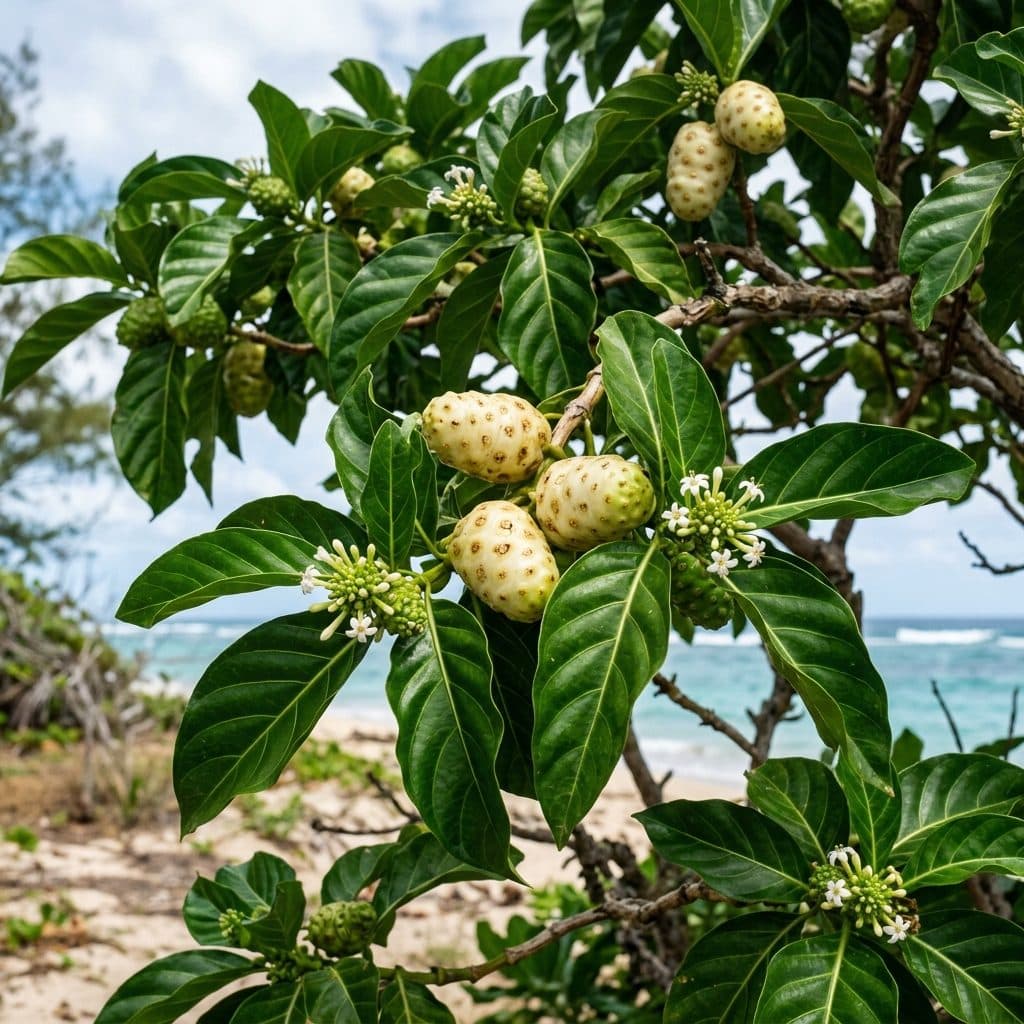
Noni blooms and fruits continuously, with flower buds, developing green syncarps, and soft, translucent ripe fruits appearing simultaneously on the same branch throughout the year.
The fruit is a botanical syncarp—a multiple fruit created by the fusion of dozens of individual flower ovaries. As the fruit matures, it expands from a hard, dark green knob into an oblong, waxy, yellowish-white fruit measuring 5 to 12 cm (2 to 4.7 in) in length. As it softens, the fruit develops a pungent, penetrating odour of octanoic and hexanoic (butyric) fatty acids, reminiscent of pungent aged cheese.
Harvest fruit when the peel turns pale waxy yellow or translucent whitish, but before it collapses into mush. To extract traditional noni juice, place cleaned ripe whole fruits into sterile glass jars or food-grade fermentation barrels without added water or sugar. Seal the containers and place them in a warm, shaded location for three to eight weeks. Natural fermentation draws out an amber, translucent, astringent liquid that separates from the pulpy residue. Filter the cured juice and store it in airtight bottles. In traditional practice, 30 to 60 ml (1 to 2 fl oz) of aged juice is consumed daily as a wellness tonic.
Beyond the fermented fruit juice, tender young leaves are steamed as a vitamin-rich green vegetable or applied as soothing poultices. The roots and inner bark contain anthraquinone pigments (morindone and morindin), used historically across the Pacific to produce permanent yellow and red fabric dyes. A single mature tree yields 50 to 100 kg (110 to 220 lb) of fruit annually.
Identifying noni tree
Morinda citrifolia is recognised by its distinctive foliage, knobby fruits, and characteristic scent:
- Form: An evergreen shrub or small upright tree reaching 3 to 8 m (10 to 26 ft) in height, often branching low into a loose, open canopy. The branches are prominently four-angled and pithy when young. The bark is smooth, greyish-brown, becoming shallowly furrowed with age.
- Leaves: Opposite, simple, broadly elliptic to oblong, thick and leathery, measuring 15 to 30 cm (6 to 12 in) long and 10 to 18 cm (4 to 7 in) wide. The upper leaf surface is lustrous dark green with deeply indented, pale yellow pinnate veins that impart a quilted appearance. Large, broad, rounded stipules are prominent at leaf nodes.
- Flowers: Small, tubular, fragrant white blossoms measuring 1 to 1.5 cm (0.4 to 0.6 in) across, emerging progressively from a dense, fleshy, globose head borne on a peduncle opposite a single leaf. Each flower features a white corolla with five spreading lobes.
- Fruit: An ovoid to oblong multiple fruit (syncarp) measuring 5 to 12 cm (2 to 4.7 in) long and 4 to 7 cm (1.6 to 2.8 in) wide. The surface is irregular, bumpy, and divided into distinct polygonal plates, each marked by a circular brown eye (the scar of an individual flower). Ripe fruit is soft, watery, and creamy translucent white, containing numerous small, triangular, hard brown seeds.
The species is distinguished from wild beach mulberry (Morinda royoc) by its far larger tree stature and leaves, and from coffee plants by its fused, knobby multiple fruits and distinct cheese-like aroma.
Cautions
Cultivating and consuming Morinda citrifolia involves several serious physiological, toxicological, and environmental cautions:
- Severe contraindication in kidney disease: Noni fruit and processed juices contain exceptionally high concentrations of potassium (measuring up to 50 to 60 mEq/L). In patients suffering from chronic kidney disease (CKD), impaired renal function, or individuals taking potassium-sparing diuretics or ACE inhibitors, consuming noni causes life-threatening hyperkalaemia. Elevated serum potassium can provoke cardiac arrhythmias, muscle paralysis, and fatal cardiac arrest. Individuals with renal vulnerability must avoid noni products entirely.
- Documented hepatotoxicity: Numerous clinical case reports in medical literature associate concentrated commercial noni juice and extracts with acute drug-induced liver injury, elevated hepatic enzymes, and acute toxic hepatitis. Persons with pre-existing hepatic disease should refrain from consuming noni preparations.
- Potent odour and pest attraction: Ripening fruit produces a strong, pungent odour of butyric acid that travels considerable distances. Decaying fruit attracts dense clouds of fruit flies (Drosophila species) and scavenger insects. Never plant noni trees adjacent to residential windows, outdoor patios, or living quarters.
- Cold sensitivity: The species suffers severe chilling injury below 10 °C (50 °F) and dies back completely when exposed to sub-zero freezes.
Sources
- Royal Botanic Gardens, Kew. Morinda citrifolia L. Plants of the World Online.
- USDA PLANTS Database. Morinda citrifolia L.
- Plants For A Future. Morinda citrifolia - L.
- Missouri Botanical Garden. Morinda citrifolia