Key takeaways
- Chill hours are cumulative hours below 45°F but above 32°F, essential for fruit tree dormancy and proper bud development.
- Each fruit tree variety has a specific chill hour requirement, ranging from less than 100 to over 1,500 hours, which must be met for optimal production.
- Calculating annual chill hours involves tracking local temperatures from late fall through early spring, often using online tools or weather stations.
- Choosing fruit tree varieties suited to your local chill hour total matters to prevent issues like poor bud break, uneven flowering, and low yields.
- Several models exist for calculating chill hours, with the Utah Model being widely used for its accuracy in varying temperature conditions.
- Temperatures above 60°F during the chilling period can negate previously accumulated chill hours, impacting overall dormancy.
Quick answer: Chill hours are the cumulative hours a deciduous fruit tree experiences between 32°F and 45°F during dormancy, essential for proper bud development and a bountiful harvest.
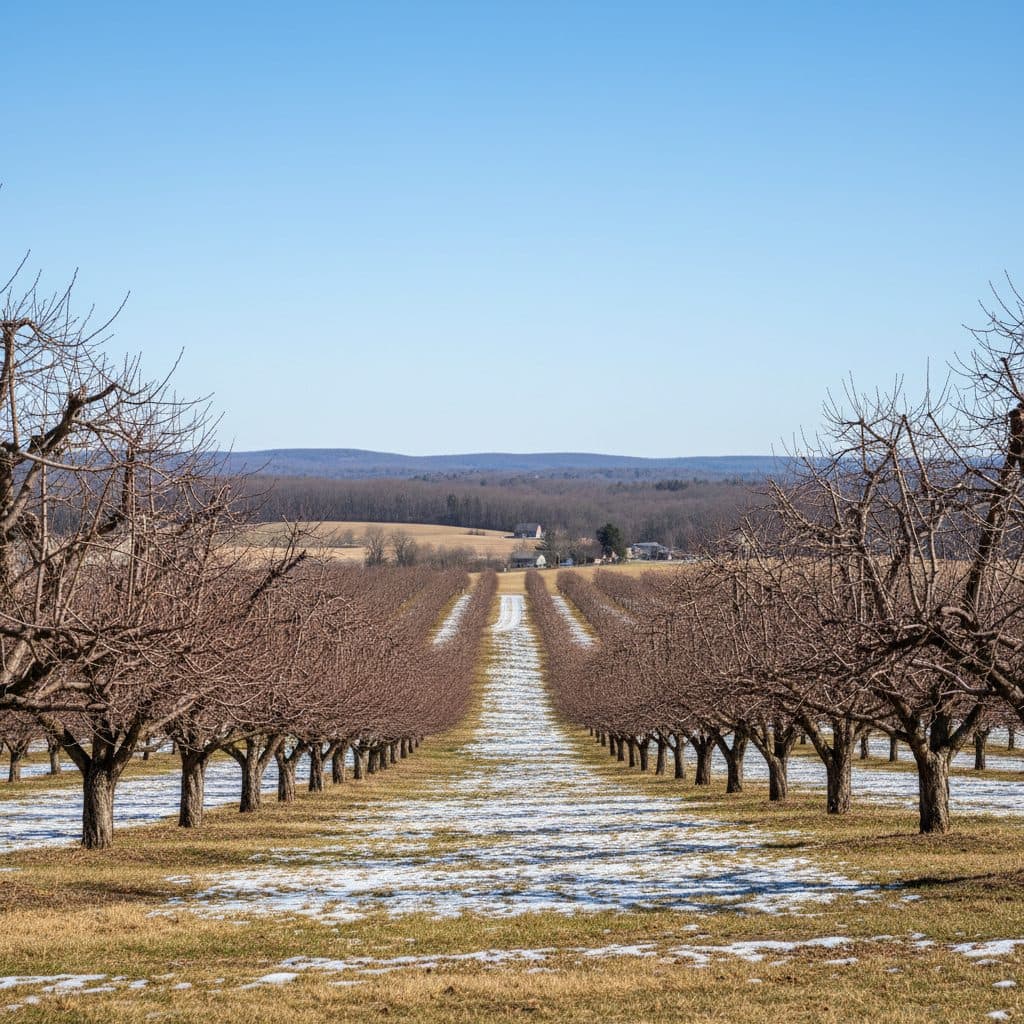
In the rolling hills of North Carolina, where apple orchards dot the landscape, growers know that a successful harvest depends on more than just sunshine and rain. It hinges on something less visible but equally critical: chill hours. For a ‘Granny Smith’ apple tree to produce its characteristic crisp fruit, it needs about 700 to 800 hours of specific cold temperatures each winter. Without this essential period of dormancy, the tree’s internal clock gets confused, leading to delayed bud break, uneven flowering, and ultimately, a sparse or nonexistent crop.
Understanding your annual chill-hour total is a foundational step for any home grower planning a fruit tree orchard. Whether you’re in USDA zone 5 contemplating a peach tree or in a warmer zone 9 experimenting with low-chill varieties, knowing this number helps you select the right trees for your climate to ensure years of productive yields. This guide will explain what chill hours are, why they matter, and how you can accurately determine the chill hours for your specific growing location.
What are chill hours for fruit trees?
Chill hours refer to the cumulative number of hours a deciduous fruit tree experiences within a specific cold temperature range during its dormant period. For most temperate fruit trees, this range is typically between 32°F and 45°F (0°C and 7°C). During this time, the tree undergoes physiological changes necessary to break dormancy to ensure a synchronized bud break, flowering, and fruit set in the spring. For instance, an ‘Elberta’ peach tree, a popular variety across many US states, often requires around 800 to 950 chill hours to perform optimally.
The science behind dormancy and chill accumulation
The process of chill accumulation is a complex biological mechanism. As temperatures drop in late fall, usually after the first hard frost below 32°F, fruit trees enter a state of dormancy. This protective phase allows them to survive cold winter conditions. The internal clock of the tree tracks the cold hours, and once a sufficient number of chill hours has been accumulated, the tree is ready to respond to warming spring temperatures. If the chill requirement is not met, the tree may exhibit several undesirable symptoms, including:
- Delayed or irregular bud break, sometimes by several weeks.
- Reduced flower production, leading to fewer potential fruits.
- Poor fruit set, with many flowers failing to develop into fruit.
- Weakened growth in the following season, impacting overall tree health.
Conversely, if a tree receives too much chill, it generally doesn’t harm the tree, though it might delay bud break slightly in some varieties. The critical factor is meeting the minimum requirement, which can vary significantly; some apple varieties need over 1,000 chill hours, while certain low-chill peach varieties thrive with just 250 hours.
Why chill hours are critical for your orchard’s success
The importance of chill hours cannot be overstated for home growers. Selecting a fruit tree variety that is not suited to your local chill-hour accumulation is a common mistake that leads to disappointing results. For example, planting a ‘Fuji’ apple, which needs 900 to 1,000 chill hours, in a warm USDA zone 9 climate that only averages 300 to 400 chill hours, will likely result in a tree that struggles to produce. This mismatch can lead to a 50% or even 80% reduction in yield, making the effort of planting and care largely unproductive.
Consequences of insufficient chill
When fruit trees do not receive their required chill, their internal dormancy mechanism is not fully satisfied. This can manifest in several ways, severely impacting the tree’s productivity and health. For instance, in a mild winter in parts of central Florida, peach trees needing 600 chill hours might only receive 250, leading to significant problems. The tree may experience:
- Erratic or prolonged bloom, with flowers opening over several weeks instead of a concentrated period.
- Poor pollen viability, reducing the chances of successful fertilization and fruit set.
- Increased susceptibility to pests and diseases due to weakened physiological state.
- Reduced fruit size and quality, as the tree’s energy is misdirected.
Understanding these consequences means matching your tree selection to your specific climate data. The USDA Natural Resources Conservation Service provides data for agricultural planning, including climate information, which can help in this assessment. This careful planning is just as important as proper pruning techniques, which ensure a strong tree structure and good air circulation for healthy fruit development. You can learn more about these practices at How to prune fruit trees: by season, by species, and by tree age.
How to calculate your annual chill-hour total
Determining your annual chill-hour total involves tracking local temperatures over the dormant season, typically from November 1st through February 28th. While manual tracking is possible, several online resources and weather stations simplify this process. The most common method, the ‘Traditional Model,’ counts all hours between 32°F and 45°F as one chill hour. However, this model doesn’t account for chill negation, where warm spells can reverse accumulated chill. For example, a week of 65°F weather in January can significantly reduce a winter’s total.
Popular chill hour models and tools
More sophisticated models provide a nuanced calculation. The ‘Utah Model’ assigns different weighting factors to temperatures within and outside the optimal range, and it includes a mechanism for chill negation. This model, often preferred for its accuracy in varying temperature conditions, counts hours between 34°F and 48°F as chill units, with temperatures above 60°F having a negative impact. Another advanced method, the ‘Dynamic Model,’ is even more complex, considering the physiological state of the tree and the interaction of temperatures, often used in research settings.
- Local Weather Stations: Many agricultural extension offices or university websites, like those in California or Michigan, provide historical and real-time chill hour data for specific locations.
- Online Calculators: Websites such as the UC Davis Fruit & Nut Research & Information Center offer tools where you can input your zip code to get estimated chill hours based on nearby weather stations.
- Personal Weather Stations: For precise data, a personal weather station can monitor temperatures directly in your orchard, recording data every 15 to 30 minutes.
- Temperature Loggers: Small, inexpensive devices can be placed near your trees to record temperature fluctuations over the entire dormant period, providing highly localized data.
When using an online tool, aim to find one that uses data from a weather station within a 5-mile radius of your property for the most accurate results. This specific data helps you make informed decisions about varieties like ‘Honeycrisp’ apples, which need 800 to 1,000 chill hours, or ‘Reliance’ peaches, thriving on 800 to 900 hours.
Choosing the right trees for your chill zone
Once you have a reliable estimate of your annual chill-hour total, the next critical step is selecting fruit tree varieties that match that number. This is where the real planning for a productive orchard begins. For example, if your location in USDA zone 7 consistently averages 600 chill hours, you would avoid high-chill varieties like many European pears (which can need 1,200 to 1,500 hours) and instead focus on options that fall within the 500 to 700-hour range, such as ‘Redhaven’ peaches or ‘Gala’ apples.
Matching varieties to your climate
Fruit tree nurseries typically list the chill hour requirements for each variety they sell. These requirements are often presented as a range, for instance, 400-500 chill hours. It’s generally best to choose varieties whose stated requirements fall comfortably within your average annual total. If your area experiences highly variable winters, consider selecting varieties with a slightly broader chill-hour tolerance. For growers in colder regions, like USDA zones 4-6, there are many excellent cold-hardy fruit and nut trees that also have specific chill requirements.
- Assess your average total: Use historical data to determine your typical chill hour accumulation over the last 5 to 10 years.
- Research specific varieties: Look up the chill hour requirements for fruit trees you are interested in growing.
- Consider microclimates: Account for any localized variations in temperature on your property, such as sheltered areas or south-facing slopes, which might affect chill accumulation by 10% to 20%.
- Plan for variability: If your chill hours fluctuate significantly year to year, choose varieties with a wider range of chill tolerance or consider planting a mix of varieties.
- Consult local experts: Your local agricultural extension office can provide specific recommendations for your region, often tailored to local conditions.
Remember that even with the right chill hours, proper care—including adequate watering, which can be monitored with a soil moisture meter, and balanced soil pH, checked with a 3-in-1 soil pH, moisture & light meter—is essential for a thriving orchard. Selecting the correct tree for your climate is a fundamental step towards years of successful harvests, potentially yielding hundreds of pounds of fruit from a single mature tree.
Managing chill hour challenges in a changing climate
As climate patterns shift, many regions across the US are experiencing warmer winters with fewer consistent chill hours. This presents a growing challenge for fruit growers, particularly in traditional fruit-growing areas like the Mid-Atlantic and parts of the Pacific Northwest. For instance, a region that historically averaged 800 chill hours might now only receive 650 in a mild winter, pushing many standard varieties out of their optimal range. Adapting to these changes requires careful observation and proactive planning to maintain orchard productivity.
Strategies for variable winters
If your region experiences highly variable chill accumulation, or if you are in a warmer climate (USDA zone 8 or higher) where chill hours are consistently low, there are several strategies you can employ. One approach is to prioritize low-chill varieties, such as certain types of peaches that need only 200 to 400 chill hours, or specific apple varieties like ‘Anna’ that thrive with just 300 hours. Another strategy involves microclimate management, where growers might plant trees on north-facing slopes or in areas that naturally retain more cold air, potentially gaining an extra 50 to 100 chill hours.
- Plant low-chill varieties: Select fruit trees specifically bred for lower chill requirements, often below 400 hours.
- Consider evaporative cooling: In some commercial settings, overhead irrigation can be used to cool buds during warm spells, potentially adding 10% to 20% to chill accumulation.
- Delay pruning: Postponing winter pruning until late dormancy can sometimes delay bud break by a few days, helping to avoid early spring frosts.
- Use reflective mulches: While primarily for heat reflection in summer, some mulches might slightly reduce soil temperatures in winter, contributing marginally to chill.
- Monitor weather forecasts closely: Be prepared to protect early-blooming trees from late frosts, which are more likely with erratic bud break.
While these strategies can help mitigate the impact of insufficient chill, the most reliable long-term solution remains selecting varieties well-suited to your average annual chill-hour total. This careful selection ensures that your orchard remains productive, potentially yielding 50 to 100 pounds of fruit per mature tree, even as local climate conditions evolve.
Typical Chill Hour Requirements for Popular Fruit Trees
Fruit Type | Chill Hours (approx.) | USDA Zones |
|---|---|---|
Apple (e.g., ‘Gala’, ‘Honeycrisp’) | 700-1,000 | 3-8 |
Peach (e.g., ‘Redhaven’, ‘Elberta’) | 600-950 | 5-8 |
Cherry (e.g., ‘Bing’, ‘Montmorency’) | 800-1,200 | 4-7 |
Pear (e.g., ‘Bartlett’, ‘Bosc’) | 800-1,500 | 4-8 |
Fig (e.g., ‘Brown Turkey’, ‘Celeste’) | 100-300 | 7-10 |
Apricot (e.g., ‘Tilton’, ‘Moorpark’) | 700-900 | 5-8 |
Apple Chill Needs: Many popular apple varieties, like ‘Honeycrisp’, need 800 to 1,000 chill hours to ensure consistent fruit production and optimal flavor.
Chill Negation: Temperatures above 60°F for even short periods during dormancy can negate up to 1.5 hours of previously accumulated chill, impacting overall totals.
Peach Variety Range: Peach trees exhibit a wide range of chill requirements, from low-chill varieties needing 200 hours to high-chill types requiring over 1,000 hours.
Frequently asked questions
What happens if a fruit tree doesn’t get enough chill hours?
If a fruit tree doesn’t receive its required chill hours, it may experience delayed or erratic bud break, poor flowering, and a significantly reduced fruit set. For example, a peach tree needing 800 hours might only produce a 20% crop if it only receives 400 hours, leading to sparse fruit and uneven ripening.
Can a fruit tree get too many chill hours?
Generally, no, a fruit tree cannot get too many chill hours. Exceeding the minimum requirement typically does not harm the tree, though in some cases, it might slightly delay bud break by a few days. The critical factor is meeting the minimum threshold, which ensures proper physiological development for spring growth.
Do chill hours need to be continuous?
No, chill hours do not need to be continuous. They are cumulative, meaning the tree accumulates hours within the optimal temperature range (32°F to 45°F) over the entire dormant period. However, warm spells above 60°F can negate previously accumulated chill, especially according to models like the Utah Model, which accounts for this ‘chill negation’ effect.
How do I find my local chill hour data?
You can find your local chill hour data through several resources. Many agricultural extension offices, university websites (like UC Davis), or online weather services provide historical and real-time chill hour calculators. Simply input your zip code, and the tool will estimate your chill hours based on nearby weather stations, often providing data for the past 5 to 10 years.
Are chill hours the same as cold hardiness?
No, chill hours and cold hardiness are distinct concepts, though both relate to a tree’s cold tolerance. Chill hours refer to the duration of cold temperatures required for a tree to break dormancy and fruit properly, typically between 32°F and 45°F. Cold hardiness, on the other hand, refers to a tree’s ability to survive extreme low temperatures without tissue damage, often measured by its USDA hardiness zone, such as zone 6, which can withstand temperatures down to -10°F.
References
- Find Your Why and Your Me (2020). Find Your Why and Your Me.
- Find out what threatened plants and animals live in your electorate (and what your MP can do about it) (2022). Find out what threatened plants and animals live in your electorate (and what your MP can do about it).
- 11. What makes a great mission statement? (2023). 11. What makes a great mission statement?.
- 6. What do you want from life? (2023). 6. What do you want from life?.
- What to Do When You Can’t Find a Job (2012). What to Do When You Can’t Find a Job.