Key takeaways
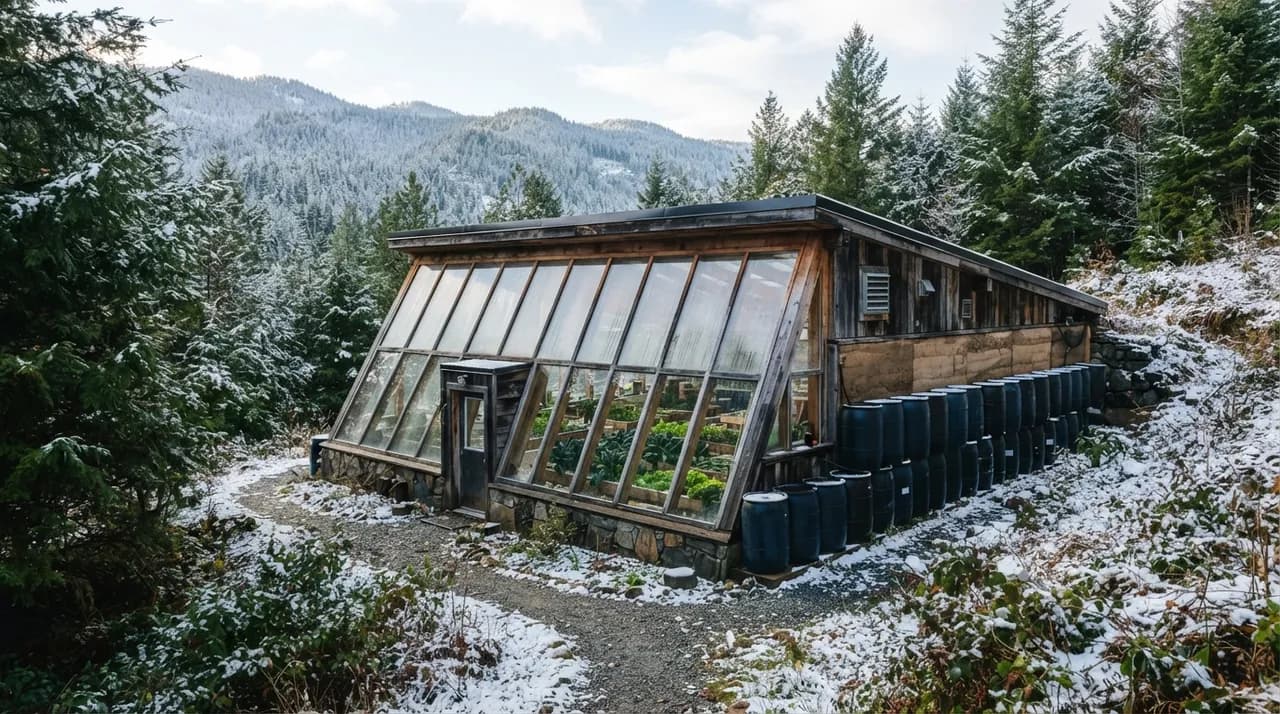
Interior of a passive solar greenhouse with a steep, clear south-facing wall and insulated opaque north wall. Black water barrels provide thermal mass, sitting near healthy green leafy vegetables like spinach and kale growing in raised beds.
Embracing a four-season growing philosophy, this passive solar greenhouse design harnesses the sun’s energy and utilizes thermal mass like water barrels to create a thriving environment for cold-hardy crops, even in deep winter.
- A passive solar greenhouse sits on an east-west axis with a steeply sloped south glazing wall, and insulates the north, east, and west walls instead of glazing them – a deep winter greenhouse built to grow in January.
- Thermal mass is the battery: a working rule of thumb is 2 to 5 gallons of water per square foot of glazing, with cold zones at the high end. Water holds 62 BTU per cubic foot per degree against about 25 for rock.
- A ground-to-air heat transfer (GAHT) system, or climate battery, buries pipe up to 4 ft down and uses fans to push warm daytime air into the soil, then pulls it back at night – the soil heats, cools, and dehumidifies at once.
- In a well-built passive-solar greenhouse, inside air has stayed above 32 degrees F even when the outside hit -22 degrees F; a climate battery can hold a greenhouse 15 to 20 degrees F warmer than outside for much of the winter.
- Glaze the south wall in 6 mm or 8 mm twin-wall polycarbonate (R-1.6 to R-1.7, about 80% light transmission) and insulate the north wall to R-10 with two layers of rigid foam.
- Deep-winter crops are the cold-hardy leaves: spinach, mache, kale, claytonia, Asian greens, and herbs; most shrug off the low 20s F, so the greenhouse only has to take the edge off, not stay warm.
A four-season greenhouse is a different animal from a heated hobby house. Instead of burning propane to fight the cold, it is designed to catch and store the sun: orient the building to the low winter sun, bank that heat in water or soil through the day, and release it overnight. The University of Georgia’s research greenhouse made the point starkly: in trials, inside air stayed above 32 degrees F on a night when the outside fell to -22 degrees F, with no furnace. This guide is the cold-climate end of greenhouse design: passive-solar orientation, how much thermal mass you actually need, the ground-to-air “climate battery” that stores heat in the soil, and the glazing, insulation, and crops that let a structure hold living plants through a USDA zone 4 or 5 winter. If you are still choosing the shell, start with the greenhouse style and structure that fits your site; a fuel-free four-season house is also core off-grid living infrastructure.
What makes a greenhouse passive-solar
A passive solar greenhouse turns the building itself into the heating system. Three design moves separate it from an ordinary glass house, and all 3 are about geometry and insulation rather than equipment.
Face the low winter sun, insulate the rest
The first move is orientation. A UGA passive-solar build sat “on an east-west orientation (the opposite of how a typical greenhouse would be sited) with the roof facing south,” so the glazing meets the low December sun head-on. University of Minnesota Extension describes the same form: deep winter greenhouses “are built in an east-west position, with a south-facing glazing wall that is steeply sloped to capture as much solar energy as possible on the coldest days of the year.” The second move follows from it: if only the south wall is glazed, the other 3 walls can be insulated. UGA covered the north wall’s exterior with “two layers of 1.5-in. rigid foam insulation (R-10),” turning the dark side of the building from a heat leak into a wall that holds warmth in.
Bank the heat, then give it back
The third move is storage, and it is what makes the design four-season instead of merely sunny. A glazed box overheats by noon and freezes by dawn; a passive-solar house parks that midday surplus in thermal mass (water or soil) and draws it back down through the 14-hour winter night. UMN puts it plainly: the “solar-heated air inside is drawn underground with a fan and stored in an insulated thermal mass of soil or rock where it is available to heat the space at night.” Orientation catches the 1 free input, insulation keeps it, and mass time-shifts it: the whole strategy in 3 sentences.
The honest limit: passive solar shifts heat, it does not manufacture it. On a string of dark, sub-zero days the stored charge runs down, which is why even a good deep-winter greenhouse keeps a small backup heater for the 3 or 4 worst nights of the year. The goal is a 90%-plus cut in heating, not a zero.
Thermal mass: water, rock, and how much you need
Thermal mass is the battery, and the single most common mistake is installing too little of it. The 2 questions that matter are what material and how much, and both have numbers behind them.
Black-painted 55-gallon water barrels line the insulated north wall as thermal mass, with winter greens grown in raised beds in front.
Water is the workhorse. By volume it stores far more heat than rock or masonry (roughly 62 BTU per cubic foot per degree F, against about 25 for rock or stone and 25 to 32 for concrete). That is why a passive-solar grower stacks 55-gallon drums of water rather than building a stone wall: a volume of concrete has about half the heat capacity of the same volume of water, so it takes twice as much to do the same job. Paint the drums dark so they absorb the daytime sun. The weight is the catch: a full 55-gallon barrel runs close to 500 lb, heavy enough that the floor and any stacking frame have to be built for it.
The 2-to-5-gallon rule
For sizing, a widely used rule of thumb is 2 to 5 gallons of water per square foot of glazing, measured against glazing area rather than floor area because glazing is where the heat enters and escapes. Colder climates sit at the high end of that band: a zone 4 or 5 greenhouse with 200 sq ft of south glazing wants on the order of 700 to 1,000 gallons of water (about 13 to 18 full drums) to ride through a long night. Under-build the mass and the house swings hot to cold daily; over-build it and you simply add stability, so err high in a cold zone.
Mass material | Heat stored (BTU/ft3/F) | Practical note |
|---|---|---|
Water (in drums or tanks) | About 62 | Most heat per volume; ~500 lb per full 55-gal drum |
Concrete / masonry | 25 to 32 | About half of water; needs ~2x the volume |
Rock or stone (with air gaps) | About 25 | Common in buried climate-battery beds |
Rule of thumb: in USDA zones 4 to 6, target the high end (4 to 5 gallons of water per square foot of south glazing). Black-painted 55-gallon drums along the insulated north wall double as the wall’s mass and as a backdrop that soaks up sun all day.
The climate battery: geothermal heat with no fuel
Water mass smooths the daily swing, but the most powerful four-season tool reaches into the ground. A ground-to-air heat transfer (GAHT) system, also called a climate battery, turns the soil under the greenhouse floor into a season-long heat store, using only fans and buried pipe.
The mechanism is simple to picture. When the greenhouse heats up during the day, fans move that hot, humid air through a network of corrugated pipe buried up to 4 ft beneath the floor. Heat and moisture transfer into the surrounding soil; the air returns to the greenhouse cooler and drier, which is why a GAHT system heats, cools, and dehumidifies in 1 loop. At night the flow reverses in effect: the warmed soil radiates back into the pipe network and the fans deliver that heat to the plants. Done well, per Ceres Greenhouse, capturing summer heat early lets a climate battery “keep the greenhouse 15 – 20 degrees warmer than the outside for at least half of the winter.”
Where a climate battery stops
A climate battery is not magic, and the same designers are candid about it: “a GAHT system alone may not always be sufficient,” and backup heat “is usually turned on during a few very cold nights a year” when stored soil heat and thermal mass run short. Think of it as the main engine that covers most of the winter, with a small heater for the 3 or 4 extreme cold snaps, following the same pattern as water mass at a bigger scale. Because it runs on fans rather than a furnace, it pairs naturally with the solar setup on an off-grid homestead.
Glazing and insulation for a cold zone
Orientation and mass do nothing if the envelope leaks heat. The cold-zone envelope is a deliberate split: a transparent, insulating south wall and 3 opaque, heavily insulated walls behind it.
For the glazing, twin-wall polycarbonate is the standard cold-climate choice because it traps a layer of air between 2 skins. A 6 mm panel runs about R-1.6 and an 8 mm panel about R-1.7, both with roughly 80% light transmission in the clear grade, giving far better insulation than single glass at a small light cost. The UGA build used “6 mm twin-wall polycarbonate sheeting” for exactly this reason. For the opaque walls, the rule is to insulate hard: UGA’s north wall carried two layers of 1.5-in. rigid foam (R-10), and a retractable thermal blanket pulled over the glazing at night cuts the biggest remaining heat leak after dark.
Envelope element | Spec | Why |
|---|---|---|
South glazing | 6-8 mm twin-wall polycarbonate, R-1.6 to R-1.7, ~80% light | Insulates while still passing winter sun |
North / E / W walls | Two layers 1.5-in rigid foam, R-10 | Opaque walls become heat stores, not leaks |
Night cover | Retractable thermal blanket over glazing | Cuts after-dark loss through the glass |
Watch-out: condensation. A cold-zone greenhouse is humid, and twin-wall polycarbonate can fog or grow algae inside the channels. Buy panels with an anti-drip (anti-condensate) coating on the inner face and seal the channel ends with vented tape so water cannot pool and cloud the glazing.
What actually grows through deep winter
The last piece is the planting list, and it reframes the whole project. In a cold zone, a four-season greenhouse is designed for cold-hardy greens that tolerate light freezing, meaning the structure only needs to moderate extremes rather than maintain summer temperatures.
Cold-hardy winter greens including spinach, mache, and kale grow in raised beds inside the greenhouse while snow covers the ground outside.
University of Minnesota Extension names the crop families that suit a deep winter greenhouse: “a variety of lettuces, herbs, brassicas, Asian greens, and sprouts.” The hardiest of these (spinach, kale, mache, and claytonia) tolerate temperatures down into the low 20s and high teens F, so a greenhouse that simply stays above freezing keeps them growing while the outdoor garden is under snow. Light is the trade, not cold: through the darkest weeks around the winter solstice (the Persephone period, when daylight drops below 10 hours) growth nearly stops, so these crops are best seeded in fall and harvested through winter rather than planted in January. Living soil in the beds matters as much as the air; keep the soil in the beds rich and biologically active so roots stay healthy in the low light.
Putting it together
A four-season greenhouse is a stack of 5 decisions, each with a number attached. Run the long axis east-west with a steeply sloped south glazing wall in 6 to 8 mm twin-wall polycarbonate. Insulate the north, east, and west walls to R-10. Size thermal mass at 2 to 5 gallons of water per square foot of glazing (towards the high end in a cold zone) using black-painted 55-gallon drums. Add a climate battery with corrugated pipe buried up to 4 ft to bank soil heat and hold the house 15 to 20 degrees F above outside. Then plant cold-hardy leaves such as spinach, kale, mache, and Asian greens that grow through a light freeze. Get those 5 right and a structure that would normally die back in November keeps cutting salad in January, on almost no fuel. Choosing the shell to build all this into starts with the right greenhouse style for your site.
Frequently asked questions
What is a passive solar greenhouse?
A passive solar greenhouse is a structure designed to heat itself from the sun rather than from a furnace. It runs on an east-west axis with a steeply sloped, south-facing glazing wall to catch the low winter sun, insulates the north, east, and west walls instead of glazing them, and stores midday heat in thermal mass (water or soil) to release overnight. University of Minnesota Extension calls the cold-climate version a deep winter greenhouse.
How much thermal mass does a four-season greenhouse need?
A common rule of thumb is 2 to 5 gallons of water per square foot of glazing, sized against glazing area rather than floor area, with colder climates at the high end. Water is the most efficient practical material, storing about 62 BTU per cubic foot per degree F versus roughly 25 for rock. A 200-square-foot glazing wall in a cold zone therefore wants on the order of 700 to 1,000 gallons (about 13 to 18 full 55-gallon drums).
How does a climate battery (GAHT) heat a greenhouse without fuel?
A ground-to-air heat transfer system uses fans to push warm, humid daytime greenhouse air through corrugated pipe buried up to 4 feet under the floor. Heat and moisture pass into the soil, so the returning air is cooler and drier; at night the warmed soil gives that heat back through the same pipe network. The soil heats, cools, and dehumidifies in one loop, and can keep a greenhouse 15 to 20 degrees F warmer than outside for much of the winter.
What glazing and insulation work best in a cold climate?
Glaze the south wall in 6 mm or 8 mm twin-wall polycarbonate, which gives about R-1.6 to R-1.7 and roughly 80% light transmission in the clear grade, providing much better insulation than single glass. Insulate the opaque north, east, and west walls hard: the University of Georgia build used two layers of 1.5-inch rigid foam for R-10. A retractable thermal blanket pulled over the glazing at night cuts the largest remaining heat leak.
Can a passive solar greenhouse really stay above freezing in deep cold?
It can, within limits. In University of Georgia trials, inside air stayed above 32 degrees F on a night when the outside reached -22 degrees F, with no supplemental heat. But passive solar shifts heat rather than creating it, so a string of dark, very cold days will draw the stored charge down. Most deep-winter greenhouses keep a small backup heater for the few worst nights of the year.
What crops grow in a deep winter greenhouse?
Cold-hardy leafy crops. University of Minnesota Extension lists lettuces, herbs, brassicas, Asian greens, and sprouts; the toughest (spinach, kale, mache, and claytonia) tolerate the low 20s and high teens F. Because growth nearly stops in the darkest weeks around the solstice, these crops are seeded in fall and harvested through winter rather than started in midwinter. Warm-season fruit like tomatoes is not realistic without heat and supplemental light.
References
- University of Georgia Extension. “Constructing a Passive Solar Greenhouse for Season Extension” (Bulletin 1566). fieldreport.caes.uga.edu
- University of Minnesota Extension. “Deep winter greenhouses.” extension.umn.edu
- Ceres Greenhouse Solutions. “GAHT System: Ground to Air Heat Transfer.” ceresgs.com
- Mother Earth News. “How to Build Your Off-Grid Thermal Mass Greenhouse.” motherearthnews.com
- Gothic Arch Greenhouses. “Multiwall Polycarbonate Panels” (R-value and light-transmission specs). gothicarchgreenhouses.com
- Johnny’s Selected Seeds. “Winter Growing Guide: Recommended Winter Crops & Varieties.” johnnyseeds.com