Key takeaways
- Full-spectrum LED grow lights delivering 5000K to 6500K daylight spectrum promote stocky, compact stems and prevent leggy seedling growth.
- Position modern LED shop lights or T5 fixtures 2 to 4 inches (5 to 10 cm) above the seedling canopy, raising lights as plants grow.
- Run grow lights on an automated electrical timer for 14 to 16 hours daily, allowing 8 to 10 hours of darkness to mobilize leaf starch and prevent continuous-light injury.
- Standard LED utility shop lights (4000 to 5000 lumens) provide an economical, energy-efficient alternative to high-cost horticultural fixtures.
- Provide gentle oscillating fan airflow across seedlings to strengthen cell walls and prevent damping-off fungal outbreaks under lights.
Quick answer: Starting vigorous vegetable seedlings indoors requires dedicated artificial lighting that provides sufficient intensity and the right color spectrum. Natural windowsill light is almost always too weak in late winter, causing seedlings to stretch into weak, leggy stems. Using full-spectrum LED or high-output T5 fluorescent fixtures placed 2 to 4 inches above plant foliage for 14 to 16 hours per day produces stocky stems, dense root systems, and dark green leaves ready for garden transplanting.
Relying on a sunny windowsill to start early spring tomatoes, peppers, and brassicas frequently ends in disappointment. Low winter sun angles and short day lengths deliver inadequate photon flux, forcing tender stems to bend and stretch toward the glass.
Modern horticultural lighting provides consistent, controllable energy that replicates bright spring sunlight inside your home or basement. Energy-efficient LED bars and shop lights have made indoor propagation affordable, drawing minimal electricity while generating negligible heat.
Get the light spectrum, hanging distance, photoperiod, and airflow right, and your indoor seed-starting station will produce sturdy, transplant-ready seedlings every spring.
LED vs fluorescent: choosing seed-starting lights
When outfitting an indoor seedling rack, growers generally choose between modern LED fixtures and traditional fluorescent tubes.
+------------------------+-----------------------------------+-----------------------------------+
| Feature                | Full-Spectrum LED Fixtures        | High-Output T5 Fluorescent Tubes  |
+------------------------+-----------------------------------+-----------------------------------+
| Energy Consumption     | Very Low (18W to 35W per 4ft bar) | Moderate (54W per 4ft tube)       |
| Heat Generation        | Minimal (passive aluminium heat)  | Moderate (warms shelf slightly)   |
| Operating Lifespan     | 40,000 to 50,000 hours            | ~20,000 hours (output falls over life)|
| Replacement Needs      | Integrated diodes (no bulbs)      | Tubes replaced as output falls    |
| Initial Cost           | Low to moderate                   | Moderate                          |
+------------------------+-----------------------------------+-----------------------------------+
For the vast majority of home gardeners, 4-foot LED utility shop lights or full-spectrum LED grow light strips represent the best value. They run cool to the touch, eliminate bulb replacement costs, and deliver high Photosynthetically Active Radiation (PAR) output directly to young leaves. Fluorescent fixtures remain functional if you already own them, but cuts operating power roughly by half against old T12 fixtures, and by around a third against T8.
Light spectrum: blue vs red for seedling development
Plants utilize specific wavelengths within the visible light spectrum (400 to 700 nanometers) to drive photosynthesis and photomorphogenesis.
+-------------------------------------------------------------------+
|               LIGHT SPECTRUM FOR SEEDLING MORPHOLOGY              |
+-------------------------------------------------------------------+
| Blue Light (400 to 500 nm): Inhibits stem elongation, thickens    |
|                             leaves, and stimulates root growth.   |
| Red Light (600 to 700 nm):  Drives active chlorophyll absorption  |
|                             and biomass accumulation.             |
| Green Light (500 to 600 nm):Penetrates deep into the lower canopy.|
+-------------------------------------------------------------------+
For seed starting, prioritize fixtures rated between 5000K and 6500K (often labeled "Daylight"). High color temperature light contains a higher proportion of blue wavelengths, which signals young seedlings to develop short internodes, thick sturdy stems, and broad leaves rather than stretching upward. Warm white (2700K to 3000K) fixtures work for seedlings too; stretching is caused far more by low intensity and lights hung too high than by colour temperature. 5000K to 6500K is simply the easier default.
Hanging distance and light intensity
Maintaining the correct distance between light diodes and seedling leaves is the single most important factor in preventing legginess while avoiding heat scorching.
+------------------------+-----------------------------------+-----------------------------------+
| Light Type             | Recommended Canopy Distance       | Adjustment Frequency              |
+------------------------+-----------------------------------+-----------------------------------+
| Full-Spectrum LED Bars | 2 to 4 inches (5 to 10 cm)        | Raise every 3 to 5 days as grown  |
| High-Output T5 Tubes   | 3 to 5 inches (8 to 12 cm)        | Check twice weekly                |
| High-Power Grow Boards | 12 to 18 inches (30 to 45 cm)     | Dim to 40-50% power for seedlings |
| Incandescent Bulbs     | Do NOT use (heat scorches leaves) | Unsuitable for seed starting      |
+------------------------+-----------------------------------+-----------------------------------+
+-------------------------------------------------------------------+
| INDOOR SEEDLING RACK CROSS-SECTION |
+-------------------------------------------------------------------+
| [Shelving Frame Top] |
| || || |
| [Adjustable Hanging Chains / Pulley Ropes] || |
| || || |
| [================ LED Grow Light Fixture ================] |
| | | |
| | 2 to 4 inches (5 to 10 cm) Air Gap | |
| | | |
| ^^^^ ^^^^ ^^^^ ^^^^ ^^^^ ^^^^ ^^^^ ^^^^ ^^^^ |
| [================ 1020 Seedling Flat ===================] |
| [================ Heated Germination Mat ===============] (Seed) |
| ==================== Wire Storage Shelf ========================= |
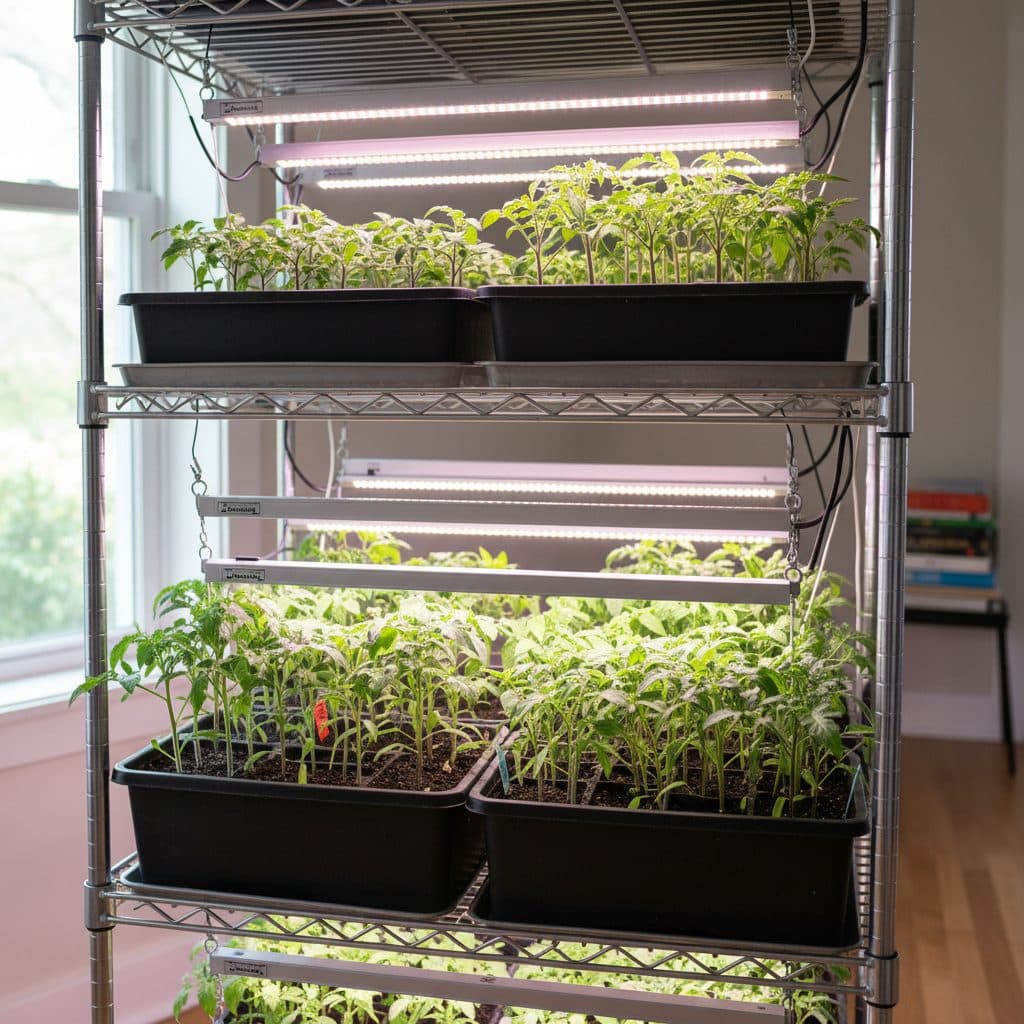
+-------------------------------------------------------------------+Intensity drops off quickly with distance, and much faster under a small point-source bulb than under a long bar or panel, so a fixture 12 inches above the flat delivers a small fraction of what it would at 3 inches. Suspend lights using adjustable rope ratchet pulleys or small link chains so you can easily raise the fixtures as plants expand.
Photoperiod: setting daily operating hours
Seedlings require a regular photoperiod of bright light followed by uninterrupted darkness. During the dark period plants draw on the starch they built up during the day, and the break prevents the leaf injury many vegetables show under continuous light.
- Recommended Daily Schedule: 14 to 16 hours of continuous light, followed by 8 to 10 hours of complete darkness.
- Timer Control: Plug your light fixtures into a basic mechanical or digital 24-hour timer. Consistent timing prevents seedling stress and eliminates the chore of manual switching.
- Never Leave Lights On 24/7: Continuous 24-hour light stresses vegetable seedlings, causing leaf chlorosis, brittle foliage, and physiological imbalances.
A steady 16-hour light cycle mirrors long late-spring days, encouraging fast, balanced vegetative growth while giving plants the dark rest they need.
Rack setup, airflow and environmental control
Creating an organized indoor growing station maximizes seedling capacity in a small footprint.
1. Wire shelving unit
A standard 4-tier steel wire shelving unit (48 inches wide by 18 inches deep by 72 inches high) holds four standard 1020 seedling flats per shelf, accommodating up to 16 flats (over 1,000 seedlings) in just six square feet of floor space. Use plastic drip trays beneath flats to protect electrical cords and floor surfaces from runoff water.
2. Oscillating air circulation
Mount a small, gentle oscillating clip fan on each shelf level. A continuous light breeze moves foliage slightly, stimulating seedlings to produce lignin—the organic polymer that strengthens plant cell walls and thickens stems. Furthermore, active air movement dries soil surfaces, significantly reducing the fungal risk covered in preventing damping off seedling failure.
3. Bottom heat vs overhead light
Use seedling heat mats only during the initial germination phase to keep potting soil at 70°F to 80°F (21°C to 27°C). Once 50 percent of seeds in a flat emerge from the soil, turn off and remove the heat mat. Warm soil combined with bright lights can cause rapid, soft stem growth; cooling the root zone to 60°F to 65°F (15°C to 18°C) encourages sturdier root systems for cool-season crops (keep heat-loving crops such as peppers, eggplant and basil nearer 70°F / 21°C).
Review complete indoor propagation schedules in our seed starting indoors us playbook and expand your seed-handling skills with seed starting for beginners and seedling care thinning spacing direct sowing.