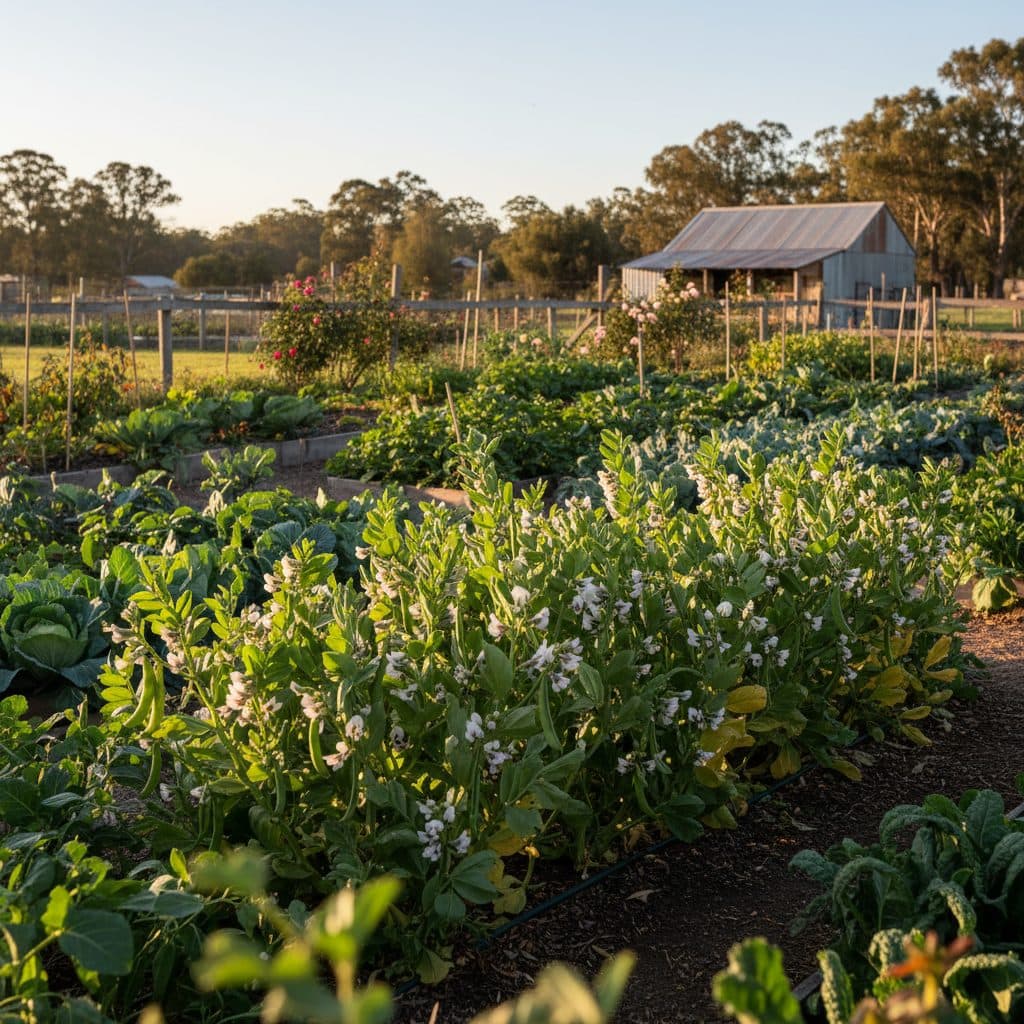
Key takeaways
- Broad beans (Vicia faba, also called fava beans) are a staple cool-season legume in Australia, grown through autumn and winter for spring harvest.
- Sow large seeds directly into open soil between April and May across temperate and subtropical regions, or March to May in cool southern districts.
- Broad bean plants fix atmospheric nitrogen in root nodules, improving soil fertility ahead of heavy-feeding summer crops like tomatoes and capsicums.
- Failure to set pods is typically triggered by early spring heat spikes above 28°C, dry root zones, or overcast weather deterring pollinating bees.
- Stake tall varieties with corner star pickets or timber stakes linked by horizontal twine corrals to prevent collapse during winter storms.
- Pick tender young pods when 6 to 10 cm long for whole cooking, or harvest plump pods in spring when internal beans are sweet and green.
Quick answer: In Australia, sow broad beans directly in autumn from April to May (March to May in cool regions) into well-drained, compost-amended soil. Plant seeds 5 cm deep and 20 to 25 cm apart in full sun, support stems with string corrals, and harvest tender pods from September through November before summer heat arrives.
Broad beans are one of the most reliable and rewarding winter crops for the Australian home veggie patch. While warm-season staples like tomatoes, capsicums, and cucumbers shut down with the arrival of autumn chill, broad beans thrive in cool temperatures, tolerating heavy winter frosts and conditioning heavy clay soils.
Successfully growing broad beans in Australia hinges on getting your autumn sowing window right. Because the plants require cool weather for flowering and pod development, sowing too late in winter leaves developing spring blossoms vulnerable to early heatwaves and dry desert northerly winds.
For gardeners in suburban Melbourne, the Adelaide Hills, coastal Sydney, or rural Tasmania, this guide covers variety selection, sowing calendars by climate zone, and troubleshooting common pod set issues.
+-------------------------------------------------------------+
|              AUSTRALIAN BROAD BEAN TIMELINE                 |
|                                                             |
|   SEASON (AU)        MONTHS         STAGE                   |
|   -----------        ------         -----                   |
|   Autumn             April - May    Direct sowing into beds |
|   Winter             June - August  Root growth & flowering |
|   Early Spring       Sept - October Peak pod filling        |
|   Late Spring        November       Final harvest & chop    |
+-------------------------------------------------------------+
When should you plant broad beans across Australian climate zones?
Broad beans need a long cool run: about 16 to 22 weeks from sowing to the first pick, and up to 30 weeks if you crop through to a late-spring finish. Timing varies across Australia's major climate zones:
+-------------------------------------------------------------+
|              AUSTRALIAN REGIONAL SOWING WINDOWS             |
|                                                             |
|   CLIMATE ZONE          REGIONS              SOWING MONTHS  |
|   ------------          -------              -------------  |
|   Cool / Cold           Tasmania, Vic Hills  March to May   |
|   Temperate             Melbourne, Sydney W, April to May   |
|                         Adelaide, ACT                       |
|   Mediterranean / Warm  Perth, Adelaide Pln  April to May   |
|   Subtropical           Coastal NSW, SE QLD  April to June  |
|   Arid / Inland         Riverina, Inland NSW April to May   |
|   Tropical Highlands    Atherton Tbld >600m  May to June    |
|   Tropical Lowlands     Not suitable — grow snake bean/cowpea
+-------------------------------------------------------------+- Cool and Cold zones (Tasmania, Southern Victoria, Tablelands, ACT): Sow from March through May. In frosty alpine pockets, seeds can also be sown in late winter (July to August) for a late spring crop.
- Temperate zones (Melbourne, Sydney west, Adelaide hills, inland NSW): Sow in April and May (Anzac Day in late April is traditional folklore timing). Plants establish deep root systems before mid-winter dormancy.
- Mediterranean / warm temperate (Perth, Adelaide plains): Sow April to May. Pods must fill before the dry heat and hot easterlies of late October and November.
- Subtropical zones (Coastal NSW north of Sydney, SE QLD): Sow in April, May, or early June. Broad beans need to flower during the coolest months (July and August) before subtropical humidity and warm temperatures set in.
- Tropical zones: Generally too hot and humid for broad beans in the lowlands; lowland growers should focus on heat-tolerant legumes like snake beans and cowpeas instead. Elevated tropical highlands (such as the Atherton Tablelands above 600 m) can sow from May to June.
Which broad bean varieties perform best in Australian soils?
Australian seed suppliers offer several distinct varieties tailored to different garden sizes and wind exposures:
- 'Aquadulce' / 'Super Aquadulce': The classic heavy-yielding variety. Produces long, slender pods containing 6 to 8 tender green seeds. Highly frost hardy and adaptable to most Australian soils. Reaches 1.2 to 1.5 metres in height.
- 'Coles Early Dwarf': A compact, sturdy variety growing to 80 to 100 cm tall. It requires less staking and is ideal for windy coastal patches, small raised beds, and large containers.
- 'Broad Windsor': A heritage favourite bearing exceptionally large, plump, flavourful beans. Performs best in cool, temperate southern districts.
- 'Crimson Flowered': An ornamental heritage selection producing deep crimson-red flowers instead of traditional white-and-black blooms. Compact habit (90 cm) with sweet, small green beans.
+-------------------------------------------------------------+
|              POPULAR AUSTRALIAN VARIETIES                   |
|                                                             |
|   VARIETY             HEIGHT         POD / BEAN TRAITS      |
|   -------             ------         -----------------      |
|   Aquadulce           1.2 - 1.5 m    Long pods, heavy crop  |
|   Coles Early Dwarf   0.8 - 1.0 m    Wind-resistant, compact|
|   Broad Windsor       1.2 - 1.4 m    Extra-large, rich seed |
|   Crimson Flowered    0.9 - 1.1 m    Red flowers, sweet pod |
+-------------------------------------------------------------+
How do you prepare soil and sow broad bean seeds?
Broad beans thrive in well-drained, open soil in full sun (at least 6 hours of direct winter sunlight).
Soil preparation
- Broad beans prefer a near-neutral soil pH of 6.5 to 7.5. In acidic Australian soils, incorporate agricultural lime or dolomite two weeks before planting.
- Fork in well-rotted compost. Do not apply high-nitrogen chemical fertilisers or fresh chicken manure; excessive nitrogen causes rapid, leafy vegetative growth that flops over and attracts black aphids while suppressing flower formation.
- Apply one light handful per square metre of blood and bone fertiliser at bed prep only; it supplies phosphorus and calcium along with some nitrogen, so do not repeat it once plants are growing. If you want phosphorus alone, use rock phosphate. Check soil for subterranean curl grubs in Australian garden beds during bed prep.
Direct sowing technique
- Broad beans are best sown directly where they are to grow, as their long taproots resent transplant shock.
- Plant seeds 5 cm deep in double rows spaced 25 cm apart, with 20 to 25 cm between plants along the row. Leave 60 to 75 cm between double rows for walking access.
- Water the bed once thoroughly after sowing, then hold off watering until green shoots emerge (7 to 14 days). Overwatering large dry bean seeds in cold autumn soil causes them to rot before germinating.
+-------------------------------------------------------------+
|              DOUBLE-ROW SOWING SPACING (METRIC)             |
|                                                             |
|   <- 25 cm ->                                               |
|   -         *    (Row 1: Seeds 20-25 cm apart in row)       |
|   |         |                                               |
|   -         *    (Row 2: Seeds 20-25 cm apart in row)       |
|                                                             |
|   <------------------ 60 to 75 cm Path -------------------> |
+-------------------------------------------------------------+
Why are your broad beans not setting pods?
One of the most frequent questions from Australian gardeners in spring is why their broad bean plants are covered in blossoms that drop off without forming pods.
+-------------------------------------------------------------+
|             POD SET TROUBLESHOOTING IN AUSTRALIA            |
|                                                             |
|   PROBLEM               CAUSE                  REMEDY       |
|   -------               -----                  ------       |
|   Early Spring Drops    Sudden heat > 28°C     Mulch & soak |
|   Mid-Winter Drops      Overcast / No bees     Plant borage |
|   Lush Leaves, No Pods  Excess soil nitrogen   Stop feeding |
|   Black Clustered Tips  Black bean aphids      Pinch top10cm|
+-------------------------------------------------------------+- Early spring temperature spikes: Broad bean pollen becomes sterile when daytime temperatures exceed 28°C to 30°C. In Australia, sudden warm spring winds in September or October can cause open flowers to abort. Keep the root zone cool with 5 cm of pea straw mulch and water deeply at the base in the morning; avoid wetting the foliage, which encourages chocolate spot (Botrytis fabae).
- Inadequate insect pollination: While broad beans are partially self-fertile, they require mechanical tripping by bees (European honeybees or native blue-banded bees) to achieve high pollination rates. On cold, overcast winter days when bees are inactive, early flowers often drop unfertilised.
- Pinching out stem tips: When the lowest 4 to 6 flower clusters have set small pods (usually late August or September), pinch out the top 7 to 10 cm of the growing tip. This stops vertical vegetative growth, directs energy into swelling pods, and deters black aphids. For natural insect management, consult our guide on organic aphid control.
How do you support broad bean plants against winter storms?
Broad bean stems are hollow and succulent. As plants grow above 1 metre in height and load up with heavy pods, winter gales will snap or flatten unsupported rows.
- Hammer sturdy timber stakes or steel star pickets into the ground at the four corners of your double bed.
- Run strong garden twine around the perimeter of the stakes at 30 cm from ground level.
- Add a second twine line at 60 cm and a third at 90 cm as the crop matures.
- For long rows exceeding 3 metres, insert intermediate support stakes every 1.5 to 2 metres to keep the twine taut.
How and when should you harvest broad beans?
Broad beans provide continuous harvesting from September through November across southern Australia:
- Young edible pods: When pods are finger-thick (6 to 10 cm long), pick them young and cook them whole like snap peas.
- Fresh shelling beans: Harvest maincrop pods when they are bright green, plump, and firm. Shell the beans immediately before cooking. Young green seeds are sweet, tender, and can be eaten raw or lightly steamed.
- Late-season double podding: If harvest is delayed and the bean skins become tough and pale grey, blanch the shelled beans in boiling water for 60 seconds, plunge into iced water, and slip off the outer skin to reveal tender bright green hearts.
When the harvest finishes in late spring, cut the plants off at soil level and toss the stems into your compost heap. Leave the root systems intact in the soil, where decomposing nitrogen nodules provide natural fertiliser for the summer crops that follow: tomatoes, capsicums, sweet corn and cucurbits planted once the bed is cleared in November. (For perennial fruit beds, see our guide on growing strawberries in Australia.)