Key takeaways
- Multi-planting 2-4 fruit trees in one hole saves significant garden space.
- Select compatible rootstocks and varieties for staggered ripening periods.
- Proper site preparation, including a 3 ft wide hole, is essential for success.
- Annual pruning is essential to maintain tree size and fruit production.
- This method can extend fruit harvest by several weeks or even months.
- Grafting allows for even greater variety and harvest extension on a single root system.
Quick answer: Multi-planting 2-4 fruit trees in one hole extends harvest by selecting varieties with staggered ripening times, allowing for continuous fruit production over several weeks or months from a single planting site.
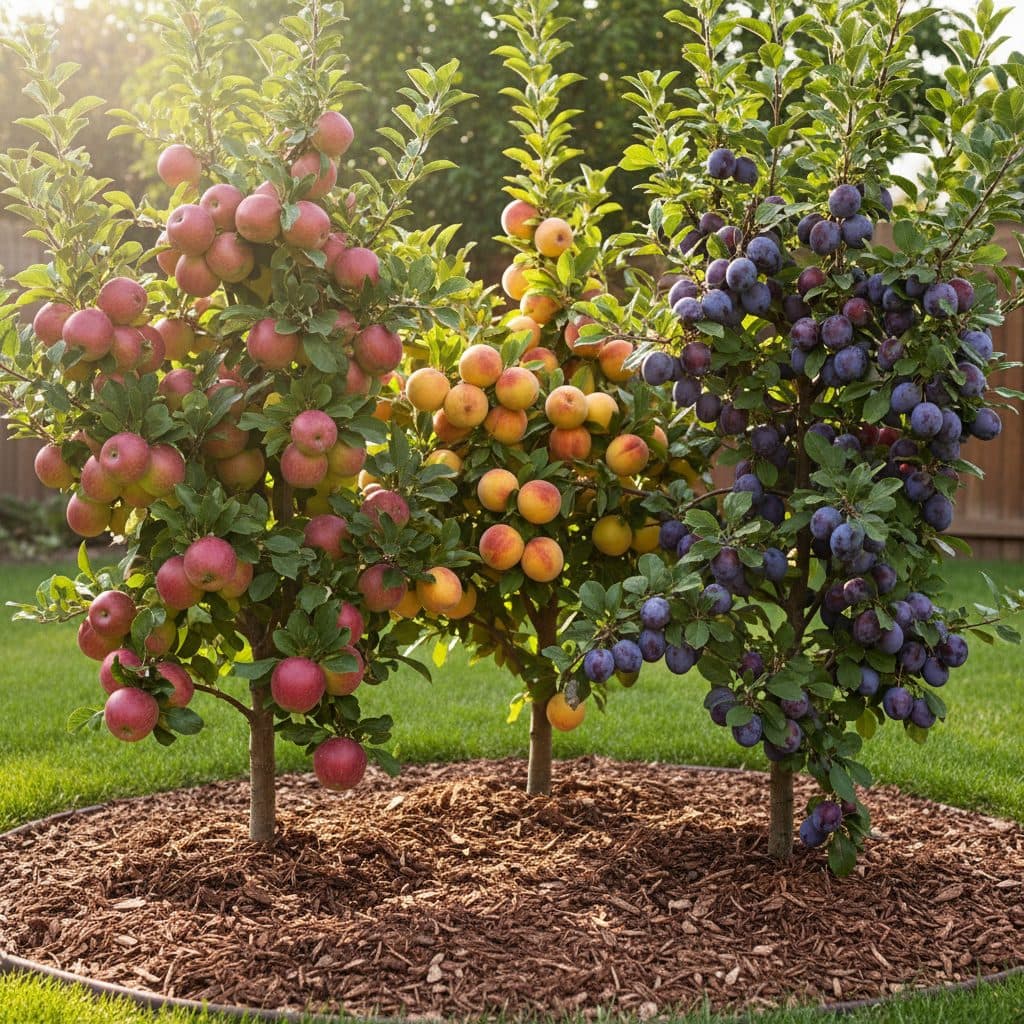
In many suburban backyards across USDA zone 6, space for a home orchard is often limited to a small patch of lawn or a narrow side yard. Traditional fruit tree planting, with each tree requiring a 10-15 ft radius for optimal growth, can quickly consume available area, leaving little room for variety or other garden endeavors. However, a technique known as multi-planting, or planting two to four fruit trees in a single hole, offers an efficient solution, allowing growers to cultivate a diverse mini-orchard in a footprint as small as 8 ft by 8 ft.
This method conserves garden space and extends the harvest well past what a single variety yields. By selecting varieties with different ripening times and compatible rootstocks, a single planting site produces fresh fruit from early summer through late fall, reducing gluts. Growers from California’s Central Valley to the Southeast use this approach across different climates.
The advantages of multi-planting for the home grower
For home growers with limited space, planting multiple fruit trees in one hole offers substantial benefits. This method allows for a greater diversity of fruit varieties within a compact area, often requiring only one-quarter to one-third the space of a conventional orchard. For instance, four apple trees can be planted in a 4 ft by 4 ft area, a footprint that would typically accommodate only one standard-sized tree. This space efficiency helps in urban and suburban settings where lot sizes average less than 0.25 acres, making it possible to grow a diverse selection of fruit in a small backyard in regions like the Northeast.
Beyond space savings, multi-planting significantly extends the harvest season. By selecting two to four varieties of the same fruit type (such as apples, peaches, or plums) that ripen at different intervals, you can enjoy fresh fruit over several weeks or even months. For example, planting an early-season ‘Lodi’ apple alongside a mid-season ‘Honeycrisp’ and a late-season ‘Fuji’ can provide a continuous apple supply from July through October in USDA zone 5, a harvest window of over 12 weeks. This staggered ripening reduces the overwhelming surplus of fruit that often occurs with single-variety plantings.
Pollination is another major advantage. Many fruit trees, including most apple and pear varieties, require cross-pollination from a different variety to set fruit effectively. Planting two or more compatible varieties close together provides reliable pollination. This close proximity also simplifies pest and disease management, as a smaller, more concentrated planting area can be more easily monitored and treated. Diverse plantings also support pollinator activity across the season.
Benefits of planting multiple trees together
- Maximize garden space, fitting up to four trees where one typically grows.
- Extend fruit harvest by up to eight weeks with staggered ripening varieties.
- Ensure reliable cross-pollination for higher fruit yields.
- Simplify orchard management due to a concentrated planting area.
Selecting the right trees and rootstocks for success
The success of a multi-planted fruit tree system hinges on careful selection of compatible varieties and rootstocks. For most deciduous fruit trees (apples, pears, plums, and peaches), dwarf or semi-dwarf rootstocks are generally preferred. These rootstocks control the tree’s ultimate size, keeping it manageable at 8-12 ft tall, essential for close-quarter planting and simplifying pruning and harvesting. For example, an M.27 or Bud.9 rootstock for apples will keep trees at 6-8 ft, while M.7 or MM.106 results in semi-dwarf trees around 12-15 ft, depending on soil and climate in regions like the Pacific Northwest. This choice can reduce mature tree size by 50% to 75% compared to standard rootstocks.
When choosing varieties, prioritize those with similar vigor and growth habits to ensure balanced competition. Avoid pairing a highly vigorous variety with a very weak one, as the stronger tree will likely outcompete the weaker. More importantly, select varieties with different ripening times but similar chill hour requirements. For instance, in USDA zone 7 you could pair ‘Reliance’, ‘Redhaven’ and ‘Contender’ peaches, which have broadly similar chill requirements and ripen in sequence from late July into early September. Check each variety’s chill hours with a local nursery or extension office before buying, since published figures vary. Check specific chill hour requirements for your region, which often range from 400 to 1200 hours.
Consider also the disease resistance of chosen varieties. Planting disease-resistant cultivars can significantly reduce chemical interventions, especially in humid regions like the Mid-Atlantic states where fungal diseases are prevalent. For example, ‘Liberty’ and ‘GoldRush’ apples offer excellent resistance to apple scab. Consulting local university extension offices or reputable nurseries will provide specific recommendations for your USDA zone, often offering varieties proven to thrive for over 20 years. SARE (Sustainable Agriculture Research & Education) recommends selecting adapted varieties for regional success.
Key considerations for tree selection
- Choose dwarf or semi-dwarf rootstocks to manage tree size, typically 8-12 ft.
- Select varieties with similar vigor and growth rates to prevent one tree from dominating.
- Ensure varieties have compatible chill hour requirements for your specific USDA zone.
- Prioritize disease-resistant cultivars to reduce maintenance and spray applications.
Site preparation and planting technique
Proper site preparation is essential for the long-term success of multi-planted fruit trees. Begin by selecting a location that receives at least six to eight hours of direct sunlight daily, a necessary factor for fruit production. The planting hole should be considerably larger than for a single tree: aim for a diameter of 3 ft to 4 ft and a depth of 18 in to 24 in. This generous size allows for ample root development and provides space to amend the soil effectively. In heavy clay, do not amend the backfill. A compost-rich hole dug into clay behaves as a sump: water runs in from the surrounding soil and sits against the roots, and the roots stay inside the amended pocket instead of growing out into the native soil. Improve drainage across the whole bed before you dig, or plant on a raised mound and put the compost on the surface as mulch instead.
Once the hole is dug, place the trees equidistant from each other, typically 18 in to 24 in apart, forming a square or triangular pattern within the hole, with each trunk leaning slightly outward from the center. Then head all of them back to the same height at planting, and every year after, cut the most vigorous tree hardest. That equalizing pruning is what keeps a multi-planted hole working; if you let one tree run, it shades out the others within two or three seasons. For instance, if planting four trees, position them at the corners of a 2 ft by 2 ft square. Ensure that the graft union (the swollen area where the scion meets the rootstock) remains 2 in to 4 in above the soil line to prevent the scion from rooting, which could negate the dwarfing effect of the rootstock. Backfill with the soil you dug out, gently firming it around the roots to eliminate air pockets and ensure good soil-to-root contact. Save the compost for the surface as mulch, where it feeds the soil without creating a drainage pocket.
After planting, water thoroughly with 5 to 10 gallons of water per tree to settle the soil. Apply a 2 in to 4 in layer of organic mulch, such as wood chips or straw, around the base of the trees, keeping it 6 in away from the trunks. This mulch helps conserve soil moisture, suppresses weeds, and moderates soil temperature, benefiting root health. For new plantings, consistent watering (two to three times per week during dry periods for the first year) is essential for establishment.
Steps for preparing your planting site
- Select a site receiving a minimum of six to eight hours of daily sunlight.
- Dig a planting hole 3 ft to 4 ft wide and 18 in to 24 in deep.
- Space trees 18 in to 24 in apart within the hole to ensure graft unions are 2 in to 4 in above soil.
- Backfill with amended soil and apply 2 in to 4 in of organic mulch, keeping it 6 in from trunks.
Ongoing care and pruning for multi-planted trees
Maintaining the health and productivity of multi-planted fruit trees requires consistent care, with pruning being the most critical aspect. The goal is to keep each tree compact and open to ensure good light penetration and air circulation to prevent fungal diseases. During the dormant season, typically late winter or early spring before bud break, remove dead, diseased, or crossing branches. Aim to maintain an open vase or central leader shape, keeping overall tree height to 8-10 ft for easy harvesting and management. For detailed guidance, see How to prune fruit trees.
Summer pruning, performed in July or August in most temperate regions, is highly beneficial. Head back vigorous new growth by one-third to one-half, especially vertical branches. This redirects energy from vegetative growth to fruit production, encourages fruiting spurs, and reduces tree size. In a crowded multi-planted hole, remove water sprouts entirely at their point of origin instead of heading them back; a headed sprout throws several replacement shoots from the buds below the cut, which defeats the purpose.
Fertilization and watering require careful management. In the first year, avoid heavy fertilization; 0.5 lb of a balanced slow-release organic fertilizer per tree in early spring is usually sufficient. As trees mature, a soil test every two to three years can guide nutrient applications to ensure optimal levels of nitrogen, phosphorus, and potassium for a 10-15% increase in fruit quality. Consistent moisture is essential, especially during fruit development; provide 10-15 gallons of water per tree per week during dry spells. A soil moisture meter helps you monitor soil moisture effectively. The ATTRA / NCAT Sustainable Agriculture program provides resources on organic orchard care with guidance on soil health.
Annual care for multi-planted fruit trees
- Perform dormant pruning in late winter or early spring to maintain tree shape and size, keeping height to 8-10 ft.
- Conduct summer pruning in July or August to encourage fruit production and manage vigor.
- Apply a balanced organic fertilizer in early spring, 0.5 lb per tree, after the first year.
- Ensure consistent watering, providing 10-15 gallons per tree per week during dry periods.
Advanced techniques: grafting for variety
For growers looking to further diversify their multi-planted fruit trees, grafting presents an advanced yet accessible technique. Grafting allows you to combine different varieties onto a single rootstock or even onto an existing branch of a mature tree. This means you could have a single apple tree producing three or four different varieties of apples, all ripening at different times. This approach maximizes fruit diversity without increasing the physical footprint of your orchard, making it ideal for very small spaces or for adding a specific variety to an already established multi-plant system. A successful graft union typically takes 4-6 weeks to heal, with visible growth appearing within 2-3 months, leading to fruit production within 2-3 years.
There are several common grafting methods suitable for the home grower, including whip-and-tongue, cleft, and bark grafts. Whip-and-tongue is often used for dormant scions onto dormant rootstock or young trees, achieving a high success rate of 70% to 90% when performed correctly in late winter. Cleft grafting is effective for larger branches, allowing you to convert an existing branch from one variety to another. For example, you could graft a ‘Granny Smith’ scion onto a ‘Gala’ apple branch, adding a tart option to your harvest. Always use sharp, sterilized tools to prevent disease transmission and ensure clean cuts, which are necessary for a strong graft union and a 95% chance of successful callus formation.
When sourcing scion wood, ensure it comes from healthy, disease-free trees of the desired variety. Collect scion wood during the dormant season, typically in January or February in northern climates, and store it properly in a cool, moist environment, ideally around 35°F, until grafting time in spring. Healthy, correctly stored scion wood is as important to a successful graft as the cut itself. Grafting can extend your harvest by introducing early-ripening varieties onto a late-ripening tree, or vice-versa, effectively adding several weeks to your fresh fruit supply from a single trunk.
Grafting tips for home growers
- Graft multiple fruit varieties onto a single rootstock or existing tree to maximize diversity.
- Utilize whip-and-tongue or cleft grafting methods, achieving 70% to 90% success with practice.
- Source healthy, disease-free scion wood during the dormant season, typically January or February.
- Sterilize grafting tools to prevent disease and ensure strong graft unions.
Harvesting and enjoying your staggered yield
One of the most rewarding aspects of multi-planting fruit trees is the extended harvest window, allowing you to enjoy fresh fruit over a prolonged period. By carefully selecting varieties that ripen sequentially, you can transition smoothly from early-season fruits to mid-season and then late-season options. For example, in USDA zone 6, a multi-planted peach hole might yield ‘Reliance’ peaches in late July, followed by ‘Redhaven’ in mid-August, and ‘Contender’ in early September. This staggered approach means you’re never overwhelmed with a single large crop, reducing the pressure to process or preserve all at once.
Knowing when to harvest each variety ensures good flavor and quality. Fruit maturity is often indicated by changes in color, ease of separation from the branch, and taste. For apples, a simple test is to lift and twist the fruit; if it separates easily, it’s likely ready. Pears, however, are often best picked when mature but still firm, then ripened off the tree at room temperature for 7-10 days. This allows their sugars to fully develop. A single mature semi-dwarf tree can produce 30-50 pounds of fruit in a good year, meaning a multi-planted hole could yield 90-200 pounds of diverse fruit over several months.
Once harvested, proper storage can further extend the enjoyment of your fruit. Early-season varieties, often softer, are best consumed fresh or processed quickly into jams or pies within 1-2 weeks. Mid-season and late-season fruits, especially apples and some pears, can be stored for longer periods. For example, ‘Fuji’ apples can be stored in a cool, dark place, ideally around 35-40°F with high humidity, for up to 3-5 months. Understanding the storage characteristics of each variety in your multi-planted system will help you maximize your yield and minimize waste, providing fresh, homegrown produce well into the colder months.
Maximizing your fruit harvest
- Select varieties ripening sequentially to extend your fresh fruit supply for several months.
- Harvest fruit at peak maturity, indicated by color change and ease of separation from the branch.
- Expect a multi-planted hole to yield 90-200 pounds of diverse fruit annually from mature trees.
- Store late-season fruits like ‘Fuji’ apples at 35-40°F for up to 3-5 months to extend availability.
Comparison of Single Tree vs. Multi-Planting for Backyard Orchards
Feature | Single Tree Planting | Multi-Planting (2-4 trees) |
|---|---|---|
Space Required | 15 ft x 15 ft (225 sq ft) for one tree | 8 ft x 8 ft (64 sq ft) for 2-4 trees |
Variety Count | One variety per tree | Two to four varieties per hole |
Harvest Window | Typically 2-4 weeks | Often 8-12 weeks or longer |
Pollination | May require a separate pollinator tree | Built-in cross-pollination |
Initial Cost | Lower per tree, higher for multiple trees | Similar per tree, but more trees in less space |
Extended Harvest: Multi-planting can extend your fresh fruit harvest by 8-12 weeks, providing continuous yield from a single location.
Increased Yield: A multi-planted fruit tree hole can yield 90-200 pounds of diverse fruit annually from mature trees, a 200-300% increase per square foot.
Frequently asked questions
How far apart should the trees be planted in one hole?
When multi-planting, trees should typically be spaced 18 in to 24 in apart within the same hole. This allows for sufficient root development while maintaining a compact canopy for all two to four trees, maximizing space efficiency.
What type of rootstock is best for multi-planting?
Dwarf or semi-dwarf rootstocks are highly recommended. They control tree size, keeping them manageable at 8-12 ft tall, which suits close-quarter planting and simplifies pruning and harvesting tasks for the home grower.
How much fruit can I expect from a multi-planted hole?
A single mature semi-dwarf tree can produce 30-50 pounds of fruit annually. Therefore, a multi-planted hole with three or four trees could yield 90-200 pounds of diverse fruit over several months, significantly increasing your backyard harvest.
How often should I prune multi-planted trees?
Annual pruning is essential. Dormant pruning in late winter or early spring maintains tree shape and size, while summer pruning in July or August helps redirect energy to fruit production.
Can I mix different types of fruit trees in one hole?
It is generally recommended to plant varieties of the same fruit type (e.g., all apples or all peaches) in one hole due to similar growth habits, pest issues, and chill hour requirements. Mixing different species can lead to uneven growth and competition.
How many years until multi-planted trees produce fruit?
With dwarf or semi-dwarf rootstocks, multi-planted fruit trees can begin producing fruit in their second or third year after planting, with significant yields typically starting in year four or five, providing a quick return on your planting effort.