Key takeaways
- Maintain consistent surface moisture for the first 10-14 days to ensure strong seed germination.
- Transition to deeper, less frequent watering after germination to encourage sturdy root development, aiming for 2-4 inches deep.
- Gradually increase watering depth to 6 inches or more as the lawn matures, reducing frequency to once or twice weekly.
- Adjust watering schedules based on grass type; cool-season grasses prefer consistent moisture, while warm-season types tolerate drier periods.
- Utilize a soil moisture meter to accurately gauge soil hydration levels and prevent over or under-watering.
- Perform the first mow when grass reaches 3-4 inches and the soil is dry enough to prevent compaction.
Quick answer: New lawn establishment in USDA Zone 6 requires precise watering, starting with consistent surface moisture for 10-14 days for germination, transitioning to deeper, less frequent watering for root development, and finally, 1 inch of water per week before the first mow.
In the warm, humid climate of Florida, establishing a new lawn can be a rewarding effort, demanding careful attention to irrigation during the establishment phase. Across the United States, from the cool-season regions of USDA zone 4 to the warm-season expanses of USDA zone 9, proper watering is the single most important factor for successful turfgrass establishment. Many homeowners, however, water for short durations, which may not be sufficient for deep root growth.
This guide outlines a precise watering schedule, from the critical initial days of seed germination through to the milestone of the first mow so your new turf develops a sturdy root system. We will explore the differing needs of cool-season grasses like Kentucky bluegrass and warm-season varieties such as Bermuda grass, providing actionable advice grounded in research and practical experience to help your new lawn thrive for years.
Initial watering for germination (days one to fourteen)
The first two weeks after seeding are critical for successful germination. During this period, the goal is to keep the top one inch of soil consistently moist, but not waterlogged. In California, for example, daily watering for 10 to 14 days is recommended for seed germination [1]. This often means applying water two to four times a day for short durations, perhaps five to ten minutes per application, depending on soil type and temperature. Sandy soils may require more frequent, shorter applications, while heavier clay soils can hold moisture longer.
Maintaining surface moisture for new seeds
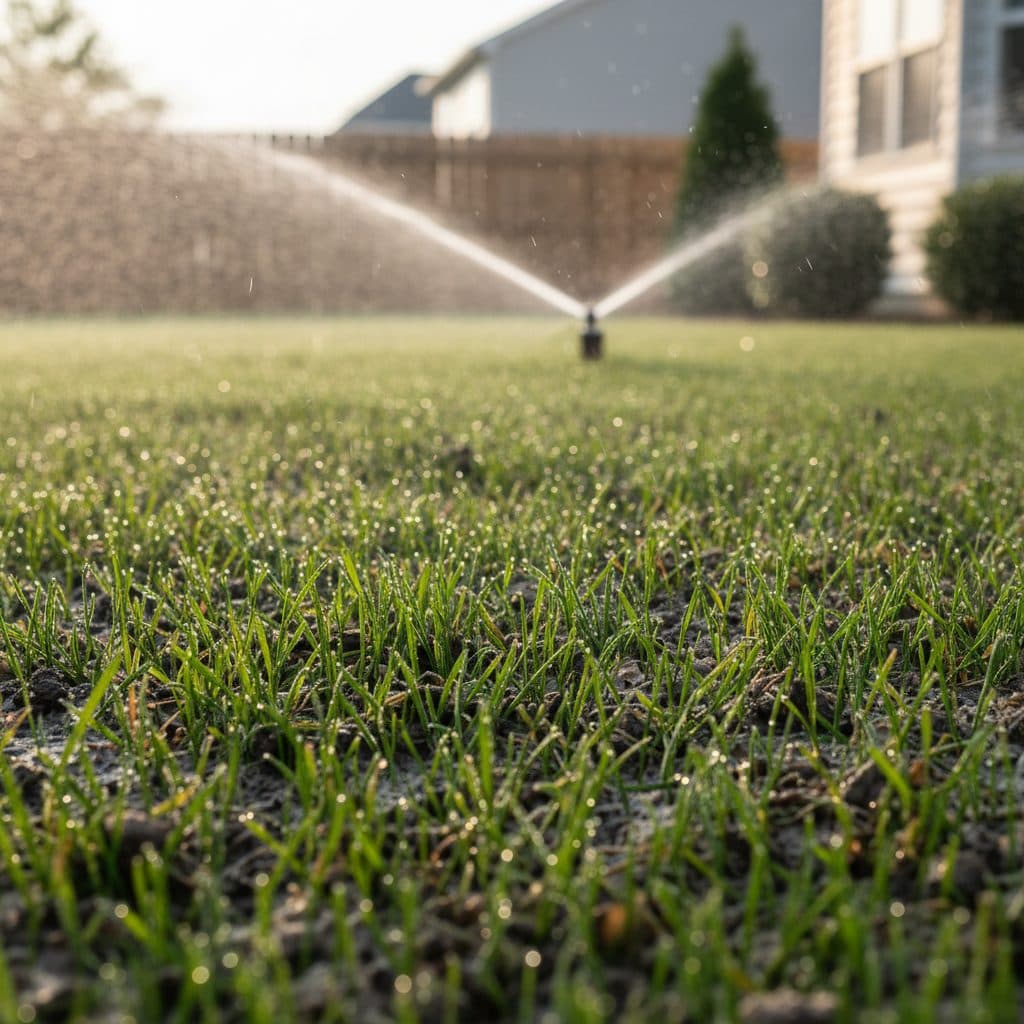
Use a fine spray nozzle to avoid washing away seeds or creating puddles. The aim is to moisten the seedbed without causing runoff, which can displace seeds and nutrients. If temperatures are consistently above 70°F, you may need to increase watering frequency to prevent the delicate seedlings from drying out. A soil moisture meter can be a useful tool during this phase, helping you gauge the exact moisture level at a depth of one inch. This type of meter provides a direct reading, preventing both overwatering and under-watering, which are common pitfalls for new lawns.
- Water two to four times daily for five to ten minutes.
- Ensure the top one inch of soil remains consistently moist.
- Adjust frequency based on daily temperatures, especially above 70°F.
- Avoid heavy streams that can displace seeds or create puddles.
- Monitor soil moisture with a dedicated meter for accuracy.
Developing roots (weeks three to five)
Once the majority of your grass seeds have germinated and seedlings are visible, typically by week three, it is time to transition your watering strategy. The focus shifts from surface moisture to encouraging deeper root growth. This means watering less frequently but for longer durations, allowing water to penetrate two to four inches into the soil. For many turf types, this might translate to watering once a day for 15 to 20 minutes, depending on your soil type and local climate conditions, such as those found in USDA zone 7.
Encouraging deep root growth
Deep and infrequent watering encourages roots to grow downwards in search of moisture, making the turf more resilient to drought and stress. For instance, Deep and infrequent watering is generally considered more effective for root development than shallow, frequent applications. You can check the depth of water penetration by using a soil moisture probe or by pushing a screwdriver into the soil; it should penetrate easily to the desired depth. If the soil is still wet at a depth of four inches after one day, you might extend the period between waterings to two days.
- Water once daily for 15 to 20 minutes to achieve 2-4 inches of penetration.
- Allow the top inch of soil to dry slightly between waterings.
- Use a soil probe or screwdriver to verify water depth.
- Adjust watering duration based on soil type; sandy soils drain faster.
- Observe grass for signs of stress, such as wilting, before the next watering.
Preparing for the first mow (weeks six to eight)
As your new lawn approaches its first mow, typically around weeks six to eight, the watering schedule should further adapt to encourage even deeper root systems. The goal now is to apply about one inch of water per week, delivered through fewer, longer watering sessions. This might mean watering every two to three days for 30 to 45 minutes, allowing the water to soak six inches or more into the soil profile. For Florida lawns, 1/2 to 3/4 inch of water per application is often sufficient, but new lawns may benefit from slightly more to establish deep roots [3].
Assessing readiness for the first cut
Before the first mow, ensure the grass blades are at least three to four inches tall and the soil is dry enough to support the weight of a mower without compacting. Mowing wet grass can lead to uneven cuts and disease. Early morning watering, between 4:00 AM and 8:00 AM, is generally best, as it minimizes evaporation losses and allows the grass blades to dry before nightfall, reducing fungal disease risk. Consider installing a durable irrigation hose system for efficient and consistent water delivery across your new lawn area.
- Apply one inch of water per week, typically every two to three days.
- Ensure water penetrates six inches or deeper into the soil.
- Mow only when grass is three to four inches tall and soil is dry.
- Water in the early morning, ideally between 4:00 AM and 8:00 AM.
- Avoid watering in the late afternoon or evening to prevent fungal issues.
Warm-season versus cool-season grasses
The specific watering needs of your new lawn will also depend significantly on whether you’ve planted warm-season or cool-season turfgrass. Cool-season grasses, prevalent in USDA zones 3 through 7, such as Kentucky bluegrass, tall fescue, and perennial ryegrass, prefer consistent moisture, especially during their peak growth in spring and fall. They generally require about one to 1.25 inches of water per week during establishment, applied deeply once or twice weekly.
Species-specific watering needs
Warm-season grasses, common in USDA zones 7 through 10, including Bermuda grass, Zoysia grass, and St. Augustine grass, are more drought-tolerant once established. However, during the initial establishment phase, they still require regular, deep watering to develop strong roots. They typically need about one inch of water per week, but can tolerate slightly longer dry periods between waterings compared to cool-season varieties. For instance, a new Bermuda grass lawn in Arizona might be watered three times a week for 20 minutes per session during its first month, while a Kentucky bluegrass lawn in Ohio can need watering every other day for 25 minutes. Understanding these differences matters for long-term success, as residential homeowners often overlook specific watering needs based on grass type [6].
- Cool-season grasses (e.g., Kentucky bluegrass) need 1-1.25 inches of water weekly.
- Warm-season grasses (e.g., Bermuda grass) require about one inch of water weekly.
- Adjust watering frequency based on grass type and local climate conditions.
- Observe grass for signs of stress, such as dull color or folded blades, indicating thirst.
- Consider local extension office recommendations for specific regional advice.
New Lawn Watering: Cool-Season vs. Warm-Season Grasses
Characteristic | Cool-Season Grasses (e.g., Kentucky Bluegrass) | Warm-Season Grasses (e.g., Bermuda Grass) |
|---|---|---|
USDA Zones | 3-7 | 7-10 |
Water per Week (Establishment) | 1 to 1.25 inches | Approximately 1 inch |
Frequency (Post-Germination) | Every 2-3 days | Every 3-4 days |
Watering Depth Goal | 6 inches or more | 6 inches or more |
Drought Tolerance (Established) | Moderate | High |
Watering Time: Watering new lawns between 4:00 AM and 8:00 AM can reduce evaporation losses, improving water efficiency.
Root Depth: Deep and infrequent watering encourages roots to grow deeper, making the turf more resilient to dry conditions.
References
- Lawn Watering Guide for California (2001).
- The rain-watered lawn: Informing effective lawn watering behavior (2017).
- Watering Your Florida Lawn (2013).
- Are you watering your lawn? (2015).
- Letters. Washday lawn watering (1971).
- Effects of Home Value, Home Age, and Lot Size on Lawn-watering Perceptions and Behaviors of Residential Homeowners (2015).