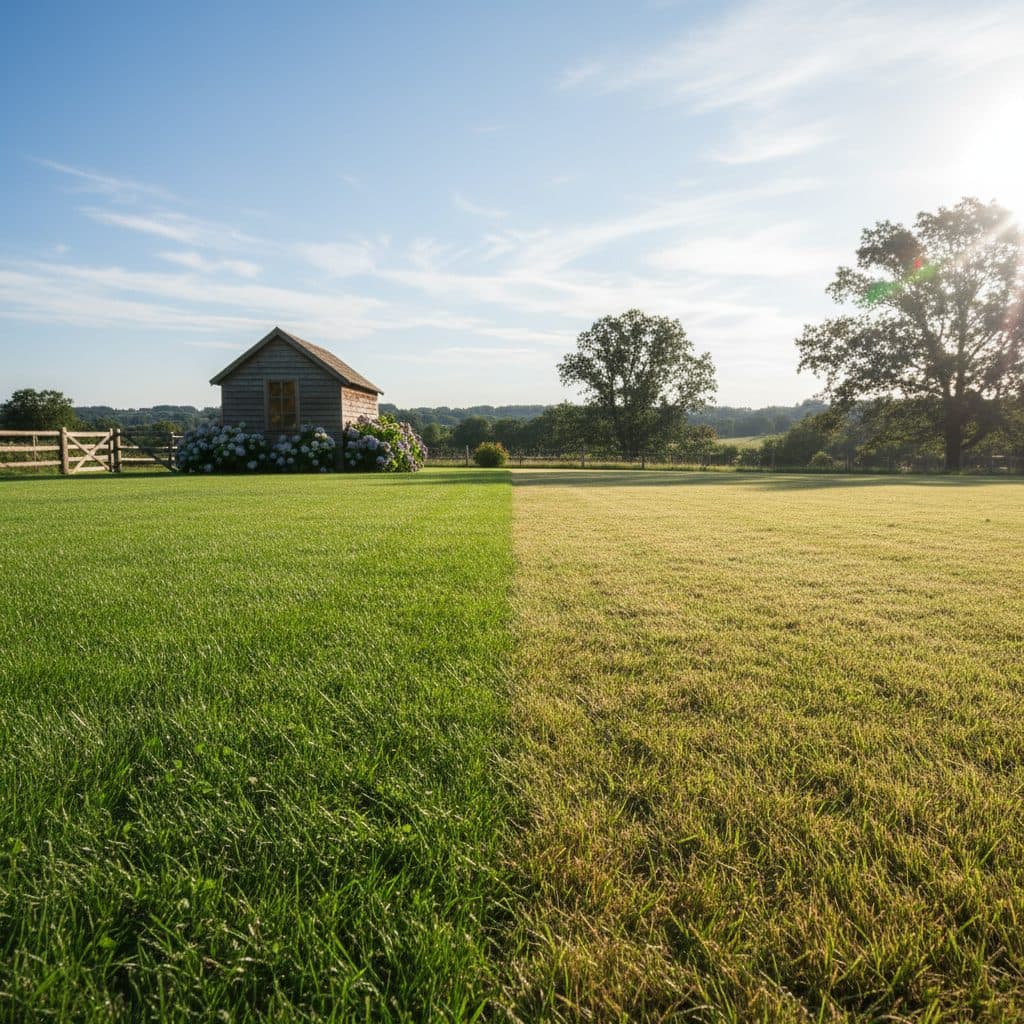
Key takeaways
- Warm-season grasses thrive in temperatures between 80°F and 95°F, growing best in USDA zones 7-11.
- Cool-season grasses prefer temperatures from 60°F to 75°F, suitable for USDA zones 1-6.
- Transition zones, like USDA zone 6, can support both types, but often require careful management or a mix of species.
- Proper establishment, including soil preparation and seeding depth of one-quarter to one-half inch, matters for both grass types.
- Overseeding warm-season lawns with cool-season annuals can provide green color during winter dormancy in southern regions.
- Regular soil testing, ideally every 2-3 years, helps maintain optimal pH levels and nutrient availability for turf health.
Quick answer: Choosing the right turf involves understanding your region’s climate and USDA zone. Warm-season grasses thrive in 80-95°F (zones 7-11), while cool-season grasses prefer 60-75°F (zones 1-6).
From the humid summers of Florida (USDA zone 9) to the cold winters of Minnesota (USDA zone 4), the United States presents a wide range of climates for growing turf. Choosing the correct grass type for your specific region is not just about aesthetics; it’s about establishing a resilient, low-maintenance lawn that can withstand local weather patterns and thrive year after year. A misstep here can lead to a patchy, struggling yard, requiring significantly more water, fertilizer, and effort to keep it looking decent.
Understanding the fundamental differences between warm-season and cool-season grasses is the first step toward a successful lawn. These two broad categories of turfgrasses have distinct growth cycles, temperature preferences, and water requirements, directly impacting their suitability for various USDA plant hardiness zones. For instance, a homeowner in central Texas (USDA zone 8) will have a vastly different experience with Kentucky bluegrass than one in northern Michigan (USDA zone 5), due to the grasses’ inherent biological needs.
Understanding warm-season grasses: growth and characteristics
Warm-season grasses are the champions of heat and humidity, thriving when temperatures consistently range from 80°F to 95°F. Their active growth phase begins in late spring, peaks during the hot summer months, and slows as autumn approaches, typically going dormant and turning brown with the first hard frost below 32°F. These grasses are well-suited for the southern half of the United States, generally USDA zones 7 through 11, where summers are long and hot. Common species include Bermuda grass, Zoysia grass, St. Augustine grass, and Centipede grass, each offering unique textures and maintenance needs.
Key traits of warm-season turf
One notable characteristic of warm-season grasses is their excellent drought tolerance once established, requiring less supplemental irrigation than their cool-season counterparts in many cases. For example, Bermuda grass can survive extended dry periods, though it will go dormant without sufficient water, usually needing about one inch of water per week during active growth. Their deep root systems, which can extend several feet, help them access deeper soil moisture. However, they are less tolerant of shade, generally requiring at least six to eight hours of direct sunlight daily to perform optimally. In areas with significant shade, such as under mature oak trees, these grasses will struggle, leading to thin patches and increased weed pressure.
- optimal temperature range: 80°F to 95°F
- dormancy: turns brown below 32°F, typically in winter
- drought tolerance: generally high once established
- shade tolerance: generally low, needs 6-8 hours of sun
- common species: Bermuda grass, Zoysia grass, St. Augustine grass
Exploring cool-season grasses: ideal conditions and varieties
Cool-season grasses are best suited for the northern United States, thriving in cooler temperatures between 60°F and 75°F. Their peak growth periods occur in the spring and fall, slowing down significantly during hot summer months above 80°F, and becoming dormant in extreme cold. These grasses are the go-to choice for USDA zones 1 through 6, covering a vast area from New England to the Pacific Northwest. Popular cool-season varieties include Kentucky bluegrass, perennial ryegrass, tall fescue, and fine fescue, each with distinct characteristics regarding texture, drought tolerance, and shade preference. For example, tall fescue is known for its deeper root system, which can reach 2-3 feet, offering better heat tolerance than Kentucky bluegrass.
Managing cool-season turf in diverse climates
While cool-season grasses generally require more consistent moisture than warm-season types, their ability to tolerate colder temperatures makes them indispensable in northern climates. According to research, cool-season grasses can produce more total biomass across the growing season than warm-season grasses when managed with an irrigation gradient [2]. This means they can maintain a greener appearance for a longer portion of the year in suitable zones. However, during summer heat waves exceeding 85°F, many cool-season grasses can enter a stress-induced dormancy, turning brown to conserve water. Proper watering, typically 1 to 1.5 inches per week during dry periods, prevents this. For those in cooler regions looking to establish or renovate their lawn, selecting the right cool-season grass is key. A reliable irrigation system can make a significant difference in maintaining turf health during drier spells.
- optimal temperature range: 60°F to 75°F
- dormancy: slows growth above 80°F, dormant in extreme cold
- drought tolerance: moderate, requires consistent moisture
- shade tolerance: varies by species, fine fescues tolerate more shade
- common species: Kentucky bluegrass, perennial ryegrass, tall fescue
The transition zone: a unique challenge
The transition zone, roughly spanning USDA zones 6 and 7, is a challenging region for turfgrass selection because it experiences both hot, humid summers and cold winters. Neither warm-season nor cool-season grasses are perfectly adapted to these extreme swings, leading to potential stress periods for any single grass type. For example, Kentucky bluegrass may struggle during a 95°F summer in Kansas City (USDA zone 6a), while Bermuda grass can suffer winterkill during a prolonged freeze at 10°F. Homeowners in this zone often face a compromise, choosing a grass that performs adequately for most of the year or employing strategies to mitigate seasonal weaknesses.
Strategies for transition zone lawns
One common strategy in the transition zone is to plant a blend of cool-season grasses, such as tall fescue with some Kentucky bluegrass, to leverage their complementary strengths. Tall fescue, with its deeper roots, offers better heat tolerance, while Kentucky bluegrass provides excellent recovery from damage. Another approach, particularly in the southern parts of the transition zone, is to grow warm-season grasses like Bermuda grass and then overseed with a cool-season annual like perennial ryegrass for winter color [1]. This provides a green lawn year-round, though it requires extra effort and cost. Regular soil testing, perhaps every two years, helps ensure optimal pH levels and nutrient availability, which is critical for stressed turf. A soil moisture probe can help monitor moisture and pH, guiding watering and fertilization decisions.
- geographic location: generally USDA zones 6 and 7
- climate challenges: hot summers (90°F+) and cold winters (below 20°F)
- common strategy 1: blends of cool-season grasses (e.g., tall fescue and Kentucky bluegrass)
- common strategy 2: overseeding warm-season grasses with cool-season annuals
- maintenance tip: regular soil testing, every 2 years, for pH and nutrients
Establishment, renovation, and ongoing care
Establishing a new lawn or renovating an existing one requires careful planning, regardless of whether you choose warm-season or cool-season grasses. For cool-season grasses, the ideal seeding time is late summer to early fall, typically between August 15th and September 30th in many northern states, when soil temperatures are still warm enough for germination (55°F to 65°F) but air temperatures are cooling. This allows the grass to establish a strong root system before winter. Warm-season grasses are best planted in late spring or early summer, once soil temperatures are consistently above 65°F, usually from April to June in southern regions. Proper seed-to-soil contact is critical; seeds should be planted at a depth of one-quarter to one-half inch.
Essential lawn maintenance practices
Ongoing care involves a combination of smart watering, precise fertilization, and appropriate mowing. For most lawns, deep and infrequent watering, delivering 1 to 1.5 inches of water per week, encourages deeper root growth and drought resistance. Fertilization needs vary by grass type and soil test results, but a general guideline is to apply nutrients when the grass is actively growing: spring and fall for cool-season grasses, summer for warm-season grasses. Mowing height also matters; cool-season grasses generally prefer a height of 2.5 to 3.5 inches, while warm-season grasses can be mowed shorter, often between one and two inches, depending on the species. Regular monitoring of soil conditions with tools like a soil pH and moisture meter can help tailor these practices to your specific lawn’s needs, preventing issues before they become severe problems.
- cool-season seeding: late summer to early fall (August 15 – September 30)
- warm-season seeding: late spring to early summer (April – June)
- seeding depth: one-quarter to one-half inch for good contact
- watering: 1 to 1.5 inches per week, deep and infrequent
- mowing height: 2.5-3.5 inches for cool-season, 1-2 inches for warm-season
Main differences: Warm-Season vs. Cool-Season Grasses
characteristic | warm-season grasses | cool-season grasses |
|---|---|---|
optimal temperature | 80°F – 95°F | 60°F – 75°F |
primary growth season | summer | spring and fall |
dormancy | winter (brown) | summer (stress), winter (green/semi-dormant) |
USDA zones | 7-11 | 1-6 |
drought tolerance | high | moderate |
shade tolerance | low to moderate | moderate to high (species dependent) |
mowing height | 1 – 2 inches | 2.5 – 3.5 inches |
common examples | Bermuda, Zoysia, St. Augustine | Kentucky bluegrass, Tall fescue, Perennial ryegrass |
optimal growth: Warm-season grasses achieve their best growth when air temperatures are consistently above 80°F, often peaking at 95°F.
water needs: Cool-season grasses typically require 1 to 1.5 inches of water per week during their active growing periods to maintain health.
discover lawn solutions
References
- A Guide to Overseeding Warm-Season Perennial Grasses with Cool-Season Annuals (2005).
- Cool-season grasses produce more total biomass across the growing season than do warm-season grasses when managed with an applied irrigation gradient (2010).
- Other Cool‐Season Grasses (1996).
- Cool‐Season Grasses for Pasture (1996).
- Cool‐Season Grasses in Rangelands (1996).
- USDA Natural Resources Conservation Service (2024).