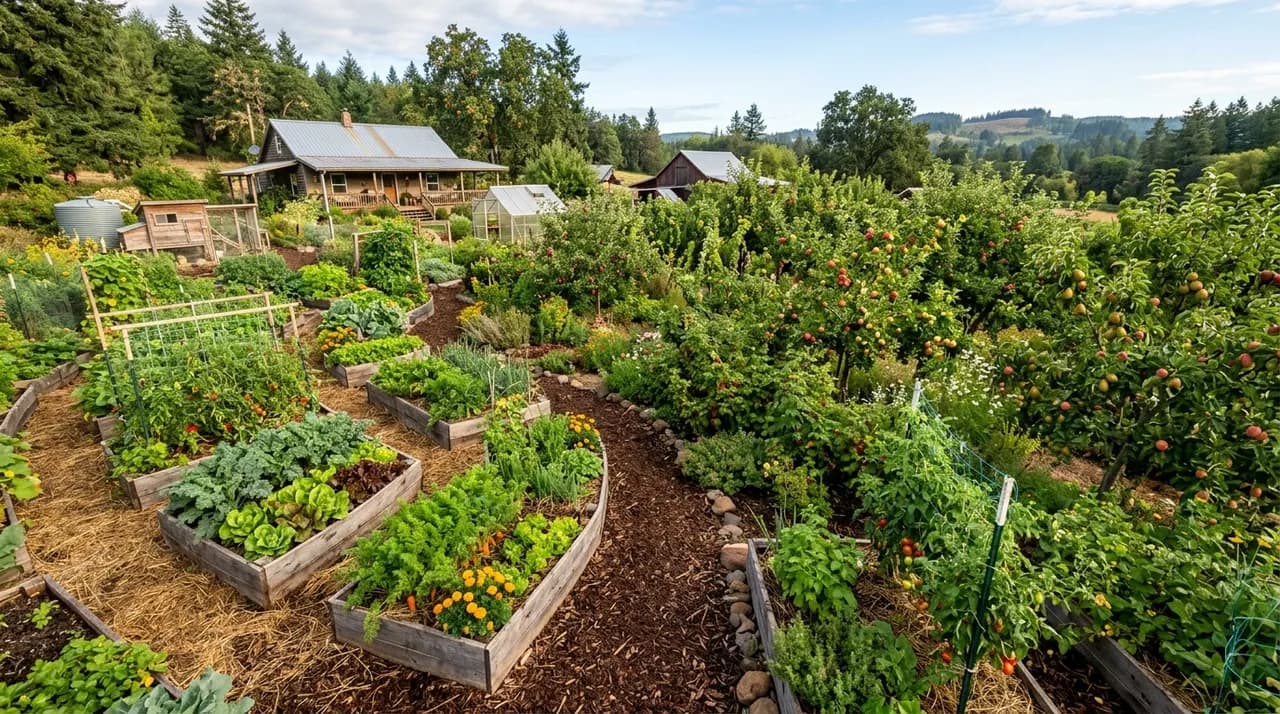
The three permaculture ethics (Earth Care, People Care, and Fair Share) form the foundational moral framework established by Bill Mollison and David Holmgren to guide ecological land design. Unlike tactical tools or agronomic recipes, these ethics define the non-negotiable boundaries within which all land management choices must operate. Applied in practice, they govern how a grower rehabilitates soil biology, meets household sustenance needs, and redistributes biological and financial surpluses without depleting the surrounding ecosystem.
The ethical foundation: why ethics precede principles
In ecological design, ethics establish the standard of responsibility, while the twelve permaculture principles are practical heuristics for problem-solving. A grower may understand how to build swales, graft nursery stock, or structure windbreaks, but technical competence alone does not guarantee a regenerative outcome. An agricultural enterprise can employ efficient irrigation or organic fertilizers while still underpaying workers, eroding soil organic matter through excessive tillage, or exhausting regional water tables.
Beginning with clear ethics ensures that technique remains subordinate to ecological health. When design decisions are evaluated against Earth Care, People Care, and Fair Share, practical choices shift from maximizing short-term output to building durable biological capital. This distinction separates permaculture from conventional production models: success accounts for the ongoing vitality of the soil, the stability of the local community, and the net resilience of the watershed rather than simply total weight harvested at the gate.
Earth care: rebuilding living capital
Earth Care requires that human stewardship conserves natural systems, rebuilds damaged landscapes, and preserves biological diversity. In practical cultivation, this ethic extends far beyond passive conservation. A neglected plot overrun with invasive monocultures or depleted by decades of chemical fertilizer does not heal simply through human absence. Earth Care calls for active, considered intervention to restore nutrient cycles, stabilize hydrological flows, and re-establish multi-layered vegetation.
For the practical grower, Earth Care manifests in everyday management decisions:
- Soil stewardship: Maintaining continuous living ground cover through diverse green manures, cover crops, and deep organic mulches to protect mycorrhizal fungal networks from ultraviolet damage and thermal shock.
- Biological diversity: Interplanting perennial species with differing root architectures and flowering periods to support predatory insects, native pollinators, and subterranean life.
- Hydrological responsibility: Capturing and infiltrating precipitation on-site instead of shedding stormwater into municipal drains, which prevents downslope soil erosion and helps replenish local aquifers.
- Eliminating synthetic biocides: Managing weed competition and pest pressure through habitat creation, rotational grazing, and physical barriers rather than chemical applications that harm non-target organisms.
Earth Care recognizes that all living organisms possess inherent worth regardless of their immediate commercial utility to humans. Tending soil organisms, maintaining uncultivated buffer zones along riparian corridors, and preserving standing dead wood for cavity-nesting birds are practical expressions of this principle on managed land.
People care: meeting needs without depletion
People Care centers on physical well-being, emotional health, and self-reliance for individuals, families, and communities. Permaculture does not demand human asceticism or martyrdom for the sake of nature. If a land project requires backbreaking physical toil that leaves the grower exhausted, injured, or financially insolvent, it fails the ethic of People Care.
Meeting human needs within an ecological system requires careful planning. Practical permaculture design emphasizes ergonomic layout, gravity-fed water delivery, and passive solar orientation to reduce daily labor. A well-designed kitchen garden situated immediately adjacent to the dwelling provides fresh herbs and salad crops with minimal walking, while perennial food systems reduce the annual labor of plowing, tilling, and bed preparation.
People Care also addresses social and communal dimensions:
- Food security: Establishing reliable perennial food crops, root cellars, and seed-saving protocols that safeguard household nutrition during climatic disruptions or supply chain failures.
- Non-exploitative labor: Designing enterprises that value human work fairly and provide safe working environments free from hazardous chemical exposures.
- Knowledge transmission: Documenting regional growing observations, sharing open-pollinated seed varieties, and teaching practical land skills to neighbors and new growers.
When a property is designed around People Care, human presence becomes an asset to the landscape rather than an extractive burden.
Fair share: managing limits and redistributing surplus
The third ethic, historically phrased as setting limits to consumption and redistributing surplus, addresses resource distribution and systemic balance. Living systems generate natural surpluses when sunlight, rainfall, and healthy soil biology interact. A mature apple tree yields far more fruit than a single household can eat; a clump of comfrey produces multiple heavy flushes of nutrient-dense foliage each season; a vigorous perennial guild generates countless root divisions and seed pods.
Fair Share asks the grower to recognize when sufficiency has been reached and to direct any excess back into supporting Earth Care and People Care. In a commercial culture oriented toward endless growth, this is often the most challenging ethic to implement. It requires resisting the temptation to convert every biological surplus into monetary profit or to scale up production beyond what the local landbase can sustainably carry.
Surplus distribution on a working homestead takes several distinct forms:
- Biomass recycling: Returning pruned branches, crop residues, and dropped fruit directly to the soil as compost or mulch, so that minerals and carbon remain within the property rather than being bagged for landfill disposal.
- Seed and plant sharing: Distributing excess division crowns, rootstocks, scionwood, and saved seed to community gardens and regional growers, accelerating localized genetic adaptation without charging commercial rates.
- Balanced harvest allocation: Splitting seasonal fruit yields intentionally among fresh household consumption, long-term pantry storage, donations to local food relief networks, and deliberate forage left for over-wintering birds and beneficial wildlife.
Navigating practical tradeoffs on the land
Applying permaculture ethics is rarely a matter of following rigid rules. In the daily reality of homesteading, the three ethics frequently exert competing pressures, forcing growers to weigh practical tradeoffs.
Consider the challenge of establishing an annual vegetable patch in a heavily wooded clearing. Earth Care encourages preserving mature native trees that provide habitat, carbon sequestration, and soil structure. However, People Care requires sufficient direct sunlight to cultivate staple root crops, brassicas, and nightshades to feed the household. A dogmatic interpretation of Earth Care might leave the forest untouched, leaving the family dependent on food transported over long distances. A balanced permaculture approach might involve selective pruning or coppicing of specific trees on the southern perimeter to open the solar canopy while leaving the root systems intact to stabilize the hillside.
Another common dilemma arises during pest outbreaks. When aphids or brassica caterpillars threaten an entire seasonal planting, Earth Care discourages broad-spectrum intervention, yet People Care requires protecting the food supply. The ethical resolution lies in temporary physical exclusion, such as fine insect netting or targeted insecticidal soaps derived from potassium salts, paired with the long-term planting of flowering umbel companions to attract predatory hoverflies and parasitic wasps.
Tradeoffs also emerge between commercial income and biological capital. A market gardener facing rising equipment expenses may feel pressured to sell every bundle of garlic and every basket of greens. Applying Fair Share means deliberately retaining a percentage of the crop, including the finest heads of garlic for replanting, damaged produce for livestock or compost, and surplus greens for barter with neighbors who provide firewood or mechanical repair. Techniques developed in food forest design and syntropic farming demonstrate how continuous biological stratification and regular biomass pruning allow growers to extract practical yields while steadily increasing the depth of fungal-dominated soil.
Evaluating land decisions through the three ethics
Before initiating a new earthwork, planting project, or infrastructure installation, experienced designers evaluate the proposal through four practical questions:
- Does this action maintain, degrade, or increase the living biological capacity of the soil and water on this site?
- Does this project meet genuine human sustenance, shelter, or health needs without causing physical exhaustion or financial distress?
- What biological or material surplus will this system generate over time, and what specific reinvestment pathway will that surplus follow?
- Does this intervention respect the natural limits of rainfall, slope stability, and local ecological communities without relying on imported synthetic inputs?
Evaluating prospective farm and garden projects through these inquiries helps agripure growers keep their land management practices aligned with these three ethics.