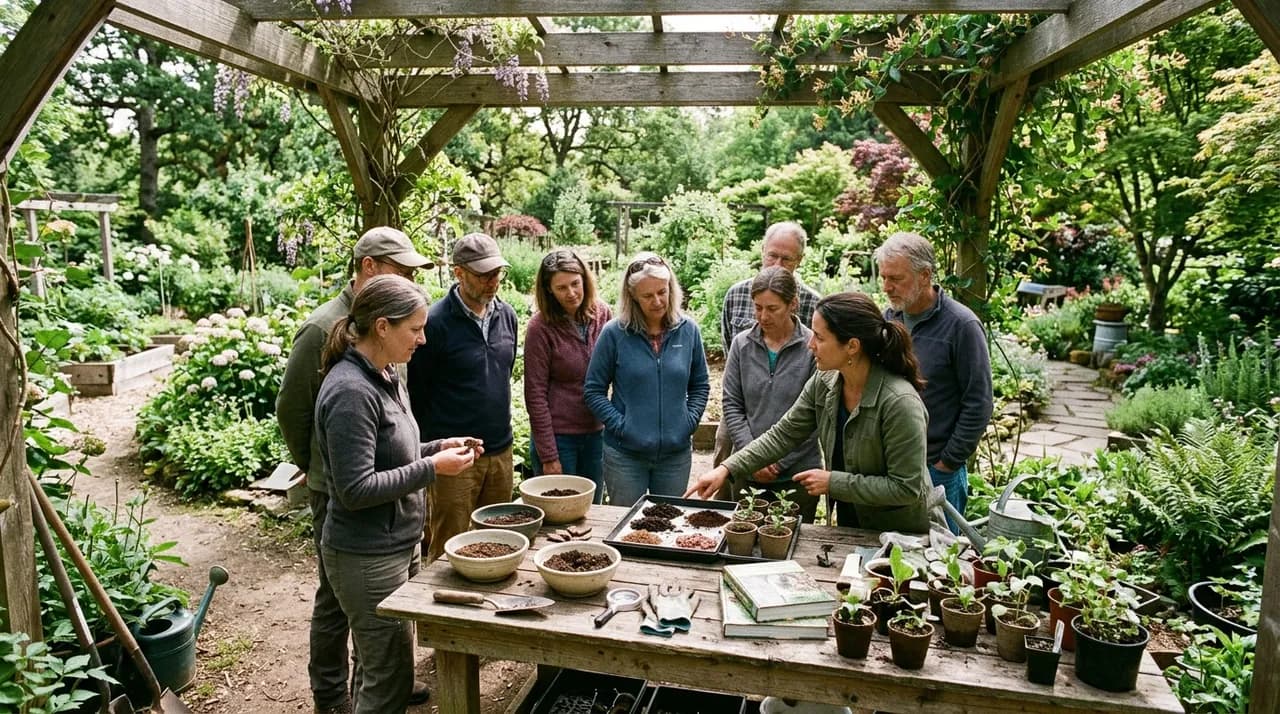
The Permaculture Design Certificate (PDC) is an internationally recognized 72-hour training program that teaches whole-systems ecological design for landscapes, smallholdings, and human settlements. Originating from the teaching framework established by Bill Mollison in the early 1980s, the curriculum trains students to read terrain, model hydrological patterns, rebuild living soils, and assemble integrated biological communities. The credential is a foundational design-thinking qualification rather than a vocational farming license, equipping graduates with the diagnostic methodology needed to evaluate landscapes systematically.
Origins and structure of the 72-hour curriculum
The modern PDC traces its syllabus directly to the foundational curriculum outlined by Bill Mollison in Permaculture: A Designers' Manual. Mollison structured the course around a standard seventy-two instructional hours to ensure that practitioners worldwide shared a common vocabulary, ethical foundation, and set of analytical tools.
Rather than teaching isolated gardening tricks, the standard curriculum progresses systematically through the core disciplines of ecological land planning:
- Design philosophy and ethics: Establishing the ethical foundation of Earth Care, People Care, and Fair Share, followed by the systematic application of permaculture principles to resolve environmental degradation.
- Climate and microclimates: Analyzing major planetary climate zones, regional weather systems, topographic air drainage, frost pockets, and methods for modifying local temperature and humidity through shelterbelts and thermal mass.
- Hydrological engineering: Reading watershed contours, sizing swales, planning keyline patterns, constructing uncompacted earthworks, designing retention ponds, and filtering domestic greywater through biological reed beds.
- Soil biological restoration: Understanding the soil food web, soil texture, compaction remediation, non-inversion aeration, thermal aerobic composting, vermicomposting, and living green manure cycles.
- Perennial plant systems: Designing multi-layered food forests, selecting windbreak species, assembling fruit tree guilds, and managing coppice systems for sustainable on-site timber and firewood production.
- Animal integration: Incorporating poultry, waterfowl, and small ruminants into rotational grazing cycles, using animal behaviors (such as foraging and scratching) to perform cultivation and pest management tasks.
- Appropriate technology and human settlement: Passive solar building orientation, thermal envelope design, composting toilets, biogas generation, and local cooperative economic frameworks.
The capstone design project: applying theory to real topography
The defining requirement of any legitimate PDC course is the comprehensive final design project. Students do not qualify simply by attending lectures or passing multiple-choice quizzes; they must complete and present a thorough site design for an actual piece of land.
Working individually or in small teams, students are assigned a physical site—often a degraded homestead, an educational property, or a functioning farm. The project requires students to synthesize the entire curriculum into practical documentation:
- Base mapping: Generating accurate scaled site maps identifying boundaries, topography, existing buildings, roads, and established tree cover.
- Sector and energy analysis: Overlaying external energies, including summer and winter solar arcs, prevailing storm winds, fire hazard corridors, wildlife travel paths, and surface runoff vectors.
- Zone organization: Arranging productive elements from Zone 1 to Zone 5 to optimize daily labor efficiency and human movement.
- Hydrological and planting layout: Siting earthworks, water storage tanks, overflow spillways, and multi-layered perennial planting guilds tailored to the site's specific soils and microclimates.
- Implementation staging and budget: Structuring a realistic, multi-year installation schedule that prioritizes water capture and soil stabilization before installing expensive perennial nursery stock.
Students present and defend their finished designs before instructors and peers, explaining why specific elements were placed in particular locations. This capstone exercise bridges the gap between theoretical knowledge and practical spatial competence.
Professional scope: what a PDC graduate can and cannot do
Because permaculture education operates outside state-accredited university systems, prospective students often misunderstand the practical and legal scope of the certificate.
What the credential enables:
- It confirms formal completion of the standard international design curriculum recognized within the global permaculture community.
- It qualifies graduates to market themselves as permaculture design consultants, conducting site assessments and creating ecological layout plans for private property owners.
- Historically, under guidelines established by Mollison, certificate holders who complete further practical field mentorship are recognized to teach introductory permaculture workshops and, eventually, co-teach full design courses.
- It provides whole-systems design competence for landscape designers, agricultural extension workers, agroforestry practitioners, and community garden coordinators.
What the credential does not represent:
- It is not a government-issued vocational license or trade qualification. It does not certify an individual as a licensed landscape architect, civil engineer, certified surveyor, or registered agronomist.
- It is not a farming license or agricultural qualification. A 72-hour classroom course cannot teach the physical muscle memory of tractor operation, commercial greenhouse climate control, herd veterinary care, or the financial realities of market garden wholesale distribution.
- It does not carry automated legal authority to sign off on structural building permits or municipal stormwater engineering plans.
In practice, a PDC provides the overarching strategic vision for a property, while licensed contractors, soil scientists, and engineers handle specialized structural execution when required.
A structured course vs. self-directed online learning
In an era when instructional videos, podcasts, and articles are readily accessible, prospective designers often ask whether taking a formal 72-hour course remains necessary.
While self-study through foundational literature, such as the titles highlighted in our review of best permaculture books, is invaluable, self-directed learning frequently leads to disjointed thinking. Internet content tends to highlight photogenic, standalone techniques, such as hugelkultur mounds, herb spirals, or swales, without teaching the underlying diagnostic criteria needed to determine whether that technique belongs on a specific site. A grower might spend weeks digging swales on a flat, sandy yard where they serve no purpose, or build a hugelkultur mound in an arid climate where subterranean logs dry out rather than decompose.
A structured course shifts the learner's focus from collecting techniques to mastering diagnostic methodology. It trains the eye to read contour lines, understand watershed dynamics, and evaluate ecological succession. Furthermore, direct critique from experienced teachers prevents costly installation mistakes, and working alongside peers builds long-term professional networks. Understanding this holistic diagnostic method also clarifies the operational differences between comprehensive design frameworks and production-focused systems, as explored in our guide to permaculture vs agroforestry.
Selecting a format: immersions, weekends, and hybrid models
PDC courses are delivered across several primary formats:
- Intensive residential immersion: Typically conducted over twelve to fourteen consecutive days on an active demonstration farm. Students live, eat, and work on-site, observing living systems continuously and engaging in hands-on earthwork and planting exercises. The immersion model offers rapid learning and deep community bonding, though its concentrated schedule can be mentally demanding.
- Part-time modular or weekend courses: Spread across six to twelve alternate weekends over several seasons. This schedule allows students to maintain regular employment while observing seasonal ecological shifts on the study site between modules.
- Online and hybrid programs: Video lectures combined with self-paced reading, remote assignments, and interactive digital critique sessions. While lacking the physical sensory experience of an in-person field site, high-quality online courses allow students to apply assignments directly to their own home properties under instructor feedback.
Prospective students should evaluate courses based on instructor field experience, the relevance of the teaching site to the student's target climate, and the depth of personalized feedback provided during the capstone design project. Applying the diagnostic discipline taught in a PDC ensures that subsequent investments in permaculture design produce functional, resilient landscapes that thrive over decades.