Key takeaways
- Permaculture is a broad, whole-systems design framework encompassing land stewardship, water management, natural building, and ecological ethics.
- Syntropic farming (syntropic agroforestry) is a specialized, process-based agronomic method developed by Ernst Götsch focused on high-density dynamic succession.
- Permaculture food forests generally aim for an established, low-intervention climax state where human maintenance labor decreases over time.
- Syntropic agriculture relies on continuous, disciplined pruning pulses (chop-and-drop) to keep the ecosystem in an active, vigorous vegetative growth stage.
- Modern ecological land designers frequently integrate both systems, using permaculture for site-wide layout and zones while deploying syntropic rows for intensive crop production.
Quick answer: The main difference between syntropic farming and permaculture is scope and management intensity. Permaculture is a holistic design philosophy that plans whole landscapes, water systems, and low-maintenance food forests. Syntropic farming is a specialized agroforestry technique that uses ultra-dense planting and heavy, continuous pruning pulses to accelerate natural succession and soil creation.
As global interest in regenerative agriculture and ecosystem restoration expands, two methodologies have emerged as leading frameworks for ecological land stewardship: permaculture and syntropic farming. Both systems reject synthetic chemical inputs, prioritize living soil biology, and draw design inspiration from natural forest ecosystems.
However, growers and land designers frequently struggle to distinguish between syntropic farming and permaculture. While practitioners often discuss them interchangeably, they originate from distinct historical contexts, operate at different design scales, and require different management approaches.
Understanding the mechanical, thermodynamic, and operational differences between these two disciplines allows land managers to select the right approach for their climate, acreage, and labor capacity.
+-----------------------------------------------------------------+
|              PHILOSOPHICAL & OPERATIONAL COMPARISON             |
|                                                                 |
|   CRITERIA         PERMACULTURE             SYNTROPIC FARMING   |
|   --------         ------------             -----------------   |
|   Originators      Bill Mollison, D. HolmgrenErnst Götsch       |
|   Geographic Root  Australia (1970s)        Brazil (1980s-90s)  |
|   Core Scope       Whole-systems landscape  Agroforestry crops  |
|   Target State     Low-maintenance climax   Dynamic succession  |
|   Pruning Regimen  Selective / Maintenance  Heavy synchronized  |
|   Planting Density Standard guild spacing   Ultra-dense (20+/m2)|
|   Primary Tool     Broadfork, hand tools    Pruning saw, machete|
+-----------------------------------------------------------------+
What is the core philosophy and scope of permaculture?
Developed in Australia during the 1970s by Bill Mollison and David Holmgren, permaculture (a portmanteau of permanent agriculture and permanent culture) was conceived as a holistic response to industrial soil degradation and resource depletion.
Permaculture is organized around three foundational ethics (Earth Care, People Care, and Fair Share) and twelve universal design principles. Its primary purpose is designing integrated human habitats that mimic the stability, diversity, and resilience of natural ecosystems.
Key characteristics of permaculture design:
- Spatial zone planning: Organizes elements by frequency of human use, ranging from Zone 0 (the home) and Zone 1 (kitchen gardens) out to Zone 5 (unmanaged wild nature).
- Sector and water mapping: Uses contour swales, keyline earthworks, and gravity-fed ponds to capture and store every drop of rainfall across the landscape.
- Multifunctional elements: Every element (such as a poultry run, greenhouse, or windbreak) performs multiple useful functions within the broader homestead. For a detailed breakdown of core principles, explore the 12 permaculture principles.
+-------------------------------------------------------------+
|              PERMACULTURE WHOLE-SYSTEMS SCOPE               |
|                                                             |
|   [ Zone 0: Home & Living Structures                      ] |
|   [ Zone 1: Intensive Kitchen Garden & Nursery            ] |
|   [ Zone 2: Small Orchards, Poultry & Perennial Beds      ] |
|   [ Zone 3: Main-Crop Farmland & Pastures                 ] |
|   [ Zone 4: Semi-Managed Timber & Forage Forestry         ] |
|   [ Zone 5: Wild Unmanaged Wilderness                     ] |
+-------------------------------------------------------------+
What is the foundation and mechanics of syntropic farming?
Syntropic farming (also termed Successional Agroforestry or the Ernst Götsch method) was developed in the humid tropics of Bahia, Brazil, by Swiss geneticist and agronomist Ernst Götsch.
The approach is grounded in thermodynamics. In physics, entropy describes the natural tendency of isolated systems to degrade into disorder and energy dissipation. Götsch observed that living ecosystems do the exact opposite: life accumulates, concentrates, and organizes energy into increasingly complex, biodiverse structures, a process termed syntropy.
Core operational pillars of syntropic agriculture:
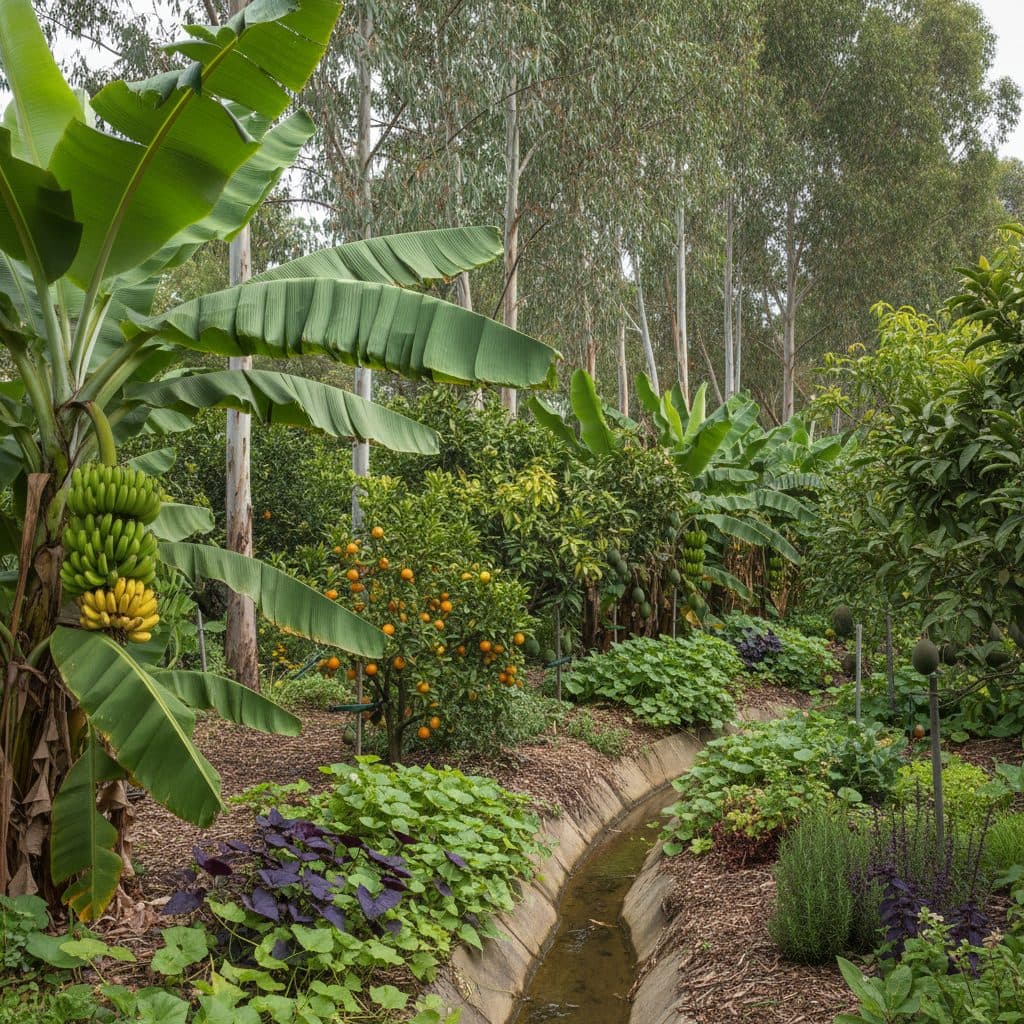
- Dynamic succession: Plants function as transient members of an orderly evolutionary succession rather than static individuals. Fast-growing pioneer species create conditions for secondary species, which in turn prepare the soil for long-lived climax canopy trees.
- Stratification in space and time: Every plant occupies a specific vertical light stratum (Low: 20-40% light, Medium: 60% light, High: 80% light, or Emergent: 100% light) and a specific lifespan window (Placenta, Secondary, or Climax). By stacking species that occupy different light strata, syntropic rows capture a large fraction of available sunlight across multiple canopy heights without destructive competition.
- Ultra-high-density planting: Seeds and seedlings are planted at high densities (often 20 to 40 seeds or cuttings per square metre), allowing root exudates and close spacing to accelerate soil development.
+-----------------------------------------------------------------+
|              SYNTROPIC VERTICAL STRATIFICATION                  |
|                                                                 |
|   EMERGENT LAYER (100% Sun): Eucalyptus, Brazil Nut, Palms      |
|   HIGH LAYER (80% Sun):      Avocado, Mango, Citrus             |
|   MEDIUM LAYER (60% Sun):    Cacao, Coffee, Guava               |
|   LOW LAYER (20-40% Sun):    Ginger, Turmeric, Arrowroot        |
+-----------------------------------------------------------------+
To explore foundational agroforestry concepts in detail, read our complete guide to syntropic farming.
How do pruning intensity and labor management differ?
The most striking practical difference between a permaculture food forest and a syntropic agroforestry system is the frequency and intensity of human intervention.
+-----------------------------------------------------------------+
|              PRUNING & INTERVENTION COMPARISON                  |
|                                                                 |
|   PRACTICE         PERMACULTURE             SYNTROPIC AGROFORESTRY|
|   --------         ------------             ---------------------|
|   Pruning Goal     Shape, health, light     Light, mulch, canopy |
|   Frequency        Seasonal / As needed     Synchronised 2-4x/yr |
|   Biomass Fate     Compost pile / Guild bed Soil blanket in line |
|   Labor Curve      High setup -> Low ongoingSteady seasonal work |
+-----------------------------------------------------------------+
In permaculture homestead designs:
- A mature food forest aims to become a self-maintaining perennial system. Once canopy trees, berry bushes, dynamic accumulators, and ground covers establish, human labor decreases significantly.
- Pruning is selective, focusing on removing dead or diseased branches, shaping fruit trees for ease of harvest, and clearing light paths for understory herbs. For classic guild design, see what is a food forest.
In syntropic agroforestry systems:
- The grower acts as an active catalyst within the ecosystem. The system relies on regular, heavy, synchronised pruning pulses.
- Fast-growing biomass support trees (such as eucalyptus, inga, or mombasa grass) are pruned aggressively back to bare trunks two to four times per year.
- Eucalyptus is flammable and draws heavily on soil water; use it where fire risk is managed and native alternatives do not produce the needed biomass. Mombasa grass (Megathyrsus maximus, syn. Panicum maximum cv. Mombasa) is a declared environmental weed and severe fire risk across northern and eastern Australia and other subtropical regions; never plant it where it can escape into bushland or pasture, and choose local clumping grasses instead.
- This synchronised cut lets light into the lower strata, drops a large pulse of carbon and nutrient-rich mulch directly onto the soil, and temporarily reduces root competition.
- The chopped woody branches and leafy matter are organised in dense, thick layers directly over the planting line, creating a deep carpet of fungal mulch that cools soil and builds topsoil rapidly. To select support species, review syntropic chop-and-drop species by zone.
+-----------------------------------------------------------------+
|              THE SYNTROPIC PRUNING PULSE CYCLE                  |
|                                                                 |
|   High-Biomass Support Trees (Eucalyptus / Grass / Inga)        |
|        |                                                        |
|        v (Synchronised Heavy Pruning Pulse)                     |
|   Massive Carbon & Leaf Mulch Layered on Planting Line          |
|        |                                                        |
|        v (Light Released, Root Competition Reduced)             |
|   Lower-Strata Food Crops Flourish with Soil Blanket            |
+-----------------------------------------------------------------+
How can you integrate both systems on a single property?
Many land managers combine the structural strengths of permaculture with the intensive agronomic productivity of syntropic farming:
- Macro-scale permaculture framework: Use permaculture principles to map the overall property. Design access roads, zone placement, residential buildings, rainwater earthworks, and wildfire protection buffers.
- Micro-scale syntropic production lines: Within productive Zone 2 and Zone 3 agricultural areas, lay out tree rows using syntropic stratification and succession. Intercrop annual vegetables, root crops, soft fruit bushes, and timber trees along organized, heavily mulched contour lines.
- Tight nutrient cycling: Syntropic methods aim to cycle nutrients tightly within the system, drastically reducing the need for brought-in inputs once established — though establishing degraded ground often requires initial mineral amendments, and regular soil tests show whether exports in harvested crop are being replaced.
Combining permaculture site layout with syntropic planting methods helps balance long-term ecological stability with regular food production.