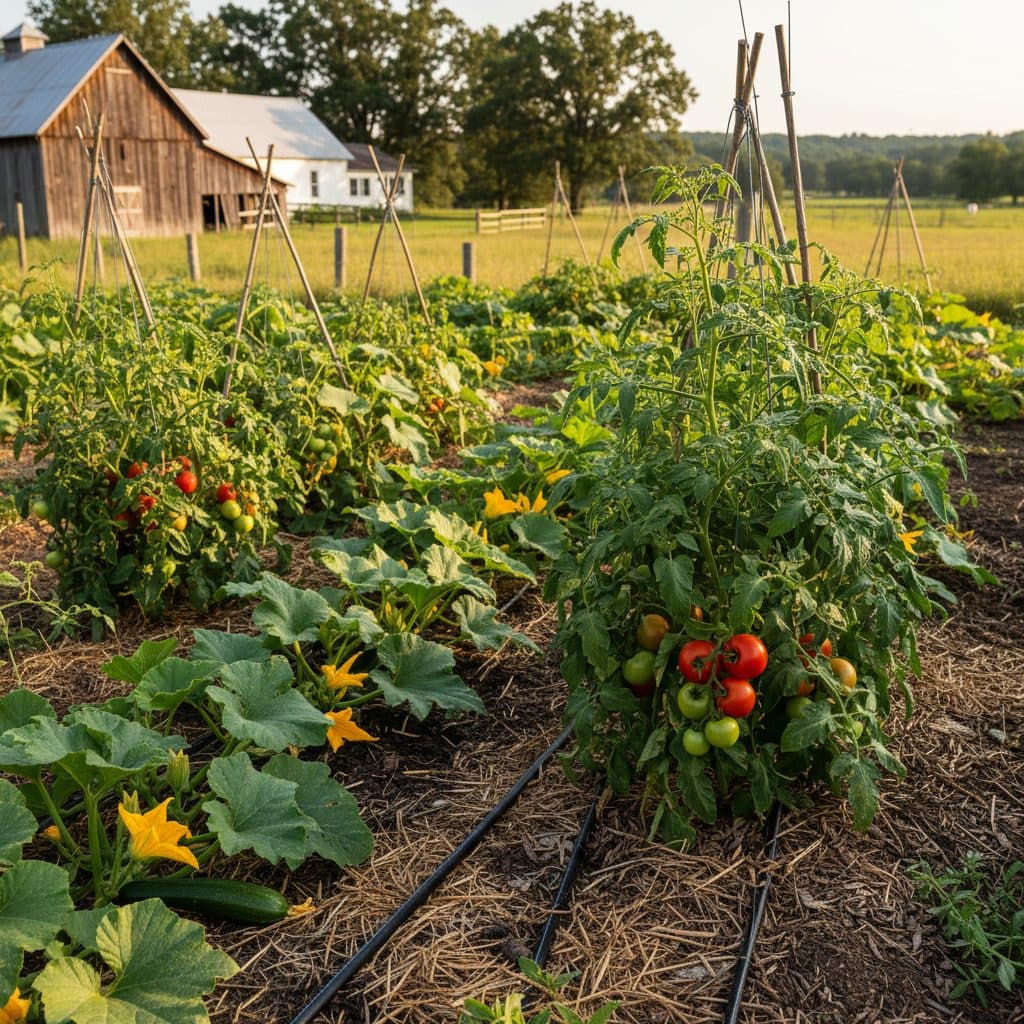
Key takeaways
- Identify your soil type — sandy, loam, or clay — to understand its water retention capacity, with loam offering the best balance for most crops.
- Adjust watering frequency and volume based on your USDA plant hardiness zone, considering average temperatures and precipitation patterns.
- Monitor plant growth stages for tomatoes and cucurbits, increasing water during flowering and fruit-set to support development.
- Use a soil moisture meter to accurately assess soil hydration at a 6 in depth, preventing both overwatering and underwatering.
- Implement mulching and consider cover crops to conserve soil moisture, especially in warmer USDA zones like 8 and 9.
- Recognize signs of watering stress, such as wilting or blossom end rot, to diagnose and correct issues promptly.
Quick answer: To prevent fruit-set issues in tomatoes, adjust watering schedules based on your soil type (sandy, loam, or clay) and USDA zone, increasing water during flowering and fruit-set stages. Use a soil moisture meter to ensure optimal hydration, avoiding both overwatering and underwatering.
In the humid summers of USDA zone 6, managing water for a productive garden often feels like a constant balancing act. From the dry heat of Arizona’s zone 9 to the cooler, more consistent rainfall in Oregon’s zone 8, every region presents unique challenges for growers. Understanding how your local climate interacts with your specific soil type is fundamental to successful watering, especially for thirsty crops like tomatoes and cucurbits during their critical fruit-set stages.
Getting watering right means more than just turning on a spigot; it involves a nuanced approach tailored to your garden’s conditions. This guide will walk you through the specifics of watering schedules, considering the diverse characteristics of clay, sandy, and loam soils, and how these needs shift across different USDA plant hardiness zones. We’ll focus on practical strategies to ensure your plants receive the optimal amount of water, preventing common problems and promoting healthy growth throughout the season.
Know your soil: the foundation of watering
Before you even think about a watering schedule, you need to understand the ground you’re working with. Soil type is the single biggest factor in how much water your garden needs and how often. The USDA Natural Resources Conservation Service (NRCS) classifies soils based on particle size, which directly impacts water infiltration and retention [6]. For instance, a sandy soil in Florida’s zone 9 might drain water away in just a few hours, while a heavy clay soil in Ohio’s zone 6 could hold moisture for several days, sometimes too much.
sandy, loam, and clay soil characteristics
Sandy soils are coarse, with large particles and plenty of air space. Water moves through them quickly, meaning they dry out fast. This can be a benefit in areas with heavy rainfall, but it requires more frequent watering in dry spells. Loam soils are the ideal mix, containing roughly 40% sand, 40% silt, and 20% clay. They offer good drainage while retaining adequate moisture and nutrients. Clay soils, with their tiny, tightly packed particles, hold a lot of water but can become waterlogged easily, reducing oxygen availability to roots. In a garden bed, you can often feel the difference: sandy soil feels gritty, loam feels smooth and crumbly, and clay feels sticky when wet. Knowing your soil’s texture is the first step to a successful watering plan, potentially saving 30% or more on water usage. Consider adding plants for clay soil if you’re dealing with heavy ground.
- Sandy soil: Drains rapidly, requires frequent watering, low nutrient retention.
- Loam soil: Balanced drainage and water retention, ideal for most crops, good nutrient capacity.
- Clay soil: Holds significant water, slow drainage, can lead to waterlogging, high nutrient retention.
- Silt soil: Medium particle size, good water retention, can compact easily.
Watering by plant growth stage: tomatoes and cucurbits
The water needs of plants, especially vegetables like tomatoes and cucurbits, aren’t static; they change significantly throughout their life cycle. A young tomato seedling in USDA zone 5 might need only a few ounces of water every other day, while a mature plant laden with fruit in the same zone could demand several gallons daily. Ignoring these shifts can lead to problems like blossom end rot in tomatoes or poor fruit set in cucumbers. During early vegetative growth, consistent, moderate watering encourages strong root development, which supports nutrient uptake later on.
critical water periods for fruit-set
The most critical periods for waterAim for about 1 to 1.5 inches of water per week for most fruiting vegetables during peak production, which translates to roughly 0.6 to 0.9 gallons per square foot.soil moisture meter can help you gauge actual soil hydration at a 6 in depth.
- Seedling stage: Consistent, light watering for root establishment.
- Vegetative growth: Moderate, deep watering to encourage strong foliage.
- Flowering: Increased water demand to support flower development.
- Fruit-set: Peak water requirement for fruit expansion and quality.
- Ripening: Slightly reduced watering to concentrate sugars, but still consistent.
Adapting to usda zones and regional climates
The USDA Plant Hardiness Zone Map, last updated in 2023, provides a baseline for what plants can survive winter temperatures in a given area [5]. However, it also offers clues about watering needs. For example, a gardener in USDA zone 4 in Minnesota will experience vastly different summer temperatures and precipitation patterns compared to someone in zone 9 in Southern California. Snowmelt, for instance, contributes significantly to soil moisture in northern zones, sometimes accounting for 30% of annual water input [3]. This means less supplemental irrigation might be needed early in the season.
zone-specific watering considerations
In warmer zones, like USDA zone 8 and 9, higher average temperatures and increased evaporation mean plants will require more frequent and substantial watering. A tomato plant in zone 9 might need watering every day or two during a heatwave, while the same plant in zone 5 might only need water every three to four days. Humidity also plays a role; high humidity in the southeastern US (e.g., zone 8b) can reduce transpiration rates, slightly lowering water demand compared to arid regions like Arizona (zone 9b) with similar temperatures. Consider using living mulches or cover crops to help retain soil moisture and regulate soil temperature, which can reduce water evaporation by up to 25%.
- Zone 4-6 (Cooler climates): Benefit from snowmelt, moderate summer watering, watch for overwatering in clay.
- Zone 7-8 (Transitional climates): Balanced approach, increased watering during dry spells, good for many fruit trees.
- Zone 9-10 (Warmer climates): High evaporation, frequent and deep watering essential, consider drip irrigation.
- Arid regions (e.g., parts of zone 8-10): Focus on deep, infrequent watering to encourage deep roots, minimize surface evaporation.
Developing effective watering schedules
Putting all this information together means creating a watering schedule that’s flexible and responsive. For sandy soils in a hot USDA zone 9, you might need to water every day or every other day, delivering smaller amounts, perhaps 0.5 gallons per plant. In contrast, a clay soil in a cooler zone 5 might only need deep watering once or twice a week, supplying 1.5 to 2 gallons per plant. The goal is to moisten the root zone thoroughly, typically 6 to 12 inches deep for most vegetables, without leaving the soil waterlogged. Deep watering encourages roots to grow deeper, making plants more resilient to dry spells.
tools and techniques for precise watering
Using tools like a soil moisture meter is invaluable for precise watering; it takes the guesswork out of the equation. Insert the probe 6 inches into the soil near your plants and water when the reading indicates dry or moist, rather than wet. Drip irrigation systems are highly efficient, delivering water directly to the root zone with minimal waste, potentially saving 50% of water compared to overhead sprinklers. Mulching with 2 to 4 inches of organic material like straw or wood chips also significantly reduces evaporation from the soil surface, especially in zones with high sun exposure. For example, a 3-inch layer of mulch can reduce soil water evaporation by up to 70% in hot climates.
- Deep watering: Encourages deep root systems, making plants more drought-tolerant.
- Morning watering: Reduces evaporation and allows foliage to dry, minimizing fungal issues.
- Drip irrigation: Efficiently delivers water directly to roots, reducing waste by 30-60%.
- Mulching: Conserves soil moisture and regulates soil temperature, saving up to 70% of evaporated water.
- Soil moisture meters: Provide accurate readings to prevent over or under-watering at a 6-inch depth.
Diagnosing and solving watering problems
Even with the best intentions, watering problems can arise. Recognizing the symptoms of overwatering and underwatering helps with timely intervention. For instance, a tomato plant showing yellowing leaves with green veins and stunted growth might be suffering from overwatering, especially in a heavy clay soil that retains too much moisture. On the other hand, wilting leaves, especially in the afternoon heat, followed by browning leaf edges, often signals underwatering. These issues can significantly impact fruit development, reducing yields by 20% or more.
common plant problems related to water
Blossom end rot in tomatoes and peppers, characterized by a dark, sunken spot on the bottom of the fruit, is a classic sign of inconsistent watering, not necessarily a calcium deficiency in the soil itself. It means the plant can’t transport calcium effectively to the developing fruit due to fluctuating moisture levels. For cucurbits, yellowing or dropping flowers can indicate either too little or too much water during the flowering stage. To correct these, adjust your watering schedule, ensuring consistent moisture at a depth of 6 to 8 inches. Adding a 2-inch layer of compost can also improve soil structure and water retention, especially in sandy soils, boosting water holding capacity by up to 15%.
- Wilting: Often a sign of underwatering, but can also occur with severe overwatering.
- Yellowing leaves: Can indicate overwatering (root rot) or nutrient deficiency exacerbated by poor water uptake.
- Blossom end rot: Inconsistent watering, preventing calcium uptake during fruit development.
- Cracked fruit: Rapid water uptake after a dry spell, common in tomatoes.
- Stunted growth: Both too little and too much water can inhibit plant development, reducing plant height by 10-30%.
Watering Guidelines by Soil Type and USDA Zone (for Mature Tomatoes)
Soil Type | USDA Zone 5-6 (Cooler) | USDA Zone 7-8 (Moderate) | USDA Zone 9-10 (Warmer) |
|---|---|---|---|
Sandy Soil | Every 2-3 days (0.75-1 gal/plant) | Every 1-2 days (1-1.25 gal/plant) | Daily (1.25-1.5 gal/plant) |
Loam Soil | Every 3-4 days (1-1.25 gal/plant) | Every 2-3 days (1.25-1.5 gal/plant) | Every 1-2 days (1.5-2 gal/plant) |
Clay Soil | Every 4-5 days (1.25-1.5 gal/plant) | Every 3-4 days (1.5-2 gal/plant) | Every 2-3 days (2-2.5 gal/plant) |
Water Savings: Drip irrigation can reduce water usage by 30% to 60% compared to overhead watering methods.
Mulch Benefits: A 3-inch layer of organic mulch can decrease soil evaporation by up to 70% in warm climates.
Root Depth: Most vegetable roots benefit from consistent moisture down to a depth of 6 to 12 inches.
Frequently asked questions
How often should I water my tomatoes in sandy soil in USDA zone 8?
In sandy soil within USDA zone 8, mature tomato plants typically need watering every one to two days. Aim to provide about 1.25 to 1.5 gallons of water per plant during peak fruit production to ensure consistent moisture.
What are the signs of overwatering in cucurbits?
Overwatering cucurbits often manifests as yellowing lower leaves, stunted growth, and sometimes wilting even when the soil is wet. The soil will likely feel soggy at a 6-inch depth, and root rot can occur, reducing yields by 20% or more.
Does mulching really reduce watering needs?
Yes, mulching significantly reduces watering needs. A 2 to 4-inch layer of organic mulch can reduce soil moisture evaporation by up to 70%, keeping the soil cooler and more consistently moist, especially in hot USDA zones like 9.
When is the best time of day to water plants?
The best time to water plants is in the early morning, between 6 AM and 9 AM. This allows the water to soak in before the sun gets too intense, minimizing evaporation and giving foliage time to dry, which can reduce fungal disease risk by 15%.
How deep should I water my vegetable garden?
You should aim to water deeply enough to moisten the root zone, which is typically 6 to 12 inches for most common vegetables like tomatoes and cucurbits. This encourages deeper root growth, making plants more resilient to dry periods.
References
- Design and Construction of A Multi-Zone IoT-Based Automatic Watering System For A School Greenhouse (2026). Design and Construction of A Multi-Zone IoT-Based Automatic Watering System For A School Greenhouse.
- Nanobubble Watering Affects Nutrient Release and Soil Characteristics (2023). Nanobubble Watering Affects Nutrient Release and Soil Characteristics.
- Review: Partitioning snowmelt and rainfall in the critical zone: effects of climate type and soil poperties. (2019). Review: Partitioning snowmelt and rainfall in the critical zone: effects of climate type and soil poperties..
- Assessment of Soil and Plant Nutrient Status, Spectral Reflectance, and Growth Performance of Various Dragon Fruit (Pitaya) Species Cultivated Under High Tunnel (2025). Assessment of Soil and Plant Nutrient Status, Spectral Reflectance, and Growth Performance of Various Dragon Fruit (Pitaya) Species Cultivated Under High Tunnel.
- USDA plant hardiness zone map (1990). USDA plant hardiness zone map.
- USDA Natural Resources Conservation Service (2024). USDA Natural Resources Conservation Service.