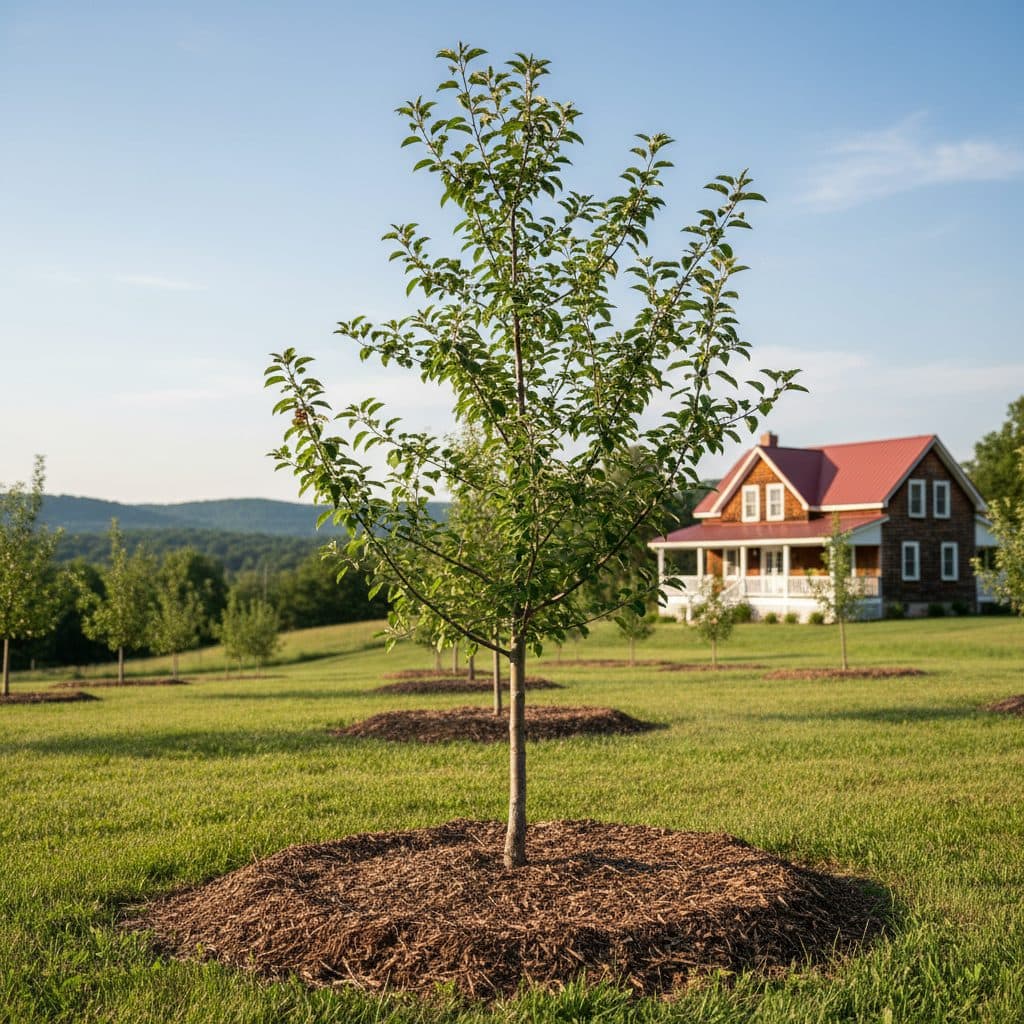
Key takeaways
- Most new fruit trees, especially those with a caliper of 1 inch or more, do not require staking in regions with moderate wind.
- Staking is beneficial in high-wind areas (consistently above 15 mph), on slopes, or for trees with a small root ball relative to their canopy.
- Improper staking can lead to weaker trunks, girdling, and poor root development, potentially reducing tree longevity by 10-15 years.
- When staking, use flexible ties, position stakes 18-24 inches from the trunk, and remove them within one year to prevent damage.
- Prioritize proper planting, root establishment, and early structural pruning to encourage strong, self-supporting trees.
- Regular inspection of stakes and ties prevents trunk damage and helps the tree develop properly.
Quick answer: Staking new fruit trees is beneficial in high-wind areas, on slopes, or for trees with a small root ball, but often unnecessary and can be harmful if done improperly, weakening the tree. Prioritize proper planting and early structural pruning for strong, self-supporting trees.
In many parts of the United States, from the fertile valleys of California to the humid orchards of Georgia, home growers often face a fundamental question when planting a new fruit tree: Should I stake it? For decades, the conventional wisdom dictated that every young tree needed a sturdy stake for support. However, modern arboricultural research, particularly from institutions like the University of California Cooperative Extension, suggests a more nuanced approach, indicating that universal staking can actually hinder a tree’s natural development.
Staking benefits young fruit trees mainly in areas prone to high winds averaging over 15 miles per hour or in shallow soils; in other conditions, it can cause more harm than good. Using proper staking materials, flexible ties, and limited duration helps newly planted fruit trees establish strong trunks and root systems in a USDA Zone 6 orchard.
The evolving view on staking new fruit trees
For many years, it was standard practice to stake nearly every newly planted fruit tree, regardless of its size or location. This approach aimed to provide stability, especially for bare-root trees or those with smaller root systems. However, research over the last three decades, particularly from universities in states like Oregon and Washington, has shifted this perspective significantly. We now understand that a certain amount of trunk movement is essential for a tree to develop a strong, tapered trunk and robust root system. Trees that are rigidly staked often grow taller and thinner, with less trunk caliper development at the base, making them more susceptible to wind damage once stakes are removed.
Why early trunk movement matters for tree health
When a young tree’s trunk moves gently in the wind, it stimulates the production of reaction wood, which is denser and stronger, particularly at the base. This process, known as thigmomorphogenesis, is essential for developing a sturdy tree capable of supporting a heavy fruit load in later years. For instance, an unstaked apple tree in a moderate wind zone, like USDA Zone 5 in Michigan, can develop a trunk diameter up to 25% larger at its base compared to a rigidly staked counterpart within two years. Without this natural swaying, the tree may become overly reliant on external support, leading to a weaker structure that could snap in a 30-mile-per-hour gust once the stakes are gone.
- Trunk taper: Encourages a wider base for stability.
- Root development: Stimulates stronger anchoring roots.
- Wind resistance: Builds natural resilience to environmental forces.
- Structural integrity: Promotes denser wood formation.
- Long-term health: Reduces reliance on artificial support.
When staking provides necessary support
While the goal is often to let trees grow naturally, there are specific situations where staking a new fruit tree is not just helpful, but essential for its survival and proper establishment. One primary factor is environmental conditions, particularly strong winds. In coastal regions of California or the open plains of Kansas, where sustained winds can exceed 20 miles per hour, a young tree’s root system may not be able to anchor it sufficiently. Trees planted on slopes with a grade greater than 15% also benefit from staking, as soil erosion and shifting can compromise root stability. Also, trees with a disproportionately large canopy compared to their root ball, common in some container-grown specimens, often require temporary support to prevent them from toppling over in even moderate breezes of 10-12 mph.
Specific scenarios for necessary staking
Consider a young peach tree (Prunus persica) planted in sandy soil in USDA Zone 7, where high winds are common. Without staking, the constant movement could prevent the delicate new roots from establishing firm contact with the soil, leading to desiccation and eventual failure. Similarly, a newly grafted apple tree, especially one with a weak graft union, might need support to protect the vulnerable joint from stress. Trees planted in high-traffic areas, like a community orchard in a suburban park, can also benefit from a stake that acts as a visual deterrent, preventing accidental damage from foot traffic or equipment. In these cases, a single, flexible stake can increase the tree’s survival rate by as much as 30% during its first year.
- High wind exposure: Areas with consistent winds over 15 mph.
- Sloping terrain: Plantings on grades exceeding 15%.
- Large canopy, small root ball: Container trees with unbalanced growth.
- Weak graft unions: Newly grafted trees needing protection.
- Vandalism/traffic risk: Public or high-traffic planting sites.
The risks of improper staking
While staking can be beneficial, incorrect techniques can cause significant, long-term damage to a young fruit tree, potentially shortening its lifespan by 10-15 years. One of the most common issues is girdling, where the staking material rubs against or constricts the trunk. This can damage the cambium layer, which is vital for transporting water and nutrients, effectively choking the tree. A study in California found that over 40% of staked trees in urban environments showed signs of girdling after two years due to neglected ties. Furthermore, stakes left in place for too long prevent the tree from developing its natural strength and trunk taper, leading to a weak point just above the soil line where the trunk was protected from movement. This can result in a tree that snaps during its first major storm after the stakes are removed, even if winds are only 35 miles per hour.
Common staking mistakes and their consequences
Another frequent error is staking too rigidly, often with a single, inflexible stake tied tightly to the trunk. This prevents the trunk from swaying, which stimulates the development of strong wood and an extensive root system. Trees that are rigidly supported often have a smaller root mass, sometimes up to 20% less, because they haven’t had to expend energy anchoring themselves against movement. The constant rubbing from poorly chosen materials, such as wire or thin rope, can also create open wounds, making the tree susceptible to pests and diseases. For example, a young cherry tree (Prunus avium) in USDA Zone 5 with an open wound from a rubbing stake is much more likely to contract bacterial canker, potentially killing it within three to five years.
- Girdling: Damage to cambium layer from tight ties.
- Trunk weakness: Lack of natural taper and strength development.
- Reduced root growth: Less need for anchoring, leading to smaller root systems.
- Wound creation: Rubbing ties can open pathways for disease.
- Over-reliance: Tree fails to develop self-supporting capabilities.
Choosing the right staking materials
When staking is deemed necessary, selecting the appropriate materials is just as critical as the technique itself. The goal is to provide flexible support that allows trunk movement instead of rigid immobilization. For stakes, sturdy wooden posts, bamboo poles, or metal rebar are common choices, typically 1 to 2 inches in diameter and tall enough to support the lower two-thirds of the tree’s trunk. Avoid stakes that are taller than the lowest branches, as this can interfere with crown development. The most important component is the tie material. It must be broad, flexible, and non-abrasive to prevent girdling. Materials like wide canvas strapping, old nylon stockings, or specialized tree ties (often 1-2 inches wide) are ideal. Never use thin wire, string, or plastic ties, which can cut into the bark within weeks.
Optimal tie placement and flexibility
The tie should be loose enough to allow the tree to sway 1 to 2 inches in any direction, but tight enough to prevent it from rubbing against the stake. A figure-eight pattern, where the tie crosses between the stake and the trunk, provides cushioning and prevents rubbing. For a single stake, position it on the side of the prevailing wind. For two stakes, place them perpendicular to the prevailing wind. If using three stakes, space them evenly around the tree. The stakes should be driven 18-24 inches into the ground, 12-18 inches away from the trunk, to avoid damaging the root ball. Inspect ties monthly, especially during periods of rapid growth, and adjust or loosen them as the trunk expands; a 1-inch diameter trunk can grow to 1.5 inches in six months.
- Sturdy stakes: Wooden posts, bamboo, or metal rebar, 1-2 inches thick.
- Flexible ties: Wide canvas, nylon stockings, or specialized tree ties (1-2 inches wide).
- Loose fit: Allow 1-2 inches of sway for trunk movement.
- Figure-eight pattern: Protects trunk from rubbing against the stake.
- Proper placement: Stakes 12-18 inches from trunk, 18-24 inches deep.
Best practices for effective staking
When you’ve determined that staking is indeed necessary for your new fruit tree, adhering to best practices ensures that the support is temporary and beneficial, not detrimental. The primary rule is to provide just enough support to keep the tree upright, allowing the top third of the trunk and all branches to move freely. This encourages the development of natural strength. For a young apple tree (Malus domestica) planted in a windy area of USDA Zone 4, a two-stake system with flexible ties is often ideal. The stakes should be placed on opposite sides of the tree, roughly 18 inches from the trunk, driven deep enough to be stable, usually 24 inches into the soil. The ties should be positioned at a height that supports the tree without restricting its natural sway, typically around two-thirds of the way up the main trunk, allowing 1 to 2 inches of movement.
Duration and removal of stakes
Perhaps the most critical best practice is the timely removal of stakes. Stakes should only remain in place for the minimum time required for the tree to establish a strong root system and trunk, typically 6 to 12 months, and rarely exceeding one year. After this period, the tree should be capable of standing on its own. Leaving stakes longer than necessary can lead to the very weaknesses you are trying to prevent. For example, a young pear tree (Pyrus communis) in USDA Zone 7 that remains staked for two years may develop a trunk that is 15% weaker at the base compared to one staked for only six months. Regularly check the ties every 30 days to ensure they are not girdling the trunk and adjust them as the tree grows. Once removed, monitor the tree closely for several weeks to ensure it can withstand local wind conditions, which might average 10-15 mph.
- Minimal support: Allow top third of trunk and branches to move.
- Two-stake system: Often best for stability and balanced growth.
- Proper height: Ties at two-thirds height, allowing 1-2 inches of sway.
- Timely removal: Remove stakes within 6-12 months, never exceeding one year.
- Regular checks: Inspect ties monthly for girdling and adjust as needed.
Promoting trunk taper and root development
These best practices lessons apply to the steps below, too.
The ultimate goal for any new fruit tree is to become a strong, self-supporting specimen capable of withstanding environmental stresses and producing abundant fruit. This strength largely comes from a well-developed trunk taper (a gradual increase in trunk diameter from top to bottom) and an extensive, deep root system. Unstaked trees, or those staked with appropriate flexibility, naturally develop these characteristics. The constant, gentle movement of the trunk in breezes, even as light as 5 miles per hour, stimulates the tree to produce more wood at its base, creating a wider, stronger foundation. This process helps trees like the Corky Coral Tree (Erythrina suberosa), which develops a naturally thick trunk in its native range.
Beyond staking: long-term care and structural pruning
Beyond the initial decision to stake, long-term care helps establish a healthy tree. Proper planting techniques, including digging a wide, shallow hole and ensuring the root flare is at or slightly above ground level, are foundational. For instance, in clay soils common in parts of Ohio to ensure good drainage around the root ball can prevent root rot and promote deeper growth. Regular, appropriate pruning, as detailed in How to prune fruit trees: by season, by species, and by tree age, helps establish a strong central leader and well-spaced scaffold branches, reducing the likelihood of structural failure. In USDA Zone 6, for a young plum tree (Prunus domestica), removing narrow-angled branches in the first two years can prevent future splitting, which is a far greater risk than not staking. Watering deeply and infrequently encourages roots to grow downward seeking moisture instead of staying shallow.
- Root flare exposure: Necessary for proper trunk development.
- Wide planting hole: Encourages horizontal root growth.
- Structural pruning: Builds strong branch architecture.
- Deep watering: Promotes deep, anchoring root systems.
- Soil health: Improves drainage and nutrient availability.
Alternatives to staking and long-term care
For many fruit trees, especially those planted in protected areas or with inherently strong growth habits, alternatives to staking can promote even better long-term health and stability. The most effective alternative is simply planting the right tree in the right place, considering its mature size and wind exposure. For instance, selecting a dwarf or semi-dwarf rootstock for an apple tree in a relatively calm backyard in USDA Zone 5 can reduce the need for staking significantly, as these trees are inherently more compact. Another strategy is proper planting depth and technique, keeping the root collar visible and unburied to prevent girdling roots or trunk rot. A 2-3 inch layer of organic mulch, kept 6 inches away from the trunk, can also help stabilize soil temperature and moisture, promoting healthy root growth.
The role of early pruning and site preparation
Early structural pruning shapes a young tree for strength without external support. Selecting a strong central leader and well-spaced scaffold branches in the first 1-2 years builds a framework that withstands wind and heavy fruit loads. Consider a young pear tree (Pyrus communis) in USDA Zone 6; removing weak, narrow-angled branches early on prevents them from becoming liabilities later. Site preparation is also important; improving heavy clay soils with organic matter, or providing good drainage in wet areas, creates a good environment for root establishment. For areas prone to strong winds, planting a windbreak using hardy species like the Gum Arabic Tree (Acacia senegal) or even a fence can reduce wind speed by 30-50% around your fruit trees, negating the need for individual staking.
- Right tree, right place: Match tree size and wind tolerance to site.
- Correct planting depth: Ensure root collar is at or above soil line.
- Mulching: Stabilizes soil, conserves moisture, and suppresses weeds.
- Structural pruning: Develops strong branch architecture early.
- Windbreaks: Reduce wind velocity by 30-50% in exposed areas.
Staked vs. Unstaked Fruit Trees: A Comparison
Feature | Staked Tree (Improperly or Too Long) | Unstaked Tree (or Properly Staked for Short Term) |
|---|---|---|
Trunk Strength | Weaker, thinner trunk; reduced taper (up to 25% less caliper at base). | Stronger, thicker trunk; pronounced taper due to natural movement. |
Root Development | Shallower, less extensive root system (up to 20% less root mass). | Deeper, more extensive root system for better anchoring. |
Wind Resistance | Higher risk of snapping after stake removal in winds over 30 mph. | Greater natural resilience to winds up to 40 mph. |
Girdling/Wounding | High risk of bark damage, girdling, and entry points for disease. | Minimal risk of mechanical damage to the trunk. |
Maintenance | Requires regular checking, loosening, and timely removal of ties (monthly). | Less ongoing maintenance once established; focus on pruning. |
Establishment Time | Can prolong dependency, potentially delaying true establishment by 6 months. | Faster self-reliance and natural establishment within 6-12 months. |
Trunk Caliper: Unstaked trees can develop a trunk diameter up to 25% larger at the base within two years compared to rigidly staked trees, improving stability.
Staking Duration: Stakes should be removed within 6 to 12 months; leaving them longer than one year can weaken a tree’s natural structure by 15%.
Frequently asked questions
How long should a new fruit tree be staked?
A new fruit tree should generally be staked for 6 to 12 months, which is typically enough time for its root system to establish firmly. Remove stakes within one year to prevent weakening the trunk or causing girdling damage.
What are the signs that a tree needs staking?
A tree needs staking if it consistently leans more than 15 degrees, struggles to stand upright in winds exceeding 15 miles per hour, or has a disproportionately large canopy compared to its root ball. Trees planted on steep slopes or in very sandy soils also often benefit from temporary support.
Can staking harm a fruit tree?
Yes, improper staking can significantly harm a fruit tree by causing girdling, where ties cut into the bark and restrict nutrient flow, potentially reducing its lifespan by 10-15 years. It can also lead to a weaker trunk that is unable to support itself once the stakes are removed.
What is the best material for staking ties?
The best materials for staking ties are wide, flexible, and non-abrasive, such as canvas strapping, old nylon stockings, or specialized rubber tree ties that are at least 1 inch wide. These materials prevent damage to the bark and allow for essential trunk movement.
How far from the trunk should stakes be placed?
Stakes should be placed 12 to 18 inches away from the tree trunk to avoid damaging the root ball and to allow sufficient space for trunk growth. This distance also allows the tree room to sway, which encourages a strong, tapered trunk.
What is thigmomorphogenesis in tree development?
Thigmomorphogenesis is the process where a tree’s trunk responds to mechanical stress, such as swaying in the wind, by producing denser, stronger wood, particularly at its base. This adaptation helps develop a sturdy, self-supporting tree capable of withstanding wind and can increase trunk caliper by 25%.
References
- Policing Proof-of-Stake Networks (2022). Policing Proof-of-Stake Networks.
- Staking Pools with Arbitrary Stake Distribution (2023). Staking Pools with Arbitrary Stake Distribution.
- Staking and proof of stake (2026). Staking and proof of stake.
- Equilibrium Staking Levels in a Proof-of-Stake Blockchain (2021). Equilibrium Staking Levels in a Proof-of-Stake Blockchain.
- 3 Staking a Claim: Broadening the Public Interest (1997). 3 Staking a Claim: Broadening the Public Interest.