Key takeaways
- Dormant pruning, performed in late winter or early spring, primarily encourages vigorous vegetative growth and establishes tree structure.
- Summer pruning, conducted from late spring through mid-summer, reduces tree size, improves light penetration, and can improve fruit quality.
- For young trees, dormant pruning is essential for developing a strong framework, while summer pruning can help control precocious growth.
- Peach trees in studies have shown increased fruit size and soluble solids with summer pruning, especially when combined with dormant cuts [1].
- Apple trees pruned in summer can experience a significant reduction in terminal shoot growth, sometimes by 30% or more, aiding in size management [2].
- Combining both pruning methods offers a balanced approach, allowing for structural development and subsequent growth regulation throughout the year.
Quick answer: Strategic pruning, combining dormant and summer techniques, can significantly boost fruit yields, improve fruit quality, and effectively manage tree size for home growers in USDA Zone 6.
For home growers across the United States, from the fertile valleys of California to the humid orchards of the Southeast, understanding when and how to prune fruit trees is fundamental to a productive harvest. In USDA zone 6, where apples, peaches, and cherries thrive, strategic pruning can significantly influence tree health, fruit quality, and overall yield. While many growers focus solely on the traditional dormant season, there are compelling reasons to incorporate summer pruning into your annual orchard care routine. A well-pruned tree is not just aesthetically pleasing; it’s a more efficient producer, capable of yielding larger, healthier fruit.
The choice between summer and dormant pruning isn’t an either/or proposition for most species. Instead, it’s about understanding the distinct physiological responses each timing elicits and applying them to achieve specific goals for your trees. Research has shown that the timing of a cut can dictate whether a tree responds with a flush of new growth or a redirection of energy into fruit development. For instance, studies on apple trees in New York demonstrated that pruning in late June could reduce tree height by 20% over four years compared to dormant pruning alone [4]. This article will break down what each pruning method does, when to apply it, and how to integrate both for a thriving home orchard.
Dormant pruning: establishing structure and vigor
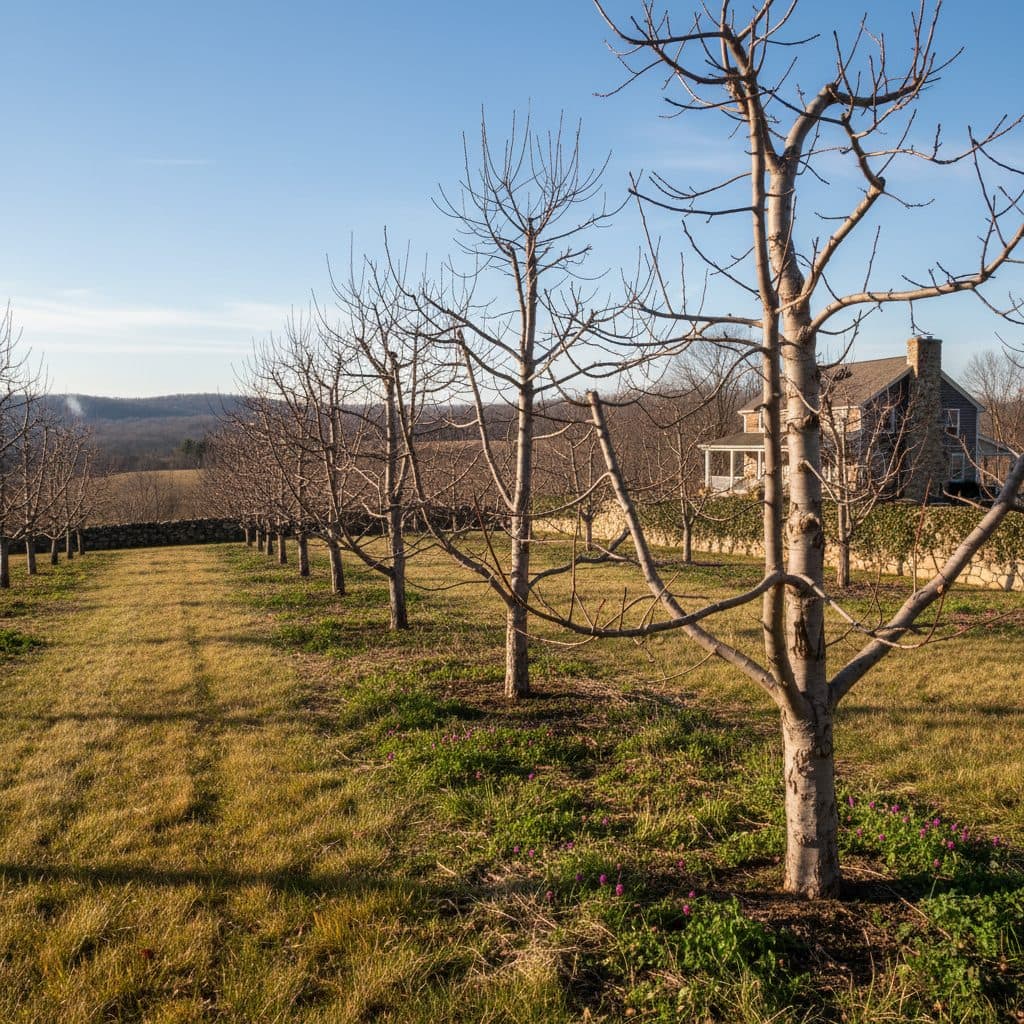
Dormant pruning is the traditional approach, typically performed in late winter or early spring, after the coldest temperatures have passed but before bud break. For growers in USDA zone 5, this often means February or March. The primary goal of dormant pruning is to remove dead, diseased, or damaged wood, improve air circulation, and establish a strong structural framework for the tree. When a tree is dormant, its energy reserves are stored in its roots and woody tissues. Making cuts at this time stimulates a vigorous growth response in the spring, as the tree attempts to replace lost branches. This is particularly beneficial for young trees that need to develop a sturdy scaffold system capable of supporting future fruit loads.
The benefits of winter cuts
This type of pruning encourages the tree to produce new shoots and leaves, which are essential for photosynthesis and overall tree health. For example, a study on peach trees in Georgia found that dormant pruning increased vegetative growth by 30% compared to unpruned trees [1]. This surge in growth helps fill out the canopy and creates a robust foundation. However, excessive dormant pruning can lead to an overabundance of vegetative growth at the expense of fruit production, especially in mature trees. It’s a balancing act, aiming for a canopy that allows good light penetration without being too sparse. For detailed guidance on specific cuts, refer to How to prune fruit trees: by season, by species, and by tree age.
- Removes winter damage: Identify and cut out branches broken by ice or heavy snow, common in regions like Michigan.
- Promotes strong scaffolds: Develops a strong framework for heavy fruit loads, especially in the first three years.
- Encourages vigorous growth: Stimulates new shoot development, helping to fill out the canopy.
- Improves air circulation: Reduces disease risk by opening up the tree’s interior, important in humid climates.
Summer pruning: managing size and improving fruit quality
Summer pruning, often performed from late spring through mid-summer (typically June to August in USDA zone 7), serves very different purposes than dormant pruning. Instead of stimulating growth, summer pruning aims to reduce overall tree size, control vigor, and direct the tree’s energy into fruit development instead of vegetative shoots. This method is particularly useful for managing mature trees that have become too large, making harvesting and pest management difficult. By removing foliage during the growing season, you reduce the tree’s photosynthetic capacity, which naturally slows its growth. This can be especially beneficial for high-density planting systems or for keeping backyard trees to a manageable height of 8-10 feet.
Targeted cuts for better fruit
The timing of summer pruning is critical; cuts made too early in spring can stimulate new growth, while cuts made too late in the season might not allow wounds to heal before winter. Studies on ‘Delicious’ apples in New York found that summer pruning in July significantly reduced terminal shoot growth by 30% compared to dormant pruning [5]. This reduction in vegetative growth often translates to improved light penetration into the canopy, which is essential for fruit color development and sugar accumulation. Peach trees, for instance, have shown increased fruit size and soluble solids (sugars) when subjected to summer pruning [3]. This method helps ensure that the tree’s resources are channeled directly into the developing fruit, rather than into excessive leaf and branch production. A soil moisture meter can help ensure trees are not stressed before pruning.
- Controls tree size: Reduces overall canopy volume, making trees easier to manage and harvest at heights of 8-10 feet.
- Improves light penetration: Allows more sunlight to reach inner branches and developing fruit, improving fruit color and sugar content by up to 15%.
- Reduces vegetative vigor: Slows down excessive growth, redirecting energy to fruit production.
- Improves fruit quality: Leads to larger, sweeter fruit with better color, particularly for peaches and apples.
Combining both methods for optimal orchard health
For most home growers, the most effective strategy involves integrating both dormant and summer pruning into an annual cycle. This dual approach allows you to harness the specific advantages of each method, leading to healthier trees, manageable sizes, and consistently high-quality fruit. In regions like the Pacific Northwest, where fungal diseases can be prevalent, maintaining an open canopy through both pruning seasons helps reduce humidity and improve air circulation, which can decrease disease incidence by 25% or more. Dormant pruning lays the foundational structure, removing significant wood and preparing the tree for vigorous spring growth. Summer pruning then acts as a fine-tuning mechanism, managing that vigor and directing the tree’s energy towards fruit development.
A year-round pruning strategy
Consider a mature apple tree in USDA zone 5. In late winter, you might remove large crossing branches, dead wood, and thin out some older fruiting spurs to encourage new ones. This dormant work establishes the tree’s basic architecture for the year. Then, in mid-summer (July), you would follow up with lighter cuts, removing upright water sprouts, shading branches, and any overly vigorous new growth that is blocking light from developing fruit. This two-pronged approach ensures that your trees maintain a strong structure while also maximizing fruit production and quality. Research on apple trees over four years in New York demonstrated that a combination of dormant and summer pruning led to better light distribution and improved fruit quality compared to either method alone [4]. This integrated strategy is particularly effective for species like apples, pears, and peaches, which respond well to both types of intervention. For cold-hardy varieties to ensure proper pruning can help them withstand winter conditions, as discussed in Best Cold-Hardy Fruit and Nut Trees for USDA Zones 4-6.
- Balanced growth: Dormant pruning promotes vigor, while summer pruning controls it, leading to a balanced tree.
- Maximized yields: Structural cuts in winter combined with light management in summer can increase fruit yields by 10-20%.
- Improved tree health: Year-round attention to tree structure and air flow reduces pest and disease pressure by up to 30%.
- Consistent quality: Ensures good light exposure for fruit development, leading to better size, color, and flavor year after year.
Species-specific considerations and long-term planning
While the general principles of dormant and summer pruning apply across many fruit tree species, there are important nuances for different types of trees. For instance, stone fruits like peaches and nectarines, common in warmer regions like USDA zone 8, often benefit significantly from summer pruning because they bear fruit on one-year-old wood. Heavy dormant pruning can remove too many potential fruiting sites. Instead, a lighter dormant prune for structure, followed by substantial summer pruning to manage growth and open the canopy, often yields better results (potentially increasing marketable fruit by 15-20%) [3]. Conversely, apples and pears, which bear on spurs (short, woody branches that produce fruit for several years), require a different approach, often favoring dormant pruning for spur renewal and structural management.
Adapting to your orchard’s needs
Understanding your specific tree’s growth habits and fruiting patterns helps guide pruning decisions. For example, a vigorous ‘Gala’ apple on an M.7 rootstock in USDA zone 6 will respond differently to pruning than a less vigorous ‘Honeycrisp’ on a dwarfing M.9 rootstock. The former might require more aggressive summer pruning to control its size, while the latter might need careful dormant pruning to encourage enough growth for a healthy canopy. The USDA Natural Resources Conservation Service provides excellent resources for understanding soil types and microclimates that influence tree growth. Always consider the age of the tree; young trees need more structural dormant pruning, while mature trees benefit from summer pruning for size control and fruit quality. Long-term planning involves visualizing your tree’s desired size and shape, aiming for a height of 8-12 feet for easy maintenance and harvest, and adjusting your pruning strategy over several years to achieve it.
- Peaches and nectarines: Benefit from summer pruning to manage vigorous growth and improve fruit quality on one-year-old wood.
- Apples and pears: Rely more on dormant pruning for spur renewal and structural integrity, though summer thinning is also valuable.
- Cherries: Sweet cherries often require minimal dormant pruning, with summer pruning used primarily for size control.
- Plums: European plums can be pruned similarly to apples, while Japanese plums benefit from more summer thinning for light penetration.
Dormant vs. summer pruning: a comparative overview
Feature | Dormant Pruning (Late Winter/Early Spring) | Summer Pruning (Late Spring/Mid-Summer) |
|---|---|---|
Timing | After coldest weather, before bud break (e.g., Feb-Mar in USDA zone 6) | After spring flush, during active growth (e.g., June-Aug in USDA zone 7) |
Primary Goal | Establish structure, encourage vigorous vegetative growth, remove dead wood | Control tree size, reduce vigor, improve light, improve fruit quality |
Tree Response | Strong regrowth, increased shoot length by 20-30% | Reduced growth, redirection of energy to fruit, 10-20% smaller tree size |
Impact on Yield | Can reduce initial fruit set if too aggressive, but builds long-term capacity | Can increase fruit size and soluble solids by 10-15%, especially for peaches |
Best For | Young trees for structural development, rejuvenating older trees | Mature trees for size management, improving fruit color and sugar |
Tools Used | Hand pruners, loppers, pruning saw for branches up to 3 inches thick | Hand pruners, loppers for smaller, softer growth |
Peach Tree Growth: Dormant pruning alone can increase vegetative growth in peach trees by 30% compared to unpruned trees, establishing a strong framework [1].
Apple Size Control: Summer pruning in late June can reduce apple tree height by 20% over four years, making trees more manageable for home growers [4].
Fruit Quality Boost: Combining dormant and summer pruning can lead to a 10-15% increase in fruit size and sugar content for peaches and apples [3].
Frequently asked questions
When is the absolute best time to prune fruit trees for health?
For overall tree health and structural development, late winter or early spring (dormant pruning) is generally considered the best time for significant cuts. This allows the tree to heal before the stress of active growth and encourages a strong flush of new growth, often increasing branch length by 20-30% in spring.
Can I prune fruit trees in the summer without harming them?
Yes, summer pruning is beneficial and generally safe when done correctly. It helps manage tree size, improves light penetration to fruit by up to 15%, and can improve fruit quality. Avoid heavy cuts during extreme heat or drought, and never remove more than 20-25% of the canopy in one season.
What’s the main difference in results between dormant and summer pruning?
Dormant pruning primarily stimulates vigorous vegetative growth and builds tree structure, leading to taller trees and more shoots. Summer pruning, conversely, reduces overall tree vigor and size, redirecting energy into fruit development, which can result in 10-15% larger and sweeter fruit, especially for peaches [3].
Should I prune young fruit trees differently than mature ones?
Absolutely. Young trees (under five years old) primarily need dormant pruning to establish a strong scaffold system and encourage steady growth, aiming for 3-5 main branches. Mature trees benefit more from a combination of dormant pruning for maintenance and summer pruning for size control and fruit quality, keeping them to a manageable height of 8-12 feet.
How much of a fruit tree can I remove during pruning?
As a general rule, never remove more than 25-30% of a tree’s total canopy in a single year, whether dormant or summer pruning. Excessive removal can stress the tree, reduce its photosynthetic capacity, and potentially decrease fruit production by 50% or more in the short term.
References
- Vegetative Growth, Yield, and Fruit Quality of Peach as Influenced by Dormant Pruning, Summer Pruning, and Summer Topping (1985). Vegetative Growth, Yield, and Fruit Quality of Peach as Influenced by Dormant Pruning, Summer Pruning, and Summer Topping.
- Dormant and Summer Pruning Compared by Pruning Young Apple Trees Once on a Succession of Dates (1965). Dormant and Summer Pruning Compared by Pruning Young Apple Trees Once on a Succession of Dates.
- Rootstock, severity of dormant pruning, and summer pruning influences on peach tree size, yield, and fruit quality (1995). Rootstock, severity of dormant pruning, and summer pruning influences on peach tree size, yield, and fruit quality.
- SUMMER AND DORMANT PRUNING OF APPLE – A FOUR YEAR SUMMARY (1984). SUMMER AND DORMANT PRUNING OF APPLE – A FOUR YEAR SUMMARY.
- Effects of Dormant Pruning, Summer Pruning, Scoring, and Growth Regulators on Growth, Yield, and Fruit Quality of ‘Delicious’ and ‘Cortland’ Apple Trees (1983). Effects of Dormant Pruning, Summer Pruning, Scoring, and Growth Regulators on Growth, Yield, and Fruit Quality of ‘Delicious’ and ‘Cortland’ Apple Trees.