secondary
Choko
Sechium edule
International hardiness
- USDA 8-11
- RHS H3
- AU: Subtropical, Tropical, Warm temperate, Cool temperate
Where it grows — regional guide
| Zones / rating | Regional notes |
|---|---|
USDA 8-11 | Known as chayote or mirliton; grown in USDA Zones 8 to 11 in Louisiana, the Gulf Coast, and California; dies back after frost and regrows in spring. |
| Zones / rating | Regional notes |
|---|---|
H3 (-5 to 1C) | Cultivated as an exotic summer climber in warm southern courtyards or glasshouses; start whole sprouted fruit indoors in early spring. |
| Zones / rating | Regional notes |
|---|---|
Subtropical, Tropical, Warm temperate, Cool temperate | A quintessential Australian backyard icon; thrives across Queensland, New South Wales, and Victoria, producing hundreds of fruits per vine. |
| Zones / rating | Regional notes |
|---|---|
USDA 8-11 (USDA scale) Canada uses its own zone system; Canadian zones run roughly one lower than USDA. | No region-specific data yet |
| Zones / rating | Regional notes |
|---|---|
No region-specific data yet | No region-specific data yet |
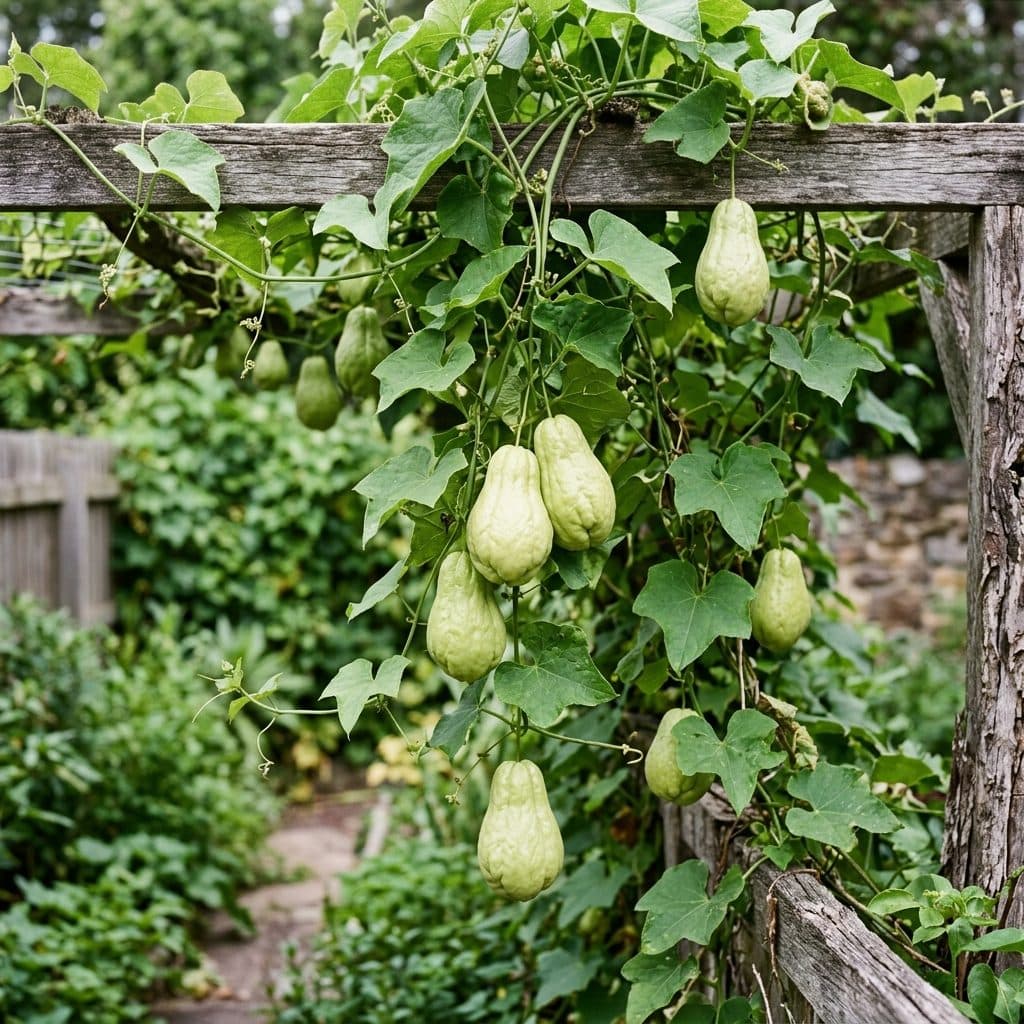
Choko (Sechium edule), known internationally as chayote, mirliton, vegetable pear, or christophine, is a perennial climbing vine in the gourd family (Cucurbitaceae). Native to Mesoamerica where it was cultivated by the Aztecs and Maya, the choko was introduced to Australia in the nineteenth century. During the Great Depression, the choko became a legendary Australian backyard survival staple, providing hundreds of pounds of food per vine across suburban backyards from Brisbane to Melbourne.
In modern permaculture systems, Sechium edule is prized as one of the highest-yielding vertical food plants available. A single established vine can produce 100 to 300 fruits in an autumn season, along with tender shoot tips and large starchy tubers. Belonging to the cucurbit family alongside cucumber, pumpkin, and bottle gourd, the choko is a vigorous climber. Trained over pergolas or outbuildings, it provides summer shade before dropping its leaves after autumn harvest to allow winter light through.
The culinary utility of the choko lies in its versatility. The crisp, pale green flesh absorbs seasonings with ease. Young fruit is delicious when sliced into salads, stir-fried with garlic, roasted with olive oil, or pickled into relishes. Furthermore, tender shoot tips are harvested as a gourmet green vegetable, sauteed like tender asparagus.
Growing choko
Understanding how to grow choko begins with its vigorous climbing habit. While aerial vines are sensitive to frost, the subterranean tuberous root system survives winter in USDA Zones 8 through 11 if protected beneath organic mulch. In spring, vigorous new shoots emerge from the underground crown to re-establish the canopy.
Chokos thrive in deep, fertile loams enriched with compost and aged manure, with a soil pH between 6.0 and 6.8. Good drainage is essential; while the vine demands abundant moisture during hot weather, standing water around the crown causes tuber rot. In heavy clay, plant on raised mounds.
Full sunlight is necessary for heavy flowering and fruit set. Site the vine where it receives at least six to eight hours of direct sun daily. Because the vine generates immense weight when carrying hundreds of fruits, a heavy-duty support structure is critical. Construct a sturdy pergola, chain-link fence, or post-and-wire arbour using treated timber or steel posts.
Propagation differs from standard garden vegetables. The choko seed is viviparous, germinating inside the fruit while still attached to the vine or sitting in storage. Choko seeds cannot be dried and packeted; removing the soft seed damages the embryo.
To start a vine, place a mature fruit on a sunny windowsill in late winter. Within several weeks, a green shoot and roots emerge from the blossom end. In early spring, once frost danger passes and soil warms to 18 to 22 °C (64 to 72 °F), plant the whole sprouted fruit directly into the ground. Set the fruit at a 45-degree angle with the sprouting end pointing downward, leaving the shoot tip barely protruding above the surface.
Water moderately until climbing shoots develop, then increase irrigation as summer progresses. A mature vine requires deep, regular watering during hot weather. Mulch the root zone with 10 to 15 cm (4 to 6 in) of straw or woodchips, and topdress in early summer with well-rotted manure or balanced organic fertiliser.
Harvest and uses
Choko vines initiate flowers as day length shortens in late summer. Flowering commences from midsummer into autumn, with fruits swelling rapidly within four to six weeks of pollination. In Australia, the main harvest runs from March through June until frosts arrive.
Harvest fruits while young, tender, and pale green, measuring 8 to 12 cm (3 to 5 in) in length. At this stage, the skin is thin, the flesh is crisp, and the central seed is soft and edible. If left until the skin turns dull and tough, fruits develop fibrous textures and prickles. Sever the fruit stem with secateurs, leaving 1 cm (0.4 in) of stalk attached.
Fresh chokos keep in a cool pantry or refrigerator crisper for up to two months. For winter storage, wrap firm fruits in paper and store in a cool, dark room.
In the kitchen, young chokos need not be peeled; cube them directly into stir-fries, curries, and gratins, or grate them raw into coleslaws. Snap off the tender top 10 to 15 cm (4 to 6 in) of climbing shoot tips throughout summer to saute with garlic and soy sauce. After several seasons, mature plants form large starchy tubers beneath the crown, which can be harvested in winter and cooked like potatoes.
Identifying choko
The choko vine is recognised by several distinct botanical characteristics:
- Habit: Perennial herbaceous climbing vine producing ribbed stems extending 10 to 15 m (33 to 50 ft) in length, climbing by means of branched axillary tendrils.
- Foliage: Alternate, broadly heart-shaped leaves measuring 10 to 25 cm (4 to 10 in) across, with three to five shallow angular lobes and rough surfaces.
- Flowers: Small, greenish-white to pale yellow flowers. Male flowers are borne in axillary racemes 10 to 30 cm (4 to 12 in) long, while female flowers are solitary in the same leaf axil.
- Fruit: Fleshy, pear-shaped pepo measuring 8 to 18 cm (3 to 7 in) long and 5 to 10 cm (2 to 4 in) wide, weighing 250 to 500 g (9 to 18 oz). Skin is pale green, marked with shallow longitudinal furrows.
- Seed: White, crisp flesh enclosing a single, large, flattened, soft-coated oval seed measuring 3 to 5 cm (1.2 to 2 in) long that remains embedded in the central cavity.
The choko differs from climbing squashes (Cucurbita pepo) and bottle gourds (*Lagenaria siceraria*) by containing a single large flat seed rather than numerous loose seeds in a hollow cavity.
Cautions
Growers should observe several management and culinary cautions with choko:
- Rampant growth and structural weight: A single choko vine produces immense biomass that can overwhelm fences and smother adjacent trees. The weight of water-filled foliage and fruits can crush wooden fences. Train vines on heavy-duty timber or steel arbours, and prune lateral stems in summer.
- Sap irritation and skin peeling: Peeling raw mature chokos releases a sticky, resinous sap containing plant latex. This sap causes temporary skin tightness, tingling, and peeling on fingers. To prevent irritation, peel raw fruits under running cold water or wear rubber kitchen gloves.
- Frost sensitivity: Aerial vines and hanging fruits die back overnight if temperatures drop below freezing. In temperate regions, harvest all fruits before autumn frosts. Mulch the root crown with 15 to 20 cm (6 to 8 in) of straw to insulate the perennial tuber against freezing winter ground.
- Viviparous seed handling: Never attempt to remove the seed from the fruit before planting; damaging the seed coat exposes the embryo to fatal rot. Always plant the entire intact fruit.
- Livestock feeding: While fruits and foliage make nutritious fodder for pigs, goats, and cattle, introduction should be gradual to avoid digestive upset from sudden high-moisture green feeds.
Sources
- Royal Botanic Gardens, Kew. Sechium edule (Jacq.) Sw. Plants of the World Online.
- USDA PLANTS Database. Sechium edule (Jacq.) Sw.
- Plants For A Future. Sechium edule - (Jacq.) Sw.