secondary
Medlar
Mespilus germanica
International hardiness
- USDA 5-8
- RHS H6
- AU: Cool temperate, Warm temperate
Where it grows — regional guide
| Zones / rating | Regional notes |
|---|---|
USDA 5-8 | Hardy across USDA Zones 5 to 8; performs reliably in the mid-Atlantic, Ohio Valley, and Pacific Northwest where summers are moderate. |
| Zones / rating | Regional notes |
|---|---|
H6 (-20 to -15C) | Fully hardy and historically celebrated across English gardens; fruits ripen in November and require bletting indoors or on the tree before eating. |
| Zones / rating | Regional notes |
|---|---|
Cool temperate, Warm temperate | Well suited to cool-temperate areas of Victoria, Tasmania, and the southern highlands of New South Wales with adequate winter chilling. |
| Zones / rating | Regional notes |
|---|---|
USDA 5-8 (USDA scale) Canada uses its own zone system; Canadian zones run roughly one lower than USDA. | No region-specific data yet |
| Zones / rating | Regional notes |
|---|---|
No region-specific data yet | No region-specific data yet |
The medlar tree (Mespilus germanica, also classified as Crataegus germanica) is a small, slow-growing deciduous pome fruit tree in the rose family (Rosaceae). Cultivated for over three millennia, the medlar occupies a distinctive chapter in European horticulture. While most temperate tree fruits are picked during late summer, the medlar is harvested in late autumn when branches are bare and its hard, russet-brown fruits undergo a post-harvest softening process known as bletting.
Native to southwest Asia and southeastern Europe, the species was dispersed across the Mediterranean by the Greeks and Romans, becoming a staple of medieval monastic orchards across Britain and northern Europe. In homestead permaculture, the medlar is a resilient secondary-layer canopy tree. It displays architectural branches, solitary white flowers in late spring, and russet-gold autumn foliage. Planted alongside companion fruits like pear, apple, and sour cherry, the medlar extends the harvest into December when other fresh orchard yields have finished.
Unripe medlars are hard and puckeringly astringent due to dense tannins. Exposure to frost and controlled cellar storage triggers natural enzymatic breakdown; starches and tannins convert into sugars, the flesh turns chocolate-brown, and the texture transforms into a soft pulp reminiscent of spiced applesauce and cinnamon.
Growing medlars
Medlars are adaptable trees that tolerate a wide range of growing conditions, making them more resilient than many cultivated apples and pears. They prefer deep, fertile, moisture-retentive loams with a pH between 6.0 and 7.0. While established trees tolerate clay ground, soils must possess adequate drainage to prevent root rot.
To achieve consistent crops, site medlars in full sun or light shade. Trees in full sun develop sturdier limbs and resist fungal leaf disorders. Medlars require approximately 500 hours of winter chilling below 7 °C (45 °F). Because flowers appear late in May on new leafy shoots, the medlar reliably escapes early spring frost damage that frequently ruins plum blossoms.
Plant bare-root trees during winter dormancy from November to March when the soil is unfrozen. Most cultivated medlar varieties are grafted onto quince rootstocks (such as Quince A) for moderate garden size, or hawthorn (Crataegus monogyna) for alkaline or poor soils. On Quince A rootstock, space trees 3.5 to 4.5 m (12 to 15 ft) apart.
Medlars are self-fertile, meaning a single tree crops reliably without a cross-pollinator. Several named cultivars are grown in Britain and Europe: 'Nottingham' is the most popular, producing medium fruits of exceptional spicy flavour; 'Breda' produces smaller, prolific fruits with a chestnut taste; and 'Dutch' bears large fruits measuring up to 6 cm (2.4 in) across.
Pruning requirements are minimal. Medlars produce flowers and fruit on the tips of the previous year's shoots and short spurs. Prune young trees in winter to establish a balanced framework of four to five main branches. Once established, restrict pruning to removing dead, diseased, crossing, or crowded branches in winter. Heavy pruning should be avoided, as it removes fruiting tips.
Trees begin bearing fruit within three to four years of planting. Annual yields increase steadily, with a mature tree capable of producing 20 to 40 kg (44 to 88 lb) of fruit each season.
Harvest and uses
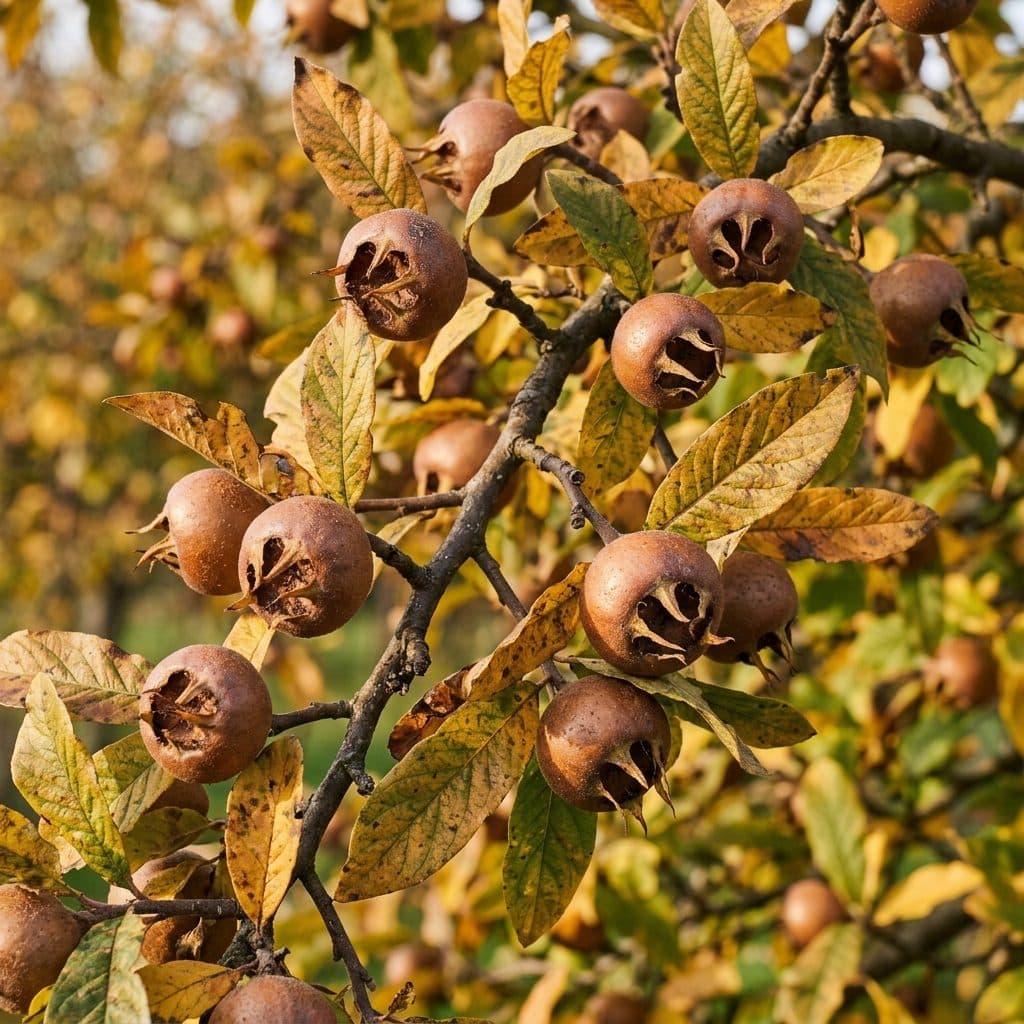
Medlars must remain on the tree until late autumn, typically late October or November in the United Kingdom. Harvest when leaves turn russet-gold and fruit stalks separate cleanly with a gentle lift. An early frost helps initiate bletting, though fruit should be picked before prolonged severe freezes damage skins.
At harvest, the fruit is hard and inedible. To blet medlars, arrange fruits eye-down in a single layer in shallow crates lined with straw or dry paper. Store the crates in a cool, dark room at 5 to 10 °C (41 to 50 °F). Over two to three weeks, the skin darkens and the flesh softens to a creamy consistency. Check crates twice weekly and remove bletted fruits as they soften.
To eat raw, tear open the thin skin and scoop out the spiced pulp with a spoon, discarding the five hard stones. In the kitchen, medlars are celebrated for medlar jelly, which yields a luminous amber-pink preserve with an apple-cinnamon flavour, setting firm due to natural pectin. Simmering bletted pulp with sugar and lemon produces medlar cheese, a dense fruit paste sliced to accompany vintage cheeses.
Identifying medlars
The medlar is recognised by several distinctive morphological characteristics:
- Tree habit: Small deciduous tree reaching 4 to 6 m (13 to 20 ft) in height, forming a contorted, wide-spreading canopy with dark, scaly bark.
- Leaves: Alternate, simple, oblong to elliptic, 7 to 15 cm (2.8 to 6 in) long and 3 to 5 cm (1.2 to 2 in) wide. Foliage is dark green and softly pubescent above, turning russet-gold and orange in autumn.
- Flowers: Solitary, five-petalled white or pale pink blossoms measuring 3 to 5 cm (1.2 to 2 in) across, featuring five leafy green sepals, appearing in late spring at branch tips.
- Fruit: Flattened, globose pome measuring 3 to 5 cm (1.2 to 2 in) across, russet-brown and rough-skinned, crowned with five persistent calyx lobes surrounding a wide, hollow central aperture.
- Interior: Contains five hard, woody stones (pyrenes) embedded within the fleshy pulp.
The medlar is distinguished from standard pears and apples by its persistent leafy calyx lobes and open fruit eye. It differs from wild hawthorn (Crataegus monogyna) by its vastly larger, unlobed leaves, large solitary blossoms, and much larger russet fruits.
Cautions
Growers cultivating and preparing medlars should observe several specific cautions:
- Raw unbletted astringency: Never consume raw, unbletted medlars. Dense concentrations of tannins cause intense astringency, digestive discomfort, and nausea. Always wait until the fruit has softened fully through bletting.
- Seed toxicity: Each fruit contains five hard, woody stones. The kernels inside contain amygdalin, which releases toxic hydrogen cyanide when crushed and digested. Never crack open, grind, or chew the internal seeds. Always strain out stones when making purees or jellies.
- Fire blight vulnerability: As a member of Rosaceae, Mespilus germanica is susceptible to fire blight (Erwinia amylovora). This bacterial disease causes blossoms and shoots to blacken as if scorched. Prune out infected branches 30 cm (12 in) below visible damage using sterilized tools.
- Medlar leaf spot: Damp weather can encourage leaf spot (Diplocarpon mespili), producing small circular brown spots that lead to early defoliation. Rake and clear fallen leaves in autumn to minimise overwintering fungal spores.
- Storage mold during bletting: Ensure stored crates are well-ventilated during bletting. Excess humidity causes grey mold (Botrytis cinerea) to spoil fruits before bletting completes. Discard fruits showing surface mold.
Sources
- Royal Botanic Gardens, Kew. Mespilus germanica L. Plants of the World Online.
- Royal Horticultural Society. Medlars: grow your own
- Plants For A Future. Mespilus germanica - L.