pioneer
Mimosa silk tree
gul-e-abresham
Albizia julibrissin
- pothohar
- kpk hills
- punjab plains
International hardiness
- USDA 6-9
- RHS H5
- AU: Warm temperate, Subtropical
Where it grows — regional guide
| Zones / rating | Regional notes |
|---|---|
USDA 6-9 | Declared an invasive exotic across southeastern states; avoid planting near waterways and check state noxious weed lists before introduction. |
| Zones / rating | Regional notes |
|---|---|
H5 (-15 to -10C) | Grown in sheltered southern gardens rated RHS H5; requires warm, sunny microclimates against a south-facing wall to ripen wood and resist dieback. |
| Zones / rating | Regional notes |
|---|---|
Warm temperate, Subtropical | Naturalised in parts of New South Wales and Queensland; restrict to contained urban landscapes to prevent seed dispersal into native bushland. |
| Zones / rating | Regional notes |
|---|---|
USDA 6-9 (USDA scale) Canada uses its own zone system; Canadian zones run roughly one lower than USDA. | No region-specific data yet |
| Zones / rating | Regional notes |
|---|---|
Pothohar, KPK hills, Punjab plains | Pakistan:Known as gul-e-abresham in northern Punjab and Islamabad; thrives in well-drained loams but seed pods contain neurotoxins harmful to grazing animals. |
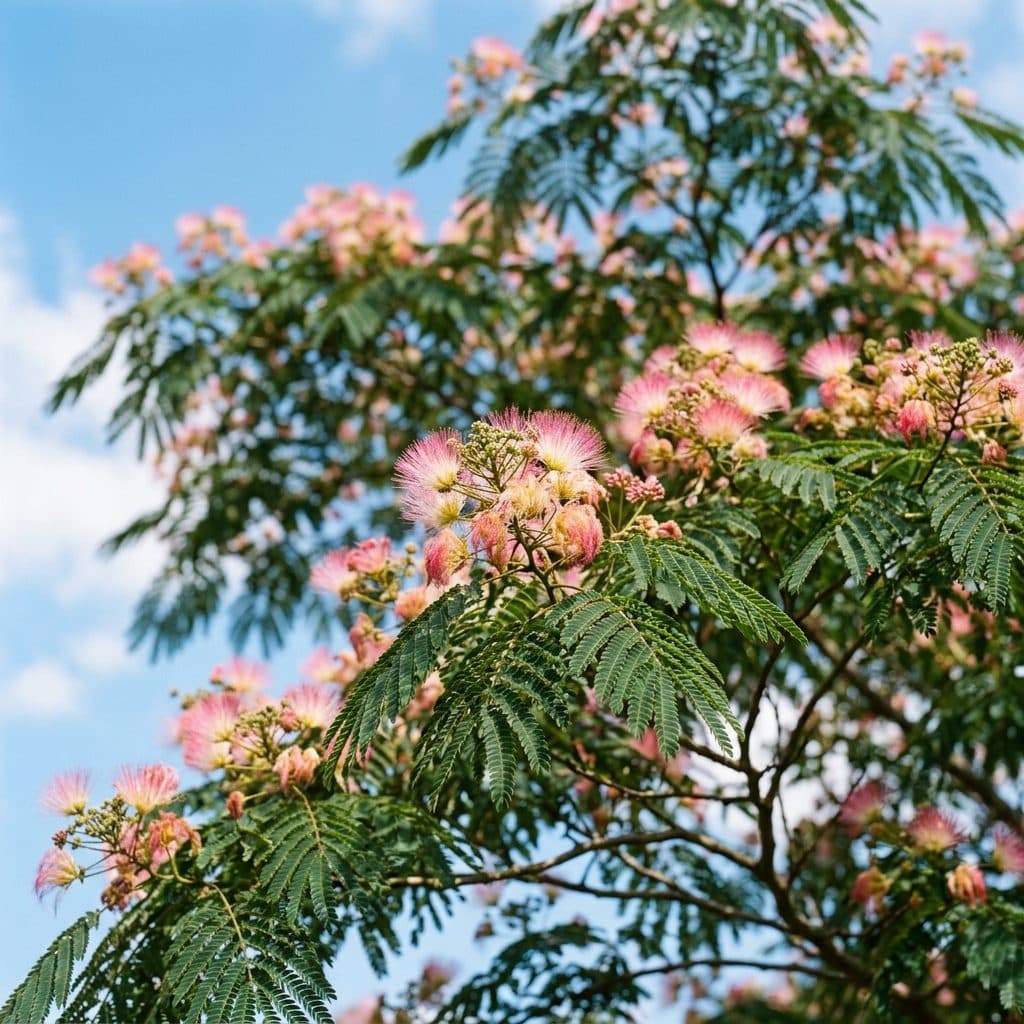
Mimosa silk tree (Albizia julibrissin), also called Persian silk tree or pink siris, is a fast-growing, small to medium-sized deciduous tree in the legume family (Fabaceae). Native to a broad belt stretching from southwestern and central Asia across Iran, the Caucasus, and the Himalayas to China and Korea, the species was introduced internationally as an ornamental specimen. Its signature feathery, bipinnate foliage and fragrant, pompon-like pink blossoms make it visually striking in suburban landscapes and homesteads. However, because it colonises disturbed soils rapidly, growers must manage its aggressive spread and understand its serious pathological and toxicological vulnerabilities.
In agroecological plantings, the tree is an early-successional pioneer. Its root system forms symbiotic relationships with nitrogen-fixing soil bacteria, enabling the tree to colonise eroded, nutrient-deficient soils, gravel banks, and degraded slopes. The open, umbrella-shaped canopy filters bright sunlight into soft dappled shade, creating a microclimate suitable for understorey plantings such as siris or white mulberry. The leaves and pruned twigs decompose swiftly into nutrient-rich organic matter. Despite these attributes, Albizia julibrissin carries substantial ecological risks that require cautious evaluation before planting.
Growing mimosa silk tree
The species prospers in temperate, subtropical, and warm Mediterranean climates, hardy within USDA Zones 6 through 9 and rated RHS H5. Mature, dormant trees withstand winter minimum temperatures down to -15 °C (5 °F) without structural damage, although unhardened young twigs suffer freeze injury during sudden autumn frosts. It demands warm summer temperatures to initiate flower buds and ripen vegetative wood. In cool, cloudy maritime areas, such as northern Britain, lack of summer heat leads to poor flowering, stunted shoots, and heightened vulnerability to fungal pathogens.
Soil requirements are modest. The tree adapts to sandy loams, silty clays, limestone soils, and compacted urban fill across a pH spectrum of 5.5 to 7.8. Superior drainage is mandatory. In waterlogged, heavy clays or areas with perched winter water tables, root respiration is compromised and soil-borne fungal pathogens thrive. Full sunlight is necessary for compact growth; trees grown in partial shade develop weak, leggy branches that break under moderate winds. Once established, the deep taproot confers remarkable drought resilience, although saplings require consistent watering during the initial two growing seasons.
Growth is rapid during youth, with annual height increments reaching 60 to 100 cm (24 to 39 in). Mature trees attain heights of 6 to 12 m (20 to 40 ft) with an expansive, flat-topped crown spanning 8 to 15 m (26 to 50 ft). Propagation is achieved primarily by seed. The hard seed coats require scarification: nick the outer coat or soak seeds in hot water at 80 °C (176 °F) for twenty-four hours before sowing in spring. Germination occurs within two to three weeks. Softwood cuttings taken in midsummer and root cuttings taken in late winter also root reliably. For silvopastoral or shelterbelt installations, spacing trees 5 to 7 m (16 to 23 ft) apart allows full crown development.
Harvest and uses
The wood of Albizia julibrissin is light, medium-textured, and pale golden-brown with darker heartwood. While not rot-resistant in ground contact, the timber finishes smoothly and serves for small cabinetry, carving, tool handles, and lightweight framing. Pruned branches dry rapidly and burn cleanly, producing light homestead firewood.
The foliage is rich in crude protein and makes acceptable green manure when applied around fruit trees like kikar or garden plantings. In traditional Chinese medicine, the dried flowers and stem bark, known collectively as he huan hua and he huan pi, are decocted for traditional calming preparations.
The fragrant blossoms yield rich nectar for honeybees, bumblebees, and butterflies, making the tree an asset for midsummer apiculture when other nectar flows diminish. However, the seeds, seed pods, and green twigs are inedible for humans and must never be consumed.
Identifying mimosa silk tree
Albizia julibrissin is distinguished by several characteristic botanical features:
- Bark and form: The trunk is covered with thin, smooth, light greenish-grey bark marked by horizontal lenticels, developing shallow fissures on mature specimens. Multiple trunks often emerge low, spreading into a wide, flat-topped canopy.
- Leaves: Alternate, bipinnately compound leaves measuring 20 to 45 cm (8 to 18 in) long, bearing 10 to 12 pairs of pinnae. Each pinna supports 20 to 30 pairs of small, asymmetrical, oblong leaflets measuring 6 to 12 mm (0.24 to 0.47 in) long. The leaflets fold inward along the rachis at sunset or during heavy rain, a nyctinastic movement that earns the tree its Persian name "sleeping tree".
- Flowers: Terminal panicles bearing clusters of showy, fragrant flowers lacking petals. The visual display consists of dozens of slender, thread-like stamens measuring 2.5 to 3.5 cm (1 to 1.4 in) long, white at the base and tipped with rose-pink to pale carmine. Blooming extends from late spring into midsummer.
- Seed pods: Thin, flat, papery straw-coloured pods measuring 10 to 18 cm (4 to 7 in) long and 2 to 2.5 cm (0.8 to 1 in) wide. Each pod contains 5 to 12 small, oval, flattened brown seeds that rattle in the autumn wind and persist into winter.
The tree is occasionally confused with Albizia lebbeck, but that species has much larger leaflets, greenish-yellow flowers, and thicker, straw-coloured pods that are nearly twice as wide.
Cautions
Despite its ornamental appeal, Albizia julibrissin presents several serious ecological and biological hazards:
- Severe invasive potential: The tree is an aggressive coloniser of roadsides, riverbanks, forest edges, and floodplains. A single tree produces thousands of viable seeds that float down waterways or spread through human disturbance. In the southeastern United States, it is formally classified as a severe invasive exotic weed that displaces native riparian vegetation. Seedlings form dense monocultures that outcompete native trees and shrubs. If you live in warm-temperate or subtropical regions near waterways, avoid planting this species or cut flower clusters before seed set occurs. Check local statutory weed lists before acquisition.
- Livestock and pet neurotoxicity: The seeds and seed pods contain the toxic neurotoxin 4-methoxypyridoxine (also known as ginkgotoxin or albizine), an anti-metabolite of vitamin B6 (pyridoxine). Ingestion of pods by cattle, sheep, horses, or domestic dogs causes neurological dysfunction, muscle tremors, uncontrollable seizures, ataxia, and mortality if untreated. Keep pastured animals excluded from under the canopy during autumn when mature pods drop.
- Lethal vascular wilt: The species is exceptionally vulnerable to mimosa vascular wilt caused by the soil-borne fungal pathogen Fusarium oxysporum f. sp. perniciosa. Infection enters through root systems, clogging water-conducting xylem vessels. Foliage rapidly yellows, wilts, and turns brown, followed by branch death and complete tree mortality within a single growing season. The fungus persists indefinitely in soil, making replanting of susceptible Fabaceae species impossible on contaminated ground.
- Structural weakness: The soft, brittle wood splits readily under heavy windstorms or snow loading. Prune competing leaders early to develop strong branch scaffolding.
Sources
- Royal Botanic Gardens, Kew. Albizia julibrissin Durazz. Plants of the World Online.
- USDA PLANTS Database. Albizia julibrissin Durazz. - Silk Tree
- NC State Extension Gardener Plant Toolbox. Albizia julibrissin
- Missouri Botanical Garden. Albizia julibrissin
- University of Florida IFAS Assessment of Non-Native Plants. Albizia julibrissin - Mimosa